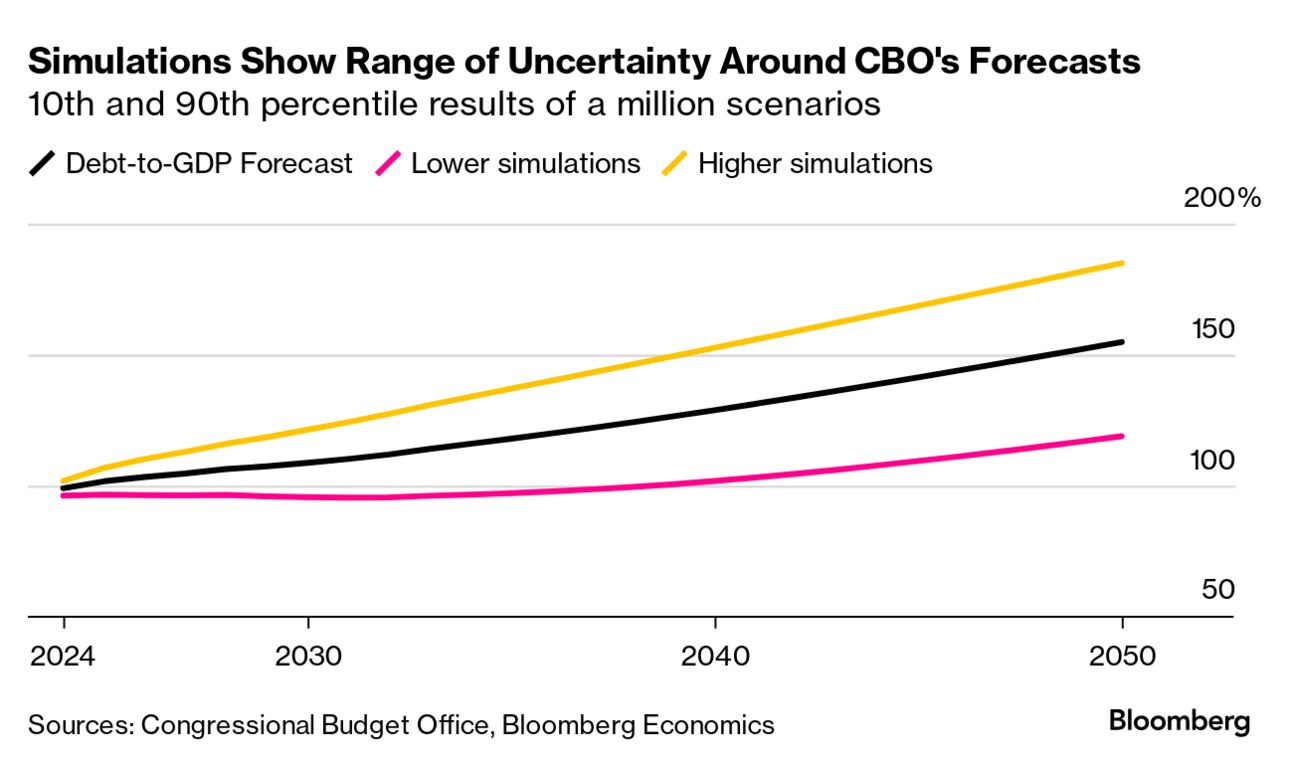
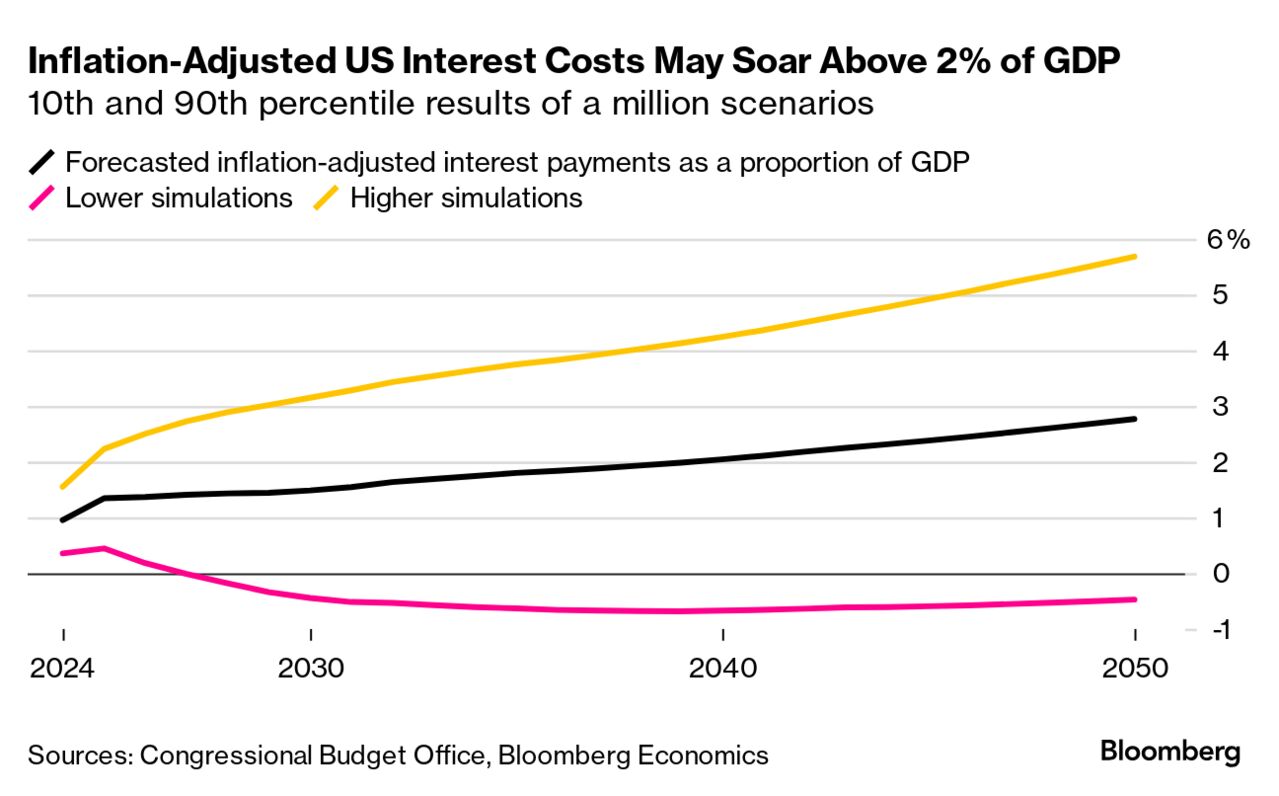
| I'm Chris Anstey, a senior economics editor in Boston, and today we're looking at fresh cause to worry about the US debt outlook. Send us feedback and tips to ecodaily@bloomberg.net or get in touch on X via @economics. And if you aren't yet signed up to receive this newsletter, you can do so here. There's a bit of a boy-who-cried-wolf problem with warnings about US debt sustainability. Such concerns have abounded for years. But low interest rates helped keep things under wraps, and various alternative scenarios always seemed possible. Inflation will help eat away the debt burden. Productivity will accelerate. Tax cuts will boost growth and Treasury revenues will soar. Now, fresh analysis from Bloomberg Economics offers a sobering perspective. Throw in a whole bunch of different potential combinations of economic variables — some 1 million of them — and 88% of the time, the results show that the debt-to-GDP ratio is on an unsustainable path. What's unsustainable? The initial definition is one that sees the ratio go higher over the coming decade than the 97% figure recorded for last year, which was almost double where things were as recently as 2009. And why is this issue pressing now? Concerns are escalating because the US has now logged years worth of solid growth, with the job market effectively at full employment. And yet the official Congressional Budget Office projections show the debt-to-GDP ratio hitting 116% in 2034 — an all-time high. BlackRock CEO Larry Fink said last week that the US public debt situation "is more urgent than I can ever remember." On Monday, Citadel founder Ken Griffin told investors in a letter to the hedge fund's investors that US national debt is a "growing concern that cannot be overlooked." And recall Federal Reserve Chair Jerome Powell weighed in in unusual fashion earlier this year with his admonition that "it's probably time, or past time" for politicians to address the fiscal situation. Treasury Secretary Janet Yellen has maintained that the Biden administration's fiscal plans keep things in check. And she says that her preferred debt-sustainability metric — the inflation-adjusted interest expense ratio to GDP — remains manageable. Yellen has indicated she'd prefer to see that yardstick below 2% of GDP. Bloomberg Economics also ran simulations on that one. There, the results were more hopeful — the threshold was violated in only 30% of the simulations. Even so, with defense spending almost certain to exceed the official projections and interest rates lingering well above pre-pandemic levels, risks are growing. While an exact "upper limit" for the federal debt cannot be known, Harvard University economist Kenneth Rogoff warned last month that there will be challenges as the level increases. "Washington in general has a very relaxed attitude towards debt that I think they're going to be sorry about," said Rogoff, an ex-IMF chief economist. - Treasury Secretary Yellen's road trips have a theme: Think global, eat local.
- The Bank of Japan's bond holdings are set to shrink for the first time in 16 years, highlighting the step-change in the BOJ's monetary settings.
- Inflation in UK stores dropped to its lowest level in more than two years as supermarkets compete to lure shoppers with low prices.
- Business sentiment is improving in Canada and fewer companies are expecting a recession.
- Australia's housing market extended gains to a 14th consecutive month in March amid declining affordability and borrowing costs at a 12-year high.
- The EU Innovation Fund is betting billions on climate tech.
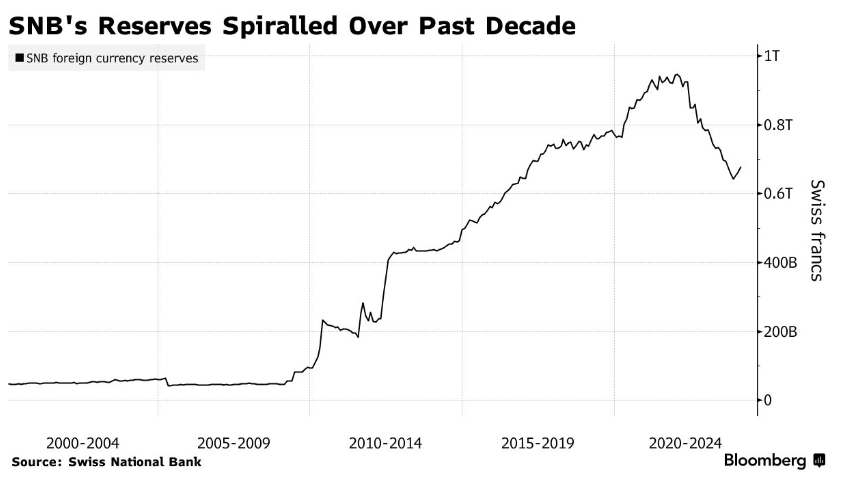
There's something of a cottage industry in debating the effectiveness of foreign-exchange intervention — something most developed nations have engaged in at one time or another to address disorderly moves in their currencies or to counter a prevailing one-way bet narrative. Analysis by Swiss National Bank staff suggests that, in their own case at least, the answer is that currency purchases "are effective and long-lasting." SNB intervention has helped Switzerland avoid a large drop in consumer prices in recent years, Tobias Cwik and Christoph Winter wrote. The duo's research indicated that the SNB needs to spend roughly 27 billion francs to keep its currency from appreciating 1.1%. As of February, the central bank's currency reserves totaled nearly 680 billion francs. The economic damage from weather events: Read more reactions on X | 








No comments:
Post a Comment