| Read in browser | ||||||||||||||

Welcome to Balance of Power, bringing you the latest in global politics. If you haven’t yet, sign up here. Just a few weeks ago, Pakistan helped broker a fragile truce between the US and Iran, easing fears of a wider Middle East war. Now, on Pakistan’s western border, the conflict with Afghanistan has flared up again. Last week, Pakistan carried out air strikes and a ground operation in three border provinces, killing 29, in response to earlier attacks by its neighbor. The military exchanges are a reminder that the region’s security risks extend well beyond the Gulf. Islamabad’s strikes on what it says are militant hideouts and training camps inside Afghanistan, followed by retaliatory action from the Taliban government, have reignited one of South Asia’s most volatile disputes just as governments were hoping regional tensions would cool. For Pakistan, the conflict complicates matters when it’s already in the middle of several overlapping crises, including friction with eastern neighbor India and the lingering fallout from the US-Israel confrontation with Iran, which abuts its southwestern flank. 
Pakistani soldiers after completing an operation in Karachi on Sunday.
Photographer: Rizwan Tabassum/AFP/Getty Images
Rather than isolated episodes, these conflicts increasingly reinforce one another, raising the risk that a localized security incident could evolve into a wider regional challenge. In its federal budget for the new fiscal year, Pakistan raised defense spending to boost security along its borders. Violence on the Pakistan-Afghanistan frontier intensified in the last month following a brief ceasefire in March. The two sides have clashed repeatedly despite global calls for a ceasefire and mediation attempts by Qatar, Turkey, Saudi Arabia and China. Relations have deteriorated steadily since the Taliban returned to power in 2021. At the dispute’s center is Pakistan’s accusation that Afghanistan is sheltering militant groups that launch attacks against its security forces, a charge the Taliban denies. The Pakistani military’s press wing recently talked of “retribution operations.” While Islamabad is still basking in its diplomatic win, any hopes of an enduring regional peace have long since faded. — Tooba Khan Global Must ReadsChinese leader Xi Jinping used a speech in Beijing to make the case that the ruling Communist Party is a force for global progress and prosperity — a role that would be backed by a strong military. In comments marking the founding of the party 105 years ago, Xi said the organization was “creating a new form of human advancement,” paving the way for developing nations to modernize. 
Xi at the Great Hall of the People in Beijing today.
Photographer: Ng Han Guan/AP Photo
US negotiators Jared Kushner and Steve Witkoff had positive discussions with regional leaders in Qatar and technical talks with Iran are moving ahead, sources said, as the countries seek to ease tensions after attacks that imperiled a fragile ceasefire. Israel and Lebanon’s latest peace deal faces an uncertain future after Hezbollah, Tehran’s most powerful proxy militant group, this week vowed to derail its implementation. Thousands of people joined anti-migrant protests in South Africa that were watched over by a massive police contingent deployed to prevent intimidation and a repeat of past violence. Africa’s biggest economy has long been a magnet for people in neighboring countries such as Zimbabwe and Malawi, stoking anger among some locals who see foreigners as competitors for economic opportunities and state services. 
Protesters in Johannesburg yesterday.
Photographer: Emmanuel Croset/AFP/Getty Images
Venezuelan opposition leader María Corina Machado remains in Panama following unsuccessful attempts to reenter the country she left in 2025 amid a wave of repression. She has vowed to return as quickly as possible after twin earthquakes last week killed nearly 2,000 Venezuelans. President Donald Trump reported earning at least $1.4 billion in 2025 from crypto and memecoin-related businesses, according to his latest annual financial disclosure. The 927-page filing provides a view into his sprawling empire, including income from hotels, golf resorts and cryptocurrency ventures as well as purchases and sales of equities, and reignites concerns over Trump profiting from his presidency. Japanese Prime Minister Sanae Takaichi heads to India for a three-day trip to bolster economic ties and align on security cooperation with counterpart Narendra Modi as the Asian powers seek to become less dependent on China. Australia proposed sweeping changes to the consulting sector including new powers to police the industry, following scandals such as staff at EY allegedly accessing Prime Minister Anthony Albanese’s bank details. 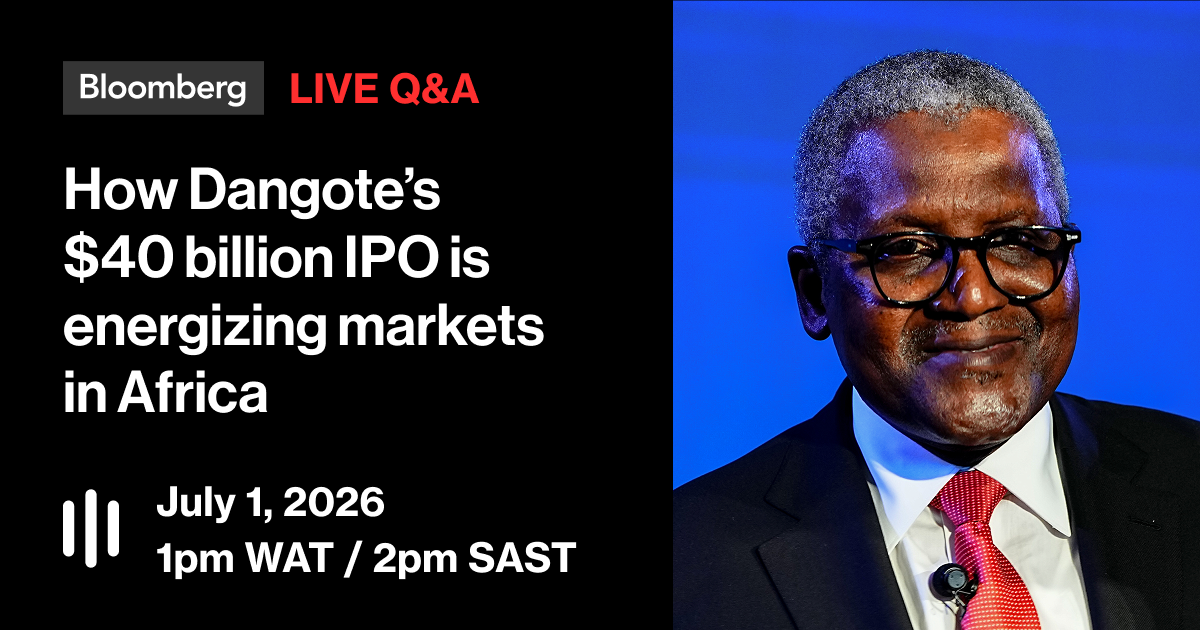
From tycoons to students, Nigerians are scrambling to be part of billionaire Aliko Dangote’s $40 billion IPO of his refinery business. Can the once-in-a-generation listing transform African markets? Click here to tune in to our Live Q&A at 1pm BST or to play it back later.
The UK’s long-awaited Defense Investment Plan leaves several hard choices for Andy Burnham if he becomes prime minister, including how to close an almost £5 billion ($6.6 billion) hole in his first budget. An influential Philippine religious group continued its protest for a second day in support of a senator allied with Vice President Sara Duterte, again slowing traffic on Manila’s main highway. Sign up for the Washington Edition newsletter for news from the US capital and watch Balance of Power at 1 and 5 p.m. ET weekdays on Bloomberg Television. Chart of the Day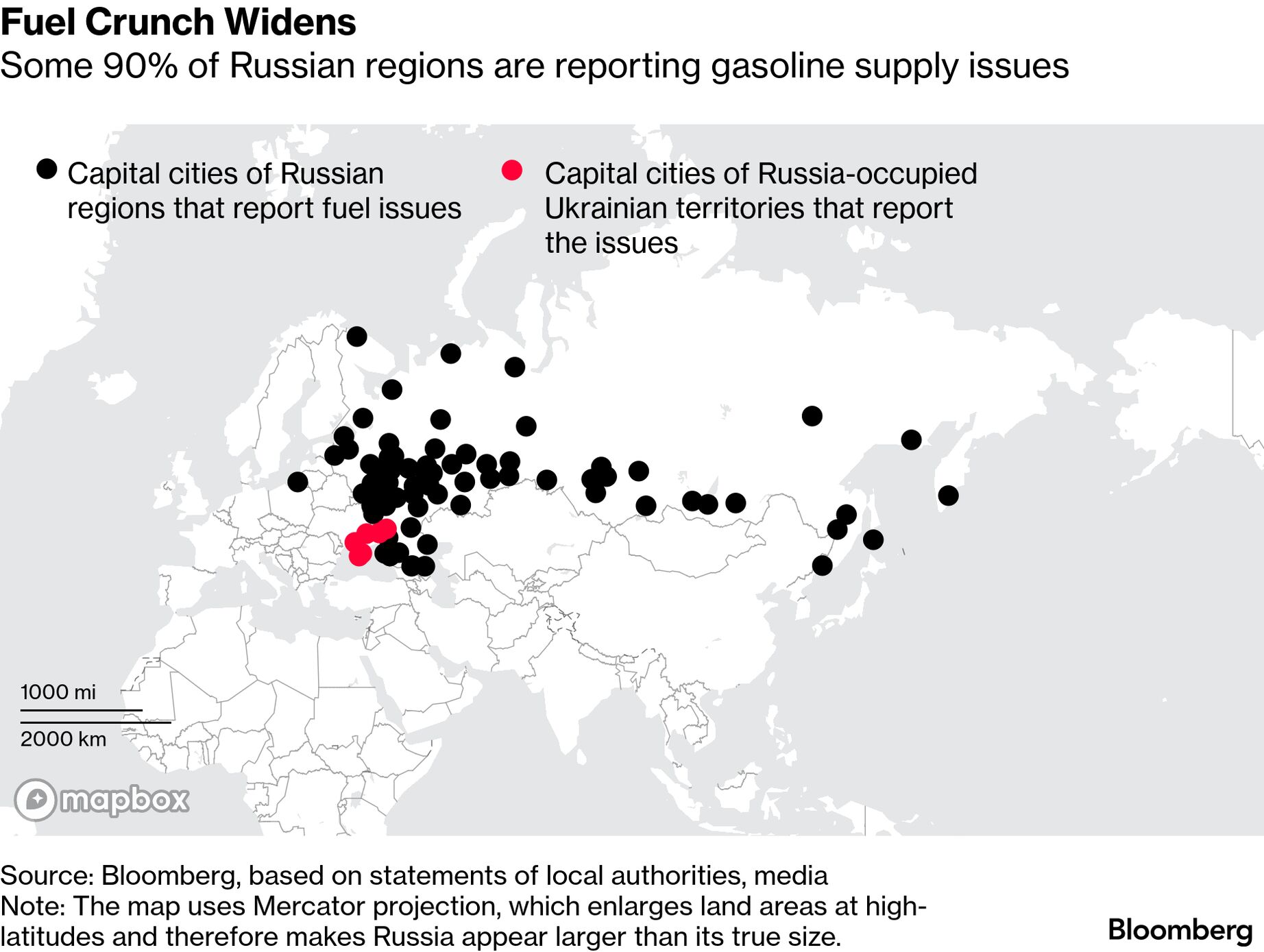
Ukraine’s campaign of attacks on Russian oil refineries is increasingly complicating the lives of drivers across the country as they are forced to embark on more difficult quests to refuel their cars. Russians are now waking up before dawn to be the first in line at the nearest filling station, downloading apps that crowd-source information on where to buy the right grade of gasoline or resorting to the black market. And FinallyOn the southwest coast of County Cork, where the lush green landscape gives way to the paler green of the Atlantic Ocean, Ireland’s economic strengths — and defensive weaknesses — are about to be laid bare. A transatlantic cable designed to handle artificial intelligence loads is due to make landfall here, symbolizing both Ireland’s burgeoning technology industry and the vulnerabilities surrounding the strategic infrastructure that’s growing up alongside it. As this long read explains, it’s a dilemma that’s placing the government in Dublin under pressure from its European partners. 
Owenahincha Beach in County Cork.
Photographer: Paulo Nunes dos Santos/Bloomberg
More from Bloomberg
We’re improving your newsletter experience and we’d love your feedback. If something looks off, help us by reporting it here. Follow Us
You received this message because you are subscribed to Bloomberg’s Balance of Power newsletter. If a friend forwarded you this message, sign up here to get it in your inbox.
|
Wednesday, July 1, 2026
Tinder box





Tuesday, June 30, 2026
Trump Issues Emergency Order That Supports Elon Musk's Next Venture
Dear Reader,
Without most people noticing, Elon Musk has started a new venture that has nothing to do with rockets, EVs, Neuralink, or tunnels.
Trump has personally issued emergency support to roll this underlying tech out as fast as possible.
It's already live in multiple states.
Behind the scenes, demand for this is already spiking...
The Financial Times says Sam Altman is begging people on the phone to build this for him and OpenAI.
And the best part for you and your wealth is:
A few little-known companies control the supply chain.
Anyone who wants this tech - be it Sam Altman or even Elon himself - must go through these companies to get it.
You can simply buy their stocks right now... before this news becomes common knowledge.
But you ought to move fast. Because leaked satellite images are already showing up online...
Click here to see how you could back Elon Musk's next venture from your regular brokerage account.
Regards,
Joel Litman
Chief Investment Officer, Altimetry
Rocket Lab Defies Gravity With $8B Buyout
Author: Jeffrey Neal Johnson. Published: 6/30/2026.

Key Points
- Rocket Lab agreed to acquire Iridium Communications in an estimated $8 billion cash-and-stock deal, transforming it into a vertically integrated aerospace and telecommunications hybrid.
- The acquisition gives Rocket Lab access to Iridium's 66-satellite constellation, profitable 12.05% net margin, and globally coordinated L-band spectrum for maritime, aviation, and defense use.
- Execution risk remains the key uncertainty, as Rocket Lab must integrate a mature telecom operator while continuing to fund development of its Neutron medium-lift launch vehicle.
- Special Report: Everyone wanted SpaceX. Smart money wants this.
Capital markets rarely provide a clear view of a structural economic shift in real time. When SpaceX (NASDAQ: SPCX) crossed the $2.5 trillion market capitalization threshold following its recent public debut, investors witnessed a permanent shift in the baseline valuation metrics for space names.
Pure-play launch providers are suddenly being viewed as incomplete businesses. The real premium lies in vertical integration. Investors want to own the rocket that breaks the atmosphere, but they also want to own the satellite network that generates recurring cash flow once the payload reaches orbit.
ALERT: Drop these 5 stocks before the market opens tomorrow! (Ad)
The Wall Street Journal is already raising the alarm about a potential market crash, and Weiss Ratings research points to the first half of 2026 as a particularly rough stretch for certain holdings.
Some of America's most popular stocks could take serious damage as a radical market shift plays out. Analysts at Weiss Ratings have identified five names you may want to remove from your portfolio before this unfolds.
If any of these are in your portfolio, now is the time to review your positions.
See the 5 stocks to avoidRocket Lab (NASDAQ: RKLB) has just executed this exact playbook. By agreeing to acquire Iridium Communications (NASDAQ: IRDM) in an estimated $8 billion cash-and-stock deal, Rocket Lab is transforming from a speculative aerospace sector manufacturer into a telecommunications sector hybrid.
This could mark the beginning of rapid consolidation in the space sector. Rocket Lab is actively building the premier public-market alternative to SpaceX, which demands a full rerating of its business.
Escaping the Margin Trap With Orbital Cash Flow
Launching hardware into low-Earth orbit is an incredibly difficult, capital-intensive endeavor. Rocket Lab has proven it can execute on the engineering front. The company recently completed its tenth consecutive successful orbital mission and secured a NASA contract for three dedicated Electron launches starting in 2027. The top-line numbers reflect this operational momentum, with Rocket Lab posting quarterly revenue that jumped 63.4% year over year.
Top-line velocity does not automatically translate into bottom-line stability in the aerospace sector. Launch economics are inherently cyclical and notoriously low margin. Rocket Lab currently operates with a net margin of negative 26.87%, driven largely by aggressive capital expenditures to develop the upcoming medium-lift Neutron launch vehicle. Heavy capital spending creates deep vulnerability during broader macroeconomic tightening cycles.
Iridium Communications completely changes Rocket Lab's financial profile. Iridium Communications operates a fully deployed 66-satellite constellation. More importantly, it generates highly predictable, high-margin subscription revenue. With a 12.05% net margin and a 1.10% dividend yield prior to the acquisition announcement, Iridium Communications acts as a stabilizing financial engine. Rocket Lab is effectively buying a cash-flow machine to fund its heavy aerospace ambitions.
Locking Down L-Band Spectrum and IoT Dominance
Understanding the strategic value of Iridium Communications requires looking beyond the physical satellites and focusing on the underlying assets. Iridium Communications controls globally coordinated L-band spectrum. Unlike higher-frequency Ku or Ka bands that suffer from severe weather interference, L-band provides highly reliable, weather-resilient connectivity, which is crucial for maritime, aviation, and defense communications.
Iridium Communications is aggressively expanding its footprint in the direct-to-device and Internet of Things (IoT) markets. The new MS150-IR IoT-NTN chipset, engineered by Iridium Communications, recently entered on-orbit testing and is targeting full commercialization by the end of 2026. Coupled with the recent commercial availability of the 9604 hybrid IoT module, which seamlessly integrates satellite, cellular, and GNSS capabilities, Iridium Communications provides Rocket Lab with a mature, immediately monetizable distribution channel.
Chasing the SpaceX Premium Through Consolidation
For years, Wall Street treated space stocks as speculative growth plays. That narrative is rapidly shifting as institutional capital rotates into tangible infrastructure. The capital rotation we are witnessing right now is a search for the next vertically integrated space-as-a-service platform capable of competing directly with Starlink.
By bringing Iridium Communications in-house, Rocket Lab insulates itself from third-party launch friction. The firm no longer has to wait for external telecommunications providers to book space on its rockets to generate revenue. It can launch proprietary payloads, expand the integrated network, and capture the full lifecycle value of orbital real estate.
This dynamic fundamentally alters how analysts must model Rocket Lab. Financial models can no longer apply a standard aerospace manufacturing multiple to the firm. The market is being forced to price in telecom infrastructure premiums, directly contributing to the 16% upside re-rating seen in Rocket Lab shares immediately following the announcement, pushing the stock above $100.
Options Flow and Buybacks Light the Fuse
A look under the hood of the options chain and institutional order flow reveals the market was already positioning for a massive repricing event. Prior to the acquisition announcement, the board of directors at Iridium Communications authorized a massive $500 million share repurchase program, effectively signaling a willingness to buy back up to 14.2% of outstanding shares.
Aggressive buyback authorizations of that magnitude indicate that management and institutional stakeholders believe the equity is deeply undervalued relative to forward cash flows. The $27-per-share cash-and-stock buyout premium validates that internal assessment, driving a 25% surge in Iridium Communications shares to $54.59.
Technical mechanics are accelerating the upside price action for Rocket Lab. Options market data highlights heavy near-term bullish speculation, with elevated call volume highly concentrated on the July 17 $105 strike. When you combine this aggressive options flow with a structural short interest setup, where off-exchange short volume ratios for Rocket Lab frequently exceed 60%, you create the perfect environment for a rapid short-covering rally. Shorts are being squeezed by a fundamental catalyst that undermines their bearish thesis.
Clearing the Launchpad for Telecom Integration
Rocket Lab currently trades at a trailing price-to-sales ratio of about 95. Under standard market conditions, a multiple approaching triple digits on trailing sales would signal extreme overvaluation and high vulnerability to multiple compression. The market is clearly pricing in the immediate accretion of the $871 million in annual sales generated by Iridium Communications and the resulting margin expansion. The transition from a pure hardware model to a high-margin space-as-a-service hybrid provides the fundamental justification for these elevated growth metrics.
The primary variable moving forward is execution risk. An $8 billion transaction size introduces immediate structural complexities for both organizations. Rocket Lab is using a cash-and-stock structure, which inherently introduces near-term shareholder dilution while adding new leverage to the balance sheet. Rocket Lab management now faces the dual mandate of seamlessly integrating a mature telecommunications operator while simultaneously funding the heavy research and development cycles required to finalize the Neutron launch vehicle.
Investors observing this capital rotation should monitor how efficiently Rocket Lab transitions the recurring cash flows from Iridium Communications to support broader infrastructure buildouts. Those analyzing the space sector must recognize that the era of the pure-play launch provider is fading. The companies capturing the highest market premiums will be the ones that own the rocket, control the satellite, and monetize the bandwidth.
SpaceX Achieves Escape Velocity With Nasdaq Fast-Track
Author: Jeffrey Neal Johnson. Published: 6/30/2026.
Key Points
- SpaceX's fast-track entry into the Nasdaq-100 on July 7 is expected to trigger approximately $4.3 billion in mandatory passive institutional buying.
- Executive-level negotiations between SpaceX and Charter Communications could allow Starlink Mobile to scale as a wireless provider without building physical infrastructure.
- Despite near-term demand catalysts, SpaceX trades at a price-to-sales ratio of 108, with Morningstar assigning a fair value well below its current $2.1 trillion market cap.
- Special Report: Everyone wanted SpaceX. Smart money wants this.
SpaceX (NASDAQ: SPCX) will bypass traditional public market seasoning requirements to enter the Nasdaq-100 index on July 7. This regulatory shift is expected to trigger an estimated $4.3 billion in forced institutional buying just weeks after the initial public offering. Paired with a rumored terrestrial backhaul partnership that positions Starlink Mobile to challenge legacy telecom providers, SpaceX now has a near-term liquidity catalyst that could temporarily outweigh structural valuation headwinds.
Index Gravity Squeeze: Front-Running the $4.3B Fast-Track
Normally, a newly public company waits months or even years to join major market indexes. Nasdaq recently amended its eligibility framework, allowing mega-cap initial public offerings (IPO) to enter the Nasdaq 100 after just 15 trading days. For SpaceX, a $2.10 trillion aerospace sector giant, this fast-track inclusion fundamentally changes the immediate supply-and-demand dynamic.
Read this or regret it forever. (Ad)
Three forces converged in 1776 to create the modern world - and according to Porter Stansberry, founder of one of the largest financial research firms in the world, they're converging again right now.
From government stakes in Intel, Lithium Americas, and MP Materials to sweeping political shifts, Stansberry says this 'New 1776 Moment' could reset the entire U.S. economic system. He's sharing the stocks to buy, the stocks to sell, and three money moves to position yourself ahead of it.
Discover Porter Stansberry's full analysis and investment recommendations todayWhen a stock enters a major benchmark, passive funds that track that index must buy it. These institutional funds do not evaluate price-to-sales ratios or profitability metrics. Their sole mandate is to replicate the index weight accurately.
J.P. Morgan modeling indicates that the July 7 reconstitution will require approximately $4.3 billion in mechanical passive inflows from benchmarked funds such as the Invesco QQQ Trust (NASDAQ: QQQ). That incoming capital adds to the estimated $3 billion SpaceX already absorbed from a recent fast-track inclusion into the Russell 1000 index.
This surge in institutional buying is meeting a structurally constrained supply of shares. Post-IPO lock-up agreements prevent early investors and executives from immediately selling their holdings.
Approximately 20% of insider shares will become eligible for sale only after the first public earnings release on Aug. 6. The limited float sharply restricts available liquidity heading into the July index event.
When billions of dollars of indiscriminate capital chase a capped share count, the result is a highly predictable pre-inclusion price squeeze. Active managers often front-run these events, accumulating shares ahead of time and pushing prices higher as passive index funds scramble to secure the allocations they need before the closing bell.
Ground Control to Charter Communications
Beyond the immediate mechanics of index arbitrage, a major shift is taking place in how broadband and mobile data reach global consumers. Executive-level negotiations are reportedly advancing between SpaceX and Charter Communications Inc. (NASDAQ: CHTR) to route Starlink Mobile traffic through established terrestrial networks.
To understand the significance of this move, it helps to consider the massive capital expenditures required by traditional telecommunications companies. Legacy operators spend tens of billions of dollars laying fiber-optic cables and erecting cell towers to maintain regional monopolies. Starlink Mobile aims to bypass much of this physical infrastructure by beaming connectivity directly from low Earth orbit to consumer devices. However, space-to-ground data transmission still requires foundational ground-based routing to handle heavy consumer traffic efficiently and keep latency under control.
Securing ground-based backhaul through a partner like Charter Communications would allow Starlink to scale instantly as a direct-to-consumer wireless provider. SpaceX could challenge terrestrial network monopolies without bearing the prohibitive costs of building out physical infrastructure.
This dual approach of dominating the orbital layer while leveraging existing terrestrial fiber could rapidly accelerate the timeline for market capture against incumbent wireless carriers like Verizon (NYSE: VZ) and AT&T (NYSE: T). The broader space infrastructure sector stands to benefit from these macro tailwinds as satellite broadband capabilities move closer to pricing and speed parity with legacy fiber networks, unlocking a massive new global subscriber base.
SpaceX Valuation Floats in the Exosphere
Aggressive physical and technological expansion requires substantial capital, and fixed-income markets appear eager to provide it. SpaceX recently settled a five-tranche, $25 billion unsecured senior bond offering, extending debt maturities to 2056.
Institutional order books reportedly peaked near $90 billion, demonstrating strong demand to finance heavy space-based capital expenditures. The proceeds will explicitly retire a $20 billion bridge loan tied to earlier xAI infrastructure acquisitions, reducing near-term maturity risk and securing a longer operational runway for massive satellite deployments.
Still, SpaceX’s current stock price reflects enormous future expectations rather than current operational efficiency. At around $165 per share, the market capitalization stands at a towering $2.1 trillion. With annual sales of $19.3 billion, SpaceX trades at a staggering price-to-sales ratio of 108. Investors are effectively paying about $108 for every dollar of revenue SpaceX currently generates. Earnings data from May 7, before the public listing, showed a quarterly loss of $1.27 per share, contributing to an estimated $4.9 billion annual net deficit.
Institutional coverage is increasingly highlighting this fundamental disconnect between price action and core business metrics. Analysts at Morningstar explicitly labeled the $2 trillion valuation as stretched, assigning a much lower fair value of $780 billion. Argus Research recently initiated coverage with a cautious Hold rating.
These financial models warn of potential multiple compression once the Aug. 6 lock-up expires and restricted shares enter the open market. Bondholders are also scrutinizing the lack of current profitability, which has led to some weakness in secondary-market trading as credit spreads widen relative to risk-free Treasuries.
Brace for Re-Entry on August Lock-Up Expiration
The immediate trajectory for SpaceX depends heavily on market mechanics rather than traditional earnings growth or deep value metrics. The $4.3 billion mandatory allocation from index trackers creates an undeniable short-term demand shock. Strategic investors often capitalize on this type of market structure, recognizing that forced institutional buying can create price inefficiencies that are largely disconnected from fundamental valuation models.
At the same time, the broader space sector remains highly attractive as direct-to-device satellite communication shifts from concept to commercially viable reality. Strategic partnerships that provide terrestrial backhaul validate the Starlink business model and open up massive new addressable markets that were previously controlled by regional telecom providers.
Investors looking to navigate this environment may want to closely monitor daily trading volume leading up to the July 6 closing bell. The mechanics of index inclusion offer a clear near-term liquidity catalyst for SpaceX, but cautious market participants may prefer to wait for the Aug. 6 lock-up expiration to see how early insiders handle their newly liquid equity before committing long-term capital to the aerospace leader.
to bring you the latest market-moving news.
This email content is a sponsored message for Altimetry, a third-party advertiser of TickerReport and MarketBeat.
This ad is sent on behalf of Altimetry, 110 Cambridge Street, Cambridge, MA 02141. If you would like to optout from receiving offers from Altimetry please click here.
Contact Us | Unsubscribe
Copyright 2006-2026 MarketBeat Media, LLC dba TickerReport. All rights reserved.
345 N Reid Place, Suite 620, Sioux Falls, S.D. 57103-7078. USA..
LIVE: The one market signal I have never seen in my career
Record highs and rising fear at the same time. Today I show you the trade it opens up. ...

-
PLUS: Dogecoin scores first official ETP ...
-
Swaps, memes, homes, tokens. View in browser Unicorn bucket We have talked a fe...


