NVIDIA’s $150B Buyback Is the Headline. Its Cash Machine Is the Story
NVIDIA just approved a $150 billion increase to its stock buyback program, do other AI leaders have balance sheets strong enough to play the same game?
The new money raises NVIDIA’s remaining authorization to $235 billion. Management expects to complete the full program through fiscal 2028. The old record belonged to Apple, which added $110 billion to its buyback in 2024.
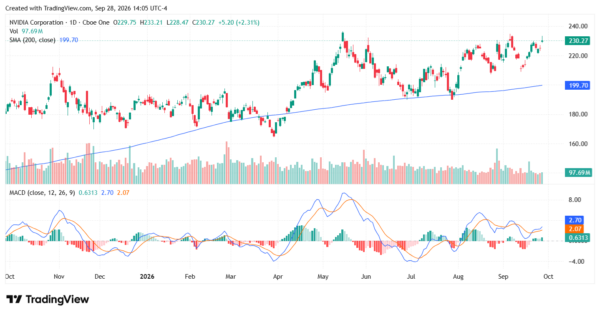
Investors cheered. NVDA shares rose 1.9% Monday morning, even as the broader tech sector slumped.
But the buyback itself is a short story. An authorization is permission, not a promise. NVIDIA will still set the pace based on its share price, cash needs, and investment plans.
The bigger story is the cash engine behind it. NVIDIA now generates enough cash to reward shareholders, fund its growth, and bankroll much of the AI ecosystem. Few companies in history have done all three at once. That raises a fair question for investors. Which other AI leaders have balance sheets strong enough to play the same game?
Buybacks say a lot about how management views its own stock. NVIDIA trades at about 24 times forward earnings, not far above the S&P 500’s 20-times multiple. That’s a modest premium for a company still doubling revenue.
This is a classic perception-versus-fundamentals gap. The market prices NVIDIA like a cyclical chipmaker nearing a peak. Management is pricing it like a platform company early in a long cycle. In the release, Jensen Huang said the authorization reflects his confidence in the long-term opportunity ahead.
Following the Cash: $70 Billion in Six Months
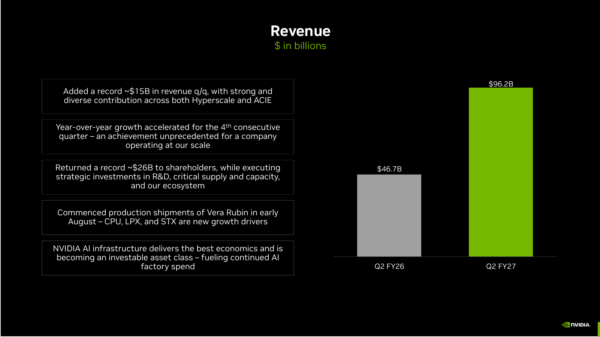
The fundamentals back up that confidence. Second-quarter revenue hit $96.2 billion, up 106% from a year ago. Free cash flow for the first six months totaled $69.9 billion.
NVIDIA returned about $26 billion to shareholders in the second quarter through buybacks and dividends. It ended the quarter with $22.4 billion in cash and $34.1 billion in marketable debt securities.
There is one wrinkle worth watching. Second-quarter free cash flow fell to $21.3 billion from $48.6 billion the prior quarter. A $22.3 billion jump in accounts receivable drove most of that decline. Growing customers are paying more slowly. Fast growth often looks like this, but it bears monitoring.
The math on the buyback is also ambitious. Spending $235 billion by early 2028 would mean more than $40 billion per quarter. That’s above NVIDIA’s average quarterly free cash flow so far this year. Notably, the company raised about $24.9 billion in new debt during the quarter.
NVIDIA Is Now the AI Economy’s Banker
Buybacks are only half of how NVIDIA deploys its cash. As of July 26, it held $99 billion in equity investments, with another $25 billion committed.
The largest stakes include OpenAI at $30 billion, Anthropic at up to $10 billion, and Safe Superintelligence at $5 billion. Some bets have already paid off handsomely. NVIDIA’s $5 billion stake in Intel was worth over $25 billion within months.
NVIDIA is also helping others finance the buildout. It partnered with Apollo, BlackRock, Blackstone, Brookfield, Goldman Sachs and KKR on platforms aiming to mobilize over $500 billion in third-party capital for AI infrastructure. It also agreed to acquire Hugging Face for $12.9 billion after the quarter closed.
Critics call this circular. NVIDIA backs companies that buy its chips, which some say could inflate valuations across the sector. That concern is valid. But it is also a luxury problem. Only a company with extraordinary cash flow can fund its own customers.
Three More AI Leaders With Deep Pockets
NVIDIA isn’t the only AI company sitting on a cash fortress. But its peers are spending theirs very differently.
Alphabet: The Biggest Cash Pile, Spending Hard
Alphabet (NASDAQ: GOOGL) holds the largest war chest in the group. It had $242.5 billion in cash, cash equivalents, and short-term marketable securities as of June 30.
Yet the headline number spooked some investors. Second-quarter free cash flow was negative $5.9 billion as capital spending of $44.9 billion outran operating cash flow. In June, Alphabet also raised roughly $49.6 billion in equity and $20.3 billion in senior notes to fund AI compute.
The fundamentals tell a better story. Trailing 12-month free cash flow remained positive at $53.3 billion. Google Cloud revenue soared 82% to $24.8 billion. Its cloud backlog reached $514 billion. Alphabet is converting cash into capacity, and the demand appears to be there.
Microsoft: Positive Cash Flow Despite Record Capex
Microsoft (NASDAQ: MSFT) is walking a similar line. Fourth-quarter capital expenditures and finance leases jumped 69% to $41 billion. Even so, the company still produced $19.6 billion in free cash flow.
Operating cash flow for fiscal 2026 rose $46.8 billion to $182.9 billion. Microsoft ended the year with $76.8 billion in cash and short-term investments, plus $36.3 billion in equity and other investments.
Like NVIDIA, Microsoft is profiting from its AI stakes. It booked a $3.2 billion gain on its Anthropic investment last quarter. Management also expects to remain free cash flow positive in fiscal 2027.
Broadcom: A Cash Machine With Almost No Capex
Broadcom (NASDAQ: AVGO) looks most like NVIDIA financially. Both design chips without owning heavy manufacturing. That keeps capital needs low and cash conversion high.
Third-quarter revenue climbed 86% to $29.6 billion. Free cash flow reached $13.7 billion, or 46% of revenue, on just $0.5 billion in capex. Cash rose to $24.0 billion from $19.6 billion a quarter earlier.
AI is the engine. AI semiconductor revenue jumped 221% to $16.7 billion, with $21.7 billion expected next quarter. Broadcom still carries debt from its VMware deal. But its cash flow is growing fast enough to shrink that burden quickly.
Elon Musk is rolling out a breakthrough technology that could replace our need for foreign oil.
Called “Dark Energy,” it can be deployed anywhere, goes online in about 5 minutes, and is 326 times more powerful than emergency generators used by hospitals.
But Musk has to go through a small group of little-known suppliers to get it.
In the AI race, the balance sheet has become strategy. The companies with the most cash set the pace for everyone else.
NVIDIA stands out because it sells the picks and shovels. It doesn’t have to pour concrete for data centers. That leaves room to buy back stock, invest in partners, and still build its own business.
The market keeps debating whether AI is a bubble. The cash flows suggest something more durable. Investors should still watch receivables and circular deals closely. But a record buyback is hard to fake. It’s a bet management is making with real money.






No comments:
Post a Comment