| Read in browser | ||||||||||||||

Rapid deployments of solar panels are starting to transform power grids globally. In today’s edition, we examine the scale of installations, and forecasts for a further acceleration. In Europe, we discover how the technology is taking root in locations previously considered too dark, too cold or too remote. Meanwhile, emergency services and residents in eastern Washington state are responding to destructive wildfires. Spokane Mayor Lisa Brown called the blazes “the worst natural disaster our region has faced.” A new solar milestoneBy Akshat Rathi The rapid deployment of solar power is one of the greatest stories of the 21st century. After crossing the 100-gigawatt mark in 2012, it took the world 10 years to deploy 1 terawatt of solar power. An additional 1 terawatt, enough to meet all of US power demand at its peak, took less than three years to build. Not even two years later in 2026 — the precise timing is subject to debate among analysts — the 3-terawatt threshold was reached. No one really noticed. 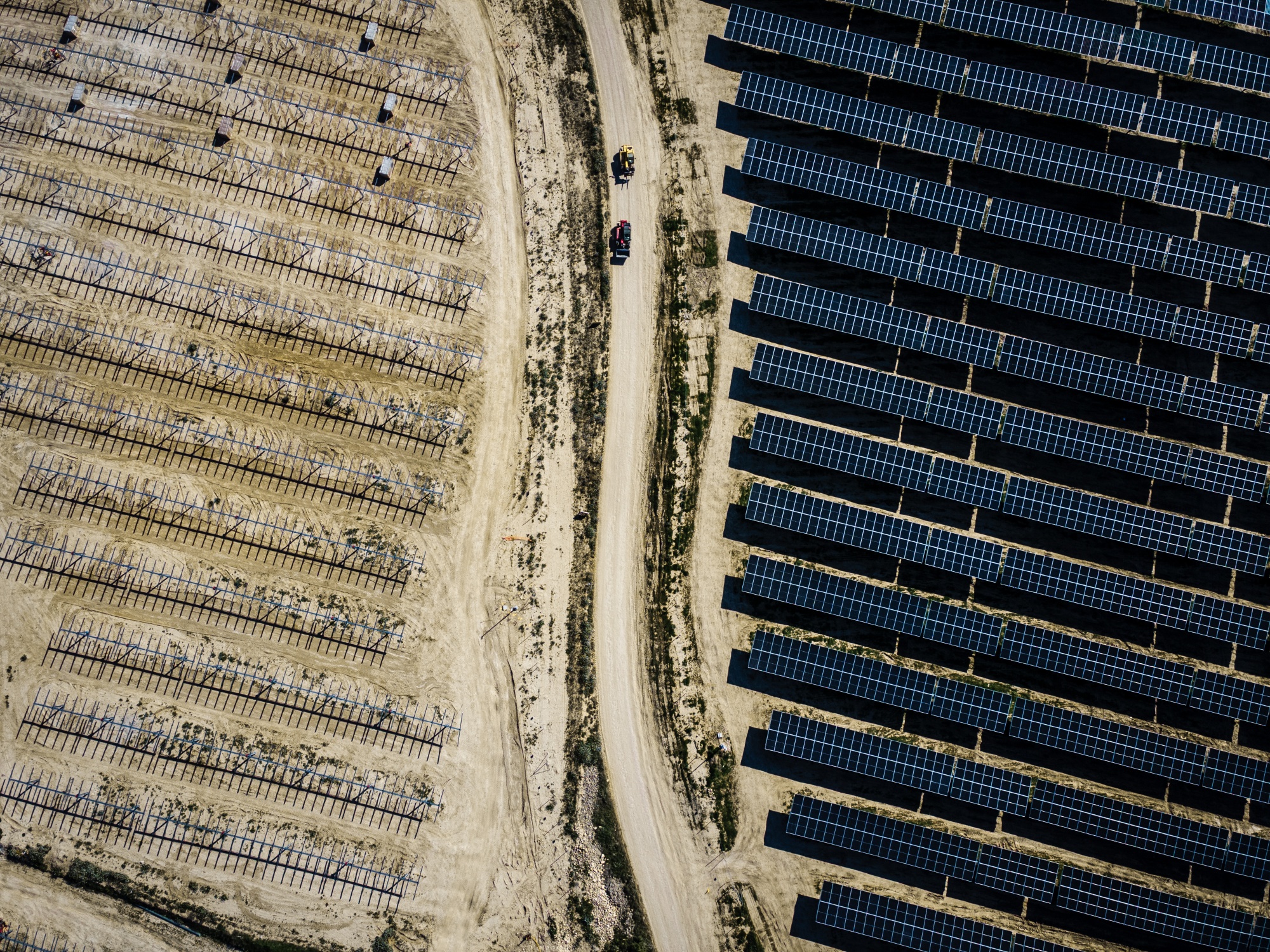
Solar panels being installed at the Fuendetodos II solar park near Zaragoza, Spain, on Wednesday, March 25, 2026.
Photographer: Angel Garcia/Bloomberg
That makes sense. For most people, the increased deployment of solar isn’t perceived in figures, but in other ways. “Take a train anywhere, say in the UK, and you’re likely to spot solar panels,” said Lara Hayim, head of solar research at BloombergNEF. The visual signal is only going to get stronger. Forecasters are so bullish about solar that, in just a few years, the 3-terawatt milestone will seem almost insignificant. BNEF expects the world to deploy more than 9 terawatts of solar by 2036. But dig in a little deeper and you’ll find interesting stories. The first terawatt was mostly rich countries subsidizing the installation of solar, with China and poor countries still finding photovoltaics too expensive. That story changed going into the second and third terawatt, with China taking the baton from rich countries. 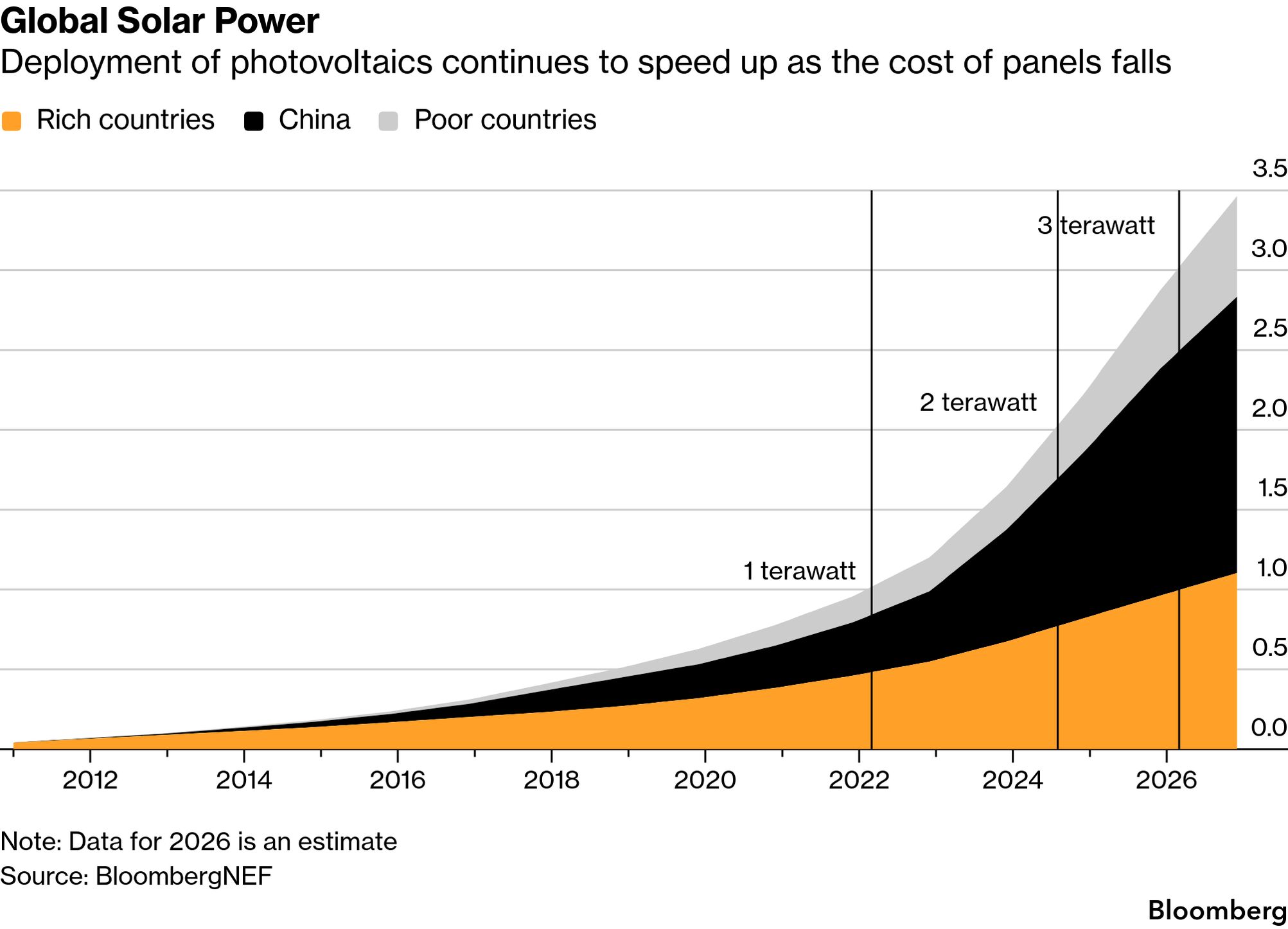
In the past few years, countries like Pakistan, Nigeria and the Philippines have seen an extraordinary increase in the amount of solar power installed on rooftops. Some smaller markets, such as Cuba and Lebanon, have also seen rapid uptakes. It’s why the number of countries with at least 1 gigawatt of solar installed has grown to as many as 74 last year, up from 42 in 2020. China’s solar deployment has been faster than the buildout of supporting infrastructure, such as transmission and batteries. That’s leading to more curtailment of solar production during peak hours, and thus a waste of resources. So analysts expect deployment in China to slow down. In its latest five-year plan, the country announced a series of measures to increase renewables consumption, rather than production, by more than 50%. BloombergNEF expects that poor countries’ share of solar deployment will start growing again from this year onward. Most developing countries are starting with very low amounts of solar penetration in the grid and won’t hit the limits that China and other big adopters are facing now. By 2036, more than a quarter of all solar deployed will be in developing countries, with rich countries’ share falling to about 20%.
Read more
Rising installations9 terawatts The volume of solar power capacity BNEF forecasts will be deployed globally by 2036 Need for batteries“Without enough energy storage, you cannot maximize solar’s potential.” Lara Hayim Head of solar research at BloombergNEF. Panels in dark placesBy Eamon Farhat For decades, Europe’s renewable energy map looked straightforward: solar was mostly used in the sunny south, while the north relied on wind. But plunging equipment costs and higher electricity prices have made solar projects viable in places once considered too dark, cold or remote to pay off. 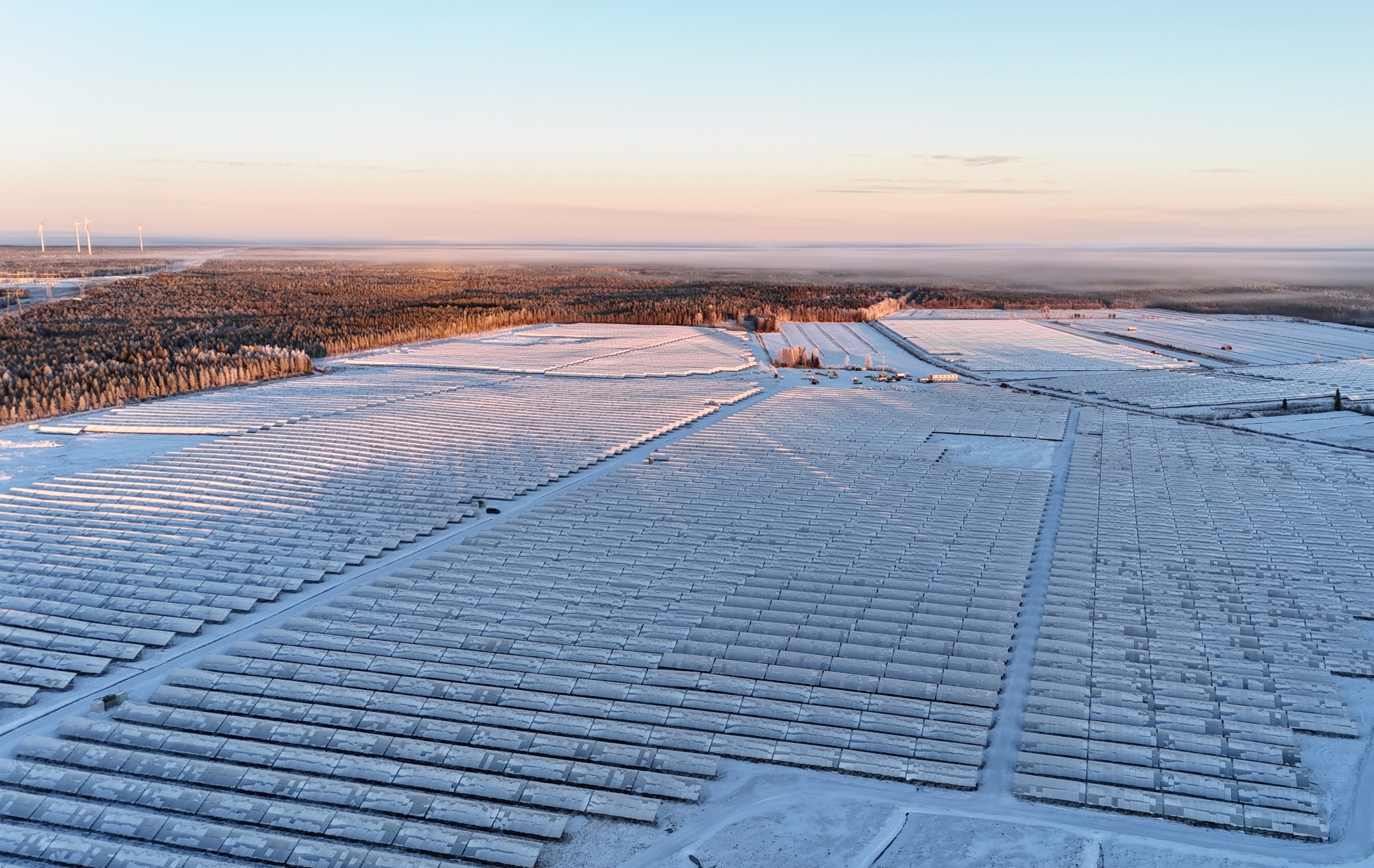
Exilion’s Simo solar park in Finland.
Source: Exilion
Large solar farms are being built around the Arctic Circle in the Nordics, rooftop panels are spreading across northern Scotland and the technology has even found a role in the notoriously cloudy Faroe Islands in the Atlantic Ocean. Its rise is giving governments another way to electrify their economies while producing more energy at home. Across the Nordic region, for the first time, investors and utilities added more new solar capacity than wind in 2025, a lead expected to continue this year, according to BloombergNEF. Governments have upgraded their own forecasts as installations exceed expectations. Sweden reached its original 2030 solar target in 2023 and is already close to meeting a newer, more ambitious goal. Finland hit its end-of-decade target six years early. “The question isn’t whether solar works this far north anymore,” said Warren Campbell, chief executive officer of Swedish solar developer Alight AB. “It’s how much we’re going to build.”
Read more
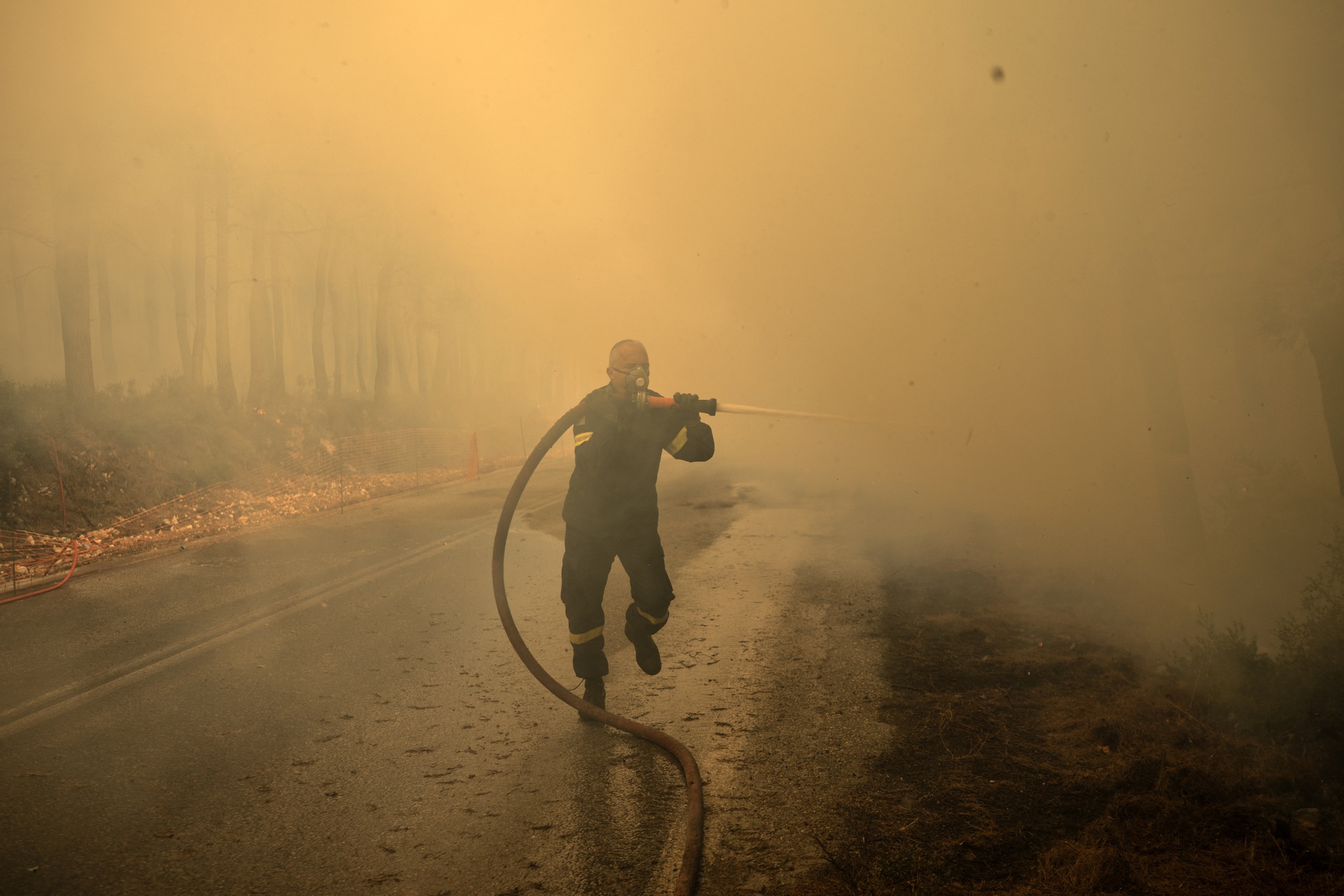
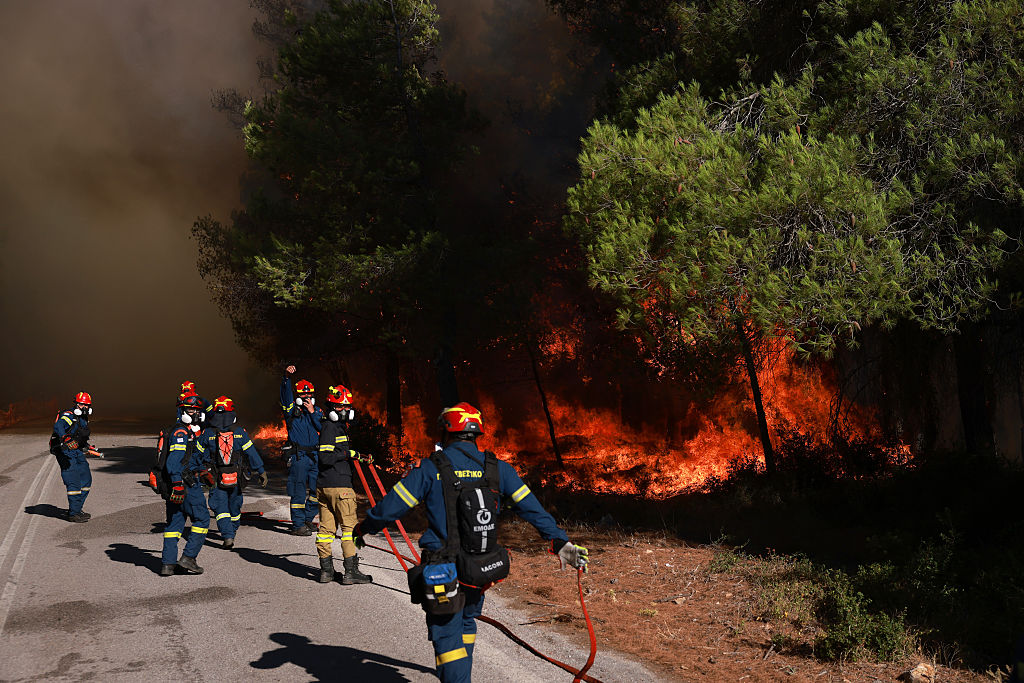
Destructive wildfiresBy Brian K. Sullivan and María Paula Mijares Torres Hundreds of structures have been destroyed and tens of thousands of people have been evacuated, as wildfires rip through eastern Washington state in what Spokane Mayor Lisa Brown called “the worst natural disaster our region has faced.” 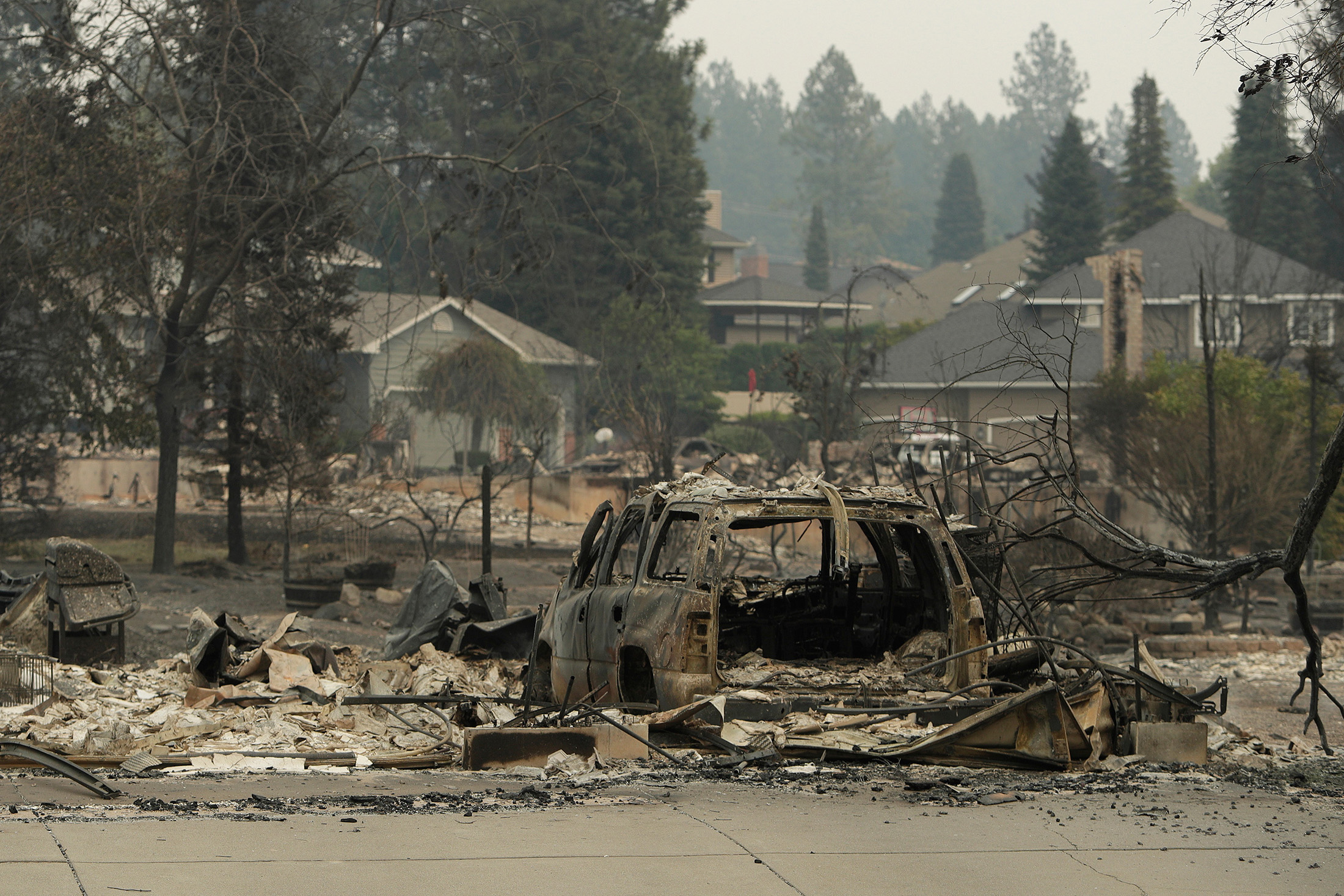
A vehicle and structure burned on N. Skyline Dr. following the wildfire in Spokane, Washington, on Aug. 2, 2026.
Photographer: Young Kwak/AP Photo via FR159675 AP
As of about 2 p.m. New York time Sunday, the Old Trails incident had consumed 3,619 acres, the Fairview fire had grown to 1,056 acres, and the Autumn Lane fire had expanded to 3,351 acres, the Washington Department of Natural Resources said on its website. Over 10,000 residences have been evacuated, Spokane Police Chief Kevin Hall said at an emergency press conference Sunday. More than 60,000 people were evacuated in Spokane, a metropolitan area of about 600,000 residents. “There are so many Washingtonians that have lost everything in a very, very short period of time,” Washington Governor Bob Ferguson said during the Sunday press conference. “Just in a matter of hours, their lives changed in deeply traumatic and fundamental ways, and so it’s difficult to find words when folks have experienced a loss like that.”
Read more
🎥 Attention all filmmakers!Working on a short documentary about climate change? Don’t miss your chance to submit it to the Bloomberg Green Docs film competition. Grand prize: $25,000. Submissions accepted through August 14, 2026. See official rules at bloomberg.com/greendocs. Your Zero listenHow should we navigate a world in which anxieties about AI, climate change and capitalism collide? This week on Zero, Akshat Rathi speaks with Helen Phillips, author of Hum and the second-ever winner of the Climate Fiction Prize. Rathi asks Phillips how she’s transformed her anxieties into captivating prose, how her relationship to technology has changed through writing and what humanity loses out on if we rely on AI too much. Listen now, and subscribe on Apple, Spotify or YouTube to get new episodes of Zero every Thursday. More from GreenMore from Bloomberg
Explore all Bloomberg newsletters. We’re improving your newsletter experience and we’d love your feedback. If something looks off, help us fine-tune your experience by reporting it here. Follow Us
You received this message because you are subscribed to Bloomberg’s Green Daily newsletter. If a friend forwarded you this message, sign up here to get it in your inbox.
|
Monday, August 3, 2026
Solar’s surprise milestone







Subscribe to:
Post Comments (Atom)

-
PLUS: Quantum threat pushes SEC into action ...


No comments:
Post a Comment