Welcome to Bw Reads, our weekend newsletter featuring one great magazine story from Bloomberg Businessweek. Today Laura Bliss and Rachael Dottle take a look at America’s overheating landfills. These hot waste piles can become environmental disasters, but a new Businessweek analysis finds that many operators and regulators aren’t taking the steps experts say are needed to control the problem. You can find the whole story online (free) here. If you like what you see, tell your friends! Sign up here. Subscribe to Bloomberg.com for unlimited access to all our coverage. One winter’s day in 2023, Shoosmith Landfill began to melt down. Underground temperatures in a section of the recently closed municipal waste site near Richmond, Virginia, reached 194F, 34% higher than federal standards allow, hot enough to give a person an instant third-degree burn. A spike in carbon monoxide readings from the landfill’s gas-collection wells was another sign that buried garbage might be releasing toxic emissions and effluents. The operator, Shoosmith Bros. Inc., told regulators there was likely no fire, but instead an unspecified event stemming from “characteristics of the waste mass.” It said it needed the state’s permission to keep parts of the landfill running at hotter-than-normal temperatures while it got things under control. Over the next two years, as temperatures inside the landfill climbed, Shoosmith Bros. made 10 more of these requests covering dozens of gas-collection wells, according to public records. Virginia regulators approved the vast majority of them. That didn’t turn out well. By December 2025, the landfill was producing more than 1 million gallons a month of leachate, a mix of rainwater and other fluids that grows contaminated as it percolates through the waste, an increase the operator later linked to the elevated heat. State officials also found dark liquids flowing into a stormwater drain that feeds into a creek leading to the Chesapeake Bay. Today, leachate is being trucked out of the landfill. The cost of long-term cleanup, including keeping the trash juice from leaking into the creek — a possibility officials have called “catastrophic” — is estimated at $173 million. But Virginia taxpayers might have to pay that price too. Shoosmith Bros., which has a long history of environmental violations, has declared bankruptcy and abandoned the site. 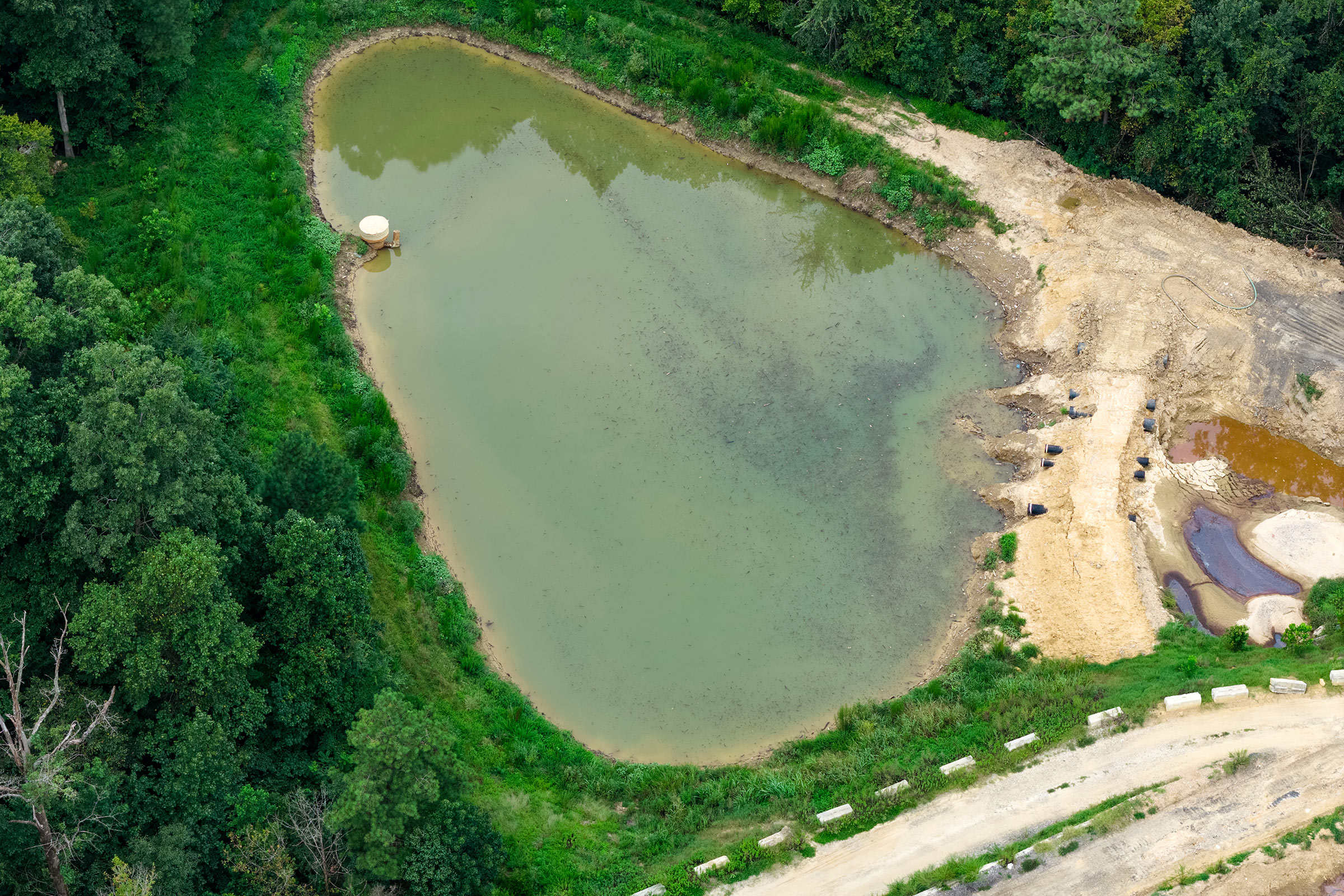
Shoosmith Landfill in Chesterfield County, Virginia.
Photographer: Leigh Vogel for Bloomberg Businessweek
Experts say the situation might have been contained if the state had acted on the red flags in the data years ago. “The regulators needed to have been more involved earlier,” says Morton Barlaz, a professor emeritus of environmental engineering at North Carolina State University who studies landfills and consults with the waste industry. The Virginia Department of Environmental Quality declined to comment, and Shoosmith Bros. didn’t respond to requests for comment. A Bloomberg Businessweek analysis shows that the overlooked warning signs at Shoosmith are part of a national pattern. Reviewing public records from 100 landfills in 20 states, Businessweek found that when temperatures and other key indicators surpass normal thresholds, operators and regulators often don’t intervene at the level that experts say is needed. In several cases, “there are clearly opportunities where regulatory oversight could have been stronger,” says Timothy Townsend, a professor of environmental engineering at the University of Florida who specializes in landfills. 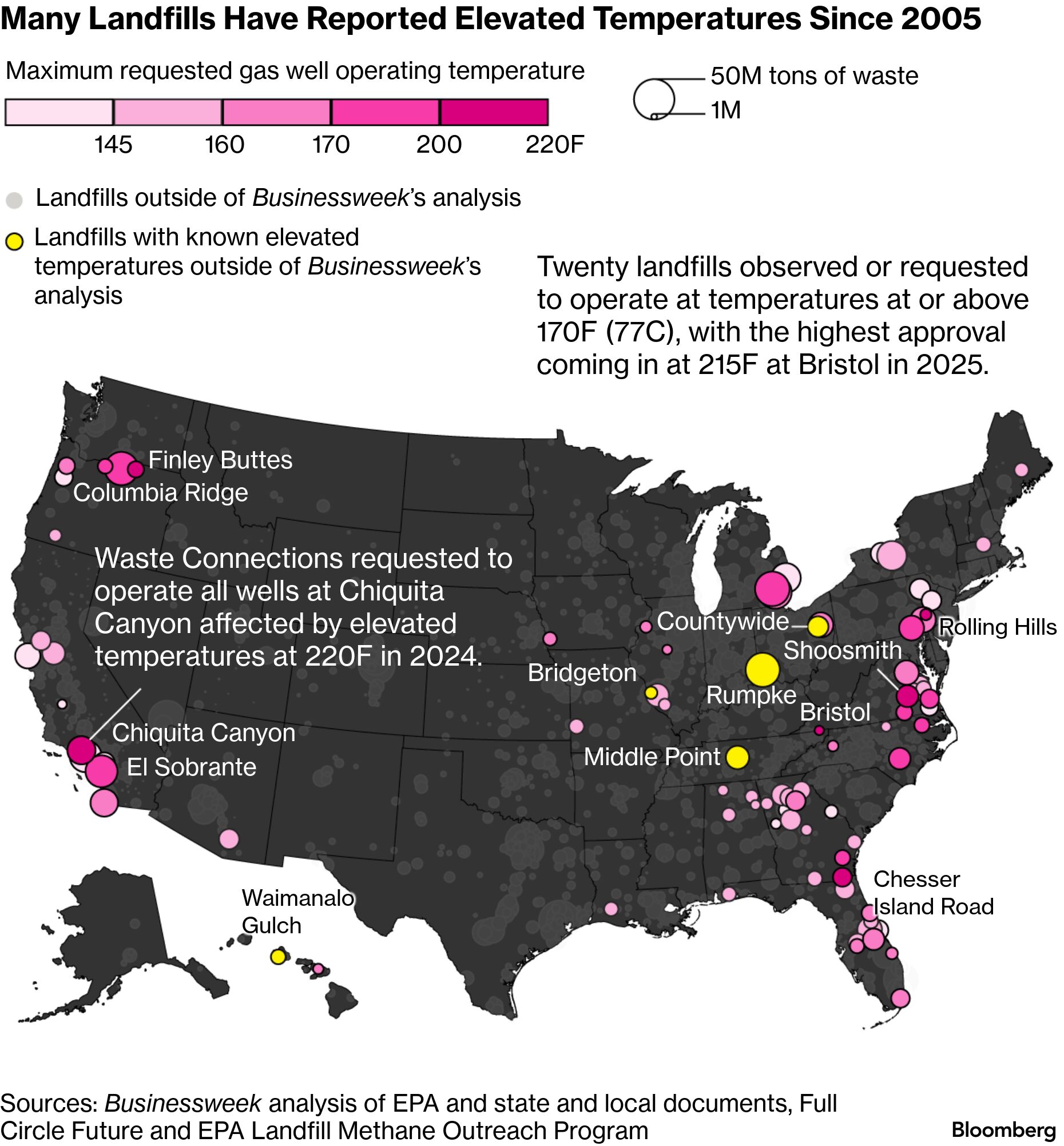
Businessweek’s analysis included data from 2005 to 2026 and was based in large part on documents obtained via public records requests by Full Circle Future, an environmental advocacy group. These documents include operator requests to run landfills at temperatures above regulatory thresholds, state and federal agency responses, landfill operating reports and additional monitoring data and correspondence. After Full Circle Future shared its trove of records exclusively with Businessweek, citing a 2025 Businessweek investigation as the motivation for its work, Businessweek obtained additional records, performed its own analysis and discussed its findings with five technical experts, including Barlaz and Townsend. While far from a complete picture, the new material provides a troubling snapshot of America’s landfill oversight. For the more than 2,600 landfills tracked by the US Environmental Protection Agency, federal regulations peg 145F as a key temperature threshold, triggering requirements for operators to determine the cause and reduce the heat because of the potential for fire or a breakdown of normal chemical processes. If temperatures exceed 170F and carbon monoxide levels surpass 1,000 parts per million, operators must act to fix the problem within 15 days to curb the elevated risk. Over the past two decades, 20 of the 100 landfills whose records Businessweek reviewed have reported temperatures at or above 170F. More than 1 million people live within 5 miles of those 20 sites, a handful of which have become full-blown crises. Businessweek’s 2025 investigation found that waste at Chiquita Canyon Landfill in Los Angeles County has exceeded temperatures of 200F and emitted noxious odors, geysers of leachate and at times elevated levels of hydrogen sulfide, carbon monoxide and benzene, a carcinogen. Neighbors have reported headaches, nosebleeds and tremors. The high temperatures at the site are ongoing as of August. After the story was published, California tightened its air-quality regulations, including by requiring landfill operators to perform “intensive monitoring and proactive responses to changing conditions” of gas-collection systems, which can increase the risk of fire if not properly managed. State and federal regulators have also issued multiple violations and enforcement actions to Chiquita Canyon, which is run by Waste Connections Inc., the third-largest operator of landfills in the US. Waste Connections has disputed claims about public health impacts stemming from the landfill and said in its most recent earnings call that the heat reaction at Chiquita Canyon is “stable, controlled and decelerating.” In a statement to Businessweek, a spokesperson for the company said, “Any suggestion that Waste Connections does not operate its landfills responsibly and in accordance with sound industry practices is inaccurate and misleading, and fails to reflect the full scope of the extensive work being performed by our employees at these facilities.”
Keep reading
On the PodcastThis week on Everybody’s Business from Bloomberg Businessweek, hosts Stacey Vanek Smith and Brad Stone take a journey into the history of the economy. First, Stacey and Bloomberg Opinion’s Allison Schrager go a field trip to the Roosevelt Island tram, a monument to the stagflation of the 1970s. Then Allison, Stacey and Brad discuss bond news, record debt and rising oil prices. Certainly, the economy is looking beleaguered, but are we truly poised to return to a ’70s style economy? Then Bloomberg Businessweek’s Laura Bliss joins to talk about landfill fires, the second installment in a series. Listen and subscribe on Apple, Spotify, iHeart and the Bloomberg Terminal. More Weekend Reads
 
Video: The Diamond Industry Wants You to Buy ‘Natural’
Play Alphadots!Our daily word puzzle with a plot twist. 
Today’s clue: Open to work? More From BloombergLike Businessweek Daily? Check out these newsletters:
Explore all Bloomberg newsletters. We’re improving your newsletter experience and we’d love your feedback. If something looks off, help us fine-tune your experience by reporting it here. Follow Us
You received this message because you are subscribed to Bloomberg’s Businessweek Daily newsletter. If a friend forwarded you this message, sign up here to get it in your inbox.
|
Sunday, August 23, 2026
Bw Reads: America’s overheating landfills






Subscribe to:
Post Comments (Atom)
The foldable iPhone
Also: Get ready for iPhone price hikes. ...
-
Revolutionary Stem Cell & PRP —Start Your Journey Today ...


No comments:
Post a Comment