Any content you receive is for information purposes only. Always conduct your own research.
*Disseminated on Behalf of Medicus Pharma Ltd.
Paul Prescott Has Medicus Pharma Ltd. (Nasdaq: MDCX) At The Top Of This Morning’s Watchlist—Friday, July 31, 2026
Don’t Miss Our Next Update—Get Real-Time Alerts Sent Directly To Your Phone. Up To 10X Faster Than Email. Pull Up MDCX While It’s Still Early… July 31, 2026 Dear Reader, How often does a company this size get cleared to run a registrational study? Not often. On July 27, Medicus Pharma Ltd. (Nasdaq: MDCX) announced that the FDA had authorized SKNJCT-005. It is an NDA-enabling registrational Phase 2b study of SkinJect® 200 mcg in patients with Gorlin Syndrome. Studies at this stage usually belong to much bigger names. This one does not. The bell rings in about ninety minutes. MDCX is front and center this morning—Friday, July 31, 2026. 
As part of its review, the FDA also provided several protocol recommendations. The agency requested baseline biopsy confirmation of nodular basal cell carcinoma for all enrolled patients, a primary endpoint requiring both clinical and histological clearance, in-person investigator assessments, and follow-up extending from 24 weeks to at least two years. Medicus accepted each recommendation through a protocol amendment. At first glance, that list may look like an added hurdle. In reality, it outlines the type of filing-grade dataset the agency expects to see. The FDA also made clear that these recommendations did not constitute clinical hold issues. The program has reached this point because of the data already generated. In the completed 90-patient SKNJCT-003 study, the 200-mcg arm produced 64% clinical clearance and 55% histological clearance at Day 57. That same dose is now being carried forward into the registrational study. In March, the study’s principal investigator and key opinion leader, Babar K. Rao, MD, FAAD, reviewed an 80% overall response rate from the Phase 2 dataset. In May, a pre-specified expanded analysis confirmed a dose-response relationship, with the 200-mcg cohort showing the strongest clinical and safety profile at Day 57. There is a second clinical asset, and it has been moving as well. On July 16, Medicus reported positive FDA feedback and central Institutional Review Board approval for an optimized Phase 2 study of Teverelix in acute urinary retention. Two separate programs picking up fresh regulatory clearance inside a three-week window is an unusual amount of activity for a company carrying roughly 56.7M shares outstanding and a market value in the mid-$20Mn range. Analyst coverage on MDCX is currently bullish across all three firms tracked by S&P Global. Alliance Global Partners initiated coverage on July 28, one day after the FDA letter was announced, while Roth MKM reaffirmed its bullish stance that same day. Each published 12-month target remains above recent share levels. 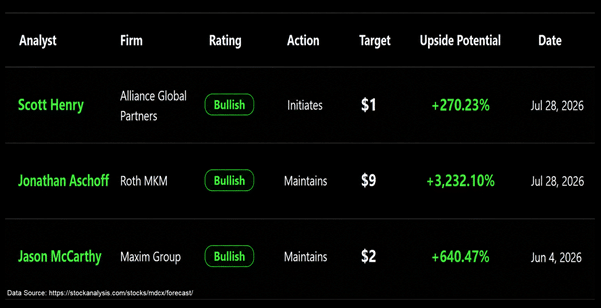
Medicus put the funding in place in May with an up to $22Mn non-dilutive structured financing facility. $12Mn arrived as immediate operating capital and $10Mn went into a collateralized deposit account released progressively against milestones. With this financing, the company put pro forma cash at approximately $30Mn and projected an operating runway beyond twenty-four months. The Company Behind SkinJect and Teverelix Medicus Pharma Ltd. is a Philadelphia-headquartered biotech and life sciences company built around a specific model. Rather than carrying assets from discovery all the way through commercialization, Medicus acquires clinical-stage candidates and advances them through Phase 2 proof-of-concept and the regulatory inflection points that reduce development risk, then works to license or partner them with established pharmaceutical companies. The company describes itself as active in multiple countries across three continents. 
One of its lead assets is SkinJect, held through wholly owned subsidiary SkinJect Inc. SkinJect is a proprietary dissolvable microneedle array that delivers doxorubicin directly into nodular basal cell carcinoma lesions through localized intradermal administration. The design intent is to concentrate the chemotherapeutic agent at the tumor site while limiting systemic exposure and the toxicities that come with it. A patient receives a patch rather than an excision, and because the approach is repeatable, it is positioned for people who keep developing new lesions. The second asset is Teverelix, a next-generation GnRH antagonist in development across three settings: acute urinary retention relapse caused by an enlarged prostate, advanced prostate cancer in patients at high cardiovascular risk, and endometriosis. 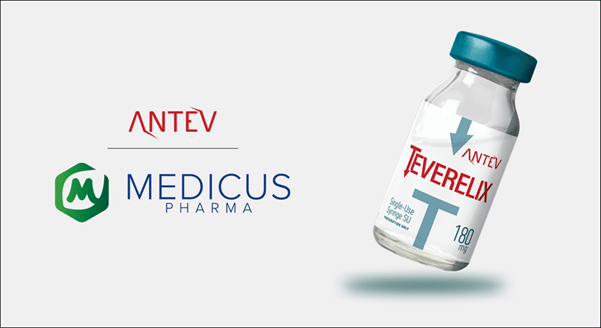
In June, Medicus filed a substantial modification through the European Union Clinical Trials Information System supporting a planned Phase 2b study in the high cardiovascular-risk prostate cancer setting, an underserved population the company sizes at roughly $4Bn annually. The acute urinary retention program addresses a market Medicus places near $2Bn. Management has also retained Deloitte as exclusive lead financial adviser to pursue an out-licensing transaction covering the doxorubicin microneedle array in basal cell carcinoma, which tells you how the company thinks about the endgame for this asset. A Common Cancer With an Uncommon Problem
Basal cell carcinoma is the most frequently diagnosed cancer in the world, and its standard treatment has changed remarkably little in decades. Surgical excision works well, and for a patient with a single lesion that is the end of the matter. The difficulty arrives with the patient who does not have a single lesion. Gorlin Syndrome, also called nevoid basal cell carcinoma syndrome, is a rare autosomal dominant disorder driven primarily by mutations affecting the Hedgehog signaling pathway. Affected individuals begin developing basal cell carcinomas in childhood or early adulthood and may accumulate dozens, and in some cases more than 1,000, over a lifetime. Each one has historically meant another procedure. What accumulates alongside the lesions is scarring, functional impairment, and a psychosocial burden that compounds across decades. The condition is estimated to affect roughly 1 in 30,000 to 60,000 people worldwide, corresponding to an estimated 6,000 to 12,000 patients in the United States and a considerably larger addressable population across major global markets. Systemic Hedgehog pathway inhibitors are available for advanced disease, but tolerability limits how long many patients are able to stay on them. That leaves a gap between a scalpel and a systemic agent, and it is precisely where a lesion-directed, repeatable, non-surgical option would sit. No therapy has been approved specifically for the Gorlin Syndrome population, and nothing has been approved for pediatric patients. That gap is what makes the commercial story so interesting. If SkinJect reaches approval, Medicus believes it could become the first FDA-approved lesion-directed therapy developed specifically for patients with Gorlin Syndrome, as well as the first microneedle-based chemotherapy platform designed to produce meaningful visual and histological clearance of basal cell carcinoma lesions. Being first in a rare-disease category can carry significant weight, which makes the two designation applications now under FDA review an important part of the broader story. From Submission to Authorization in Eight Weeks July 27, 2026
FDA issues a "Study May Proceed" letter authorizing SKNJCT-005, the NDA-enabling registrational Phase 2b study of SkinJect 200 mcg in Gorlin Syndrome, with enrollment planned for up to 50 patients. July 16, 2026
Positive FDA feedback and central IRB approval received for the optimized Phase 2 Teverelix study in acute urinary retention. June 22, 2026
SkinJect registrational strategy and the Teverelix precision medicine program presented at BIO International 2026. June 15, 2026
Rare Pediatric Disease Designation request submitted to the FDA for SkinJect in Gorlin Syndrome, following the orphan designation application filed in April. June 8, 2026
European submission filed, advancing Teverelix toward registrational development in high cardiovascular-risk prostate cancer. June 3, 2026
Protocol SKNJCT-005 submitted to the FDA, formally moving SkinJect into registrational development for Gorlin Syndrome. May 28, 2026
Up to $22Mn structured financing announced without equity issuance, lifting pro forma cash to approximately $30Mn with a projected runway beyond 24 months. May 14, 2026
First quarter 2026 financial results reported alongside a corporate update. May 6, 2026
Pre-specified expanded Phase 2 SKNJCT-003 analysis demonstrates a positive dose-response, with the 200-mcg arm strongest at Day 57. MDCX Is Topping Our Watchlist This Morning, And Here Are 7 Reasons Why—Friday, July 31, 2026…
1. Multiple Potential Catalysts: MDCX delivered positive FDA developments for both SkinJect and Teverelix within a three-week period, highlighting activity across two clinical programs. 2. FDA Authorization: MDCX recently received an FDA “Study May Proceed” letter authorizing its NDA-enabling registrational Phase 2b SkinJect study in Gorlin Syndrome. 3. Registrational Path: MDCX has advanced beyond exploratory studies, with its lead program now designed to support a potential regulatory submission. 4. Clinical Data: MDCX reported Phase 2 results that included 64% clinical clearance, 55% histological clearance, and an 80% overall response rate at the selected dose. 5. Strong Balance Sheet: MDCX secured up to $22Mn in structured financing without issuing equity, ending with approximately $30Mn in pro forma cash and a projected runway beyond 24 months. 6. First-Mover Potential: MDCX believes SkinJect could become the first FDA-approved lesion-directed therapy developed specifically for patients with Gorlin Syndrome if it ultimately reaches approval. 7. Bullish Coverage: MDCX is currently covered by three firms tracked by S&P Global, with bullish ratings and published 12-month targets of $1, $2, and $9. Pull Up MDCX While It’s Still Early…

A lot can change in a few months. For MDCX, the last several weeks have included FDA authorization for a registrational study, additional FDA activity across a second clinical program, two rare disease designation applications under review, and financing designed to extend its operating runway without equity issuance. Take a closer look at MDCX while it’s still early, and be sure to watch for my next update, it could be coming very soon. Sincerely, Paul Prescott
Co-Founder & Managing Editor
Street Ideas |



No comments:
Post a Comment