Tuesday, April 8, 2025

Green investors assess market mayhem

Are there any safe harbors?
View in browser
Bloomberg

Today's newsletter looks at continued market reaction to US President Donald Trump's tariffs. As China vows to "fight to the end" on the US's new import taxes, we examine what the global trade war means for clean energy investors. Keep up with all of the latest news on Bloomberg.com. For unlimited access to climate and energy news, please subscribe

Assessing the damage

By Lisa Pham, Dan Murtaugh, and Ishika Mookerjee

Investors this week see trade wars delivering a blow to the energy transition in the US — yet there is still hope for opportunities in China as it pursues its renewable ambitions. 

The decoupling of trade ties between the world's two largest economies "cements challenges for US companies to import components key to decarbonization-related technologies," according to analysts at UBS Group AG's global wealth management arm.

"Ultimately, tariffs are likely to push clean tech costs higher at a time when clean tech already costs significantly more in the US compared to other countries," UBS Wealth analysts including Amantia Muhedini and Tiffany Agard wrote in a note to clients dated April 4.

Read More: Clean Energy Already Has Big Trade Barriers. Now Comes Trump

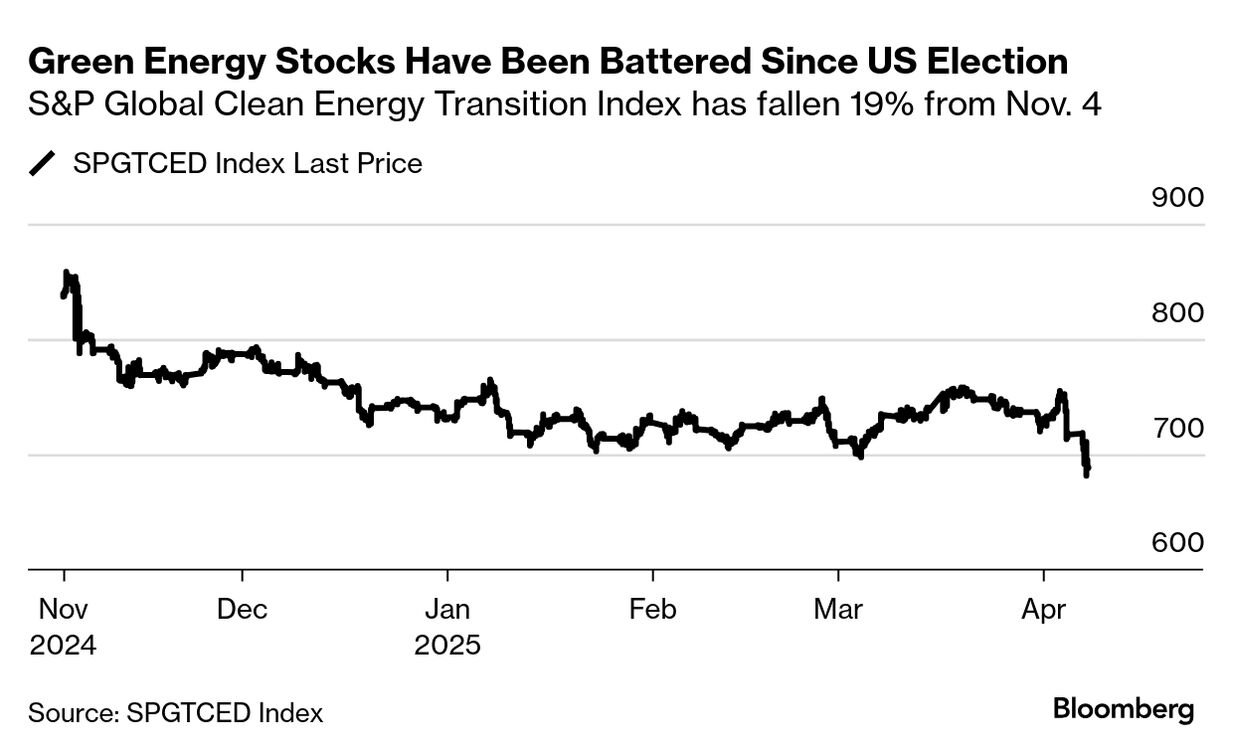
Stock indexes with clean energy themes initially weathered the shock of President Donald Trump's tariff announcement on April 2. But UBS notes that was likely due to the presence in those indexes of US utilities, which were briefly treated as a haven by investors. That trade has since unwound, and clean energy stocks have been dragged down along with the wider market.

Is there any safe harbor in this market? Wind generator China Longyuan Power Group Corp. and hydro-dam operators China Yangtze Power Co. and Huaneng Lancang River Hydropower Inc. were three of just 20 firms on the CSI 300 whose shares were up from the start of trading Monday through midday Tuesday. The index as a whole is down over the past two sessions. 

The utilities have the benefit of low-cost, tariff-free inputs like sunshine, wind and water, and Chinese developers rely mostly on domestic supply chains to build out solar, wind and hydro plants.

"The China power sector remains one of the most defensive, and we prefer hydro to other power operators given lowest generation costs, valuation support and decent fundamentals," Jefferies analysts Alan Lau and Johnson Wan said in a research note Tuesday.

Investors are also expecting more clean energy equipment to be bought and sold within Asia. "Asia selling back to Asia will be a big theme," said Khan Yow, managing director at Singapore-based Seraya Partners, a $1.3 billion private equity firm that invests in Asian infrastructure. "It will be somewhat shielded from tit-for-tat measures."

Yow said investors see Asia as a good long-term bet for clean energy growth. "One of the strongest hedges is to double down on our focus on Asia as a region in renewables, energy transition and digital infrastructure," he said.

Meanwhile, the market mayhem may inspire more investors to take clean energy companies private. "It makes sense that there would be an uptick in take-private deals in the clean energy space as public market valuations come under pressure," said Armina Rosenberg, co-founder of Minotaur Capital, a Sydney-based hedge fund.

Read More: Green Investors Are Finding Bargains in Trump's Big Oil Era

Rosenberg noted there could be some good opportunities in companies focused on energy management software, grid optimization or smart energy systems "that have solid underlying tech but face market volatility."

Stopping the world

2.6 billion
This is how many metric tons of carbon dioxide weren't emitted as a result of the global slowdown caused by Covid-19 in 2020, according to estimates at the time.

No win for climate

"Lower economic activity does result in lower carbon emissions. However, this is not a durable approach as we have learned the last five years since the Covid-19 pandemic."
Analysts at UBS Wealth

More from Green

There's yet another tariff impact to consider: home insurance rates

The cost for rebuilding homes after climate disasters will rise as tariffs are expected to push up the cost of construction materials. That in turn could raise insurance rates further due to repairs becoming costlier, said Insurify's Matt Brannon, an author of a new report. 

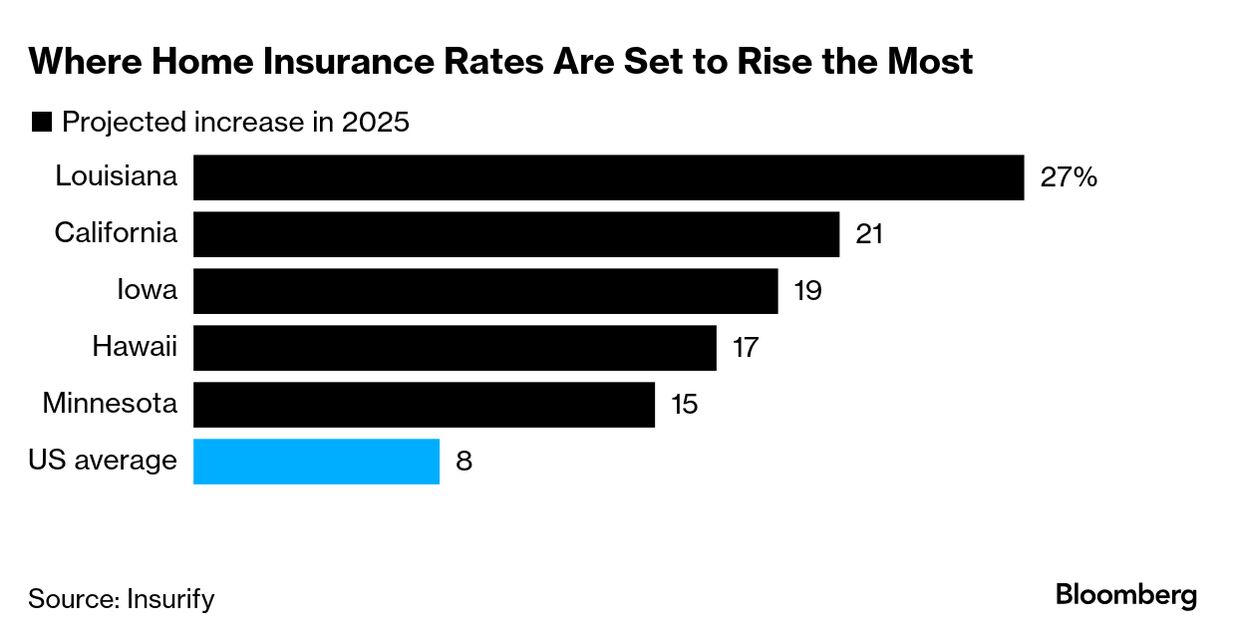
Already the  average annual cost of home insurance is expected to increase 8% nationally by the end of the year to $3,520 for a home worth $400,000, Insurify projects. Some states, including Louisiana, Iowa and Minnesota, will see double-digit increases.

Trump looks to fulfill his promise on reviving coal. President Donald Trump is set to sign an executive order on Tuesday afternoon that will help expand the mining and use of coal inside the US. The move is a bid to power the boom in energy-hungry data centers while seeking to revive a declining US fossil fuel industry.

Hydrogen planes won't be taking passengers anytime soon. Airbus SE said the aviation industry's ability to power commercial aircraft using hydrogen for fuel is as much as a decade behind schedule, in a setback to the sector's efforts to hit its net-zero emissions target by 2050.

Meanwhile, Bezos is putting his money behind more climate-friendly cows. The Jeff Bezos-backed philanthropic organization is funding research programs focused on breeding climate-smart cattle. The work is part of efforts to curb the environmental impact of livestock.

Worth a listen

The race for EV market dominance is constantly changing. While Teslas are now being hawked from the White House lawn in the US, China seems to have taken an unassailable lead. Electric car giant BYD recently announced a battery that can be charged to go 400km in just 5 minutes, and Chinese automakers increasingly moving into emerging markets. All the while a rearrangement of global trade and tariffs is sending shockwaves through the global industry. On the latest Zero, Bloomberg's global automotive editor Craig Trudell unpacks the latest twists and turns in the EV revolution.

Listen now, and subscribe on AppleSpotify, or YouTube to get new episodes of Zero every Thursday.

A protester and a Tesla Cybertruck driver argue at a Tesla Takedown rally outside a Tesla showroom in Columbus, Ohio on March 29, 2025.  Photographer: Brian Kaiser/Bloomberg

More from Bloomberg

  • Hyperdrive for expert insight into the future of cars
  • Energy Daily for a daily guide to the energy and commodities markets that power the global economy
  • CityLab Daily for top stories, ideas and solutions, from cities around the world
  • Tech In Depth for analysis and scoops about the business of technology

Explore all Bloomberg newsletters.

Follow Us

Like getting this newsletter? Subscribe to Bloomberg.com for unlimited access to trusted, data-driven journalism and subscriber-only insights.


Want to sponsor this newsletter? Get in touch here.

You received this message because you are subscribed to Bloomberg's Green Daily newsletter. If a friend forwarded you this message, sign up here to get it in your inbox.
Unsubscribe
Bloomberg.com
Contact Us
Bloomberg L.P.
731 Lexington Avenue,
New York, NY 10022
Ads Powered By Liveintent Ad Choices

No comments:

Post a Comment

This is the week to invest in yourself

Memorial Day savings on advanced technologies ...