| I'm Shawn Donnan, a senior writer for economics in Washington. Today we're looking at twin shocks hitting the world economy. Send us feedback and tips to ecodaily@bloomberg.net. And if you aren't yet signed up to receive this newsletter, you can do so here. - China has pledged to retaliate against Donald Trump's latest tariff threat and is stepping up efforts to support the market and economy.
- Trump's latest threats, including an extra 50% levy on Chinese goods, kept markets on edge. Shares in Japan gained on expectation it'll get priority in trade talks.
- Meantime, frustrated world leaders are at a loss as to what might placate Trump.
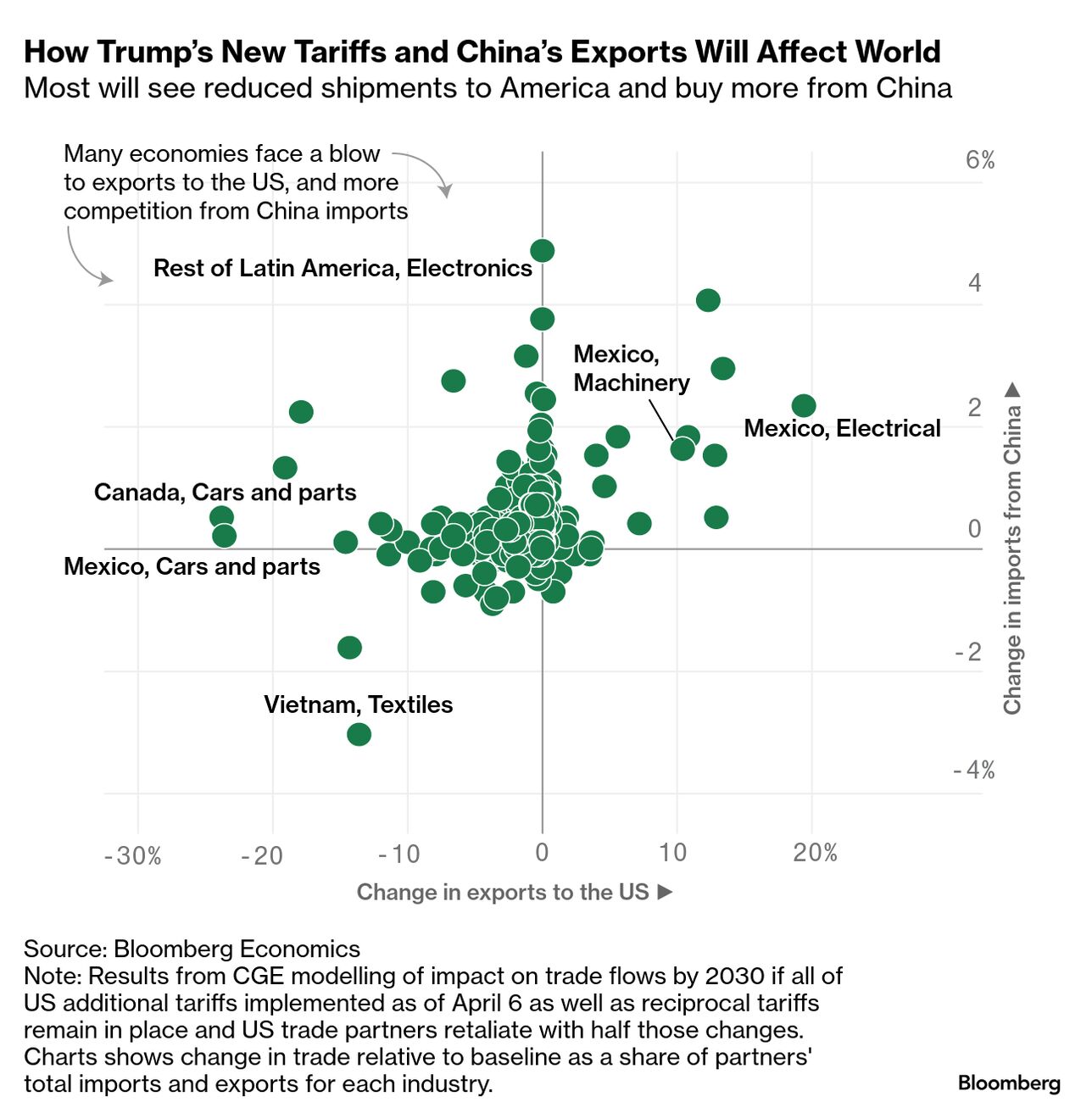
For a quarter century at least the world has been living with the effects of an epochal economic shock as China's rise has reshaped whole industries and communities around the world. But that jolt to the global economy has been joined by another over the past week: The Trump Shock is truly here. The initial impact has been on markets and been manifested in the turmoil that has rolled over trading floors and investors around the world since President Trump last week announced the largest package of US tariffs in a century. But as we write in today's Big Take, that's just the beginning of the story. The flow of goods and capital around the world is set to undergo a fundamental change over the next five years, a new Bloomberg Economics analysis finds. That's exactly what Trump and his cheerleaders are unabashedly aiming for. They want to rewrite the rules of global commerce in America's favor. Supply chains will be tangled, investment plans rewritten, prices for imports will spike, and trade and security relationships with both allies and rivals will be remade. Trump's whole bold gamble hinges on upheaval. The thing is that tariff-driven Trump Shock is also likely to amplify the enduring China Shock as the world's second largest economy will be forced to find a replacement for a US market that remains a significant destination for its exports. That in turn will lead to countries putting up their own tariffs against Chinese goods. Think of that rolling shock that hit financial markets over the past week turning into a wave of tariffs circulating around the world. It's a tale of twin shocks that are not just colliding but hitting the rest of the global economy. The new story is who is getting shocked hardest by whom. It seems unlikely to have a happy ending for a world that only just escaped the human and economic carnage of a pandemic. The Best of Bloomberg Economics | - Fed watchers say the Federal Reserve is unlikely to intervene in current market turmoil.
- In Canada, where voters around Toronto will play a key role in the election, premier Mark Carney said Trump's tariffs are economic self-sabotage.
- Switzerland's outsized gold exports to the US shouldn't be included when studying their trade balance, a Swiss National Bank paper said.
- Argentine President Javier Milei has had more success tearing down physical symbols of the old guard than untangling red tape it left behind.
- Coming up, central banks in Kenya and Uruguay may cut interest rates, while early tomorrow, officials in New Zealand and India may do so too.
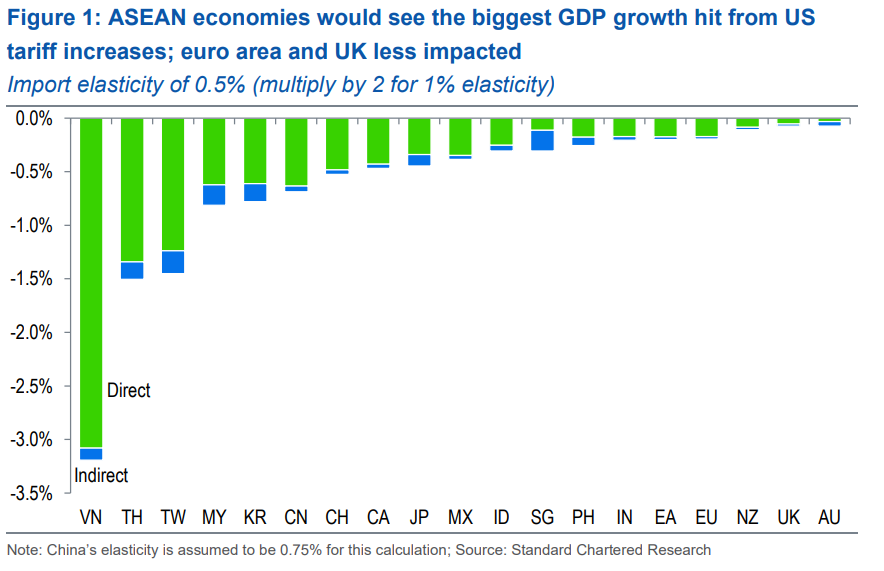
Taking a look at the global impact of the US reciprocal tariffs, Latin America is emerging with "a lighter slap on the wrist," while Asian economies are bearing the biggest burdens, according to analysis by Standard Chartered. Vietnam, Thailand, and Taiwan are those likely to see the biggest impact to their GDP, according to the bank's economists, led by Madhur Jha. Vietnam — singled out as a friend-shoring partner under the Biden administration — has a potential growth cut of over 3 percentage point, while Thailand and Taiwan are at 1.5 each. China (before the latest warnings from Trump Monday) and Malaysia were at 1 percentage point. Standard Chartered's baseline global growth forecast for 2025 is 3.2%, and the announced tariffs suggest a 0.5 percentage point impact, the team wrote. Retaliation by US trade partners could seen that rate "dip further towards the 2.0% mark considered recessionary for the world economy." | 







No comments:
Post a Comment