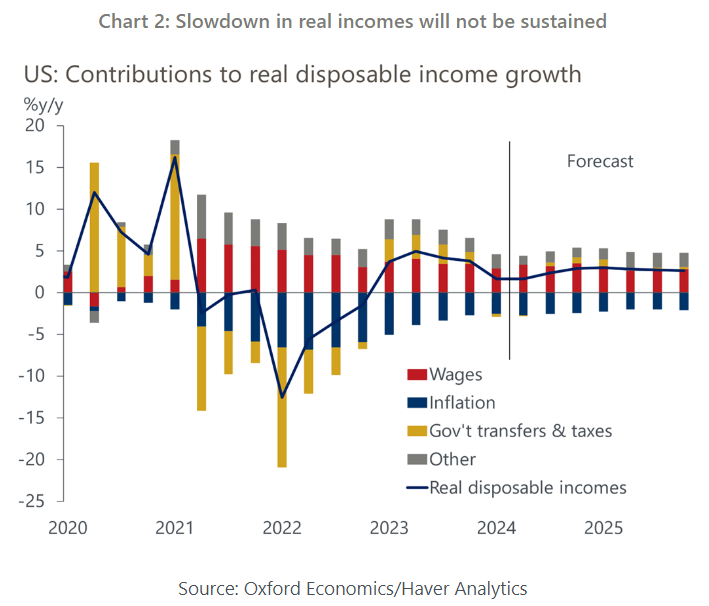
| To get John Authers' newsletter delivered directly to your inbox, sign up here. It's a tense time in America. Last week, a decision by 12 jurors in New York over whether a man was or was not guilty of the crimes of which he had been accused swiftly became a frontal political and cultural conflict. As Donald Trump is the most polarizing figure in the US, that's not surprising. Perhaps harder to predict is the way a statistical debate among economists over how to measure changes in prices has also turned into an intense culture war. Like the Trump trial, views on inflation are so settled that few if any voters will change their minds about it between now and November's election. But it matters for financial markets and for all of us as people. So, let's look first at US inflation and the economy, and then at the political argument about why so many are convinced that it's worse than the official figures say. Latest confirmation came last week with publication of April's personal consumption expenditures deflator, the measure targeted by the Federal Reserve. The rate of change of core PCE fell more or less exactly in line with expectations. The trimmed mean metric produced by the Dallas Fed, which excludes the greatest outliers in either direction, confirmed the decline by dropping below 3%. Disinflation is obviously well advanced, but it's slowing down as it approaches the 2% target: 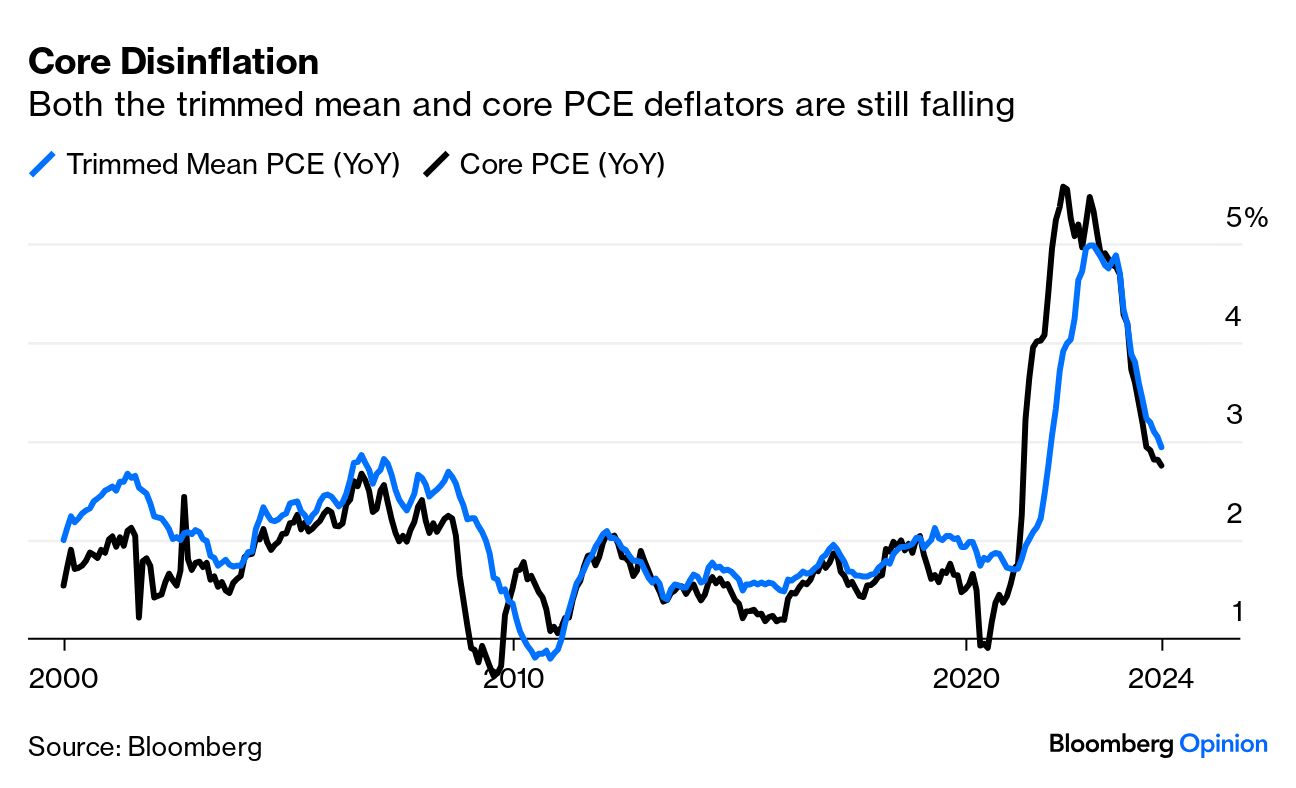 Source: Bloomberg In terms of expectations for the Fed, this barely moved the needle. The possibility of the need for more rate hikes looks remote now, but figures that were exactly what had been predicted gave investors no good reason to adjust forecasts for rate cuts. The odds of a cut before the election (meaning it would have to happen in one of the next three Federal Open Market Committee meetings) are still at only about 60%. It's a little surprising rate expectations didn't move more, as there was more data to suggest that it was getting just a little easier for the Fed to cut. As measured by the University of Michigan for the second consecutive month, consumers' expectations for inflation over the next five to 10 years stood at exactly 3%, the top range of the Fed's target. These expectations have had a strong tendency in the past to exaggerate the inflation that lies ahead, so this constitutes reassuring evidence that most people aren't basing their decisions on an assumption of higher price rises forever: 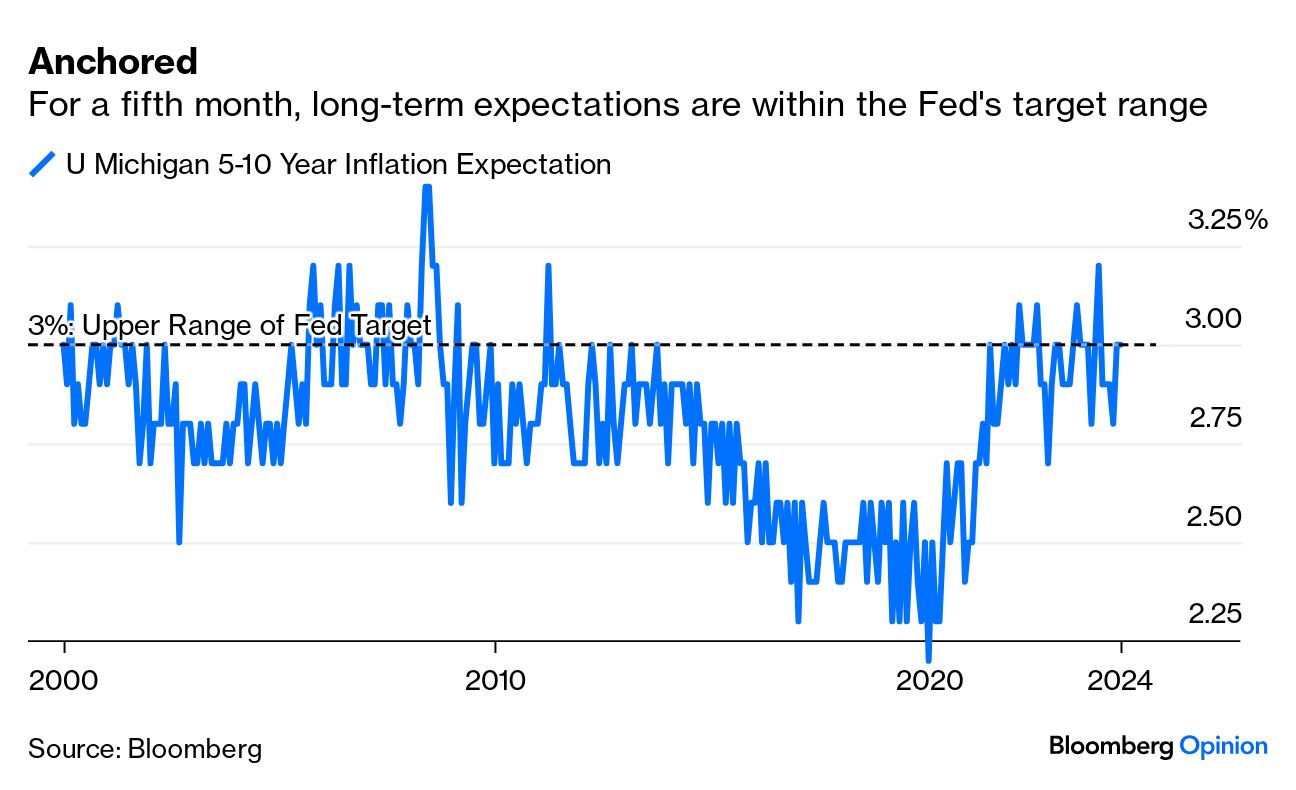 Source: Bloomberg The housing market is directly affected by monetary policy via mortgage rates, and is also showing signs of slowing down after a period of rising prices. That is good news for the Fed, as shelter inflation has been obdurately high. Purchases of new houses dropped by far more than expected last month: 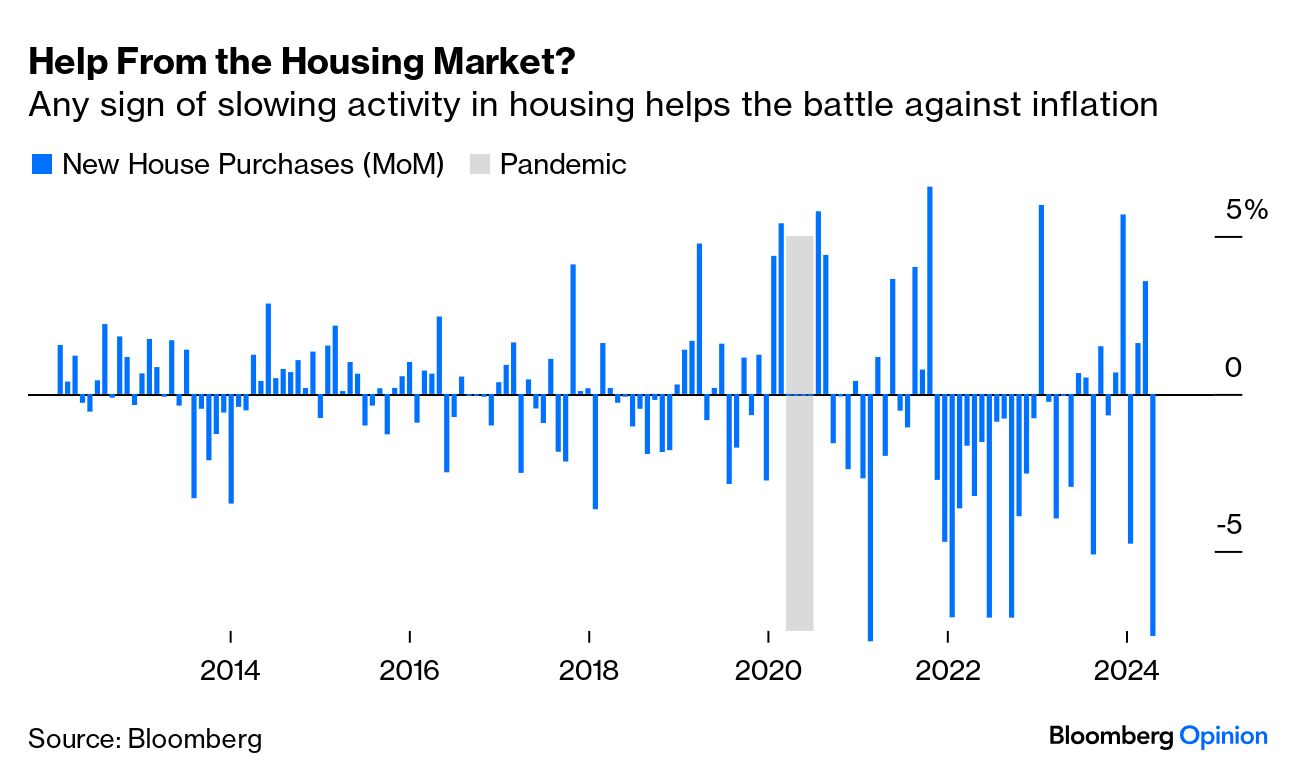 Source: Bloomberg Put all of this together with news that consumer spending is beginning to tail off, and the risks of overheating seem lower than a month ago, while the chances of the hoped-for soft landing look a little better. But, of course, that's not how most people see it. Now for the thornier part. A majority of Americans are convinced that inflation is higher than the official data say. Points of Return explored why this might be last week, and I was also able to cover it in more detail in the Remarks column for Bloomberg BusinessWeek. The core (pun intended) of my argument in that piece concerned the way the inflationary burden fell. Inequality has been deepening in the US for decades. The less money you have, the greater the problem caused by price rises. And inflation has been worst in areas that take a big bite out of low-income people's budget. To start, there is what I call "anti-core inflation," which tracks the combined rise of food and energy prices, the two elements excluded from the core number of most interest to politicians. Bloomberg Opinion's data editor Carolyn Silverman has calculated the course of food+energy inflation back to 1958, using the relative weights that they were given over time. (Both tend to take a smaller portion of consumers' budgets than they used to, a symptom of growing prosperity.) This is what has happened to anti-core inflation since the indexes' inception: 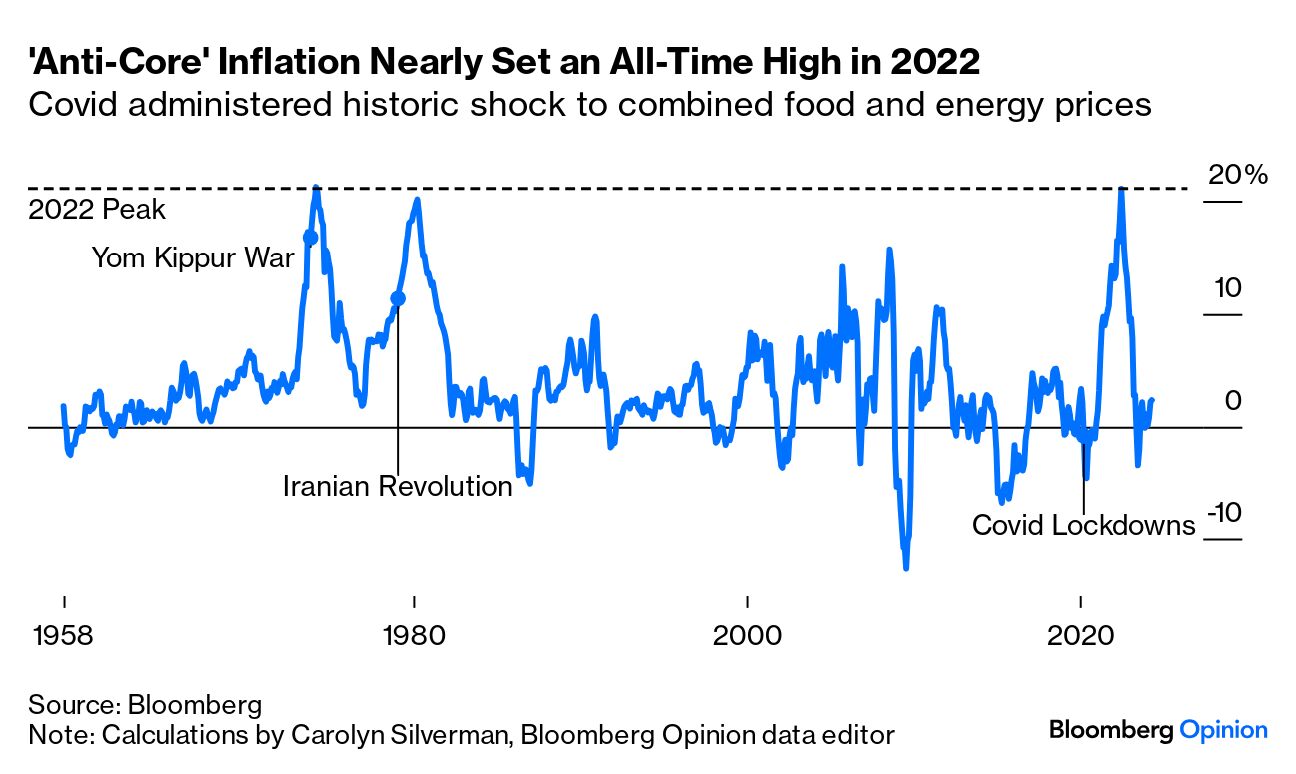 Source: Bloomberg Judged this way, these essentials have just endured their biggest price shock in more than four decades. The figure peaked in 2022 at a rate infinitesimally below its record after the 1973 Yom Kippur war led to an oil embargo. The only other remotely comparable incident came with the hit to oil supply after the 1979 Iranian revolution. There's a good reason that central bankers look at a core measure that excludes food and energy, because this focuses them on the areas over which they have some control. But high anti-core inflation shows why some find this offensive. Further, it's been such a long time since a major shock that there's no folk memory of what tends to happen next. Anti-core inflation briefly went negative last year and is now barely above zero, but it hasn't gone into the kind of massive deflation that would be needed to bring food and energy prices back to where they were before the pandemic. History suggests that was never going to happen; but the pain created by a sharp upward shift in the price of essentials is real. There's further evidence that inflation has disproportionately hurt the poorest if we look beyond the anti-core to businesses that provide goods cheaply to the less well-off. Last week, McDonald's went to the lengths of publishing a statement asserting that the restaurant chain provided "meaningful value" to customers, following allegations that the price of a Big Mac had more than doubled since the pandemic. Meanwhile, Walgreens, a giant on US main streets operating pharmacies and selling personal goods, announced a range of price cuts, saying it understood that "our customers are under financial strain and struggle to purchase everyday essentials." Both companies specialize in catering to the less well-off, and plainly know that their customers think prices are too high. If we look at the level of the official CPI price indexes for products sold at Walgreens, and for fast food, we see why customers feel this way. Prices of bathroom products had stayed stable since this sub-division was added to the CPI in 1998, but suddenly took off in the last year. As for meals and snacks, they had inflated very steadily and predictably until also taking a sudden move upward. In both cases, the perception that prices are higher than they used to be, and that something unusual has happened, is fully justified by the data: 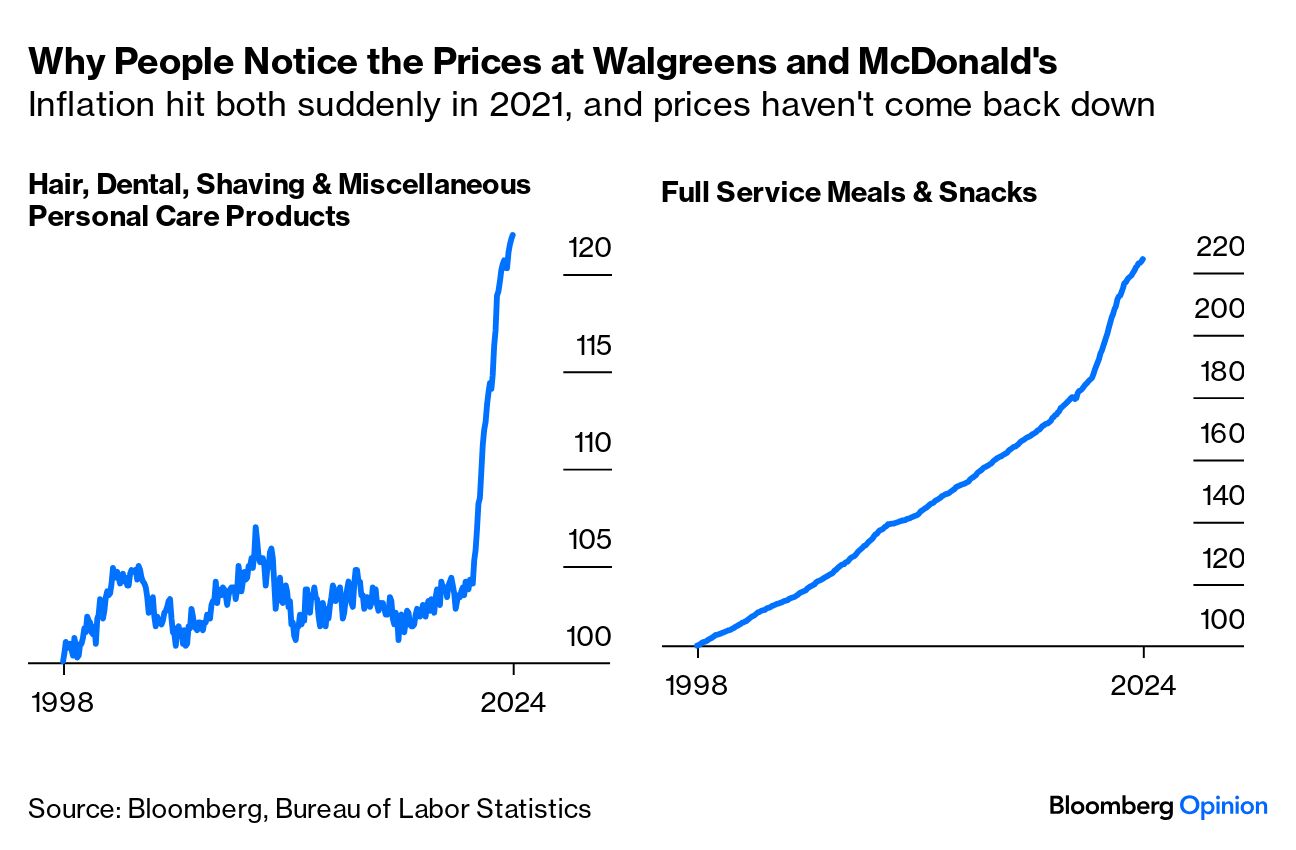 Source: Bloomberg, Bureau of Labor Statistics Viewing them in year-over-year terms, the spike looks even more dramatic, particularly for the stuff on sale at Walgreens. And while inflation rates for both have come down sharply, it's noticeable that both remain above 3%. Inflation is still noticeably higher than recent experience: 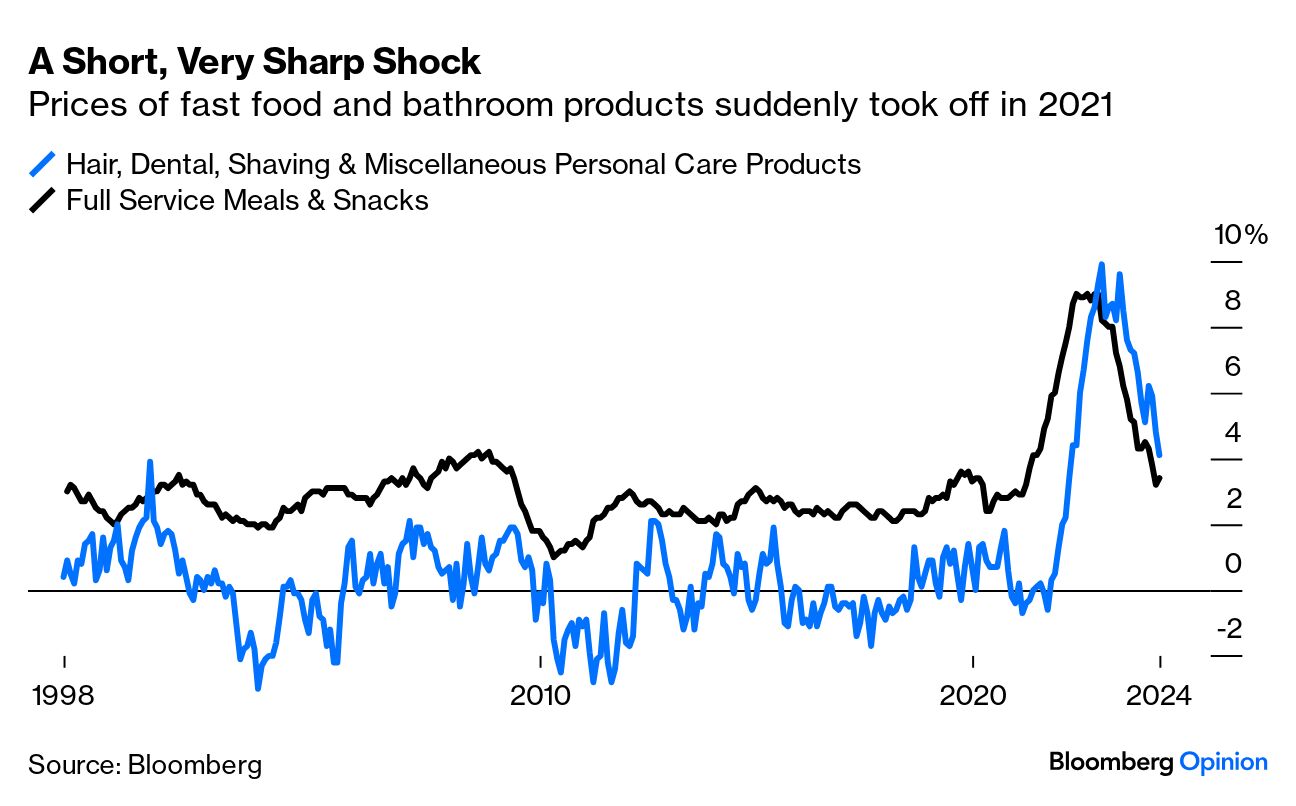 Source: Bloomberg This adds to the evidence that lived experience of inflation is a serious problem for many people, even though the overall numbers are less severe. Both can be true simultaneously. It shouldn't matter that prices stay at a higher level if wages rise to join them. Measuring average wages is as contentious as gauging inflation. But the Atlanta Fed's Wage Tracker index for low-skilled workers suggests that the low-paid found it steadily easier to afford the basics they would buy at Walgreens — until recently. Wages haven't risen enough to catch up: 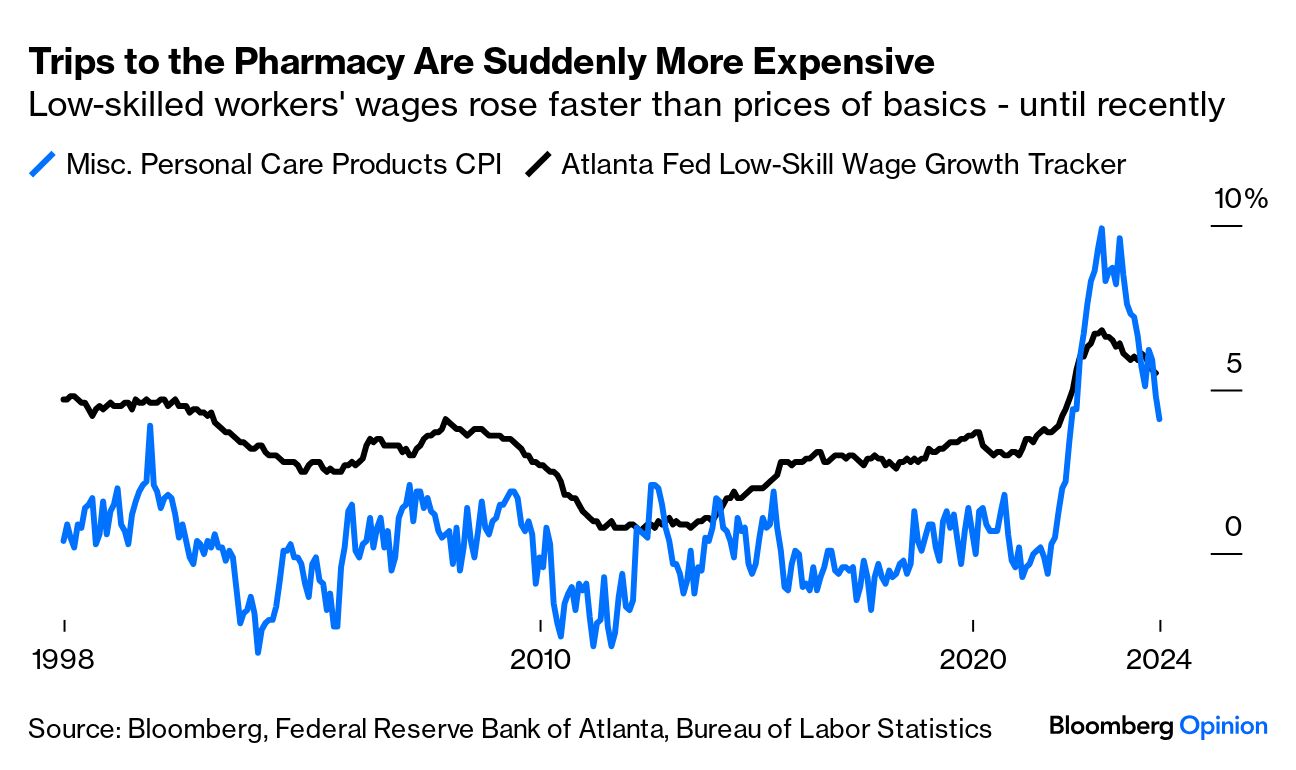 Source: Bloomberg, Federal Reserve Bank of Atlanta, Bureau of Labor Statistics The Atlanta Fed data only go back to 1998. However, the official figures for average nonsupervisory wages (capturing the bulk of the population that doesn't get bonuses or restricted stock) in average earnings go back 60 years, and offer a reasonable measure of the impact higher prices are having. If we take the food and energy CPI index levels at that point and divide them by nonsupervisory earnings, we get a measure of how the weight that these essentials exert on a pay packet has changed over time. Here it is: 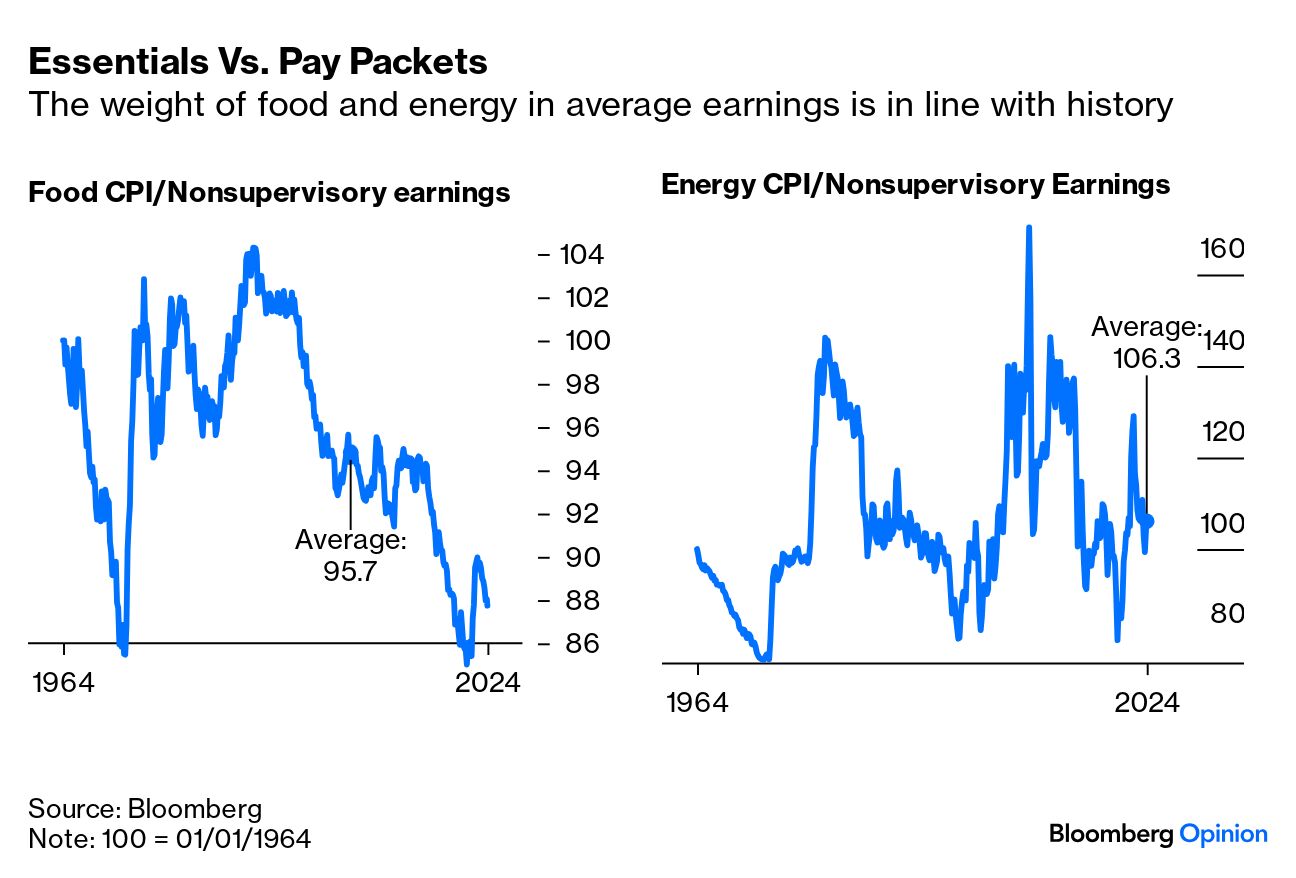 Source: Bloomberg During the pandemic, food took the biggest leap as a proportion of earnings in many decades. That share is now declining, and has always been well below the average for the last 60 years. As for the highly volatile energy index, its ratio to wages is now at exactly its average for that period. It was significantly higher in 2022 — but always well below the high set during the spike in oil prices that preceded the Global Financial Crisis in 2008. So, once earnings are taken into account, the food price spike is obviously painful and still not totally remedied — but in historical terms, this isn't as horrific as it might appear. Oxford Economics provides a handy guide to the impacts of inflation and earnings on disposable incomes. For a few quarters, inflation ate up all the gains in earnings, but that is now over: If the economy does execute a soft landing, and unemployment stays contained, then another year or two of the pandemic price shock might no longer rankle. But that will take time; there's no way this could happen in the remaining five months before before the election. The disruption is and will remain a big negative for Biden. But with cultural issues so dominant, his campaign might just find a way to win despite this. That's my best attempt to explain the divide between perception and data. Others are offering their own. The Washington Post's editorial board shows that the cumulative rise in prices under Biden has been the greatest since George H.W. Bush. Several presidents oversaw greater inflation but the difference this time is that people have had a generation to get used to controlled and subdued price rises. This shock felt very much greater because of that. In The New York Times, two former Bloomberg colleagues weighed in: Jeanna Smialek asked a range of contacts "why people are so down about the economy," while Peter Coy averred that Americans "are not completely stupid about inflation." Bloomberg Opinion colleague Tyler Cowen suggests that the best books to guide you in business aren't necessarily about business, but rather something you know and understand. He, like me, is fascinated by The Beatles. Even books that don't try to treat them as a business give strong lessons as to what helps (a really good manager and an innovative popular product are helpful), and what can go wrong, as in the relationship between John and Paul. Biographies are also crammed with insights. If you ever have the time to wade through the four completed volumes of Robert Caro's biography of Lyndon Johnson (he still hasn't got as far as Vietnam), you will learn so much about how to succeed, and how things can fail. Ditto for sports books, and not just Michael Lewis's Moneyball (although particularly that one). I find myself reading more and more biographies and non-fiction, and less on the stuff I write about; it seems Tyler is the same, and that we might be on to something. Reading broadens the mind! Have a great week everyone.
Like Bloomberg's Points of Return? Subscribe for unlimited access to trusted, data-based journalism in 120 countries around the world and gain expert analysis from exclusive daily newsletters, The Bloomberg Open and The Bloomberg Close. More From Bloomberg Opinion: - Andreas Kluth: Biden Is Reacting, Not Leading, on Ukraine and Gaza
- Noah Feldman: Why Trump's Lies Didn't Work in a Courtroom
- Andy Mukherjee: India's Exit Polls May Be More Noise Than Signal
Want more Bloomberg Opinion? OPIN <GO>. Or you can subscribe to our daily newsletter. | 








No comments:
Post a Comment