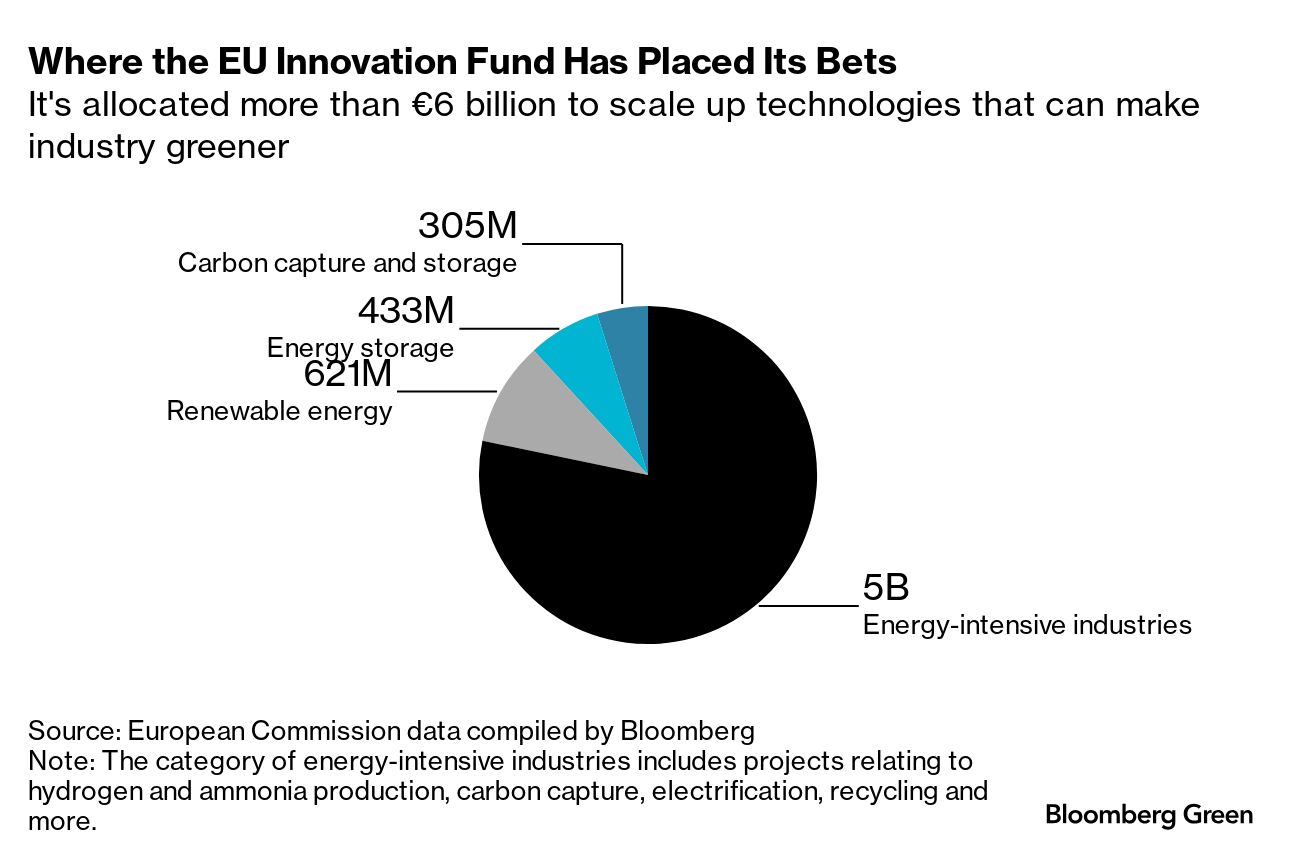
| By Will Mathis and John Ainger A solar panel manufacturer that's laying off workers. A battery maker that spurned Europe for American subsidies. A green hydrogen project stalled for lack of electricity. These are a handful of the early results from the European Union's Innovation Fund, a €40 billion ($43 billion) investment vehicle at the core of Europe's plans to overhaul its economy to be zero-carbon by the middle of the century. It's also part of the EU's counter to the US Inflation Reduction Act: Officials hope the subsidies will keep key industries from decamping overseas. While the fund is still fairly new and backs dozens of projects, including the world's first major green steel plant, some of them — especially in the manufacturing and hydrogen sectors — have struggled to get off the ground.  Collage: Steph Davidson, Getty The Innovation Fund is one of the "must-succeed" programs to ensure that new technologies can quickly play a major role in bringing down EU emissions, according to Marcus Ferdinand, chief analytics officer at Oslo-based research firm Veyt. If its early stumbles turn out to be widespread trends, that will be a worrying sign for the bloc's ability to hit its 2040 climate targets. Since it was launched four years ago, the fund has allocated over €6 billion to scaling up clean technologies, such as capturing CO2 from some of Europe's biggest polluters, like French industrial gas giant Air Liquide SA and Swiss cement maker Holcim Ltd. It backs major energy producers such as Shell Plc and German utility RWE AG in their efforts to produce hydrogen. And it supports large-scale plants that make solar panel equipment, batteries and other renewable energy technologies. Manufacturing projects are among those that have faced the most difficulty. The fund has given out at least three quarters of a billion euros to manufacturers, half of whom have announced plans to shut down operations, lay off staff or discontinue the projects completely, according to an analysis of project data by Bloomberg Green. Kurt Vandenberghe, director general for climate at the European Commission, said the EU anticipated that some of its bets wouldn't work out. The fund is for investing "in the novel, innovative activities of the future," Vandenberghe said. "This means that not all projects will necessarily go to their end, because there's a fair degree of risk. Otherwise we shouldn't do it, if the market is taking this forward on its own." And bad bets don't necessarily mean that a lot of money was wasted. Funding is paid out in phases. Those that don't make a final investment decision don't receive any funding at all. But it still means valuable time lost for decarbonization — and an erosion of Europe's competitive advantage if companies leave. Europe's green manufacturers face the lure of attractive US subsidies on the one hand and competition from cheap Chinese products on the other. Swiss solar-panel maker Meyer Burger Technology AG got €200 million to build new manufacturing facilities in Germany and Spain. Since then, the company has announced plans to shut a manufacturing facility in Germany as it pivots operations to the US. The company is in talks with the commission about its options, according to a spokesperson. "The European Union must guarantee a level playing field for its domestic solar industry by restricting dumping and product manufactured with forced labor," the spokesperson said by email. "Without it — as of today — production of solar modules does not make economic sense" in Europe. Hydrogen projects account for more than a quarter of the money awarded by the Innovation Fund so far. But the technology isn't panning out to be as economically feasible as once thought. Green hydrogen is much more expensive than the kind commonly used today that's produced with natural gas. Projects meant to scale the industry up and bring down costs have faced trials. One was a plan by a division of German utility Uniper SE to produce green hydrogen at a site on the outskirts of Rotterdam. In many ways it's an ideal location, close to major industrial users and right on the coast, giving it easy access to the growing fleet of offshore wind farms in the Dutch North Sea. But soaring costs in recent years for electricity, labor and financing have made green hydrogen even pricier, making it difficult to attract potential customers. "It is too expensive at the moment," said Dyonne Rietveld, managing director for Uniper in the Netherlands. "Interest rates and the costs of grid-connection fees and the risk profile of power purchase agreements are killing investment decisions." Read the full story here. | 








No comments:
Post a Comment