| Read in browser | ||||||||||||||


Welcome back to Pursuits Weekly, our look at the world’s biggest culture stories, as well as ideas and recommendations around travel, dining and art. Sign up here to get this newsletter every Saturday in your inbox. History as amenity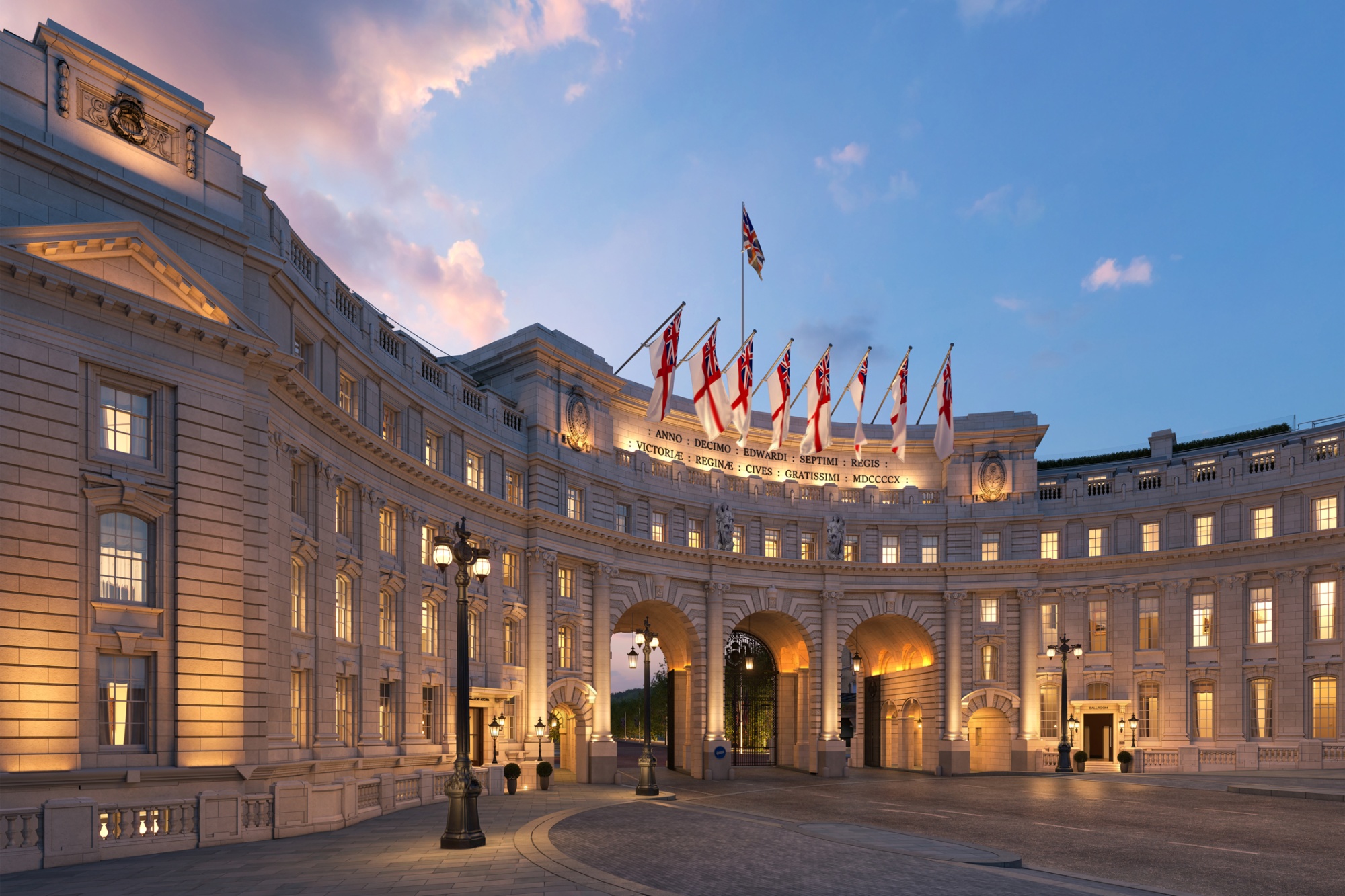
Admiralty Arch, formerly government offices, will soon be reborn as Waldorf Astoria London.
Source: Waldorf Astoria
The War Office, built in 1906 on Whitehall in London, featured the Army Council Room on its second floor. The D-Day landings were planned there. Today, renamed the Churchill Suite, it’s one of the swankiest accommodations in the Raffles Hotel, with an asking price in the neighborhood of $25,000 per night. For that kind of money you don’t just get 39-foot ceilings and 24-hour butler service. You also get a story. The Raffles is one of many grand new London hotels being converted from government use. “Given the disdain so many of us feel for present-day politics, there can be a kind of illicit thrill that comes from being granted permission to play in these places,” Raffles guest John O’Ceallaigh tells Sarah Rappaport. Old government buildings often don’t work well as offices any more, not least because civil servants tend to blanche at upgrade costs. The Old War Office, for instance, was purchased for for £350 million in 2016 — a number that pales in comparison to its £1.4 billion redevelopment bill. 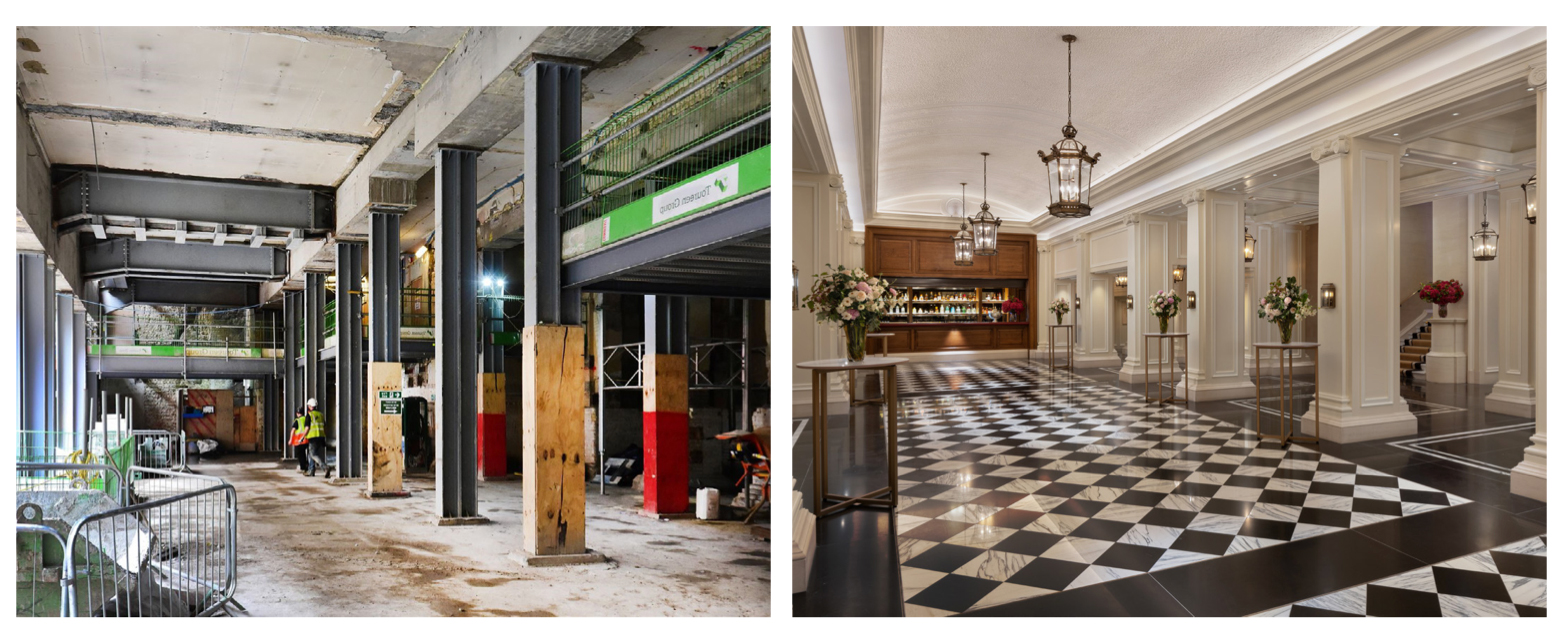
The Old War Office was gutted before being reborn.
Source: EPR Architects
The story is international — ex-ministries in Paris and Lisbon and the former Rome headquarters of Italy’s central bank have reopened as hotels, and I adore the Ned Doha, which used to be Qatar’s Ministry of the Interior — but London has more such adaptations than any other city. The Chancery Rosewood occupies the former US Embassy, NoMad London can be found in a former magistrates court, and later this year Admiralty Arch, a grand neoclassical building and Edwardian gateway, will reopen as a Waldorf Astoria. These hotels “have turned institutional history into a selling point,” writes Rappaport. And they do seem to be good at finding buyers, even when prices head north of $1,000 a night. As Cristina Balekjian, director of hospitality analytics at CoStar, puts it: “When you have that history, it makes the hotel feel more special.” By the numbers
Photographer: Philip Vukelich for Bloomberg
$350 The price of a pair of silver-foil running shorts from Satisfy, a brand that adds holes to its $140 T-shirts and calls it MothTech. Lily Meier finds the runners who are pushing the limit of how much it’s possible to spend on running gear. $1,900 The price of Samsung’s Z Fold 8, a foldable phone that, Chris Welch writes, excites him every time he picks it up. His conclusion: “Between its feathery weight and its out-of-the-ordinary shape, this is a fun device to use.” 700 million The number of Chinese microdrama viewers. The format is now going global, with series like the 60-episode Fated to My Forbidden Alpha, about a young woman torn between two rival werewolf clans, available on Peacock in the US. It stars Kasey Esser, who tells Yang Yang and Sohee Kim that he didn’t know what it was. “You had to download an app, pay per episode — it seemed like a lot of friction.” How to speak expensively
Illustration by SMLXL
Brandon Presser, a veteran of hundreds of luxury hotels, has discerned what he calls Luxury Voice — a whole new lexicon of buzzwords, delivered slowly and quietly. And yes it’s a deliberate strategy: “Tone, pacing and delivery signal confidence and discretion,” Tom Rowntree, vice president for global luxury brands at IHG Hotels & Resorts, tells him. Hilton called it “hushpitality” in its 2026 trend report, which has to be the worst travel-related portmanteau since “bleisure.” Jonah Berger, of the Wharton School of the University of Pennsylvania, has even managed to quantify the effect. Staff in customer-facing roles at luxury hotels, retail and dining reduce their rate of speaking by more than 10% from everyday talking speeds, he found. Then there are the word transformations. A “room” becomes a “sanctuary.” A “stay” becomes a “journey.” A “masseuse” becomes a “therapist.” A friend of mine just received a reservation confirmation from a two-star restaurant in Spain informing her that “at Mugaritz, language is very present and concepts serve as gates to creation.” Do let me know if you have a clue what that might mean. Most art is unwanted
The Great Art Transfer is upon us.
Illustration by David Huang for Bloomberg
Beware! The sheer tonnage of boomer-owned art is vast, and the total demand for it doesn’t come close to the amount of supply that’s about to arrive. Just looking at items that can be sold for cash on the secondary market, which is a tiny minority of all the art out there, roughly $1 trillion of art is expected to change hands just in the next 10 years, per Deloitte. No one is ready, least of all the baby boomers themselves, the vast majority of whom have made no plans for what’s going to happen to all of their art. Will a museum want it? Probably not. “There is an avalanche coming,” Michael Darling, who founded a company called Museum Exchange, told me. “It’s going to be difficult to metabolize all of that art into museums and nonprofits.” One Very Specific Recommendation: The maitake skewer at Oriana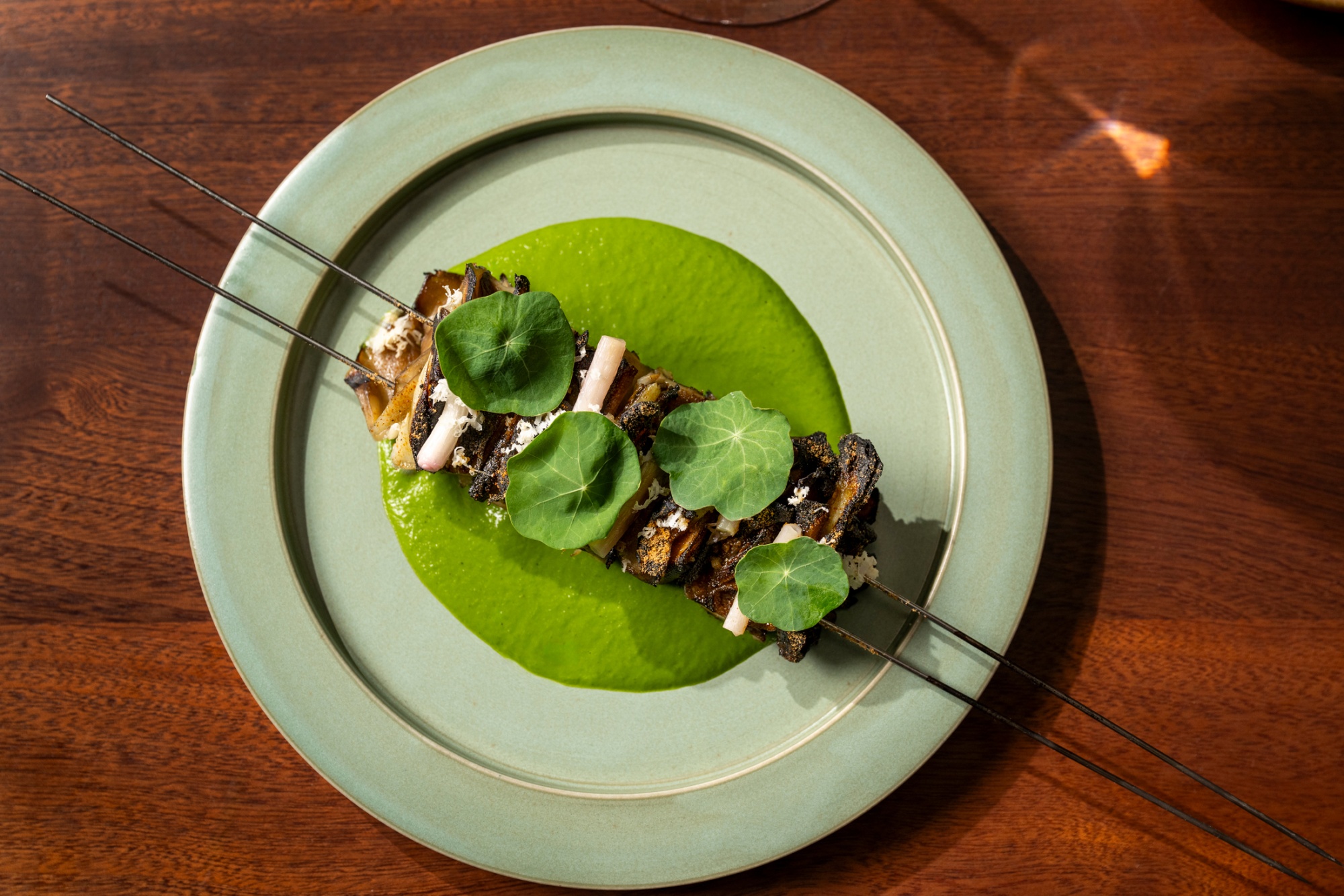
It’s more powerful than it looks.
Photographer: Evan Sung
The most interesting innovation at Oriana, a New York restaurant owned by tech investor Kevin Ryan, is the list of 45 wines available by the 375ml carafe, allowing diners to drink a much broader range of wines than is normally available by the glass without having to commit to buying a whole bottle. (The bottle is presented at the table, either empty or half-empty, depending on whether someone else has ordered a carafe of the same wine before you.) The most interesting dish, on the other hand, is a $26 maitake skewer, the exemplar of what Grub Street’s Matthew Schneier calls the restaurant’s “microscaled intensity.” The skewer actually contains two different types of mushroom, steamed until they are just cooked, broken into small pieces and skewered with spring onion. The skewers are then charred over a wood-fired grill before they’re finished with a combination of pickled ramps and — crucially — fresh horseradish. Finally, they’re plated on top of a romesco sauce made with Marcona almonds. Chef Andy Quinn has his own theory of why the dish works. “It pretty much presents as a meaty, grilled skewer,” he says, “but in fact it’s totally vegan.” My theory is slightly different: I just love the outsized punch delivered by something that could easily be mistaken for a dainty appetizer. If you were on the fence about whether to try the restaurant out, these mushrooms should make the decision easy. New for subscribers: Free article gifting. Bloomberg.com subscribers can now gift up to five free articles a month to anyone you want. Just look for the “Gift this article” button on stories. (Not a subscriber? Unlock unlimited access and sign up here.) More from Bloomberg Ideas & Culture
We’re improving your newsletter experience and we’d love your feedback. If something looks off, help us fine-tune your experience by reporting it here. Follow Us
You received this message because you are subscribed to Bloomberg’s Bloomberg Pursuits newsletter. If a friend forwarded you this message, sign up here to get it in your inbox.
|
Saturday, August 1, 2026
Ministry of Extravagance





Subscribe to:
Post Comments (Atom)
Today at 2PM the full picture hits the screen.
15 months. Every number. The watchlist goes out tonight. ͏ ͏ ͏ ͏ ͏ ͏ ͏ ͏ ͏ ͏ ͏ ͏ ͏ ͏ ͏ ͏ ͏ ͏ ͏ ͏ ͏ ͏ ͏ ͏ ͏ ͏ ͏ ...

-
Revolutionary Stem Cell & PRP —Start Your Journey Today ...


No comments:
Post a Comment