| Standing before an annual gathering of climate experts and emergency officials in Mumbai earlier this month, Kamal Kishore, a bureaucrat at India's National Disaster Management Authority, made an impassioned address urging solutions that will prevent the loss of life and livelihoods as South Asia sees more frequent — and brutal — heat waves. "The coming years and decades are not going to be pretty for India," Kishore told the wonkish crowd at the Indian Institute of Technology Bombay. "There is no disagreement on that." Home to almost 2 billion people, South Asia is courting climate catastrophe and is perhaps one of the least equipped regions in the world to deal with global warming. India suffered its hottest March in more than a century last year, with severe heat waves ruining harvests and causing widespread power blackouts. Already, spring is being squeezed by the onset of India's summer, a typically fierce season here whose start is steadily creeping forward. Days after Kishore's warning, the India Meteorological Department issued its first heat warning for 2023 — weeks earlier than we saw last year. The number of Indian states hit by such waves since 2015 more than doubled to 23 by 2020, according to the NDMA. Few Indians can hide from the dangerous impact of extreme temperatures. Less than 10% of the population has access to air conditioning, and many labor outdoors with limited shelter. And even as India expands access to electricity and artificial cooling, that's only increasing demand for its main power source: coal. 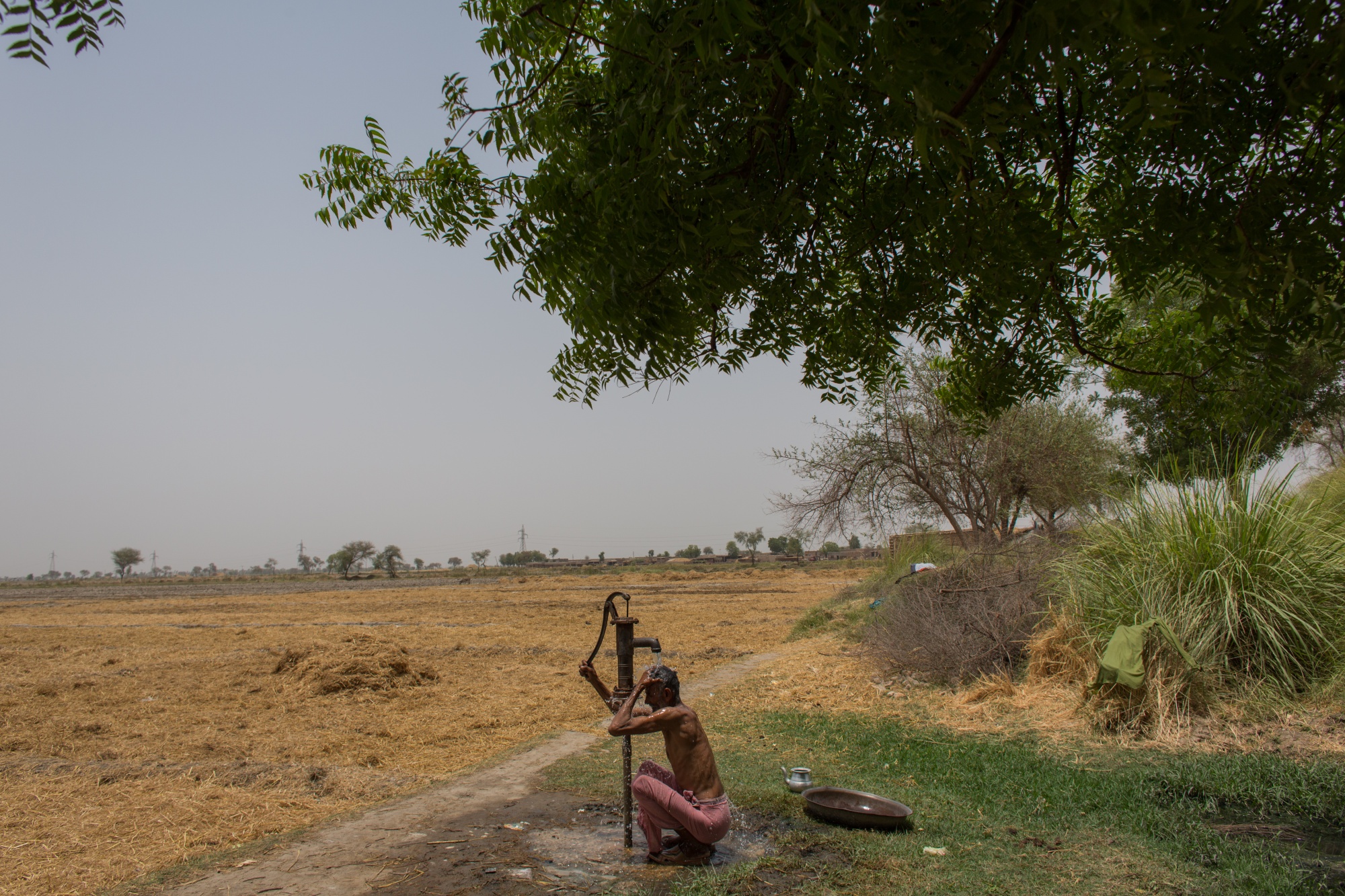 A man bathes under a hand pump during a heat wave in Jacobabad, Pakistan, on Friday, May 27, 2022. Photographer: Asim Hafeez/Bloomberg "I can assure you that we cannot air condition our way through the heat problem," Kishore said. His agency estimates mortality levels from heat waves have fallen sharply, down from 2,040 in 2015 to just four people five years later. That's partly due to 2020's Covid lockdown measures, along with public awareness campaigns, medical training and new heat action plans. But Kishore also cast doubt on India's patchy mortality statistics. Most people die at home in India, and a great many deaths — let alone the causes — go unrecorded. The debate over death data clouds arguably a more important question: Will India's planning protect its citizens from the ravages of a rapidly rising temperatures? According to one study, climate change will kill 1.5 million Indians each year by 2100. Kishore voiced his own concerns that the more than 120 local authorities who are said to have drawn up heat action plans may see them as little more than an exercise in checking a box. Case in point: When climate researchers Aditya Valiathan Pillai and Chandni Singh dug more deeply, they could only track down 37 such blueprints. Analyzing those, they found that just two plans explicitly identified how they would be financed. And because India doesn't legally recognize heat waves as disasters, that makes emergency funding scarce. "All the heat action plans are preparing for yesterday or today's heat," Singh warned that same gathering here in Mumbai. "If we are adapting to 2022's Delhi temperatures, we're not really preparing." —Chris Kay | 







No comments:
Post a Comment