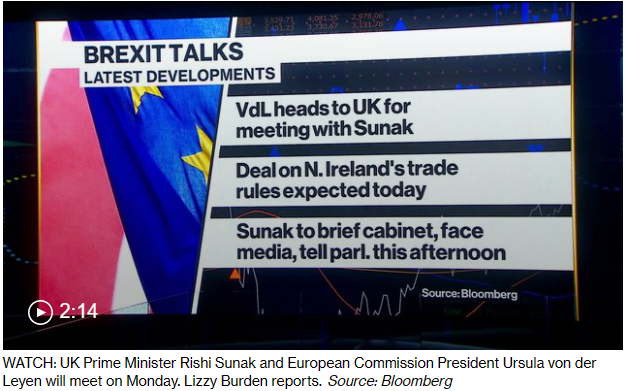
| Three years after the UK left the European Union, London and Brussels appear close to a deal on trade arrangements involving Northern Ireland that could allow them to reset relations. British Prime Minister Rishi Sunak is expected to announce an agreement today when he meets European Commission President Ursula von der Leyen in Berkshire, where King Charles III's Windsor Castle is situated. Yet he still faces an uphill battle in getting the deal across the line in his own camp. Key reading: Opposition from Northern Ireland's Democratic Unionist Party and some pro-Brexit lawmakers from the governing Conservative Party could derail its implementation. The DUP has refused to engage in a power-sharing administration in protest at how the current protocol creates a de facto border in the Irish Sea. To address such criticism, the agreement will create "green" and "red" customs lanes for goods entering Northern Ireland from the rest of Great Britain, cutting down on checks and paperwork for items that will remain in the UK. It will also seek to clarify the role of the European Court of Justice in potential trade disputes that relate to EU law. Despite the many obstacles ahead, if Sunak is able to win eventual acceptance, the two sides could put the danger of a trade war behind them and focus on other matters such as improving security ties and facing global challenges such as climate change, as well as China's growing clout and Russia's war in Ukraine. Sunak's drive to repair some of the damage Brexit caused with the continent is part of a realization that an isolated UK standing somewhere between the EU and the US is far weaker than one cooperating with its biggest trade partner. It remains to be seen whether his party, which sticks to its mantra that Brexit has made the UK stronger, agrees with that imperative. —Richard Bravo | 







No comments:
Post a Comment