Your Next Job Applicant Isn't RealBy Joel Litman, chief investment officer, Altimetry
 Recruiters are now asking job candidates to point their webcams at a wall outlet... Recruiters are now asking job candidates to point their webcams at a wall outlet...
It's a quick way to tell if someone is actually in the U.S. American plugs look different from the ones used in most other countries. It's also one of the milder tricks hiring managers are using these days. Some employers now scan applicants' faces, check how old their e-mail accounts are, and track where they're logging in from... all before the first interview. The reason for this precaution is AI. Chatbots can write a polished resume in seconds, and deepfakes can put a different face on a video call. One recruiter interviewed a candidate... only to have a different person show up on the first day of work. Research firm Gartner (IT) predicts 1 in 4 job applications will be fake by 2028. And getting fooled is expensive. In 2025, 23% of U.S. companies surveyed by background-check provider Checkr said hiring or identity fraud cost them more than $50,000 in the past year. All that suspicion is creating an opportunity for a company most folks know from the airport. And as we'll explain today, Wall Street is badly underestimating how profitable it could become... Identity-verification company Clear Secure (YOU) is known for saving people time...Members of its CLEAR+ service pay a yearly fee to skip the regular airport security line. They scan their eyes or fingerprints at a kiosk and go straight to screening. Clear now has nearly 44 million members. Revenue grew 27% year over year last quarter, to $278 million. But investors have soured on the stock. Shares have fallen about 31% since late May, partly due to worries that fewer people are flying.
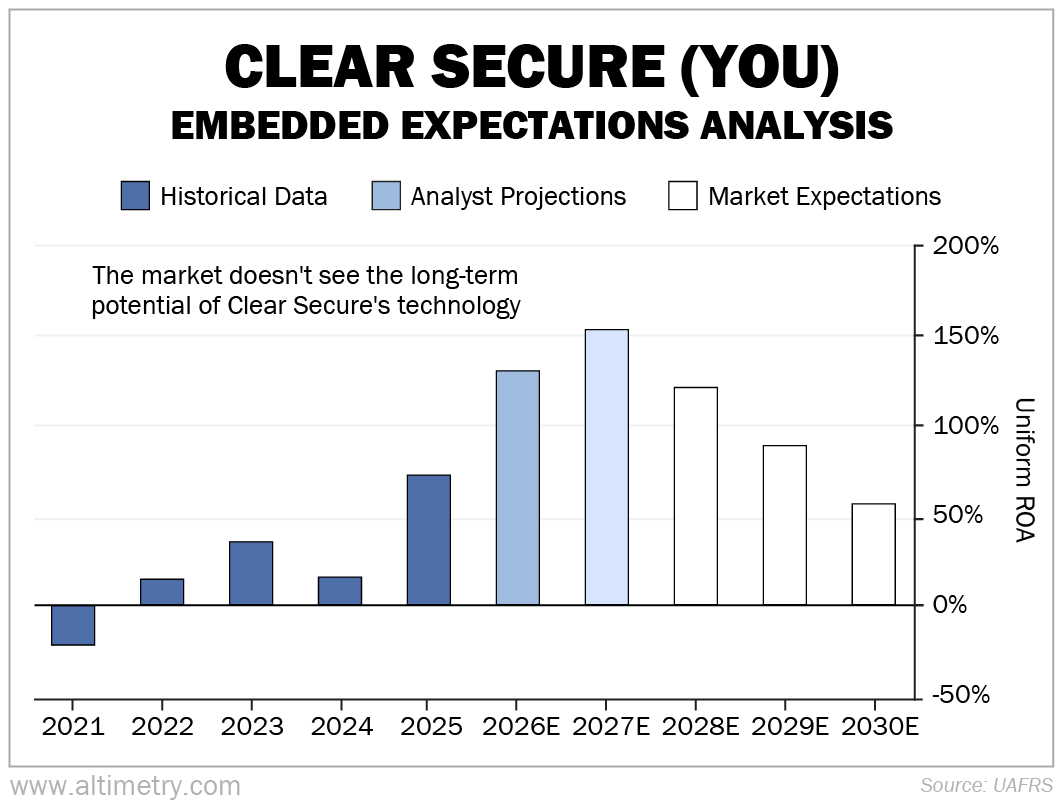
The market is treating Clear like a mere airport tollbooth. It's missing what the company is turning into... The hardest part of Clear's business was always getting people to sign up...Each member hands over a photo ID and biometric data. Clear is then able to confirm if they're real in just seconds. The company has started selling that service to other businesses through CLEAR1, its business identity platform. In 2025, it teamed up with hiring-software firm Greenhouse so job seekers can confirm their identity before an interview. Clear also signed on with the Centers for Medicare & Medicaid Services, the federal agency that runs Medicare, to verify people creating accounts on the Medicare website. CLEAR1 bookings grew about fivefold year over year in the first quarter of this year. In the second quarter, its number of new customer signups and its pipeline of potential deals each jumped more than 50% from the prior quarter. And Clear already paid to build its kiosks and sign up its members. Letting a company like Greenhouse check those identities using Clear's data costs Clear very little extra... so most of each new dollar of revenue becomes profit. That's already showing up in Clear's returns...Uniform Accounting strips out the distortions in standard accounting rules. On that basis, Clear's Uniform return on assets ("ROA") jumped from 16% in 2024 to 72% in 2025. That's 6 times the 12% corporate average. And Wall Street analysts expect even more. They see Uniform ROA climbing to 129% this year and 152% in 2027. But the market is betting Clear's best days are nearly behind it...We can see this through our Embedded Expectations Analysis ("EEA") framework. The EEA starts by looking at a company's current stock price. From there, we can calculate what the market expects from the company's future cash flows. We then compare that with our own cash-flow projections. In short, it tells us how well a company has to perform in the future to be worth what the market is paying for it today. At today's price, investors expect Clear's Uniform ROA to slide back down to 56% by 2030. That would cut returns by nearly two-thirds of what Wall Street expects within the next two years, to below last year's level. Take a look...
The market is pricing in a steep drop in profits... just as Clear is starting to get businesses to pay them for the identity checks it has already completed. Fake applicants may be a headache for job recruiters...But they're a growth market for a company that has already verified the identities of tens of millions of Americans. While each new partner brings in more money, Clear doesn't have to build much to serve that additional customer. To beat the market's expectations, Clear just needs to hold on to most of the gains analysts already see coming. When a company finds a new way to sell something it has already built, profits can grow far faster than sales. So don't judge a business only by the product it's famous for. Look at what else its assets can do. At today's stock price, Clear isn't yet receiving the credit for what it's capable of. Regards, Joel Litman
October 14, 2026
|





No comments:
Post a Comment