Editor's note: The U.S. can fire a missile in minutes. But replacing it can take years. The war with Iran is exposing just how quickly America's stockpiles can disappear during a conflict. That's why Joel Litman, chief investment officer of our corporate affiliate Altimetry, sees defense companies as a long-term opportunity as they replenish the military's arsenal... or keep it well-armed ahead of potential future conflicts.
The Pentagon's Shelves Are Emptying FastBy Joel Litman, chief investment officer, Altimetry
The U.S. spent years stockpiling some of the most sophisticated weapons on Earth... That includes Patriot interceptors, Tomahawk cruise missiles, and Terminal High Altitude Area Defense ("THAAD") interceptors. These high-end weapons are designed for difficult missions – from knocking ballistic missiles out of the sky to striking targets hundreds of miles away. Unfortunately, the war with Iran is showing just how quickly our inventories can vanish. The military has already burned through much of its existing supply of specific missiles. And military planners have been warning for years that a major showdown with China would exhaust important weapons stockpiles in just weeks. So the longer we fight in Iran, the more we're ultimately reducing our arsenal ahead of another possible conflict. That changes the way America needs to think about defense spending... Today, I'll show just how quickly America's most important munitions are being depleted... and explain why rebuilding our inventories could support defense suppliers for years.
America Needs to Rebuild Its ArsenalIt takes years of effort to build up critical weapons supplies. But those supplies can disappear surprisingly fast when demand surges. And today, our munitions stockpiles are dwindling... Estimates suggest the U.S. may have consumed more than half of its Patriot interceptor inventory during the Iran war. America spent much of the past decade steadily accumulating these missiles. Our supply grew 17-fold between 2015 and 2025. Then, in a short period, wartime demand erased a huge portion of that progress. Take a look... 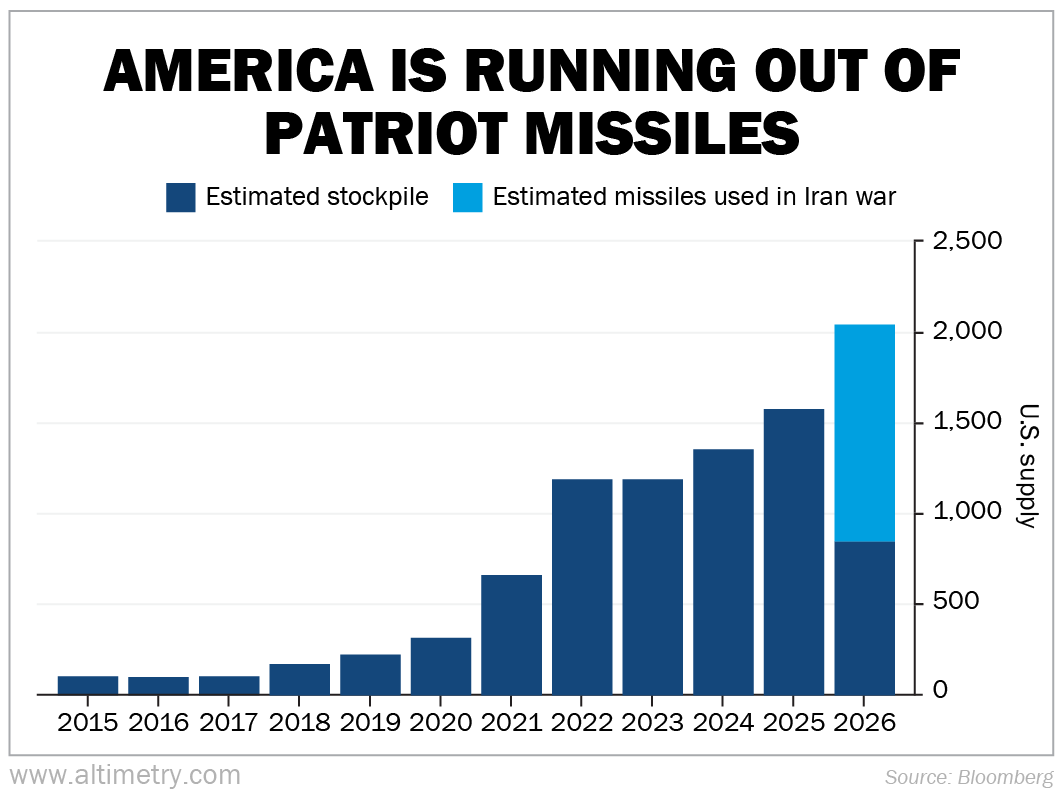
At this point, less than half of last year's inventory remains. And Patriots are only one part of the story. Our military may have also used roughly one-third of its global Tomahawk missile inventory... and around 40% of its THAAD interceptors. Stockpiles of some smaller, newer missiles are in even worse condition. This Missile Shortage Could Fuel Defense StocksA military can absorb heavy usage for a short period... if it can replace what it uses. But that replacement happens on a completely different timeline. These weapons rely on specialized components and tightly controlled manufacturing processes. That means a missile can be used up in minutes... while replacing it can take months or years. For example, replenishing the Patriot inventory is expected to take more than two years. Tomahawk and THAAD stockpiles could remain low for even longer. The issue is, the U.S. needs to stay ahead of its adversaries. If enemy nations believe America is vulnerable, they may be more likely to strike. That creates an unusual kind of demand... Normally, the Pentagon plans ahead to make sure it has enough weapons for future needs. But with its munitions stockpiles quickly dwindling, it needs to plan even further ahead. That's why the Pentagon has already committed billions of dollars to buying more weapons and expanding production. Just last month, it signed a nearly $23 billion contract with Raytheon for more Tomahawk missiles. All told, defense companies now have a better idea of what the Pentagon will need to keep the military armed. They don't have to wait or guess what demand will look like as the government spends years debating how large its defense budget should be. Even if the conflict with Iran ends tomorrow, a significant amount of expensive military hardware has already left the shelves. Replacing it will take years at current rates. That gives defense suppliers more certainty that they'll sign government contracts in the coming months and years. In short, defense companies have plenty of runway left to profit as they work to replenish the weapons we've already used. The rebuilding process has already begun... and it's only going to grow as the U.S. uses up more of its missiles. If you're looking for somewhere to put your money today, defense companies are a good place to start. Regards, Joel Litman
Editor's note: Iran has openly said that America is weaker than it first thought. As other foreign threats look on, the stakes for Washington are real. That's why Joel says President Donald Trump is preparing a dramatic move to reshape America's defense industry... and redirect trillions of dollars of government money. In his "America Unleashed" briefing, Joel explains what he sees coming... and why it could rattle the stock market in the coming days.
|
|
|
|
Further ReadingThe "SaaSpocalypse" sell-off this year was the result of a simple fear: that AI would make software obsolete. But just months later, it seems investors had the story wrong... because the companies supposedly facing extinction are now the ones using AI to improve workflows. The global economy spent decades becoming more interconnected. Now, that process is starting to reverse. Countries want control over their own industries, raw materials, and manufacturing capacity – and they're willing to spend heavily to get it. |
|
|
|
|
|






No comments:
Post a Comment