|
|
TQ Morning Briefing |
New Zealand skipped a hike markets had priced, hours before the Fed decides. SK hynix jumped 11% in Seoul while U.S.-listed hardware suppliers that beat slid. Crude rebuilt its war premium, and diesel didn't follow. |
The Week's First Central Bank Broke From Its Pricing
The Fed decides this afternoon. New Zealand has already shown how much a close hold can move.
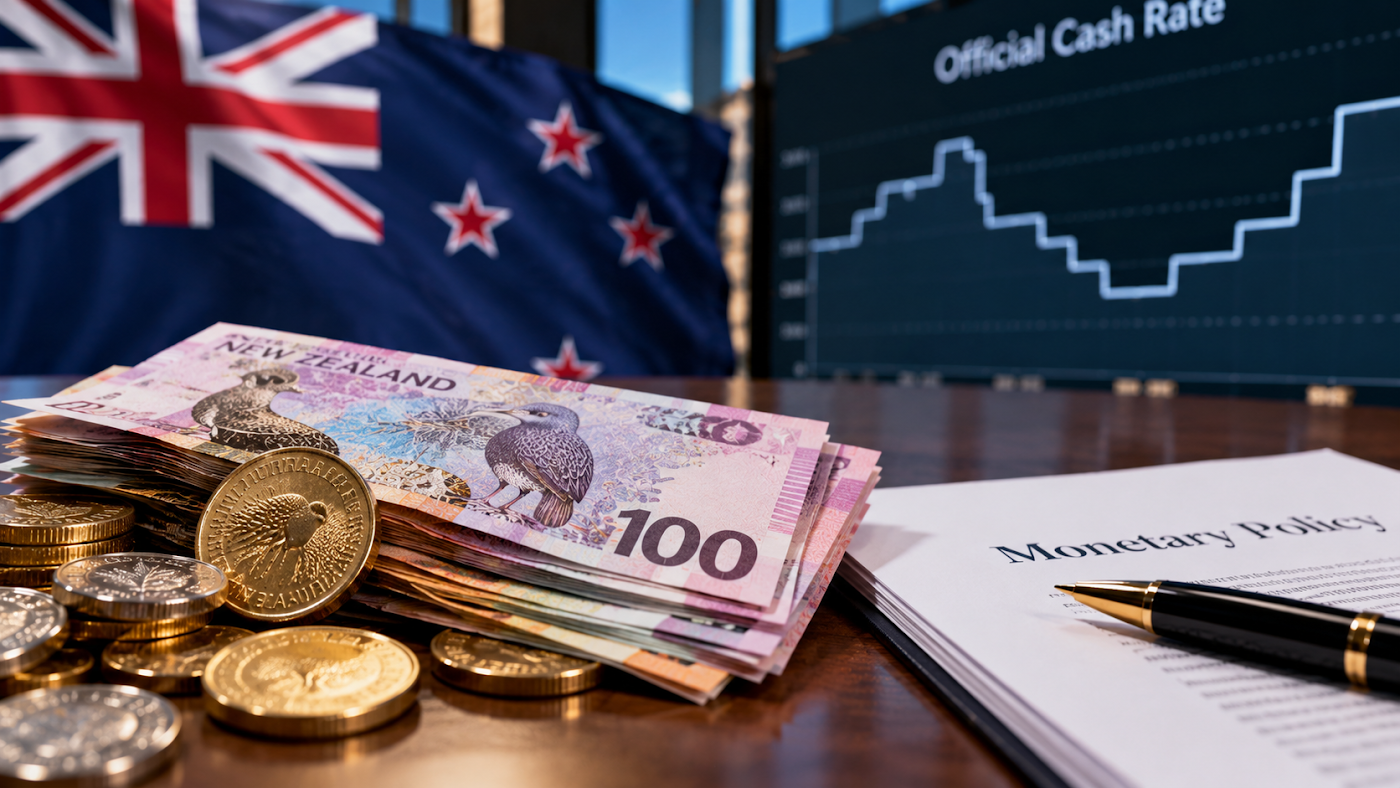
The Reserve Bank of New Zealand held its cash rate at 2.75% on a 4-3 vote. Three members wanted a hike, and markets had priced about 23.5 basis points of one, according to ANZ. When the hike didn't come, the kiwi fell about 75 pips and the two-year swap rate dropped about 13 basis points. The bank still said tighter policy is likely, and a December hike stayed about 80% priced, ANZ said.
Across the Tasman, Australia's monthly inflation rate rose to 4.3%, with fuel prices up 9.4% in September alone.
At home, Kalshi's contract on a Fed hike today slipped to 5 cents. Kalshi's December hike contracts still sum to about 79 cents.
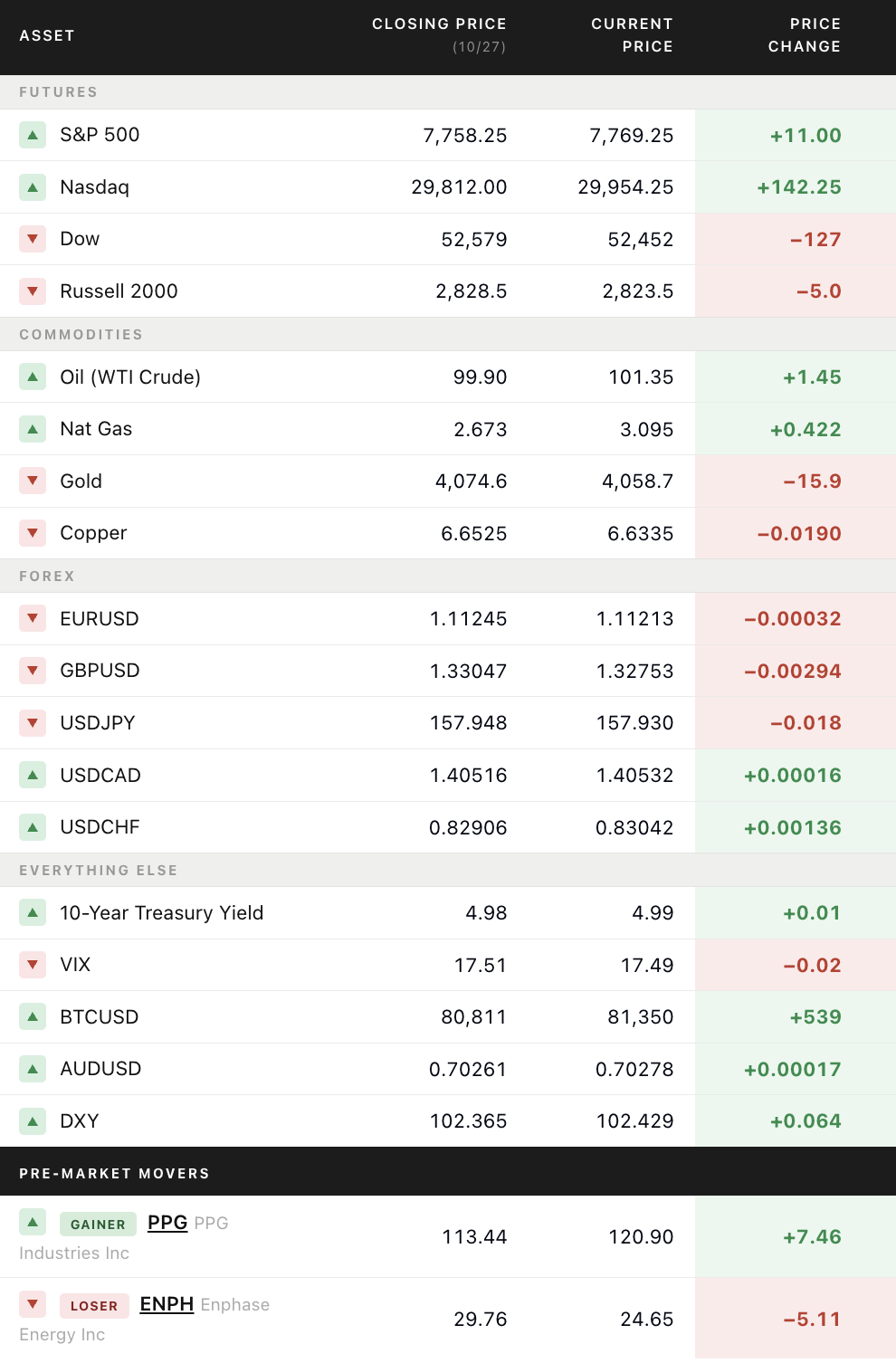
The 10-year last closed at 4.99%, and the VIX sat near 17.5. Bitcoin held near $81,400 after spot bitcoin funds took in about $176 million on Tuesday, a second straight day of inflows.
Market Implication
A hold is not a neutral event when the vote is split and the guidance leans the other way. New Zealand's rates fell on the skipped hike, but the three dissents and the promise of tightening later kept December firmly in play. The Fed carries the same setup into today, with the decision nearly certain and December hike pricing near 79 cents. Any repricing will show up in rates and currencies tied to December, as it did in Wellington, rather than in today's contract.
The SpaceX IPO made Elon Musk the wealthiest man who has ever lived.
Now he's spending it to complete his dynasty...
He's already acquired a $40 billion AI firm and a $1 billion turbine company.
But a handful of companies still stand between him and total control of the space economy.
Click here to see why early investors could walk away with a fortune.
WHAT ACTUALLY MOVED MARKETS
Seoul Paid for Memory. New York Graded the Slope.
SK hynix (SKHY) beat forecasts for operating profit by about $4.7 billion, at an 80% margin. Its shares rose 10.9% in Seoul, and the Kospi jumped 6.6%. The U.S. line was indicated about 8% higher.
U.S.-listed suppliers that also beat got a colder reception. The drops appeared to track whether growth was speeding up or slowing down.
NXP (NXPI) grew 8% from the prior quarter and guided to about 2%. It was indicated about 7% lower. Teradyne (TER) reported record memory-test revenue, but its fourth-quarter midpoint is roughly flat with the third. It was down about 3%.
Seagate (STX) guided next-quarter revenue about 13% above the quarter it just reported, with earnings of $9.20 a share against $8.61 expected. A pre-dawn discount of nearly 4% had narrowed to about 1%.
Microsoft (MSFT) and Alphabet (GOOGL) report after the close.
Structural Setup
The overnight sort paid for acceleration, not for the size of the beat. Seagate, the only one guiding to a clear step-up, held up best. NXP, whose sequential growth slows most, from 8% to about 2%, fell hardest. A beat paired with a plateau is trading like a ceiling. If Microsoft and Alphabet show spending still climbing, those flat guides start to look like pauses.
A Change of Venue Outearned Two Beats
General Motors (GM) added about $3.6 billion in market value on Tuesday after saying it will move its listing to Nasdaq on Nov. 17. The stock rose 5.5%, against 1.1% for Ford (F). Nothing in the business changed. The switch makes GM eligible for the Nasdaq-100, but selection at the December reconstitution depends on a size ranking that isn't settled.
The overnight beats earned less. Visa (V) topped estimates, but client incentives, its payments to banks and merchants, rose 21%, faster than its 13% revenue growth. It expects low-double-digit growth in fiscal 2027, down from 15%. Shares were indicated nearly 2% lower.
Robinhood (HOOD) was indicated about 8% lower. Its provision for credit losses nearly tripled to $71 million, and net interest revenue fell 9%.
Private credit built its own exit. KKR (KKR) closed its first continuation vehicle for private credit, with more than $460 million of commitments led by Allianz Global Investors, PitchBook reported. It recapitalizes a direct-lending fund that finished raising in 2017.
Sector Read
The past day paid more for demand a rulebook might deliver than for demand a company has to earn. An index listing promises buyers who must own the stock if it qualifies. Visa's incentives and Robinhood's credit provisions show rising costs behind the revenue. The tape is marking down the quality of growth faster than it marks up its size, and if GM misses the December cut, the part of its gain tied to the index has nothing underneath it.
Why Did Trump Just Ban America's Most Powerful AI?
It's not Nvidia. It's not OpenAI. It's not Google.
It's a San Francisco AI lab whose technology is used by eight of the ten largest companies in America — and which Bloomberg calls the highest-revenue AI company on earth.
Trump banned it from every federal agency and the Pentagon blacklisted it. The reason isn't what you think. Full details here.
Crude Rebuilt Its Premium. Diesel Didn't Follow.
U.S. crude climbed back above $100 overnight after two days of declines. Brent traded near $115.
On Tuesday, Yemen's Houthis claimed a missile strike on Saudi Arabia's Ras Tanura refinery, and Saudi authorities had not confirmed any damage. Separately, The Wall Street Journal reported that Washington told Gulf governments to prepare for a short, intense campaign against Iran after the Nov. 3 midterms, citing people briefed on the conversations. President Trump has not made a final decision, the report said.
Heating oil, the diesel benchmark, barely moved as crude rose. A loss of Gulf refining capacity would normally show up there first.
Polymarket's Iran ladder split by date. The Oct. 31 ceasefire contract firmed to about 95.5 cents. The Nov. 15 contract slipped to 50.5 cents from 54.5.
Watch Signal
The oil market is pricing a date, not a damaged refinery. Crude carries the risk of a wider campaign across Gulf supply, while heating oil reacts to lost refining, so crude-only strength points at the calendar rather than at Ras Tanura. The ceasefire ladder agrees: near-dated calm, a coin flip after the midterms. If heating oil starts outrunning crude, the refinery claim has become a supply problem, and the premium stands on two legs instead of one.
Credited Is Not Custodied
Its shares fell 49.6% on Tuesday to about 7 cents.
The coins came from a $150 million share sale to Scilex Holding, paid in about 1,328 bitcoin. According to the filing, they were credited to Datavault's Biconomy account through an off-chain transfer. They were never delivered on-chain to a wallet Datavault controlled.
Its audit committee concluded the bitcoin should have been booked as an amount owed by Scilex, according to reports on the filing. The company will restate past results, cutting reported assets by $92.2 million as of the end of 2025.
The Read
A bitcoin treasury is only as solid as its control of the keys. An off-chain credit is a claim on the exchange, so its value rests on the exchange honoring a withdrawal, not on bitcoin's price. That turns a balance-sheet line most investors read as bitcoin into credit exposure to a single counterparty. If investors begin asking smaller treasury companies to prove where their coins sit, the discount will land on the names that can't.
Middle East Conflict Lights Fuse on US Debt Bomb
America was already drowning in $38 trillion of debt, but the recent conflict in the Middle East just accelerated the timeline.
As oil spikes, a 100-year-old stock market signal that accurately predicted the 2008 and 2020 crashes is flashing a massive "Sell" on dozens of popular U.S. equities.
If you hold the wrong stocks when this debt crisis hits, it could wipe out years of gains.
Click here to see the 10 popular stocks to dump immediately
11780 US Highway 1, Palm Beach Gardens, FL 33408-3080 Would you like to edit your e-mail notification preferences or unsubscribe from our mailing list? Copyright © 2026 Weiss Ratings. All rights reserved.
Economic Data: Federal Reserve decision this afternoon. Bank of Canada decision this morning. Weekly U.S. crude inventories. Third-quarter GDP and September PCE prices on Thursday.
Fed Speakers: Chair Kevin Warsh holds his press conference after the decision.
Earnings: After the close: Microsoft (MSFT), Alphabet (GOOGL), ServiceNow (NOW) and KLA (KLAC). Thursday: Amazon (AMZN), Eli Lilly (LLY), Caterpillar (CAT), Merck (MRK), Coinbase (COIN) and Strategy (MSTR).
Overnight: Kospi +6.63% | Nikkei +1.08% | Shanghai +0.91% | FTSE -0.32% | DAX flat
Slope Beat Level Overnight
The market spent the night pricing the next move instead of the current one.
It sold suppliers whose growth is flattening, repriced New Zealand toward its next decision, and paid crude for a date after the midterms.
The Fed is priced to hold this afternoon, so the decision itself carries little information. The statement's lean on December carries most of it. Tonight, Microsoft and Alphabet do the same job for AI hardware. Spending plans that still accelerate would make Teradyne's flat quarter look like a pause. Flat plans would make NXP's 7% drop the template.
Same Rate Move. Three Different Bills.
The 10-year went from 4.19% to 5.29% this year. Every company on your screen felt that. They don't feel it on the same schedule.
Some earn more when rates rise. Some pay more. The difference shows up in earnings, one report at a time.
We traced three of them: IBKR, WRB and FIS.
FREE Special Report: Rates Just Reset. Who Feels It First?
Who earns it fast. Who earns it slowly. Who pays. One has already reported. The other two report next, and the report tells you the exact line to check.
We'll text the report straight to your phone.
Text Me the Three Names →(free)
|
|
|
|







No comments:
Post a Comment