|
How the Stock Repair Strategy Works
|
|
To understand the strategy, let’s consider an example where you bought 100 shares of a stock at $200. But after buying those shares, the price tumbles to $100.
|
|
As I mentioned above, if the reasons you bought those shares no longer exist, then you’re better off just cutting your losses.
|
|
However, if you believe the stock will recover, you have choices…
|
|
You could hold on in the hope that the stock gets all the way back up to $200. But that could take a long time… if it happens at all.
|
|
The riskier choice is to “average down” and buy another 100 shares at $100. That lowers your average entry price to $150. But now you own twice as many shares and have tied up more of your valuable capital. You’re even more vulnerable if the stock takes another leg down.
|
|
In contrast, consider the strategy we’re looking at today…
|
|
In this scenario, you decide to keep your original 100 shares that you bought at $200 a share.
|
|
Then you buy one call option with a strike price of $100 – that’s right around the current stock price.
|
|
Buying that call option gives you the right to buy 100 shares at $100 per share until the option expires.
|
|
If you exercise the option, you will own 200 shares. You would also lower your average entry price to $150 (similar to averaging down).
|
|
However, there’s a major difference…
|
|
That call option only costs you a fraction of buying more shares.
|
|
And a second leg to this strategy lowers your cost (and potentially hands you a credit)…
|
Tune in to Trading With Larry Live 
Each week, Market Wizard Larry Benedict goes live to share his thoughts on what’s impacting the markets. Whether you’re a novice or expert trader, you won’t want to miss Larry’s insights and analysis. Even better, it’s free to watch. Visit us on YouTube to catch the latest! |
|
|
A Better Option Than “Averaging Down”
|
|
For the second leg, you sell two call option contracts at a $150 strike price. You typically receive enough premium to cover the cost of buying the $100 strike call option contract. So you shouldn’t be out of pocket to enter this trade.
|
|
Then, if the stock rises to $150 (or higher), the option buyer will likely exercise their contracts, and you’ll be out of the trade at breakeven.
|
|
(Remember, if you exercise your bought call option at the $100 strike, your breakeven becomes $150.)
|
|
It’s a low-cost way to reduce your breakeven on the original trade without committing additional capital.
|
|
If the stock stays around the current level (or falls), you’re no worse off than if you had just held your original 100 shares.
|
|
Yet if it recovers up to $150, you’re out of the trade without a loss.
|
|
As with all option strategies, you need to understand the risks and obligations…
|
|
Using our example, buying the $100 call option gives you the right (but not the obligation) to buy 100 shares at $100 per share right up until expiry.
|
|
However, selling two $150 call options means you must hand over 200 shares at $150 if the buyer exercises those options. That’s true even if the shares recover strongly and are trading much higher than $150.
|
|
Also, remember that options expire, so the clock is always counting down on your position. You have to get the recovery you’re expecting within a specific time frame.
|
|
And one more note: This strategy offers no protection if the stock price continues to slide below the $100 level.
|
|
But when you remain convinced that a stock could recover after a fall, this can be a very useful strategy. And unlike “averaging down,” it enables you to lower your breakeven without tying up additional capital.
|
|
Happy Trading,
|
|
Larry Benedict
Editor, Trading With Larry Benedict
|
|
|
|
|
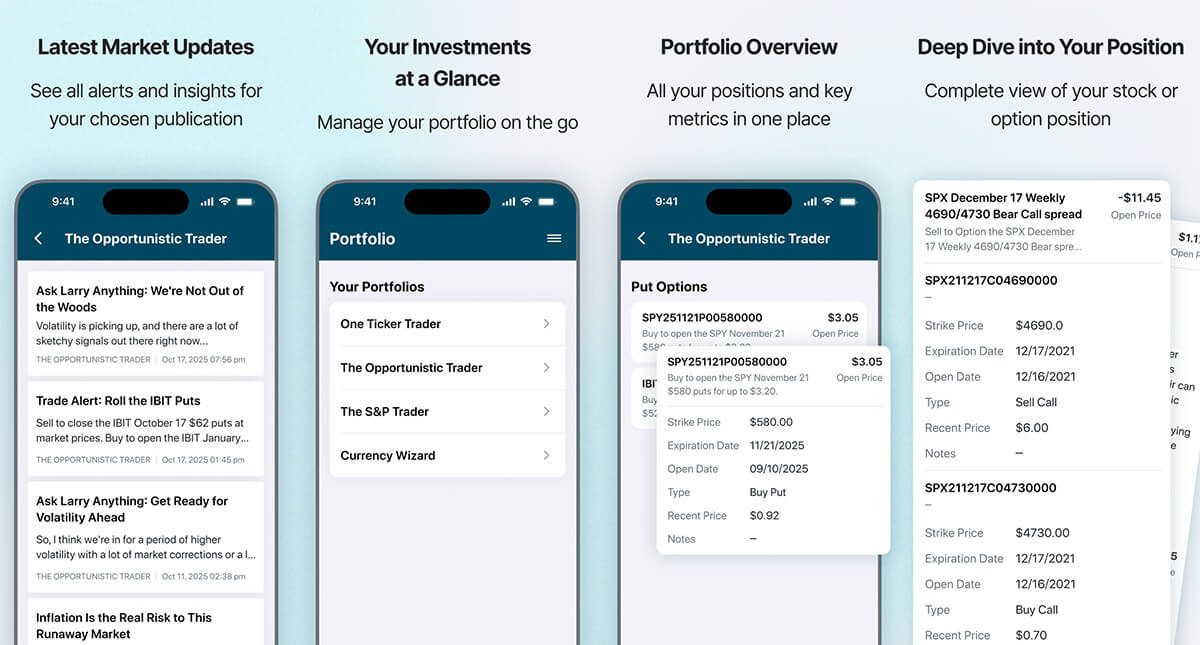
Get Instant Trade Alerts on Mobile!
|
|
|
|
Click the icon below from your mobile device to download The Opportunistic Trader app today for one-tap access to trade alerts, issues, and model portfolios for all of Larry’s services.
|
|
Available in the app store on Android and iPhone.
|
|
|
|












No comments:
Post a Comment