| Read in browser | ||||||||||||||

Sometimes a win for the climate is as mundane as speeding up bureaucratic processes. Today, we look at how a permitting reform bill presented by a bipartisan group of US senators could reduce carbon dioxide emissions. And, as California and the US West sizzle during an unusually hot autumn, a reminder of the health hazards of high temperatures. More than 34,600 people died from the brutal heat in five Western European countries over the summer. Subscribe to Bloomberg.com for unlimited access to all our coverage. Clearing the wayBy Zahra Hirji and Leslie Kaufman After years of false starts, a bipartisan group of senators on Wednesday produced a 417-page permitting reform bill, designed to make it easier to build everything from long-distance power lines to renewable energy projects to natural gas pipelines. A vote is not expected until after the midterm elections. That leaves plenty of time to argue over what the sprawling compromise would actually do for the climate: decrease or increase US greenhouse gas emissions? The answer isn’t obvious. Faster permitting could unlock clean-energy projects that have been stuck waiting for approvals, while also making it easier to build pipelines and other fossil-fuel infrastructure. Researchers are now starting to put numbers around those competing effects. 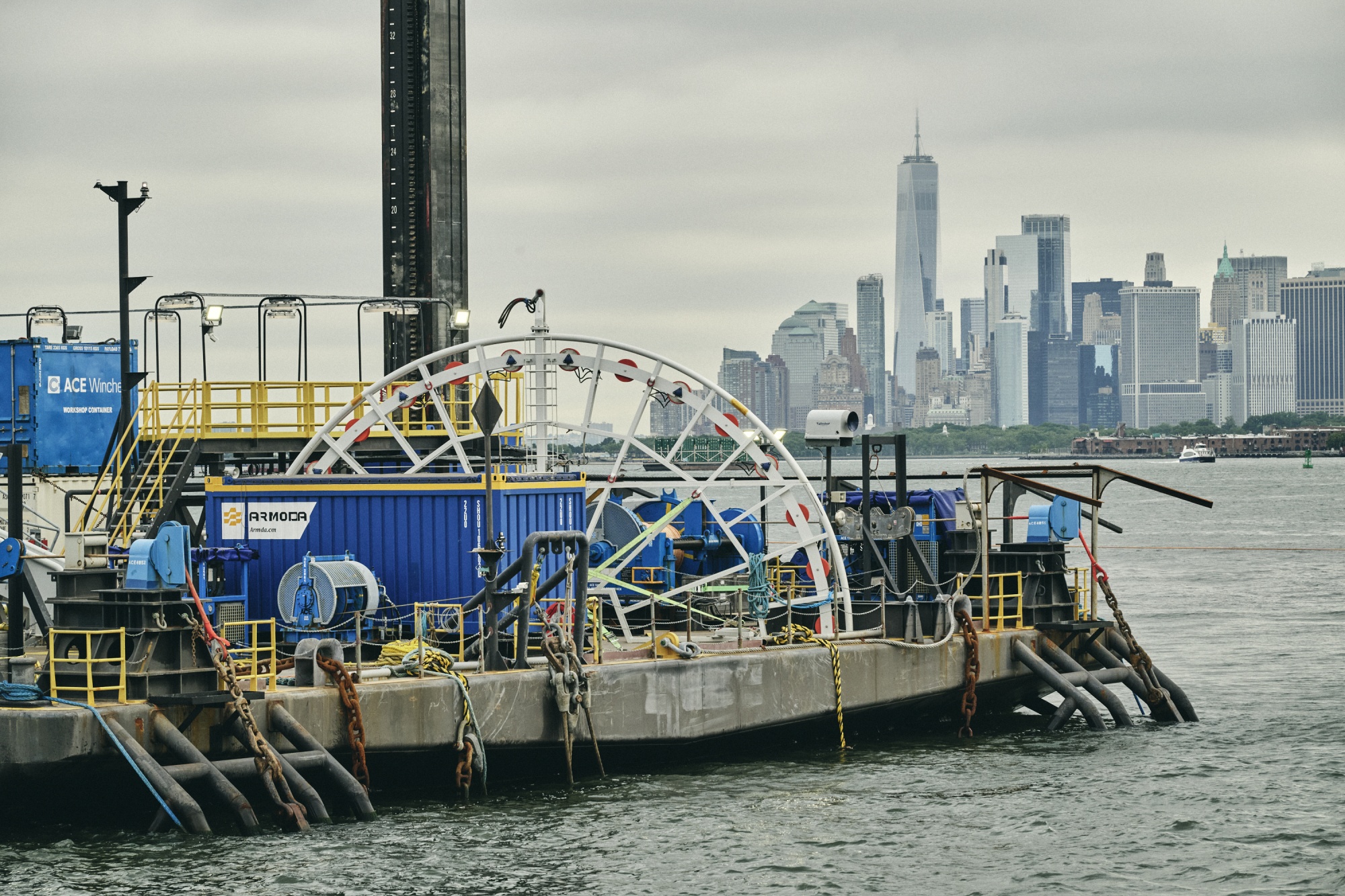
A cable-laying barge in the New York Harbor in July, 2025. The crew were charged with laying cable to connect the Empire Wind farm to New York City’s grid.
Photographer: Bryan Derballa/Bloomberg
One new analysis published this week offers a sense of the potential climate payoff from an important piece of the legislation: transmission reform. Streamlined rules making it faster to connect energy projects to the grid and expand energy connection, or transmission, between regions could cut carbon dioxide emissions by 71 million metric tons, or 9%, in 2035 compared to a non-reform scenario. The modeling, conducted by the nonprofit Center for Climate and Energy Solutions (C2ES) and consulting company Greenline Insights, does not comprehensively address the bill’s laundry list of proposed reforms. It’s only focused on the transmission piece and on how changes would affect four regions of the country that account for about half of US electricity demand. Despite those limitations, C2ES president Nathaniel Keohane told Bloomberg News he’s confident the bill “on net is good for the economy, it’s good for consumers, and it’s good for climate.” The estimated impact on power-sector emissions is particularly notable, he added: “We’re talking gigaton-scale emissions reductions over time.” Rob Gramlich, president of the consulting firm Grid Strategies LLC, said that although the package is technology neutral — meaning it doesn’t favor specific types of energy generation — it “enables a clean energy future” that’s “just going to be very hard to get” otherwise. Consider data centers. One way to power them quickly is to build gas infrastructure on site. “This bill would open up a lot more options,” Gramlich said, adding that there are many states, utilities and technology companies looking to clean up their power supply. Read More: Senate Permit Deal Would Force Data Centers to Pay Grid Cost Other climate science and policy experts seem to agree. In a post on X, Jane Flegal, a former Biden administration climate official who is now a senior fellow at the liberal think tank Searchlight Institute, called the bill “awesome.”
Read more
Transmission rules71 million The number of metric tons of carbon dioxide emissions that transmission reform would cut in 2035 compared to a non-reform scenario. Net benefit“We’re talking gigaton-scale emissions reductions over time.” President Center for Climate and Energy Solutions Deadly summerMore than 34,600 people died in five Western European countries due to heat this summer as the region posted its hottest June, July and August on record, according to a Bloomberg compilation of mortality estimates from different agencies. Spain saw its deadliest summer since records began in 2015, with 5,805 excess deaths attributable to heat between May 15 and Sept. 30, according to data from the Instituto de Salud Carlos III that was made public on Thursday. In France, three heat waves led to an estimated 7,824 deaths, the highest toll since at least 2015, according to provisional figures from the national public health agency. Germany, the UK and Belgium also recorded elevated heat-related mortality. 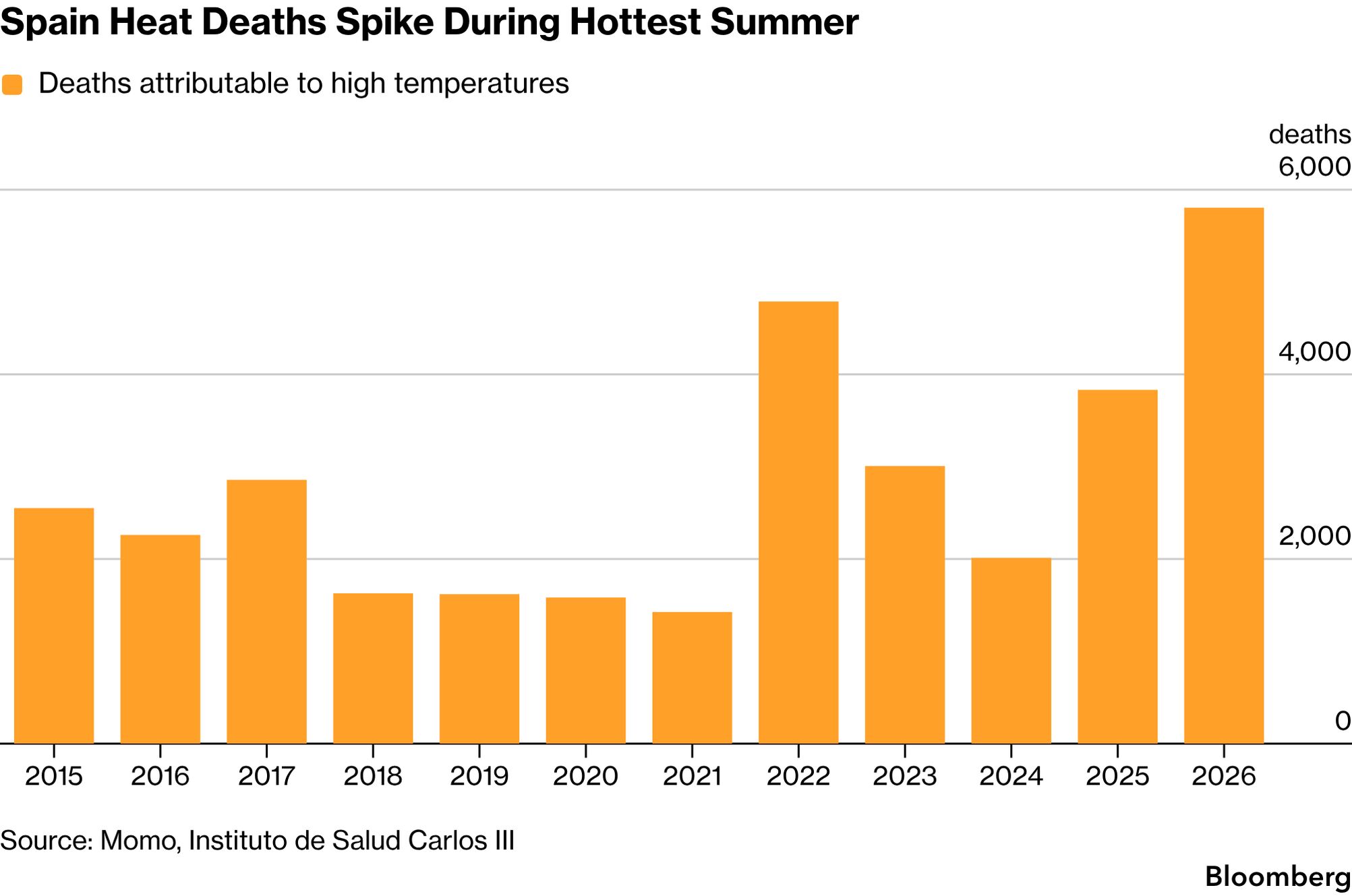
“Spain has recorded 61 heat wave days over the summer, with four heat waves, a fifth in September and extreme heat episodes in May,” said Diana Gómez, head of the mortality monitoring system at ISCIII. “All of that has resulted in an increase of deaths attributable to heat.” Heat can exacerbate existing illnesses and is particularly dangerous for vulnerable people including young children, the elderly and workers exposed to high temperatures over long periods of time. Western Europe faced extraordinary heat throughout the summer, with average temperatures for the region 2.5C above the average between 1991 and 2020, according to the latest monthly report by Earth observation program Copernicus. 
Volunteer firefighters spray a square with cooling water during high temperatures in Prague, Czech Republic, on Sunday, June 28, 2026.
Photographer: Milan Jaros/Bloomberg
European data indicate temperatures over the summer were the highest since at least 1979 across virtually all of England, Wales and Belgium, as well as most of France, Spain, Italy, Switzerland and Austria. The previous record was set in 2003, when countries including the UK, France and Germany recorded tens of thousands of heat deaths and healthcare services struggled to cope with cases of heat stroke, forcing authorities to improve emergency responses and hot-weather services. On 17 days this year, at least 60% of Western Europe experienced temperatures above 30C (86F), according to a Copernicus report released on Friday. That compares with 11 days under the same conditions during the summer of 2003. A record 52% of the European continent experienced temperatures of 38C or higher during the summer, which qualifies as “very strong” heat stress under the Copernicus ratings system.
Read more
Your Zero listenChina is a hotbed of innovation, filling nearly half of the world’s new patents every year. Much of that work is in the world of clean tech and a whole ecosystem is growing to help make these breakthroughs commercial.This week on Zero, Akshat Rathi is joined by Tonny Xie, chairman of Bluetech Clean Air Alliance, a China-based nonprofit organization that’s helping to grow the next era of climate startups. Listen now, and subscribe on Apple, Spotify or YouTube to get new episodes of Zero every Thursday. Listeners’ Choice Calling all fans of Zero! We’re excited to announce that Bloomberg Green’s Zero podcast has been selected as a finalist for the Signal Podcast Awards in the Sustainability & Environment category. Now it’s up to you to help Zero win. Please vote for your favorite podcast by October 15. More from Green🎥Attention all filmmakers!Working on a short documentary about climate change? Don’t miss your chance to submit it to the Bloomberg Green Docs film competition. Grand prize: $25,000. This is the final day submissions will be accepted. See official rules at bloomberg.com/greendocs. More from Bloomberg
Explore all Bloomberg newsletters. We’re improving your newsletter experience and we’d love your feedback. If something looks off, help us fine-tune your experience by reporting it here. Follow Us
You received this message because you are subscribed to Bloomberg’s Green Daily newsletter. If a friend forwarded you this message, sign up here to get it in your inbox.
|
Friday, October 2, 2026
Cutting red tape and CO2









Subscribe to:
Post Comments (Atom)
The AI Boom's Hot New Caterer
For this catering business, AI-related growth won't last forever... ...

-
Revolutionary Stem Cell & PRP —Start Your Journey Today ...
-
You’ve shown interest in Regenerative Medicine ...


No comments:
Post a Comment