| Read in browser | ||||||||||||||

There’s an unexpected source of relief helping to mitigate at least some of the energy chaos being experienced by Cuba amid widespread blackouts. Exports of solar cells and modules from the US have surged this year. Also in today’s edition, the EU plans to push for greater emissions cuts at next month’s COP31 talks in Turkey — and has flagged the bleak outlook for new climate finance commitments. Elsewhere, BBVA says bankers heading to the summit must find ways of mobilizing capital at greater scale. And new calculations by Bloomberg Intelligence show the size of the opportunity in the EU and UK for industrial companies as governments lift spending to improve infrastructure resilience. Keeping the lights onBy Jim Wyss Cuba’s chronic power woes have made life a misery on the island of 9.4 million people. But that pain is being mitigated by one of the fastest solar adoption rates in the hemisphere. And the US is helping keep at least some of the lights on. In the first seven months of this year, the US exported $6.3 million worth of solar cells and modules to Cuba, according to US Census data. That’s up 1,070% versus all of 2025, when just $538,000 worth of equipment was shipped to the island from American ports. 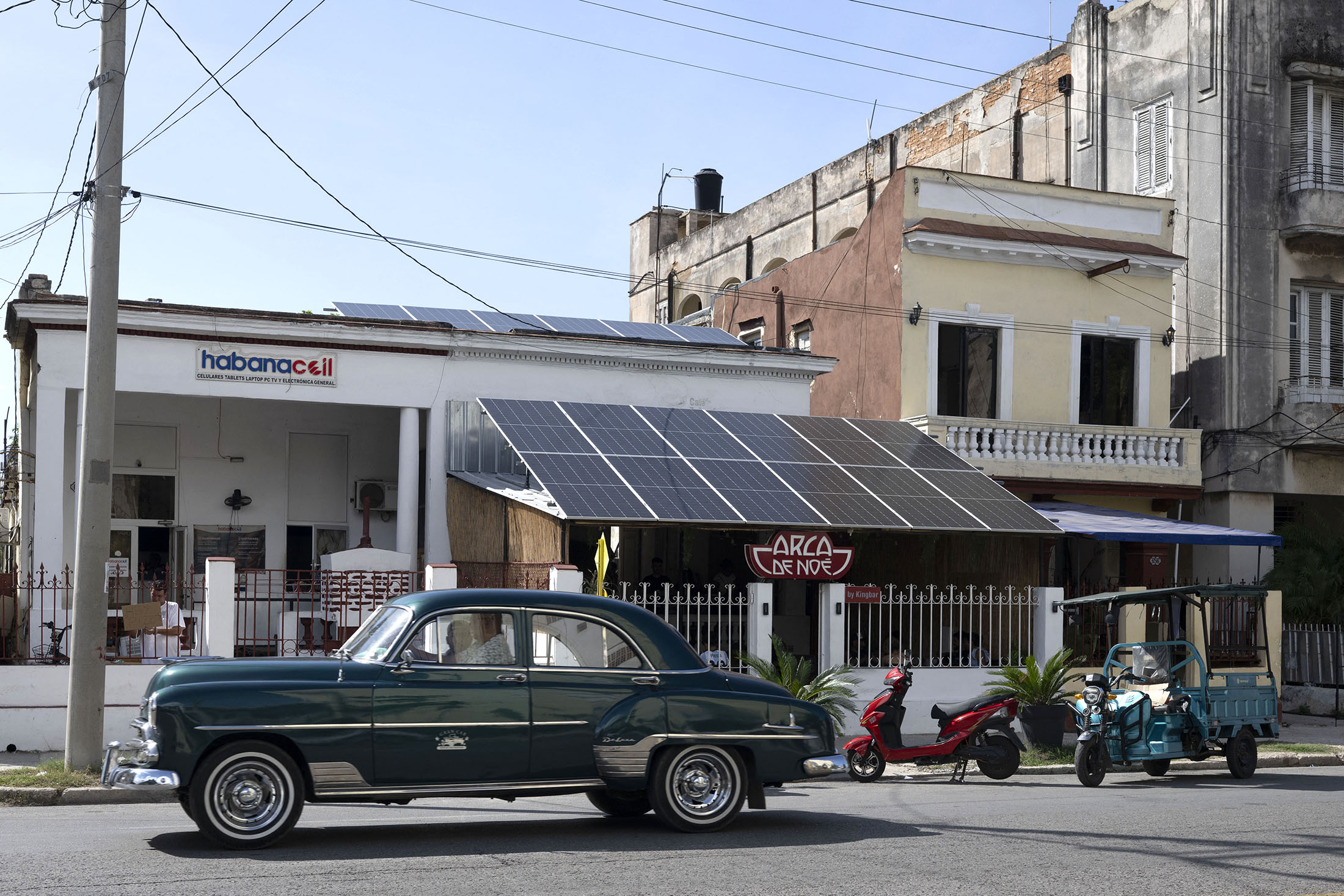
Solar panels on private businesses in Havana’s Vedado neighborhood on June 8.
Photographer: Pablo Porciuncula/AFP/Getty Images
And while China remains the main supplier by far, exports from Cuba’s longtime ally are dropping. By the end of July, the Asian giant had exported $19.5 million in solar equipment to Cuba. That’s down 83% from 2025’s full-year tally, according to data compiled by BloombergNEF. Even as President Donald Trump squeezes Cuba hard in hopes of ousting the Communist Party that’s held power for almost seven decades, his administration is allowing goods to be sent to entrepreneurs on the island like Llovet through a loophole in the longstanding trade embargo. Trump’s de-facto fuel blockade and ever-tighter sanctions have chased away allies such as Venezuela and Mexico, dovetailing with the president’s push to reassert US dominance of the Western Hemisphere and curb the influence of China and Russia. That’s created space for American exporters to step in, with the resulting surge in cargo shipments helping both to stave off a complete humanitarian collapse in Cuba and to create a dependency on the US in the absence of other benefactors. 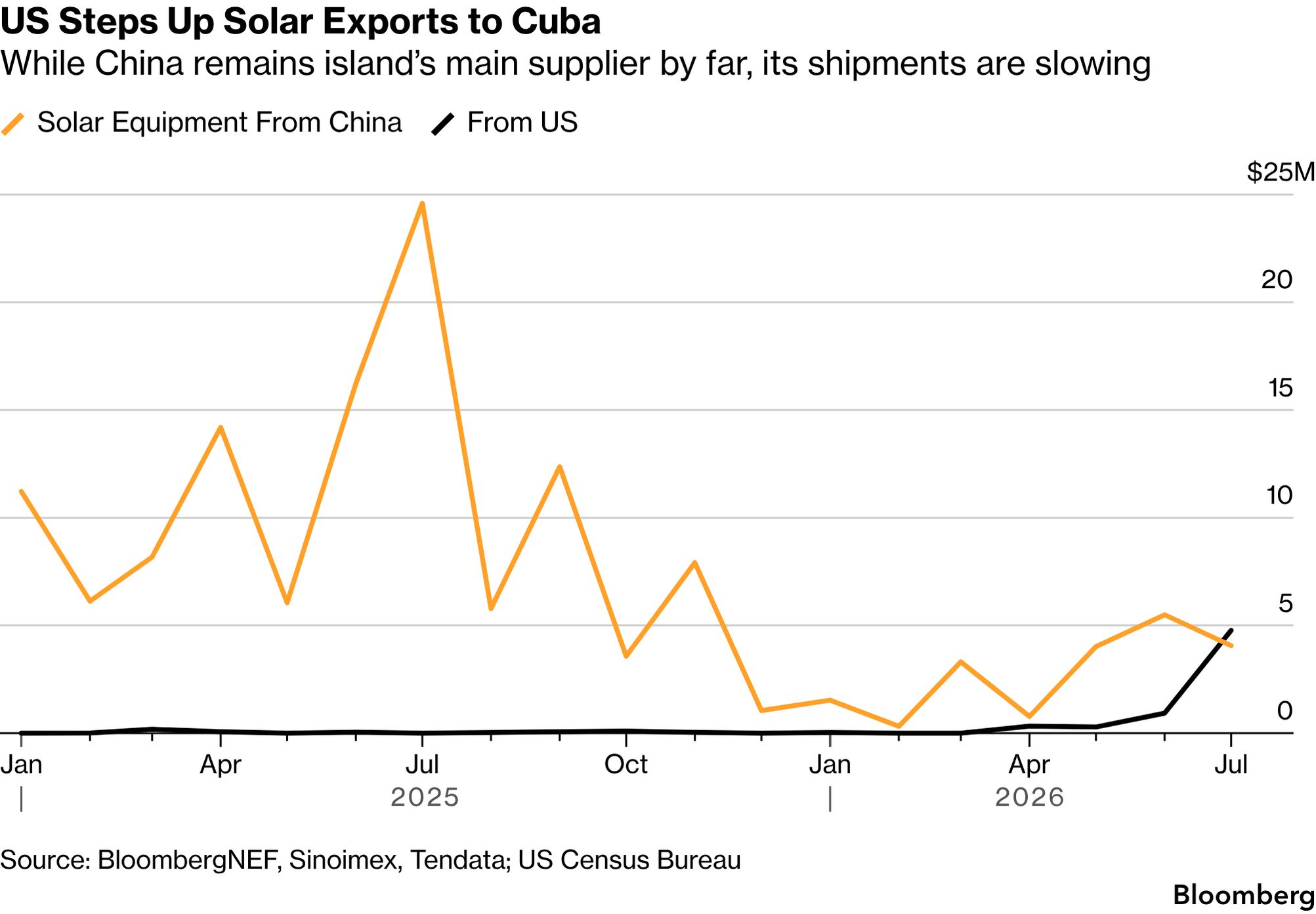
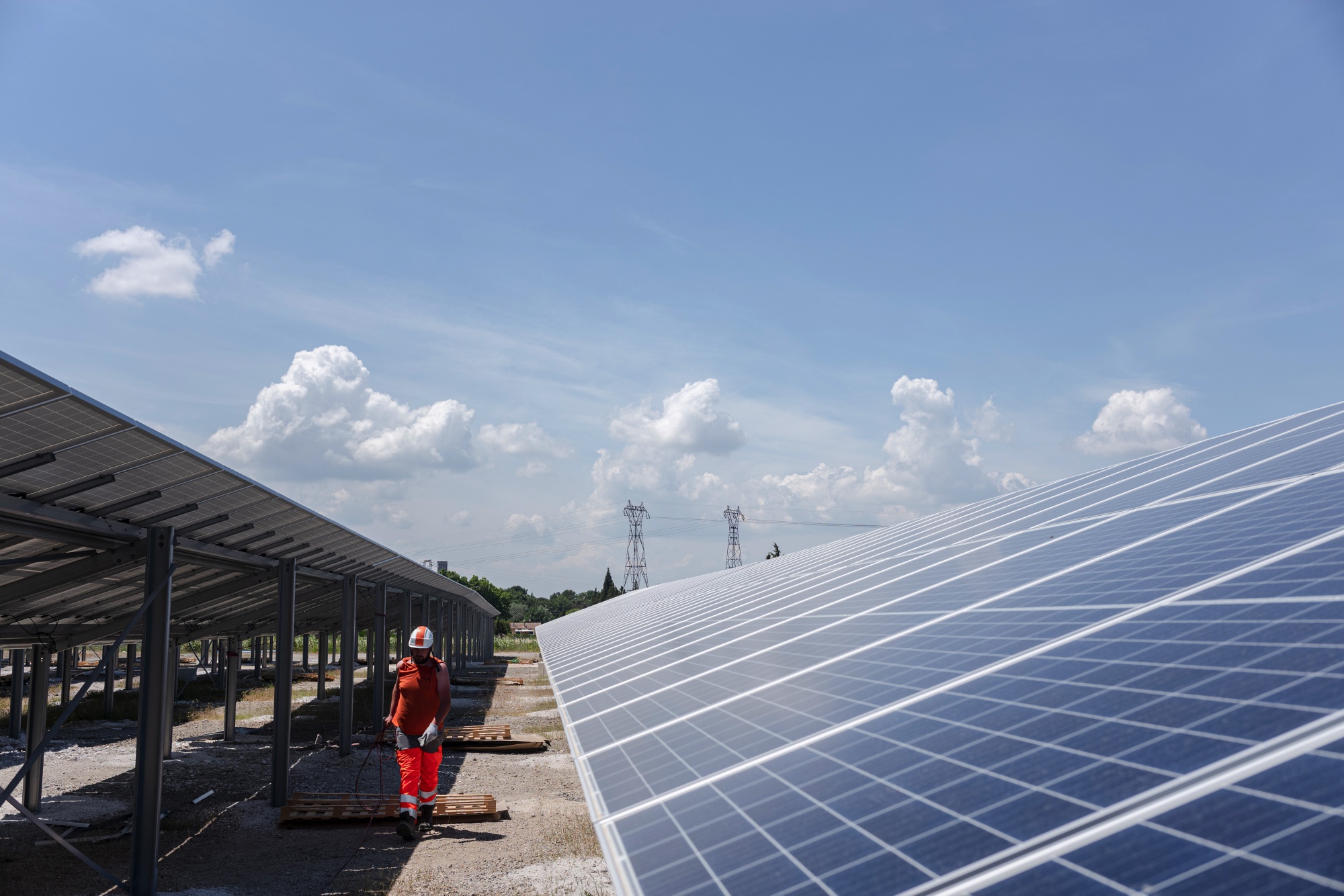
Deputy Cuban Foreign Minister Carlos Fernández de Cossío told Bloomberg News that for the last eight months he’s only had power at his home for two or three hours a day. Trump’s pressure campaign “has successfully intimidated the whole world so it doesn’t export fuel and other products” to Cuba, he said. “That’s an aberration.” Cuba’s 144 solar parks now produce 1,418 megawatts of energy, or about a fifth of total national electric generation, President Miguel Díaz-Canel told state radio last month. In addition, the private sector now produces 20% of its own energy needs.
Read more
Trade flow$650 million The value of goods shipped to Cuba from US ports so far this year, almost half from Port Everglades in Florida. Energy progress“Despite the blackouts, this is an area where we’ve made great strides.” President Miguel Díaz-Canel Cuba’s leader commented on progress being made on energy self-sufficiency to state radio last month. EU maps out COP prioritiesBy John Ainger, Ewa Krukowska and Frances Schwartzkopff The EU has struggled over the past couple of years to get the world to agree on a faster pace of emissions cuts, or implement a commitment made in 2023 to transition away from fossil fuels. Instead the bloc has become bogged down in issues of finance and trade, and has lost a key ally in the US after President Donald Trump pulled out of the Paris Agreement. 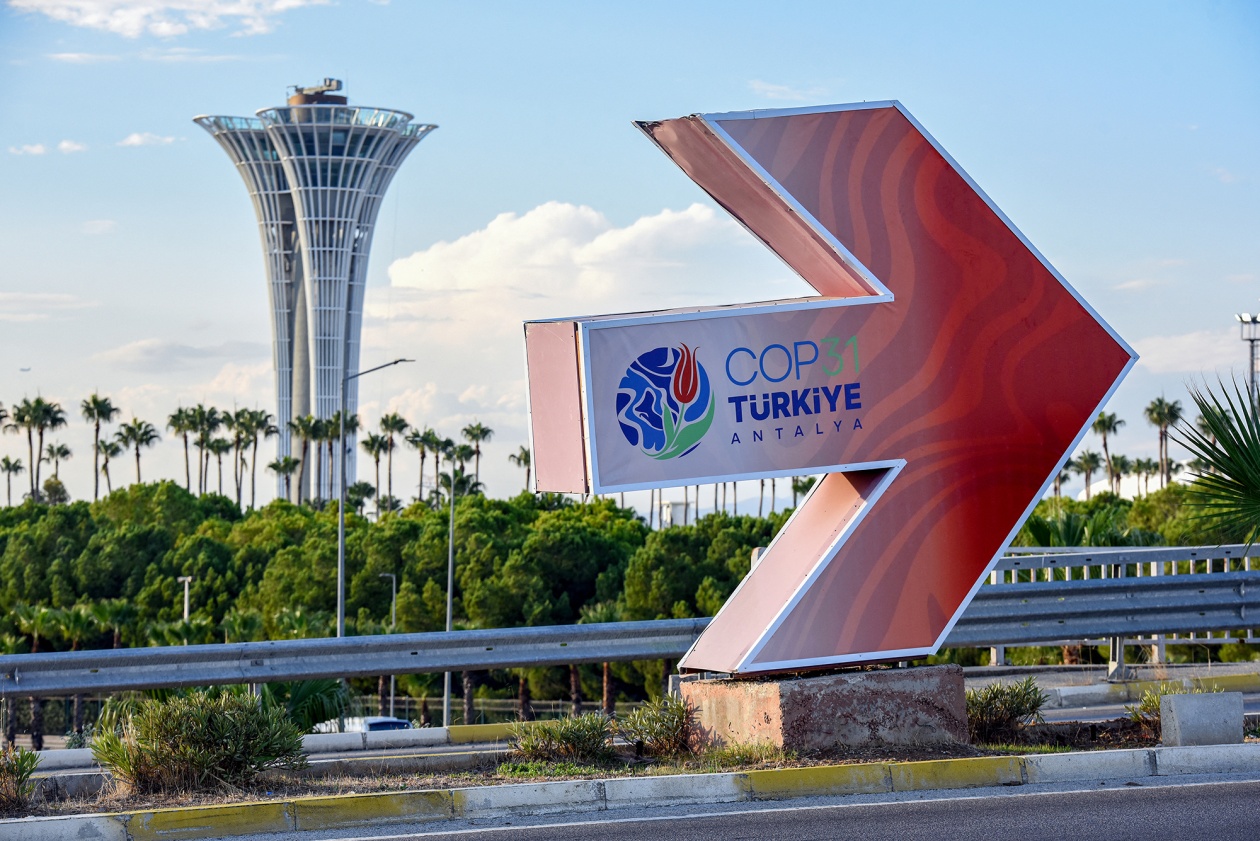
COP31 signage near the Antalya Expo venue in Antalya, Turkey on Sept. 30.
Photographer: Goksel Yapar/AFP/Getty Images
At November’s COP31 summit in Antalya, Turkey, the EU will double down on its push to cut emissions globally. Negotiators want to prolong a key “Mitigation Work Programme” negotiating track — a forum for discussing how to best cut emissions — until at least 2040, and lay the groundwork for the key Global Stocktake in 2028, according to a draft document seen by Bloomberg. “We need to mobilize capital at a much greater scale,” Javier Rodríguez Soler, global head of sustainability and corporate and investment banking at BBVA, said by email. “The challenge is not simply finding capital; it is creating enough bankable, scalable and replicable opportunities for that capital to invest in.” Rodríguez Soler is also co-chair of the COP31 Climate Finance and Investments Working Group, which operates alongside the talks in Turkey to offer recommendations to the summit’s presidency. “We are increasingly seeing sustainability driven not only by climate objectives, but by competitiveness, energy security, resilience, technology and supply-chain security,” he said. “These are structural economic trends.”
Read more
A $561 billion resilience marketBy Sofia Gerace and Chloe Meley Europe’s worsening heat waves, wildfires and floods are prompting governments to increase spending on climate-resilient infrastructure, opening a lucrative new market for industrial companies. Industrial equipment makers including Schneider Electric SE, ABB Ltd., and Siemens AG stand to benefit from a rush to harden buildings and grids against increasingly extreme weather. EU and UK government investment specifically to make infrastructure more resilient is expected to total about €500 billion ($561 billion) over the next decade, according to Bloomberg Intelligence. 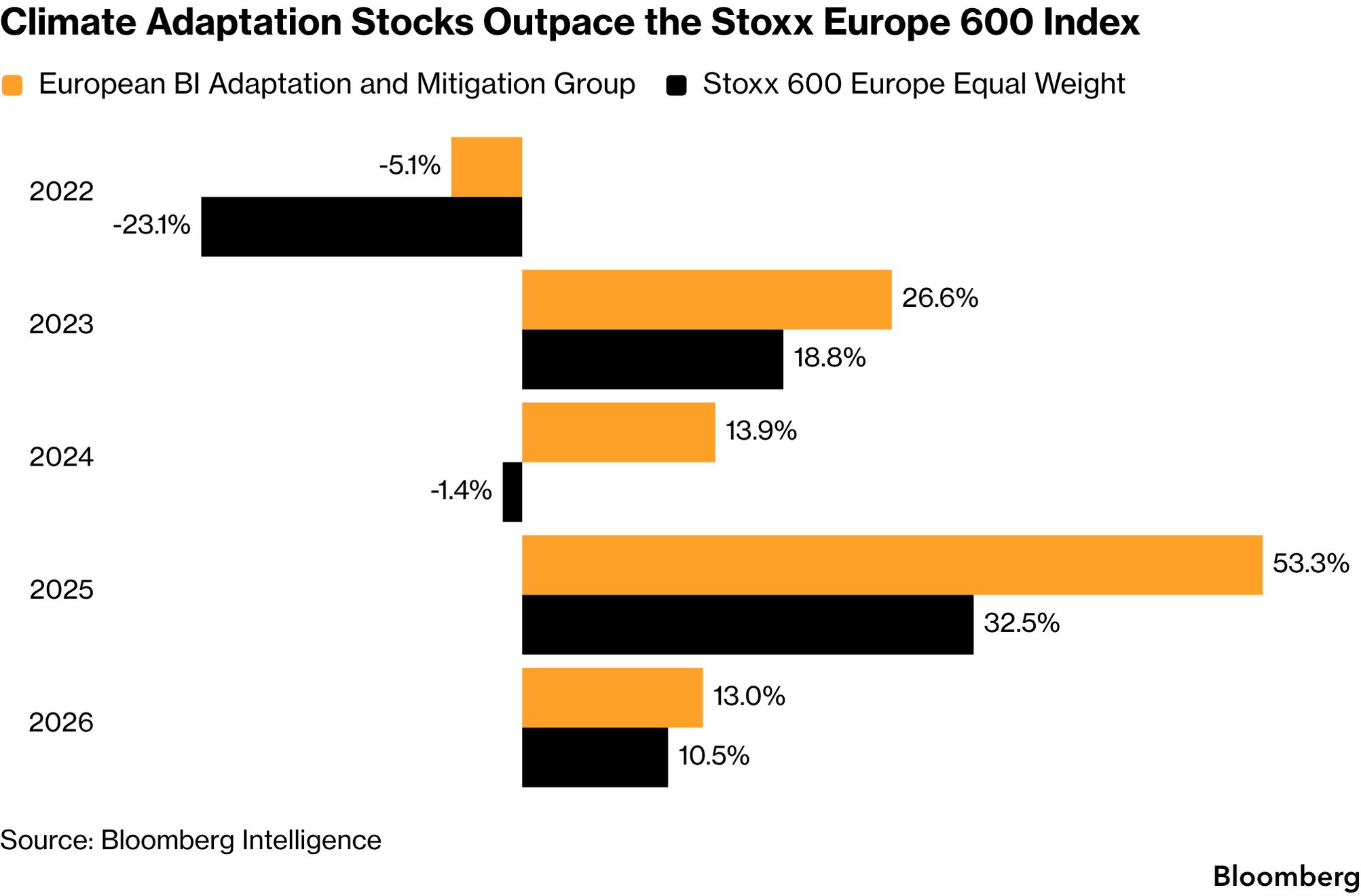
Demand for cooling, electrical and grid equipment has been driven by data-center construction in recent years. Climate adaptation is set to provide another growth driver, with investment targeting many of the same technologies used in data centers, including electrical resilience, grid reinforcement and systems to automate building energy use. “Industrials have done phenomenally well from AI-related demand, and there are murmurings about whether that demand is slightly tempering out,” BI analyst Grace Osborne said in an interview. “Climate adaptation adds a layer of demand.”
Read more
More from GreenYour Zero listenChina is a hotbed of innovation, filling nearly half of the world’s new patents every year. Much of that work is in the world of clean tech and a whole ecosystem is growing to help make these breakthroughs commercial. More from Bloomberg
Explore all Bloomberg newsletters. We’re improving your newsletter experience and we’d love your feedback. If something looks off, help us fine-tune your experience by reporting it here. Follow Us
You received this message because you are subscribed to Bloomberg’s Green Daily newsletter. If a friend forwarded you this message, sign up here to get it in your inbox.
|
Wednesday, October 7, 2026
Cuba’s surprise solar savior






Subscribe to:
Post Comments (Atom)
-
Revolutionary Stem Cell & PRP —Start Your Journey Today ...
-
You’ve shown interest in Regenerative Medicine ...


No comments:
Post a Comment