| Read in browser | ||||||||||||||

The US Supreme Court will hear arguments today in a case that could clear a path for dozens of suits around the country seeking climate damages, or close it. In the newsletter, we examine how the court’s ruling has implications for a field of science called climate attribution, which identifies the role played by global warming in extreme weather events and has faced criticism by climate skeptics. And, a look at how the droughts and floods becoming more frequent and severe in London are poised to hurt valuations for the city’s premium homes, which have already suffered from taxes, political turbulence and economic decline. Subscribe to Bloomberg.com for unlimited access to all our coverage. Climate’s legal showdownBy Eric Roston In 2018, local officials in Colorado sued oil companies in state court, charging that pollution from fossil fuels contributed to global warming and harmed Coloradans through extreme summer temperatures, more frequent wildfires and higher risk of some insect-borne diseases. 
A refinery in Torrance, California.
Photographer: Caroline Brehman/Bloomberg
Their complaint did not cite potentially key scientific evidence. That’s because it didn’t exist yet. Just then gaining public recognition was a field of research known as climate attribution, looking at how global warming affects the atmosphere in specific places or during specific weather events. The field is now advanced, and climate advocates hope to harness it as legal evidence against polluters. But in the US, that may rest on the outcome of the 2018 case, which is now before the Supreme Court. It will hear arguments Monday in Suncor v. Boulder. Read More: Exxon, Suncor Bid to Block Climate Suits at US Supreme Court The key issue before the justices is whether climate lawsuits can be brought under state tort law, or if federal law preempts that. The high court will either leave open a path for dozens of suits around the US seeking climate damages, or close it. Or the outcome could be somewhere in between. “It is possible that the court will rule in a way that preserves at least some, if not all, of state tort claims related to climate harms,” said Rachel Rothschild, an associate professor at the University of Michigan Law School, who on Saturday published an article on the topic in the Yale Law Journal. 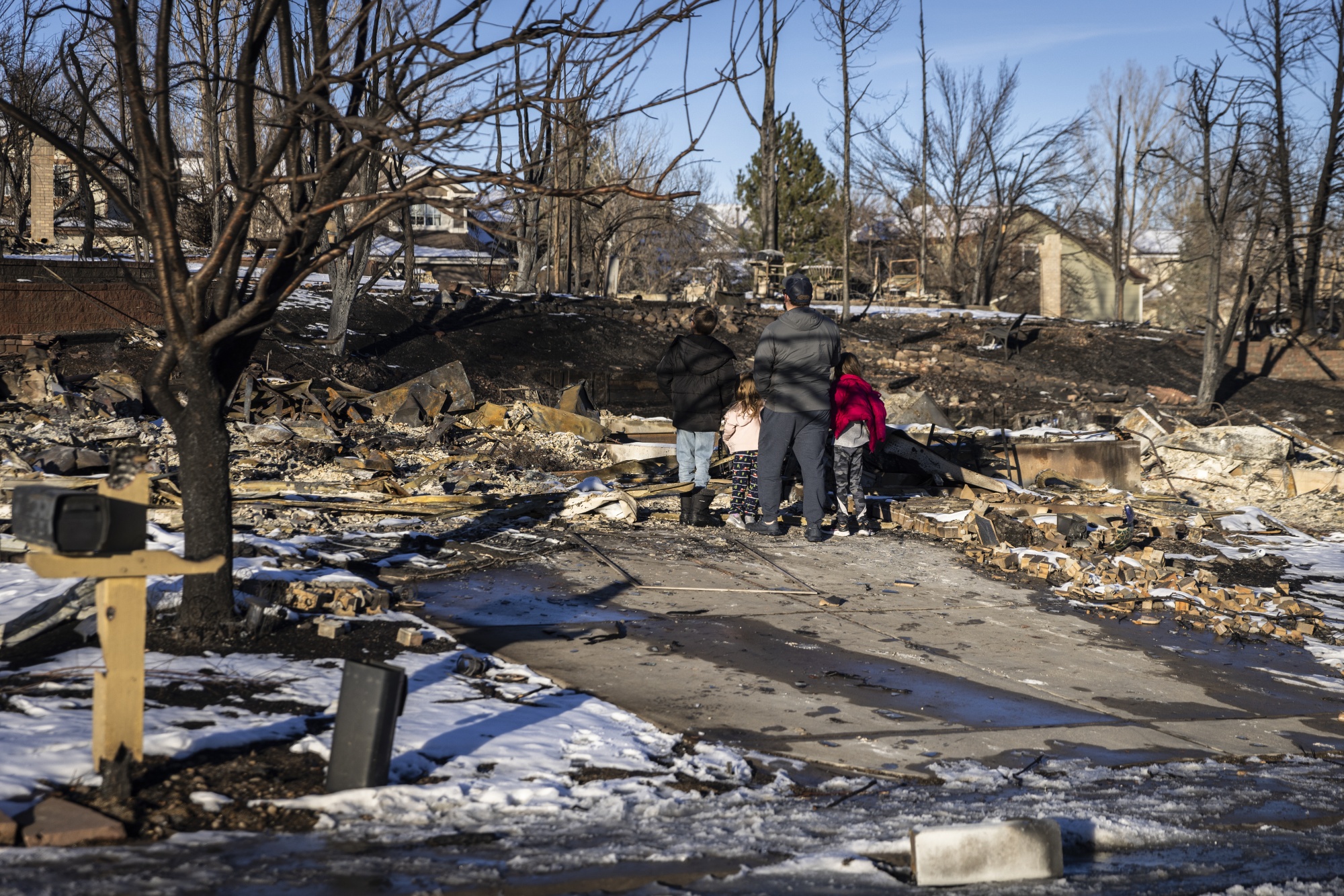
Residents survey remains of homes that were burned during the Marshall Fire in Superior, Colorado, in Boulder County, on Jan. 2, 2022.
Photographer: Chet Strange/Bloomberg
Scientists in the last decade honed their ability to conduct rapid analyses of extreme weather events, to estimate within days whether greenhouse gases changed the likelihood or intensity of a given heat wave, flood, cyclone, drought or wildfire. In 2021, the most authoritative global climate science body, the United Nations Intergovernmental Panel on Climate Change, confirmed extreme-event attribution science as a central topic of study. This July, the US National Academies published a 250-page assessment of the field that validated the approach, finding human-induced changes to the global climate have “a direct and well-understood impact” on extreme heat and rainfall. (It also noted some “significant challenges” the method faces, including limited observations to draw on and an imperfect understanding of how atmospheric dynamics themselves may be changing.) Interest-group campaigns have targeted climate scientists whose research could support litigation against fossil-fuel producers. Under pressure from Republican officials, the Federal Judicial Center removed a chapter from its latest science manual for judges that discussed climate research, including on attribution.
Read more
Escalating costs$20 trillion The amount of spending that could be required globally in the next decade to cope with extreme weather, according to a Bloomberg Intelligence estimate. The figure for 2025 was $1.4 trillion. Scrutinizing scientists“You’ve seen more concern expressed about the science by the fossil fuel companies. And that’s because that would show liability.” Alice Hill An energy and environment fellow at the Council on Foreign Relations who is also a former prosecutor and judge. A threat to high-end homesBy Olivia Rudgard 
Residential properties in the Kensington and Chelsea district of London.
Photographer: Jason Alden/Bloomberg
The assessment comes from Prime Purchase, the branch of Savills UK that represents property buyers in the top end of the real estate market. Guy Meacock, a director at Prime Purchase, says too many premium homes in the UK capital are ill-equipped to deal with the fallout of increasingly frequent extreme-weather shocks. The development follows a summer during which London’s vulnerability to extreme heat was laid bare. Air conditioning remains a rarity, existing in less than 10% of properties countrywide. Even basic cooling features such as shutters and awnings have proved hard to get for some of London’s priciest real estate. More worrying still, perhaps, is the city’s flood risk as freak downpours fueled by climate change leave a growing number of properties — including those with luxury mega-basements — more difficult to insure.
Read more
The view from Bloomberg OpinionMore from GreenYour Zero listenChina is a hotbed of innovation, filling nearly half of the world’s new patents every year. Much of that work is in the world of clean tech and a whole ecosystem is growing to help make these breakthroughs commercial. More from Bloomberg
Explore all Bloomberg newsletters. We’re improving your newsletter experience and we’d love your feedback. If something looks off, help us fine-tune your experience by reporting it here. Follow Us
You received this message because you are subscribed to Bloomberg’s Green Daily newsletter. If a friend forwarded you this message, sign up here to get it in your inbox.
|
Monday, October 5, 2026
Climate on trial








Subscribe to:
Post Comments (Atom)
Welcome To GrabAGun 👋 Here's $20 Off
$20 off $250. The best deal you'll get from us. ...

-
Revolutionary Stem Cell & PRP —Start Your Journey Today ...
-
You’ve shown interest in Regenerative Medicine ...


No comments:
Post a Comment