The Rack Has Become the Data CenterBy Joel Litman, chief investment officer, Altimetry
 For years, a normal AI server rack needed about 25 to 40 kilowatts of power... For years, a normal AI server rack needed about 25 to 40 kilowatts of power...
But today's racks can require up to roughly 150 kilowatts. And Nvidia's (NVDA) upcoming Rubin systems are expected to eventually reach around 300 kilowatts per rack. The industry is already preparing for racks that use close to 1 megawatt. For comparison, the average data center built between 2000 and 2018 had a total capacity of just 1.3 megawatts... And each data center can house anywhere from 2,000 to 5,000 servers. This heightened level of power demand is changing how data centers operate... They now need better cooling, more efficient power supplies, and equipment capable of handling loads that would have sounded absurd only a few years ago. That puts digital-infrastructure leader Vertiv (VRT) in an enviable position. Today, we'll explain why Vertiv is becoming critical to the AI build-out... and why investors may already know how valuable that position is. More powerful chips need more powerful infrastructure...AI companies want to pack as much computing power as possible into each rack. However, more computing power creates more heat. Nvidia ran into that issue with its Blackwell chips. Blackwell delivered more computing capacity with the same amount of energy as its predecessors. But squeezing more power into the same-sized space generated too much heat for the existing air-cooling systems. That has led Nvidia to try to keep its chips cooler in future generations... thus spurring demand for liquid cooling systems. Liquid cooling is more efficient than air cooling. Instead of using fans to push cold air through racks, these systems use a closed loop of circulating liquids around the chips to absorb and move the heat away from them. Vertiv is one of the companies supplying the equipment for these liquid cooling systems. A study conducted by Nvidia and Vertiv found that direct-to-chip liquid cooling improved overall data-center energy efficiency by 15%. In addition to improving the cooling within data centers, there's another process Vertiv is positioned to help strengthen... moving and converting electricity throughout the facility themselves. Nvidia estimates that roughly 30% of data-center power currently goes somewhere other than AI computing...Cooling is one major alternative use. Moving and converting electricity is another. Electricity enters a data center from the grid at high voltage. It then has to be converted and stepped down before a chip can use it. Every conversion wastes a little energy, so across a big AI campus, those small losses add up significantly. Power distribution alone accounts for roughly one-third of total power losses in a data center. That's why Nvidia, Vertiv, and other equipment makers are moving away from alternating current ("AC") systems and toward direct-current ("DC") systems. Alternating current changes its direction periodically, whereas direct current flows in a constant direction. AC systems alternate between switching the current from AC to DC for batteries, back to AC for racks, and so on. On the other hand, DC systems eliminate these repetitive switches and carry direct current throughout the data center... resulting in energy savings. By simplifying how electricity moves through the facility, the industry believes distribution losses could eventually fall below 1% of total energy use. Many AI data centers could adopt this new architecture by 2030.
| Recommended Links: |
|
 NOW LIVE: Chaikin's Income Acceleration Project Wall Street legend Marc Chaikin reveals a novel way to use his Power Gauge system to target regular payouts like $713, $1,166, $1,488, and $2,608 in as little as seven days. Marc says an unusual market event that has been quietly building for years is hitting a breaking point – creating more income-generating opportunities than he has seen in nearly six decades on Wall Street. He explains exactly how this strategy works and shares one of his best recommendations for free. Click here for the full details. |
|
|
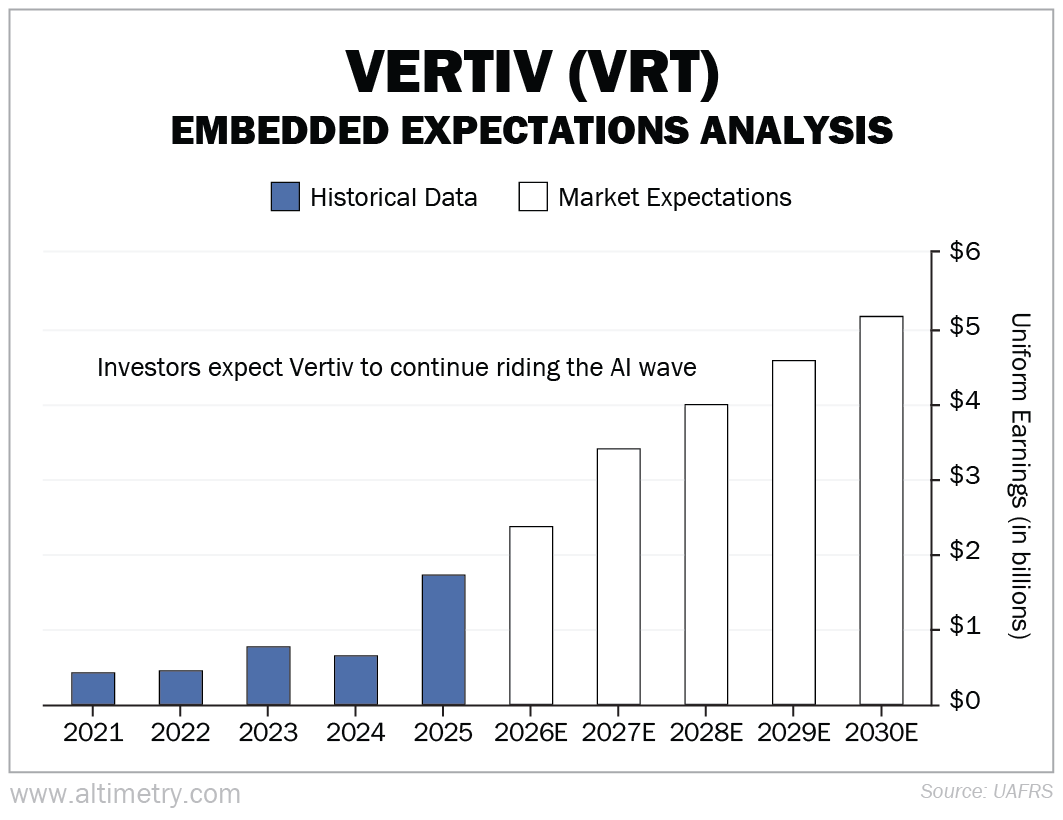
So Vertiv is able to help solve two major issues facing data centers. AI servers need better cooling... and better power infrastructure. The harder AI chips become to run, the more important Vertiv's equipment becomes. The problem is that investors already know this...We can see that through our Embedded Expectations Analysis ("EEA"). The EEA works backward from the stock price to determine how much earnings growth the market is already pricing in. Vertiv generated roughly $1.7 billion in Uniform earnings in 2025. Analysts expect that to jump to about $2.4 billion this year... and $3.4 billion in 2027. That means the company will roughly double its earnings in the next two years. But at its current share price, Vertiv needs to do even better over the long run. Vertiv's current valuation implies Uniform earnings of roughly $5 billion by 2030. That would mean nearly tripling earnings from 2025 levels in just five years. Take a look...
In other words, investors are betting that Vertiv will turn this infrastructure boom into exceptional earnings growth over the next few years. While this is possible, it's likely the best-case scenario for Vertiv. Investors see no issues in the future, which means that if any issues arise, the stock could tumble. Since May 14 of this year, the stock is down more than 30% because the company missed its revenue targets. Any more hiccups could lead to more volatility. Investors have already priced in the gold standard for this stock and understand that it's a huge beneficiary of the AI boom. This further strengthens why we see no near-term slowdowns or disruptions in the AI industry. Vertiv has the kind of problem investors normally want a company to have...Its customers need more of what it sells. AI racks are getting hotter and more power-hungry with every generation. That means more spending on cooling, electrical equipment, and the rest of the infrastructure surrounding the chips. Vertiv is positioned directly in front of that spending. But great businesses can still carry demanding expectations. And with investors' current outlook, Vertiv needs to remain one of the biggest winners of the AI build-out for years to come. Regards, Joel Litman
September 3, 2026 P.S. Last week, I went live to discuss how Elon Musk is preparing to take over all the major AI bottlenecks. Because of this, there's a short list of stocks that could soar 1,000% or more. If you play your cards right, you could double your money in 30 days or less. Today is the final day you have access to this presentation, so click here before it's too late.
|





No comments:
Post a Comment