Everyone's Blaming Inflation. The Real Culprit Is Ambition.By Rob Spivey, director of research, Altimetry
 Investors are starting to worry again... Investors are starting to worry again...
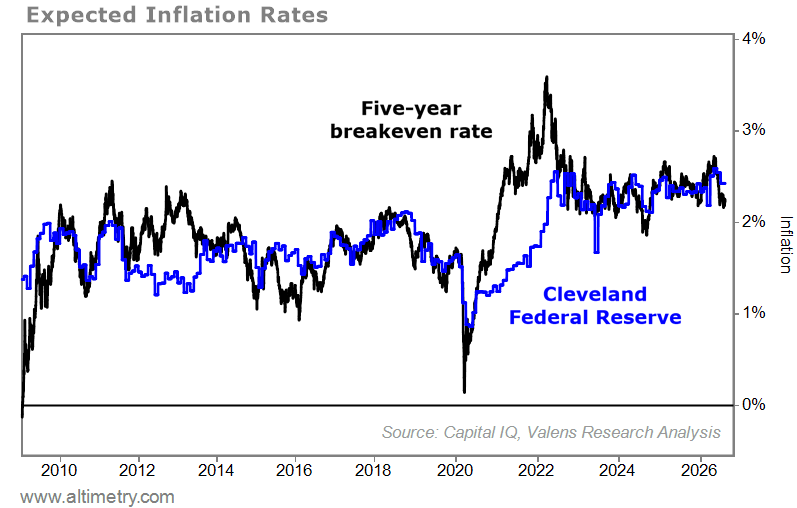
The 10-year Treasury yield is back on the rise. That's essentially the interest rate the government pays to borrow money for a decade. Some worry that government spending is getting out of control... inflation is about to take off again... and the bond market is revolting. You may even hear people talk about the return of the "bond vigilantes"... But there's another explanation for rising Treasury yields that investors may be overlooking... The economy is competing for capital. When the 10-year yield rises, borrowing gets more expensive across the economy. Mortgage rates, corporate-bond yields, and other financing costs typically move higher. So investors pay close attention to it. The popular explanation is that investors are punishing Washington...Treasury bonds promise investors a fixed income stream. But if investors expect inflation to stay high, those future dollars become less valuable. So they may demand a higher return before they're willing to buy Treasurys. That's what bond investors mean when they say they're "punishing" Washington. The idea is that investors are demanding higher interest rates because they no longer trust the government to keep spending or inflation under control. And there's also the fear that the Federal Reserve is "losing its grip." The Fed can't simply set the 10-year Treasury yield wherever it wants. Long-term rates are determined by investors. So if the Fed says inflation is under control but investors disagree, the 10-year yield can keep climbing. That sounds like a reasonable explanation for rising yields today. But there's a problem... The data tells a different story...We can gauge investors' inflation expectations over several years using the five-year breakeven inflation rate. We can also compare that with the Cleveland Fed's estimate of five-year inflation expectations. Both measures are remarkably calm right now. The five-year breakeven rate is around 2.2%. The Cleveland Fed's measure is around 2.4%. Both are close to their long-run averages... and below the peaks we saw in 2022. More importantly, neither has moved meaningfully higher as Treasury yields have risen. Take a look...
A Treasury yield has two basic pieces...
One compensates investors for the inflation they expect over the life of the bond. The other is the return they demand above inflation for tying up their money. So if inflation expectations barely move while Treasury yields climb, inflation can't explain much of the increase.
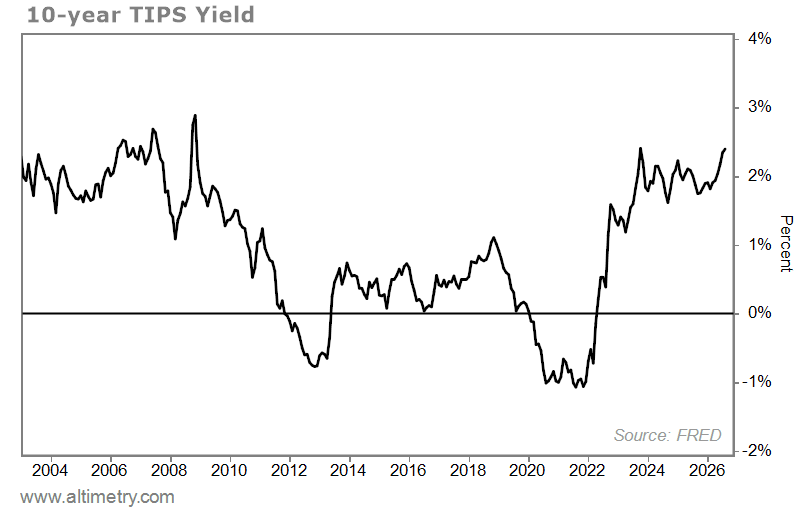
We can see this even more clearly by looking at the 10-year yield, excluding inflation. Treasury Inflation-Protected Securities ("TIPS") are government bonds that exclude inflation entirely. So the 10-year TIPS yield shows us the real return investors demand, but with inflation stripped out. That yield has been climbing steadily. Take a look...
While it feels like yields are reaching extreme highs, we're still around "normal" levels historically, apart from the window where we had near-zero yields after the Great Recession.
And the rise is coming entirely from the real return side, not from inflation fears. That tells us demand for credit is what's rising. So something else has to be driving rates higher. The real driver is competition for capital...Some of the largest corporations on Earth are spending unprecedented amounts on the AI build-out. Alphabet (GOOGL), Amazon (AMZN), Oracle (ORCL), Meta Platforms (META), and their peers are pouring hundreds of billions of dollars into the infrastructure needed to support the AI boom. Microsoft's (MSFT) capital expenditures cost roughly $65 billion in fiscal 2025. The vast majority went to data centers and other AI-related infrastructure. Alphabet spent more than $90 billion in 2025... up from about $52.5 billion the year before. Meta spent roughly $70 billion in 2025, while Amazon is expected to spend $200 billion this year. That's a huge amount of capital chasing one investment theme. For years, these companies could fund expansion almost entirely from their own cash flow. Their businesses generated so much cash that they rarely needed to issue significant amounts of debt. But that's changing... Now even the biggest companies are tapping into the debt markets...Meta has issued multibillion-dollar bonds, including a roughly $30 billion offering in 2025. And Alphabet has raised billions through debt markets as it finances data-center expansion and other long-term investments. In other words, some of the world's biggest companies are now competing with the U.S. government for investors' money. And debt works like any other market. When everybody wants the same scarce thing, prices rise. In this case, the thing everybody wants is capital... and the price of capital is the interest rate. That's why Treasury yields are rising while inflation expectations remain contained. Companies see enough attractive investment opportunities that they're borrowing at rates that would have seemed steep just a few years ago... All because they believe the returns on AI infrastructure will more than justify the costs. That's a sign of economic strength, not weakness. The economy is racing to build. The AI build-out is still in its early stages, and the companies supplying its physical backbone are sitting at the center of the biggest capital-investment cycle in decades. Follow where the capital is flowing. Regards, Rob Spivey,
September 8, 2026
|






No comments:
Post a Comment