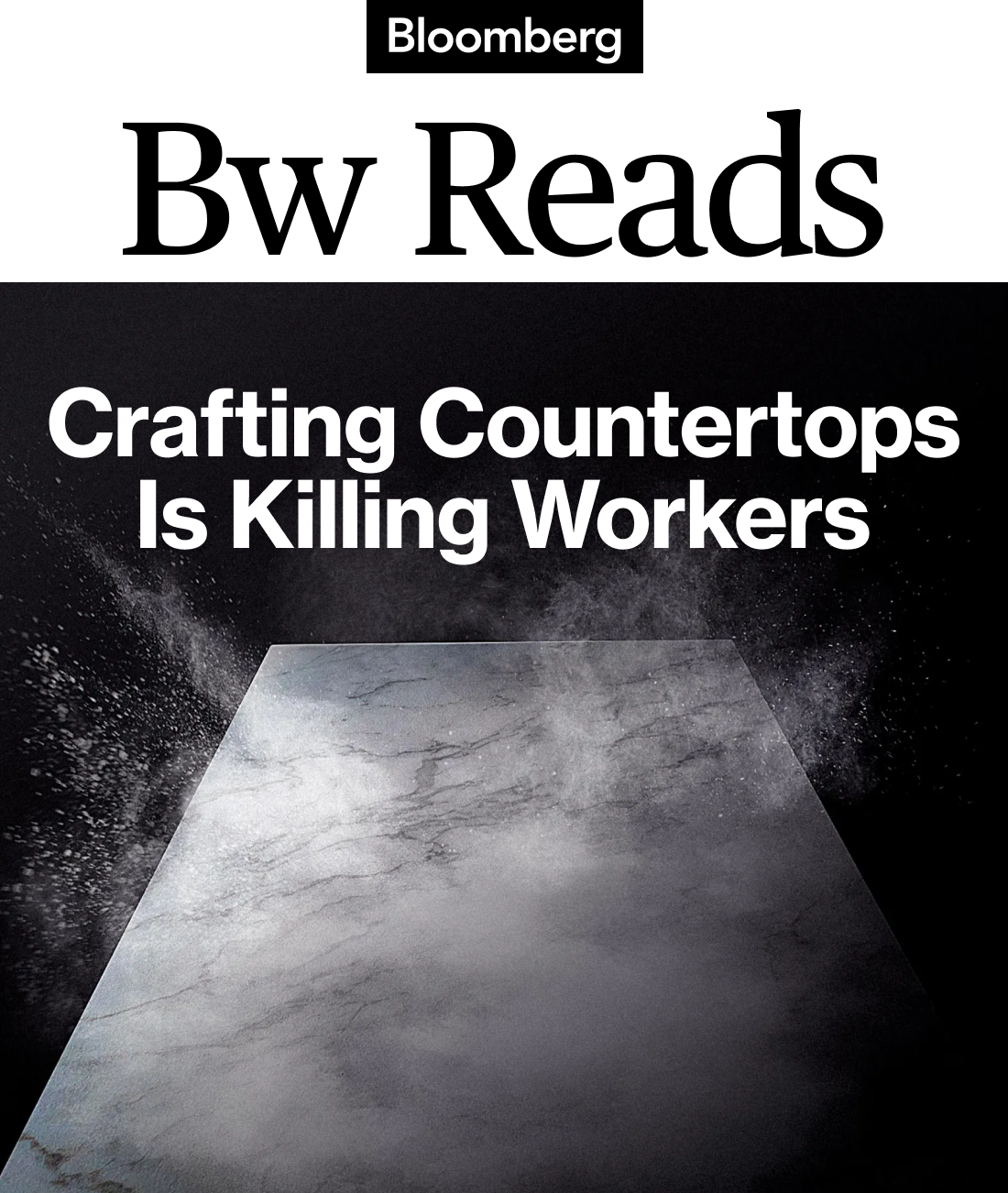
Welcome to Bw Reads, our weekend newsletter featuring one great magazine story from Bloomberg Businessweek. Today Josh Eidelson writes about the growing number of workers contracting silicosis. While hundreds of them are seeking damages from the artificial stone industry, which produces the popular countertops they say have made them sick, manufacturers have their defenders in Congress. You can find the whole story online (free) here. If you like what you see, tell your friends! Sign up here. Subscribe to Bloomberg.com for unlimited access to all our coverage. Silicosis is a killer that’s been at large for millennia. It’s an incurable workplace disease caused by breathing in dust with tiny, jagged particles of respirable crystalline silica, which is released by cutting or crushing objects like stone or gravel. These invaders, each less than one-tenth the width of a human hair, are difficult to keep out of your body; mucus is no match for them. As they pile up, RCS particles gradually destroy your lungs, inflaming them, scarring them, shrinking them, hardening them. Along the way, the silica dust can also cause lung cancer, chronic obstructive pulmonary disease, autoimmune disorders and kidney failure. “My patients with silicosis, I wish they only had lung cancer,” says University of California at Los Angeles pulmonologist Jane Fazio, who’s been studying a new surge of US cases. “Lung cancer can be cut out.” In recent history, silicosis has typically been associated with decades of intense work around harmful dust. Doctors were used to diagnosing miners in their 60s and 70s. But the wave of patients whom Fazio and others are studying has started to look a bit more like 32-year-old Tyler Jordan. Once an athletic stonecutter, Jordan found in 2022 he could no longer take a full, deep breath, and he hasn’t since. Jordan felt unwell for weeks before he first met with doctors, cycling through fevers and chills. His wife, Caitlin, made him go in after he collapsed from shooting pain in his back. A physician told him he was far too young to have silicosis, until results came back from a biopsy of the lung that was stuck to the wall of his chest. A specialist concluded that Jordan had contracted the disease by breathing in silica dust from slabs of trendy artificial quartz, while working for his father turning them into countertops. What followed was chemo, dialysis, depression, renal failure, a kidney transplant and a more sensitive surgery to mitigate the brutal side effects on his reproductive anatomy. 
Jordan outside his home in Urbana, Missouri, in August.
Photographer: Neeta Satam for Bloomberg Businessweek
A father of three, Jordan used to mountain bike, snowboard and play hockey. These days, basic activities are exhausting or dangerous. And organ transplants tend not to last more than a decade or two, so he’s likely to need several kidney or lung transplants if he’s lucky. “Right now, it’s just focusing on my kids,” he says. “I can do frisbee with them, but I stand in one spot, and if they miss me, then they have to go get the frisbee.” His daughter Faith, the oldest, is 11. The family of five have moved from Colorado to Missouri, for the cheaper cost of living and greater help from his in-laws. “It’s hard to be a great role model, and I can’t be a hard worker — show them hard work, like my dad,” Jordan says. He’d always wanted to inherit Jordan Marble & Granite, the countertop business owned by his parents, Jimmy and Tina. Instead, he got his father’s kidney. Jordan is one of hundreds of workers across the US who’ve recently sued the manufacturers of artificial quartz slabs, accusing them of peddling a needlessly toxic product and misrepresenting its risks. California’s Department of Public Health, the agency tracking these cases the most systematically, has identified more than 600 silicosis diagnoses in-state that are linked to artificial (sometimes called “engineered”) stone, which contains far greater concentrations of silica than the natural marble and granite products it’s displaced. Most of those patients are Latino; almost all are men. Their median age of diagnosis is 46, and 35 of those Californians have died of the disease, at a median age of 52. Over 6,000 workers with artificial stone silicosis have been identified worldwide, and many more could be at risk. Scientists project there will be thousands of cases a year among the fabrication workers grinding, polishing, cutting and customizing manufacturers’ slabs to create the countertops consumers want. Those slabs increasingly consist of artificial quartz, which in recent decades has surged in popularity. When Australia’s Queensland set out to test its fabricators, it found that close to 1 in 5 had silicosis. Within a few years, Australia banned the use of artificial stone slabs, effective in 2024. In the US, some officials are pushing to do the same. Others are moving to protect the manufacturers against lawsuits instead. Artificial stone manufacturers, led by Cambria Co., have insisted that their products aren’t the problem. Cambria, which didn’t respond to detailed inquiries, has blamed afflictions like Jordan’s on small businesses like his parents’, arguing that the track records of its in-house shops show the slabs can be safely fabricated. Part of the basis for that claim, Cambria research chief Jon Grzeskowiak testified during Jordan’s trial this spring, is that sampling of the air in Cambria’s own shops shows silica levels lower than the “action level” set by the Occupational Safety and Health Administration. “We have air monitoring results that confirm that all the dust levels are below the action level in our shops,” Grzeskowiak testified. But an investigation by Bloomberg Businessweek shows that over the past decade, that has frequently not been the case. Confidential company records reviewed by Businessweek detail dozens of instances of dust levels above that threshold in Cambria shops — in some cases, far above it. Thousands more pages of company documents, court filings and transcripts complicate the company’s narrative further, as do interviews with scientists, doctors, attorneys, enforcers, fab shop owners and the workers whose lives have been upended by the dust.
Keep reading
On the PodcastFor the past few weeks we’ve heard a lot about existential risks posed by artificial intelligence. But some critics argue that these warnings draw attention from more immediate problems like AI-generated scams, a glut of “slop” and the rise of “cognitive surrender,” what researchers at the University of Pennsylvania’s Wharton School define as the uncritical acceptance of AI’s answers in place of one’s own reasoning. This week on Everybody’s Business from Bloomberg Businessweek, hosts Stacey Vanek Smith and Max Chafkin explore a potential solution: technology that promises to detect AI in the same way spam filters sort out junk email. Vauhini Vara joins to talk about her profile on Pangram Labs, the startup behind this software. Also on the podcast, Bloomberg News senior reporter Randall Williams takes a look at the influx of private equity cash into sports and why it could cause fan backlash. How Kevin Warsh acted like a conventional Federal Reserve chair. Listen and subscribe on Apple, Spotify, iHeart and the Bloomberg Terminal. The Best B-Schools & MBA Programs 2026–27ICYMI, Businessweek published the annual guide to the best business schools and MBA programs around the world. For the eighth year in a row, Stanford Graduate School of Business tops the list in the US, but is an MBA degree worth it? Find out with our return-on-investment calculator. More Weekend Reads

Pangram’s founders, Max Spero and Bradley Emi in their new offices.
Photographer: Elinor Kry for Bloomberg Businessweek
 
The Mishal Husain Show: Maggie Haberman on Trump’s ‘Unreality Bubble’
Test Your Knowledge
More From BloombergLike Businessweek Daily? Check out these newsletters:
Explore all Bloomberg newsletters. We’re improving your newsletter experience and we’d love your feedback. If something looks off, help us fine-tune your experience by reporting it here. Follow Us
You received this message because you are subscribed to Bloomberg’s Businessweek Daily newsletter. If a friend forwarded you this message, sign up here to get it in your inbox.
|
Sunday, September 20, 2026
Bw Reads: Crafting countertops is killing workers











Subscribe to:
Post Comments (Atom)
Please confirm your payment/affiliate account (6067 daily)
figured i'd stop sitting on it ...

-
Revolutionary Stem Cell & PRP —Start Your Journey Today ...
-
You’ve shown interest in Regenerative Medicine ...


No comments:
Post a Comment