|
What Actually Moves a Currency
|
|
The key to understanding forex is that you are anticipating one currency will strengthen against another. And there are several factors that determine which currency comes out on top.
|
|
One of the biggest is interest rates. If rates (or expected rates) are higher in one country than another, global capital often flows toward that currency, chasing a higher return.
|
|
Economic performance matters too. A strong economy can attract foreign capital trying to take advantage of that growth. Note, though, that if growth becomes too strong and drives up inflation, the country’s central bank could be forced to raise rates – adding a tailwind to the currency.
|
|
Then there’s political (in)stability, government policy, and geopolitics. As we’ve seen repeatedly this year, changes in any of these can cause enormous amounts of capital to move very quickly.
|
|
And that brings us to our latest trade…
|
|
A big interest rate differential between the U.S. and Eurozone had seen the euro steadily fall against the USD this year – pushing EUR/USD lower. A strong U.S. economy had added to the move, while Europe’s heavy dependence on imported energy created drag on the euro.
|
|
But that move had become overdone…
|
|
The pair had fallen far below its 50-day moving average. And the Relative Strength Index (RSI) – a momentum indicator – hit oversold territory. That’s happened only five times in two years.
|
|
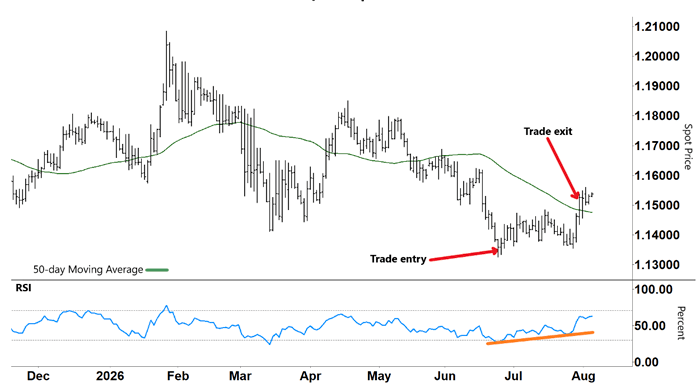
So we opened a long position to capture a mean-reverting move higher. Check out the chart…
|
|
EUR/USD Spot Price
|
|
|
|
Source: eSignal
|
|
As you can see, initially, the trade moved our way. But around mid-July, EUR/USD started pulling back, moving against our position.
|
|
Yet something important was happening beneath the surface. Although the pair was struggling, the RSI (orange line) was making a series of higher lows. That meant buying momentum was gradually building even though that wasn’t fully reflected in the price.
|
|
That was one reason we remained patient rather than bailing out of the trade. (Note, though, that we also had a hard stop-loss level.)
|
|
Eventually, the fundamentals gave us the catalyst we needed…
|
Tune in to Trading With Larry Live 
Each week, Market Wizard Larry Benedict goes live to share his thoughts on what’s impacting the markets. Whether you’re a novice or expert trader, you won’t want to miss Larry’s insights and analysis. Even better, it’s free to watch. Visit us on YouTube to catch the latest! |
|
|
The Fed Meeting That Turned the Trade
|
|
The initial move came following the Federal Reserve’s July meeting.
|
|
Markets had gone into the meeting expecting Fed Chair Kevin Warsh to reinforce the case for higher interest rates. And while the Fed’s statement certainly wasn’t dovish – three officials dissented in favor of an immediate 0.25% hike – it wasn’t as hawkish as markets had anticipated.
|
|
That’s an important distinction.
|
|
Markets don’t move simply because news is good or bad. They move according to how that news compares with what investors have already priced in.
|
|
With traders heavily positioned for a stronger USD going into the meeting, the moderately hawkish message was enough to trigger some unwinding of those positions. The dollar began selling off, pushing EUR/USD higher.
|
|
Then came another catalyst the following day.
|
|
Japan’s Ministry of Finance (MoF) intervened in the currency market to support the yen. The MoF sold dollars and bought yen. That put selling pressure on the dollar across the board – including against the euro.
|
|
That helped EUR/USD push decisively higher and through its 50-day moving average (MA, green line).
|
|
Oil also pulled back from its July 23 peak. That cooled inflation worries – and took away one argument for higher U.S. rates.
|
|
Importantly, this wasn’t necessarily a story about the euro suddenly becoming much stronger. It was primarily about the market repricing the U.S. dollar.
|
|
And that’s another important lesson with forex. You don’t necessarily need the currency you’re buying to become fundamentally stronger. Sometimes you simply need the currency on the other side of the trade to weaken.
|
|
With EUR/USD finally moving strongly in our direction – and uncertainty beginning to build again – I didn’t see any reason to get greedy. So we decided to take our profits off the table.
|
|
I know currency trading can seem complex at first. But when you break it down into its parts – interest rates, economic expectations, geopolitics, and what the technicals are telling you – the picture becomes much clearer.
|
|
And importantly, it gives us another market to trade when opportunities elsewhere are harder to find.
|
|
Happy Trading,
|
|
Larry Benedict
Editor, Trading With Larry Benedict
|
|
|
Get Instant Trade Alerts on Mobile!
|
|
|
|
Click the icon below from your mobile device to download The Opportunistic Trader app today for one-tap access to trade alerts, issues, and model portfolios for all of Larry’s services.
|
|
Available in the app store on Android and iPhone.
|
|
|
|














No comments:
Post a Comment