
Key Points
- Short interest in AirJoule Technologies has surged to record levels above 17%, reflecting concerns over cash burn, commercialization costs, and dilution risk.
- AirJoule faces a critical moment of truth involving UL certification and proving it can produce and deploy its technology at scale by 2027.
- Strong analyst conviction, heavy institutional accumulation, and an upcoming Kubota deployment catalyst suggest a possible short squeeze despite execution risks through 2028.
- Special Report: These gold assets are priced for $1,800 gold [it's over $4,000]
AirJoule Technologies (NASDAQ: AIRJ) is well-positioned to gain market share in the data center ecosystem and other water-dependent industries, but it faces hurdles and a moment of truth that will make all the difference. As good as the outlook is, risks remain and have been sufficient to keep short-sellers engaged.
Short interest is rocketing higher in Q3, up 25% as of early August to above 17% and at record levels, providing sufficient cause for concern. Shorts are focused on cash burn, commercialization costs and the timeline to revenue ramp—a combination that leaves the business at risk of needing capital and shareholders at risk of dilution.
AirJoule has already diluted shares, so the risk is real. Still, as of mid-August, the cash infusion is sufficient to keep the company operating for the foreseeable future, and commercialization is underway. Highlights from the Q2 report include updates on product launches and initial customer deployments, which remain on track. The company is slated to deliver several Core units this quarter, has one Prime unit in operation and being fine-tuned, and expects initial deployments by year’s end.
The moment of truth entails two critical events. The first is achieving UL certification, which is required for the widespread use of AirJoule technology and would significantly validate its products. The result will be more serious attention from end markets, including within the data center community.
Second, AirJoule must prove it can produce, deploy, and operate at scale, providing the expected utility for its customers. That is the linchpin in this chain, and it is not expected to be seen until sometime in 2027.
AirJoule Has Support—Short Squeeze Is Possible
AirJoule’s chart shows the market is strengthening, with price action supported. While shorts are selling, trading volume for this stock has risen, pushing the price higher alongside positive news flow. The news flow includes unveiling the Prime final design, commencing initial operations, and a deal with Kubota (OTCMKTS: KUBTY) that provides AirJoule with a global-quality distribution and service team.
Other technical factors to note include a strong MACD that is converging with the latest high and a move to fresh highs, suggesting a shift in dynamics. With this in play, a short squeeze is possible and requires only a catalyst to invigorate market appetite.
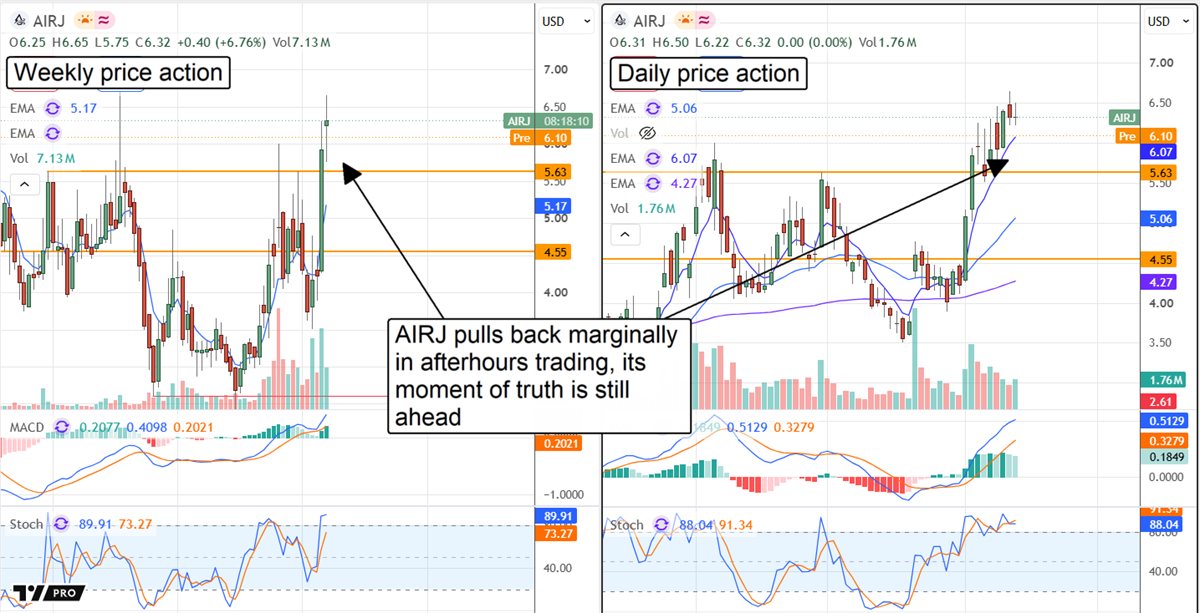
The nearest and most significant catalyst is the initial deployment of Core systems with Kubota. Kubota aims to incorporate them into a greater water collection, distribution, and treatment system for residential applications. Delivery of the first two units is expected this quarter, transitioning AirJoule from a purely speculative start-up into a revenue-generating business with global-scale partnerships. Meanwhile, deploying the first Prime to the Net Zero Innovation Hub will be a validating event, giving end users an up-close look at the tech.
Analysts and Institutions Underpin Market Action
Analyst coverage of AirJoule remains tepid, with only five tracked by MarketBeat, but analysts show high conviction in the Moderate Rating, with 80% of ratings pegged at Buy.
More importantly, the price target range suggests a price floor exists above the critical support target. The analysts’ low-end target is $6, well above the $5.65 support target, with consensus forecasting a move to $8.25, more than 30% upside from mid-August highs. While the Q2 results are unlikely to catalyze bullish behavior, they are likewise unlikely to alter analysts' positions. The likely outcome is that they maintain their ratings and wait to see what happens next.
Institutional coverage is more robust. This group owns more than 60% of the shares, which is high for a pre-revenue entity, and has been aggressively accumulating. MarketBeat data reflects a trailing 12-month balance of greater than $10 to $1, with activity ramping into early Q3.
Again, Q2 results are unlikely to accelerate activity but are likewise unlikely to alter support. The biggest risk is that accumulation slows as prices rise, leaving the market susceptible to noise and near-term, knee-jerk price movements.
Execution Risks and the Path to Profitability
The company’s biggest risks are execution and unexpected hurdles. Any delays and cost increases will be reflected in the share price, with downside potentially unlimited if commercial uptake fails. Cash burn is also a risk, as the company accelerates investment to advance its strategy. Delays mean additional losses and increase the risk of future dilution.
Current estimates suggest sufficient capital to fund operations and deployments into 2028, which may be enough to reach positive cash flow, but maybe not, especially if delays arise. The best-case scenario is that AIRJ’s uptake is quick and profit inflection occurs in mid-to-late 2028.
Read this article online ›

The best investment opportunities don't wait. Get our research and stock ideas delivered straight to your smartphone—so you never miss a market-moving opportunity. Our text alerts ensure you see timely stock ideas and professional research reports instantly, whether you're in a meeting, commuting, or away from your desk.
Get Text Alerts from American Market News (free)


No comments:
Post a Comment