| Read in browser | ||||||||||||||

AI’s biggest startups, OpenAI and Anthropic, have so far been largely silent about their impact on the climate. Today’s edition details how a new California regulation is likely to force the companies to publicly account for their footprints. Elsewhere, hybrid vehicles are experiencing a revival as consumers waver on high-priced EVs. And, while climate threats to Pacific island nations are on the agenda at this year’s COP31 summit, some regional leaders see the issue being eclipsed by security challenges and the impacts of the Iran war. AI’s climate change deadlineBy Olivia Raimonde and Summer Maxwell In a few short years, US artificial intelligence startups have grown into some of the most powerful and influential businesses in the world, reaching near-trillion-dollar valuations. As two of them, Anthropic and OpenAI, prepare for initial public offerings, there’s a notable absence: The companies haven’t disclosed their greenhouse gas emissions, made net-zero pledges or published sustainability reports. (Anthropic did join a carbon-removal coalition called Frontier.) 
Illustration: Daniel Zender
Not too long ago, investors would have cried foul. Even fossil-fuel stalwarts like ExxonMobil Holdings Corp. have been voluntarily producing sustainability reports for years. The Big Tech companies scaling up AI infrastructure — Alphabet Inc.’s Google, Meta Platforms Inc., Amazon.com Inc. and Microsoft Corp. — have net-zero goals and report their emissions, which are now spiking due to the data-center boom. But in an era of climate backlash, many investors have fallen quiet on the issue and US regulators have retreated. So the public is left guessing about how much climate pollution is tied to the large language models of OpenAI, Anthropic and SpaceX’s SpaceXAI, and whether the companies plan to curb it. While they aren’t yet public companies, their scale dwarfs what people associate with startups. Although precise numbers are lacking, it’s clear that the sector’s emissions are enormous. New gas plants for data centers in the US alone could soon generate as much climate pollution as the entire country of Australia, according to research by the nonprofit Environmental Integrity Project. 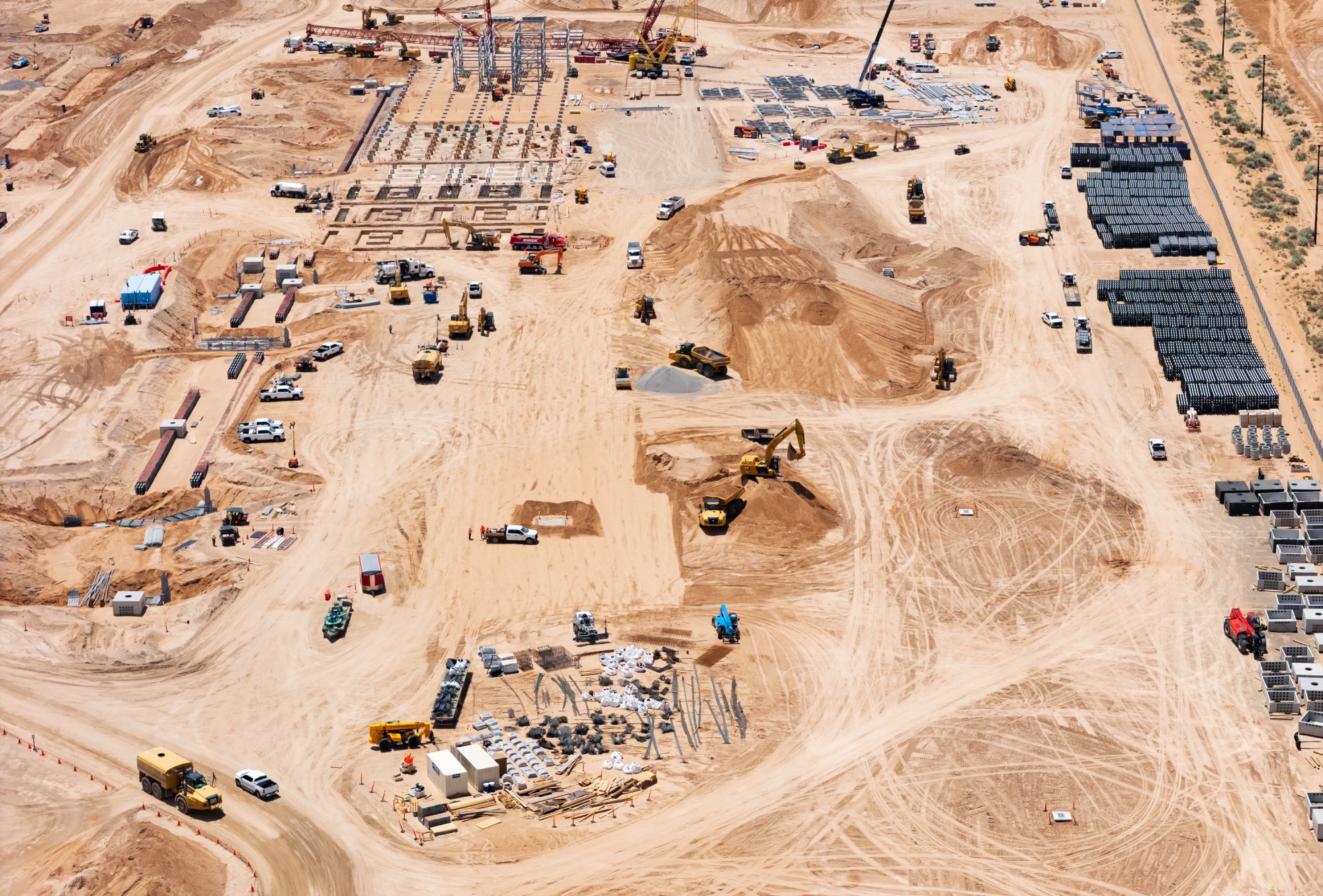
The construction site of Project Jupiter, a data center backed by tech giants like Oracle and OpenAI, in Santa Teresa, New Mexico.
Photographer: Rebecca Noble/Bloomberg
“They should absolutely be disclosing,” said Ioannis Ioannou, an associate professor at the London Business School whose research focuses on integrating sustainability into corporate strategy. “We’re talking about the potential environmental impact of a scale that we haven’t seen before.” Later this year, the AI newcomers will have to. California’s law SB253 begins to go into effect in November, requiring companies with more than $1 billion in revenue doing business in the state to report their Scope 1 and 2 greenhouse gas emissions. These measures account for the planet-warming pollution caused by a company’s operations and energy usage — and California’s regulations apply to activity outside the state. Both Anthropic and OpenAI may be able to delay reporting the bulk of their emissions. Since they rent data capacity from other companies, it’s possible they could choose to classify the related emissions as belonging to their supply chain, or Scope 3. California’s Scope 3 requirements are expected to go into effect in 2027. By 2029, after phased implementation, the EU’s Corporate Sustainability Reporting Directive would also require the companies to report all their emissions. But both Europe’s and California’s original deadlines were postponed, and there’s a possibility of further delays or walkbacks. Under pressure from the Trump administration, Europe has already narrowed its directive as well as pushing back the timeline for implementation. Business groups have lobbied against California’s law. As businesses across the economy embrace AI, the environmental unknowns become their problem too. “They don’t have any idea of the impact” of their usage, said Sasha Luccioni, co-founder and chief scientific officer of the Sustainable AI Group. “It’s really frustrating because I think a lot of folks want to make sustainability-minded decisions when it comes to AI, but then they’re just flying blind.”
Keep reading
Changing investor sentiment$82 billion Outflows in 2025 from funds focused on ESG or environmental themes, according to Bloomberg Intelligence. Better disclosure“It is time to come clean. If AI is to help build a better future, it must be honest about what it costs us now.” Antonio Guterres United Nations Secretary-General Guterres in June urged the AI sector to fully disclose its energy, water and land use and commit to using renewable power. A revival for hybridsBy Chester Dawson, Valentine Hilaire, and Alisha Sachdev Even with gasoline prices near a four-year high, global sales of electric vehicles are slowing dramatically as consumers balk at steep prices and spotty charging infrastructure. In this odd climate, hybrid cars are hot again after a quarter-century out of the limelight. Automakers are selling more of them than ever, and in more countries, ramping up production to meet demand. 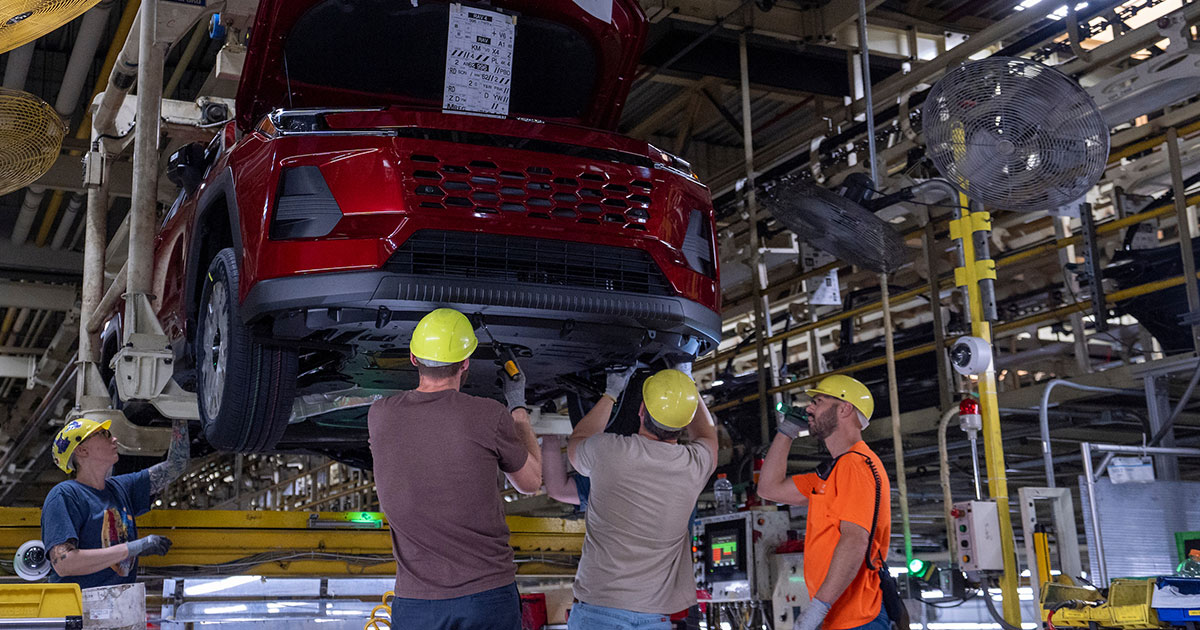
Toyota workers assemble a RAV4 hybrid at the company’s plant in Georgetown, Kentucky.
Source: Toyota Motor North America
Hybrids accounted for about 1 in 7 new cars sold in the US last year, up from less than 3% in 2020. In Spain hybrids make up almost half of all deliveries; in Japan, more than half. India, South America and Southeast Asia are expected to be the fastest-growing markets through 2035, according to research company GlobalData Plc. Global sales growth for hybrids and EVs will probably be about even in 2026, a sharp reversal from previous years. Hybrid sales are likely to rise in China as well — despite a government policy favoring EVs — while in the US demand is expected to more than double over the next decade. Even California is back on the bandwagon, with hybrid registrations overtaking those of EVs in the second quarter. “The consumer has spoken, and hybrids are a hit,” says David Christ, who leads the Toyota brand in North America. “We’re just going to keep building more.” The gasoline-electric category has come a long way since the Toyota Prius arrived around the turn of the century. Whereas hybrids were once seen as a pit stop in the transition to fully electric vehicles, consumers are choosing them over EVs in greater numbers because they are usually cheaper, have a longer driving range and can be refueled at any gas station. For automakers battered by inflation and tariffs, hybrids are also attractive, fetching a premium of $1,500 to $3,000 per vehicle over wholly gasoline-powered models, according to Edmunds.com.
Read more
🎥 Attention all filmmakers!Working on a short documentary about climate change? Don’t miss your chance to submit it to the Bloomberg Green Docs film competition. Grand prize: $25,000. Submissions will be accepted through October 2, 2026. See official rules at bloomberg.com/greendocs. This week’s ZeroThe Middle East conflict is now in its fifth month, deepening the oil and gas supply shock. Early in the war, analysts worried that the oil price would rise to $200 a barrel, causing a global recession and widespread panic, but that didn’t happen. This week on Zero, Akshat Rathi is joined by Bloomberg Opinion columnist Javier Blas to discuss why oil prices stayed around $100 per barrel and why the war is the start of a new paradigm in energy politics. Listen now, and subscribe on Apple, Spotify or YouTube to get new episodes of Zero every Thursday. Shifting Pacific prioritiesFor years, the Pacific islands managed something remarkable — some of the smallest nations in the world persuaded their larger, more powerful allies that climate change was the region’s defining security challenge and pushed them to act. 
Foreign ministers and top diplomats of the Pacific Islands countries attend the Pacific Islands Forum in Suva, Fiji, on Aug. 7.
Photographer: Ben Strang/AFP/Getty Images
Now, that hard-won focus is being tested as strategic competition with China and the impact of the Iran war on fuel supplies increasingly dominate the region’s diplomatic agenda. At the Pacific Islands Forum Foreign Ministers’ meeting in Fiji last week, China’s ballistic missile test in the Pacific last month and the Middle East conflict were the issues at the forefront of discussions. Papua New Guinea Foreign Minister Justin Tkatchenko said on the sidelines of the meeting that climate change was no longer the region’s priority. “In this situation we’re now facing with war all around the world, of course, it takes more priority than climate change,” he said. “Climate change has been put on the outer, really, at this point of time when we’re more interested in what oil we can get and how much we can get of it.” Anna Powles, an associate professor at Massey University’s Centre for Defence and Security Studies in New Zealand’s capital Wellington, said many Pacific leaders and organizations are concerned that geopolitical competition is overshadowing Pacific priorities, namely climate change. “There’s a frustration that clearly identified Pacific priorities, like climate change, are not getting the same level of attention that strategic competition is getting,” she said.
Read more
More from GreenMore from Bloomberg
Explore all Bloomberg newsletters. We’re improving your newsletter experience and we’d love your feedback. If something looks off, help us fine-tune your experience by reporting it here. Follow Us
You received this message because you are subscribed to Bloomberg’s Green Daily newsletter. If a friend forwarded you this message, sign up here to get it in your inbox.
|
Wednesday, August 12, 2026
AI giants face a climate reckoning









Subscribe to:
Post Comments (Atom)
Brian O. closed his NVDA SuperFly trade at 1,500%.
Arthur J. exited at 600%. Rockwell R. at 243%. ͏ ͏ ͏ ͏ ͏ ͏ ͏ ͏ ͏ ͏ ͏ ͏ ͏ ͏ ͏ ͏ ͏ ͏ ͏ ͏ ͏ ͏ ͏ ͏ ͏ ͏ ͏ ͏ ͏ ͏ ͏...

-
PLUS: Quantum threat pushes SEC into action ...


No comments:
Post a Comment