| Read in browser | ||||||||||||||


This is Bloomberg Opinion Today, a non-algorithmic feed of Bloomberg Opinion’s opinions. On Sundays, we look at the major themes of the week past and how they will define the week ahead. Sign up for the daily newsletter here. Subscribe to Bloomberg.com for unlimited access to all our coverage. Little ManI went to Berlin this month with my grown children to look at museums (some closed), art galleries (mostly closed) and döner kebab carts (open! open! open!).[1] But what we most enjoyed was spending a lot of time on street corners with this guy: 
Source: Oed/ullstein bild via Getty Images
Who after some time would change into this guy: 
Source: Oed/ullstein bild via Getty Images
At first we thought it was Our Lord and Savior transubstantiating into a döner-laden DoorDasher. But it turns out that while East Berlin may have been overwhelmed by the West in 1989, the former’s “Walk” and “Don’t Walk” icons — the beloved Ampelmännchen — survived the fall of the Wall. Just look at them! Sooooooo cute! Needless to say, customer traffic at the Ampelmann gift store on Unter den Linden was vast, brisk and made up largely of adolescent girls. Then there is the Ampelmänn genesis story, from the brand’s official site: “On October 13th, 1961, the traffic psychologist Karl Peglau submitted his suggestions in Berlin for new traffic light symbols, including very specific ones for pedestrians: the little East German traffic light men were born.” Traffic psychologist!! What a thing to put on your business card! Equally wonderful was how he came up with the idea: “One evening, watching television, he saw Erich Honecker wearing a straw hat, he declared that his Ampelmännchen would do so as well.” Yep, the last remnant of one of the most efficient police states in human history is a silly little man wearing the former communist strongman’s Panama! Even on vacation, however, the green-and-red scheme was a reminder of a more permanent stop-and-go in my life: The elevators in the Bloomberg mother ship in NYC don’t have the typical little white up and down arrows. Rather, a large lightbox flashes green for up or red for down, an appropriate visual reference to the market and trading charts that power our company’s bottom line. Well, that’s what I’m told anyway. As we all know, the specifics of just about anything market-related make my head sore. But I got to thinking that those cute little Ampelmännchen can simplify things for the finance-challenged like me. No need for candlesticks and scatters and vertical dumbbells and heatmaps when you can just rely on DoorDash Jesus. So herewith is my guide to some of last week’s financial news, rated one to five Ampelmännchen, based on fluctuations in literal stock, personal stock and even some livestock. The big news story was Meta’s acknowledgment that it, y’know, might have destroyed the brains of an entire generation of children and thus would cough up as much as $18 billion — a tad more than its profit in a single quarter! — to make them whole again. Our Dave Lee came to a less cynical conclusion. 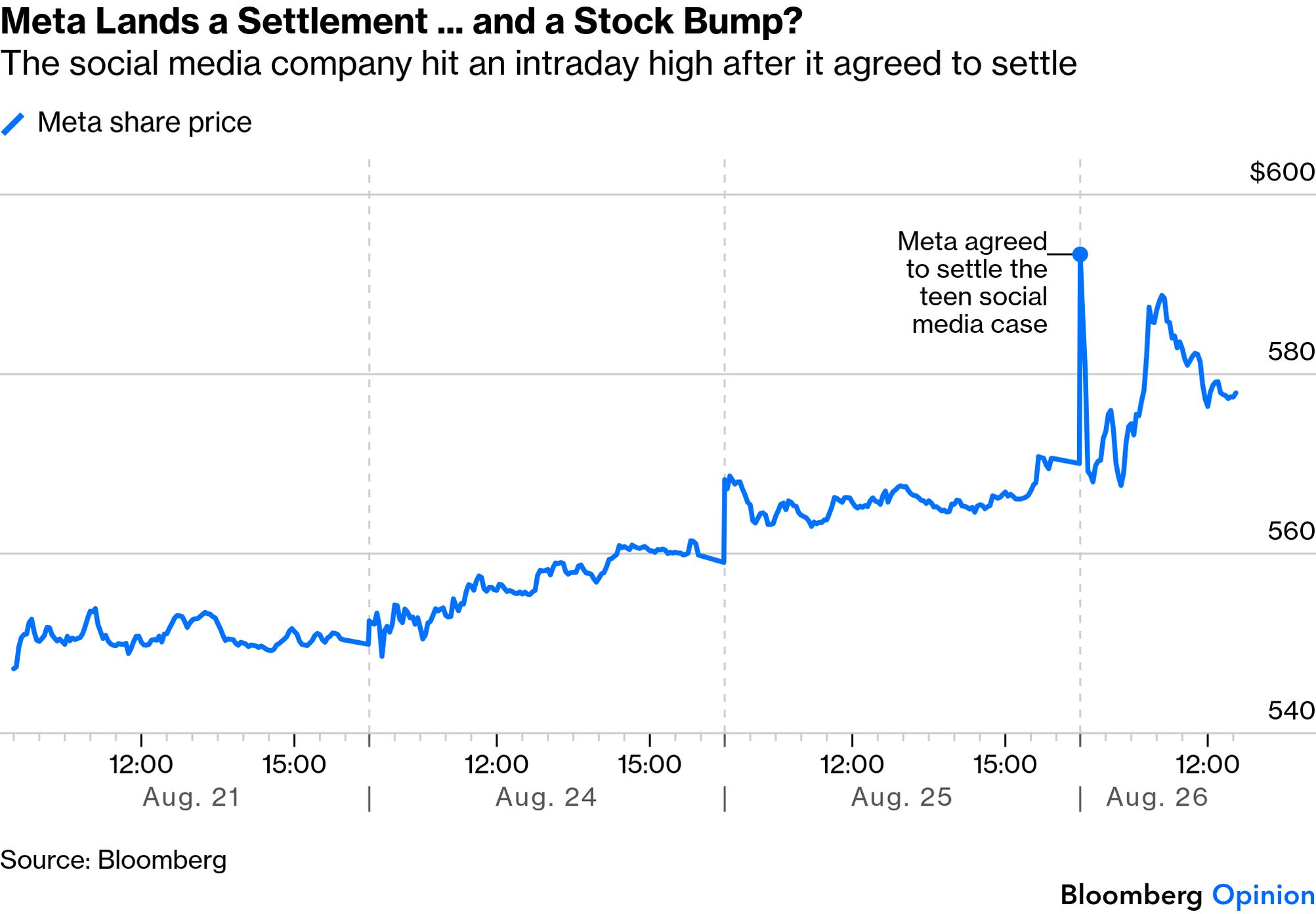
In the immediate aftermath of the announcement, Meta’s stock shot up by 1%, only to settle back into its long-term slide. Given the paucity of the punishment, I’ll give the company two green Ampelmännchen: 
Source: Oed/ullstein bild via Getty Images
For Facebook founder Mark Zuckerberg, who has yet to make a convincing display of contrition, a personal-stock drop of a single red Ampelmännchen: 
Oed/ullstein bild via Getty Images
While Meta was busy with legal trouble and parent outrage, Alibaba ran into something worse: Michael Burry. The hero of The Big Short is so skeptical of the ecommerce company’s $10.2 billion share sale that he moved his entire Alibaba position into rival JD.com Inc. “Alibaba’s American depository receipts tumbled 8.6% on Friday, making it the worst single-day decline in over a year, even as US-listed Chinese names rose,” Shuli Ren reports. “The odds of that happening is roughly 1 in 1,500 trading days, based on daily returns over the last five years.” For Alibaba: 
Source: Oed/ullstein bild via Getty Images
For Burry: 
Source: Oed/ullstein bild via Getty Images
On the other side of the Big Tech seesaw is a company that wasn’t even on the playground a few years ago. “Nvidia Corp. is not only tightening its grip on artificial intelligence, it’s also absorbing the companies fighting to keep the industry open and decentralized,” writes Parmy Olson. “On the same day the chip giant announced quarterly revenue that had doubled and would continue rising next year, sending its shares up 7%, news broke that it has reportedly agreed to spend $13 billion on Hugging Face, a platform for open-weight AI models” that “could rev up Nvidia’s cloud ambitions, giving it another way to rent computing power to AI makers.” 
Source: Oed/ullstein bild via Getty Images
John Authers, who took most of the week off but was still more productive than I’ve been all month, was on to another big winner. 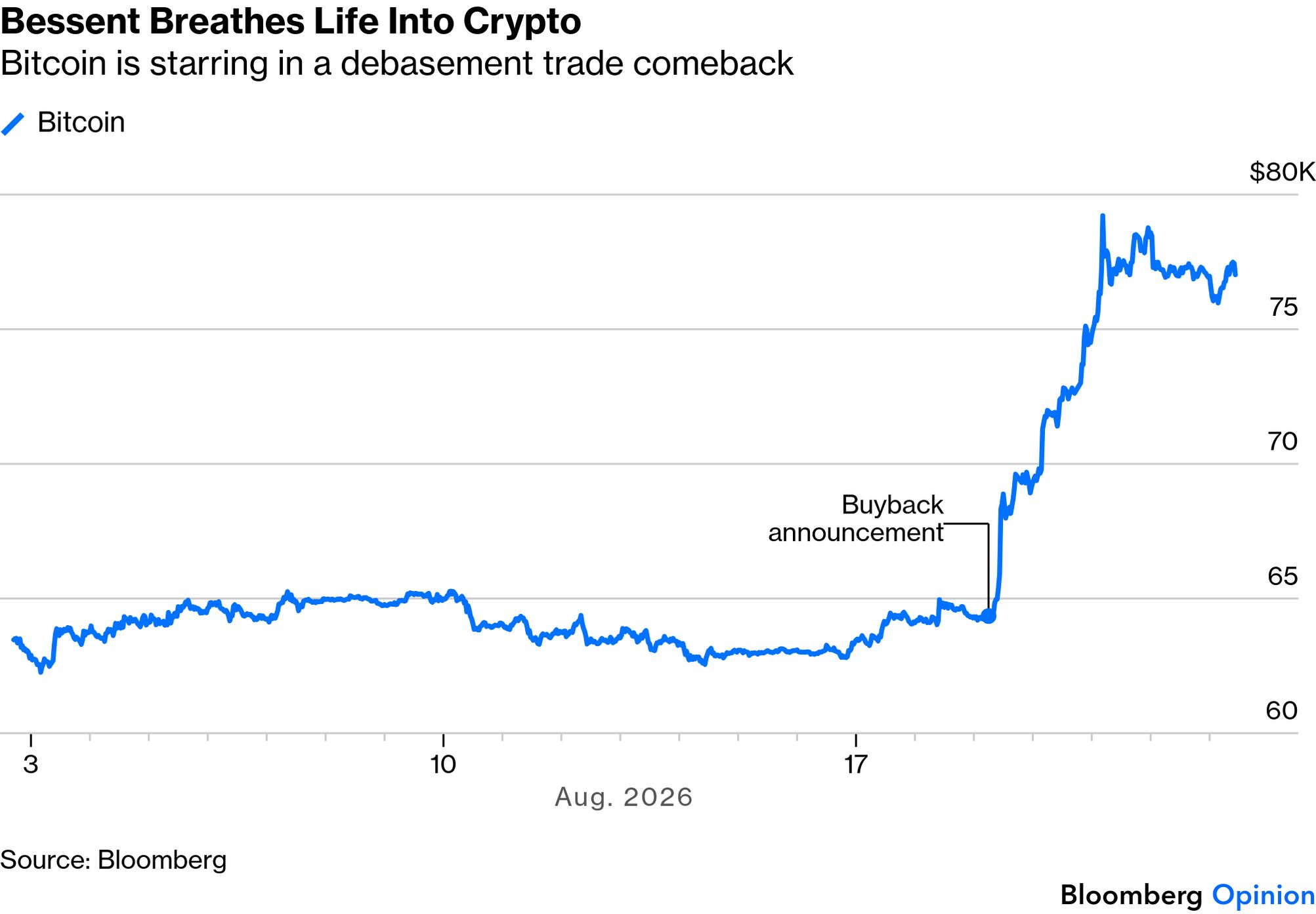
“Bitcoin’s uninspiring run this year is making a turn for the better. It needed a catalyst and Wednesday’s announcement from the Treasury Department that it will double the size of buybacks for longer-dated securities jolted the debasement trade — a bet against fiat currencies like the dollar – back into life,” writes John. “The cryptocurrency surged as much as 23% in the days following Secretary Scott Bessent’s decision.” For magical, invisible Bitcoin: 
Source: Oed/ullstein bild via Getty Images
Hold on a minute!!! Emily Nicolle is less impressed when she looks at the longer-term picture: “Bitcoin has long been in search of an established story to show that it has fundamental worth, and isn’t just a pure speculative asset,” she writes. “A hunt that’s become more necessary since it entered its teenage years and piqued the interest of heavyweight institutional money managers. It’s telling that it still hasn’t settled on a consistent or persuasive narrative.” Bitcoin may or may not be an effective dollar hedge, so I’ll hedge my rating: 
Source: Oed/ullstein bild via Getty Images
And Bessent’s personal stock? “Putting it mildly, Treasury Secretary Scott Bessent has had a disappointing month,” writes Jonathan Levin. “First, his dubious use of public funds to support Japan’s yen was called in question. Then he embarked on a futile attempt to manipulate the bond market, which led legendary hedge fund manager Stanley Druckenmiller to publicly upbraid his former mentee for the amateurish gambit. Finally, after promising to unleash ‘the greatest coordinated economic isolation in the history of the world’ on Iran, Bessent’s big reveal proved underwhelming, leaving far more questions than answers.” 
Source: Oed/ullstein bild via Getty Images
Bessent isn’t the only member of Donald Trump’s administration who wasn’t kicking back in August: “After US-Canada trade talks collapsed Friday, the United States imposed a 50% tariff on a long list of Canadian goods via the never-used Section 338 of the Tariff Act of 1930. US Trade Representative Jamieson Greer went on TV first thing Monday in an attempt to calm financial markets with some basic tariff math,” writes Scott Lincicome. “He said the new action hits a small percentage of Canadian imports into the US and an even smaller share of consumption, so there’s ‘no possible way it can really affect US well-being.’ ” Maybe, maybe not. 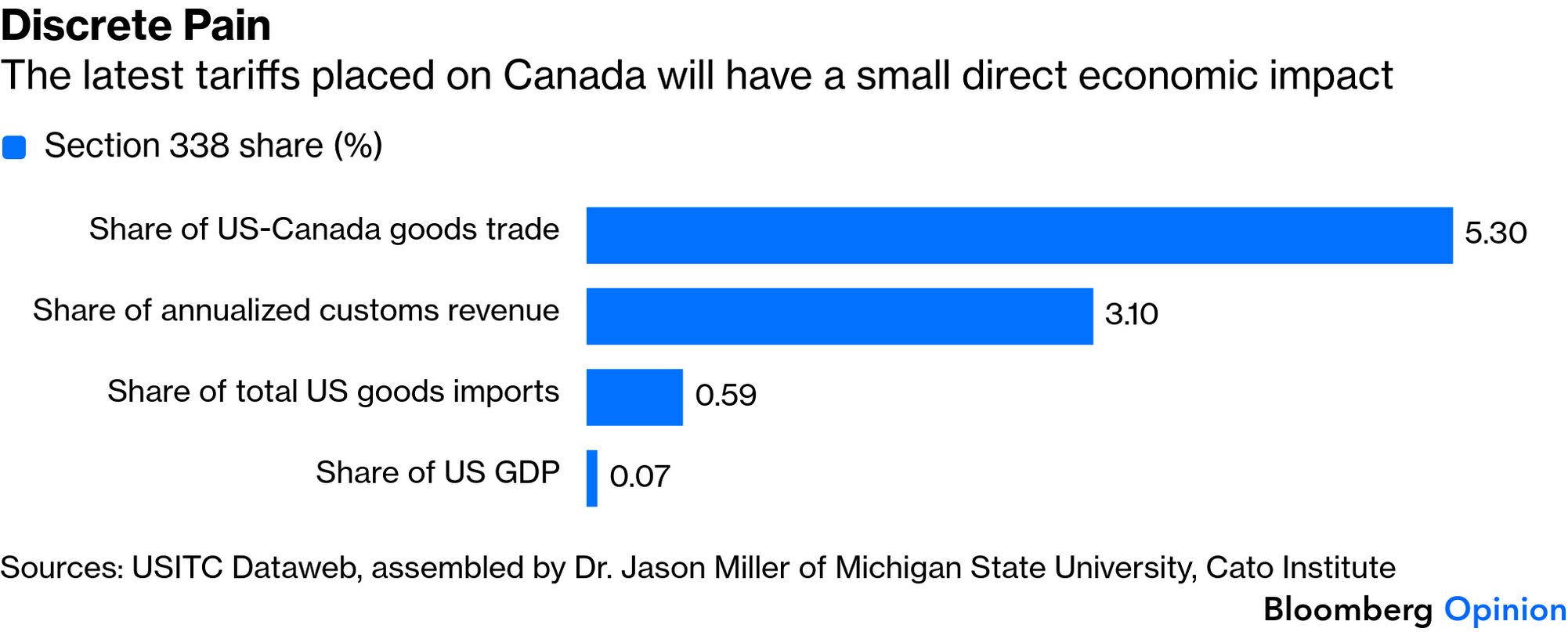
“Some discrete pain will nevertheless occur, especially where Canada is a major source of imports,” Scott adds, while “the spat injects significant new uncertainty into both the trillion-dollar bilateral relationship and the broader global economy.” For US consumers:
Source: Oed/ullstein bild via Getty Images
For Greer, Canada and everybody else: 
Oed/ullstein bild via Getty Images
Another busy beaver from Team Trump seemed to fare a bit better. “For the first time in his three months on the job, Federal Reserve Chair Kevin Warsh said the right things,” writes Jonathan Levin (again). “In his keynote speech Friday at the Federal Reserve Bank of Kansas City’s annual central banking event in Jackson Hole, Warsh acknowledged that inflation was elevated and widespread, and had been so for ‘far too long.’ He also said he would be ‘hard pressed’ to describe financial conditions in the economy as ‘restrictive,’ meaning he didn’t think the central bank’s current interest-rate settings were helping contain inflation.” For Warsh: 
Source: Oed/ullstein bild via Getty Images
Who had the worst week? “Asia’s second-richest business clan just made a highly public commitment to rein in its youngest scion’s passion project, a controversial wildlife sanctuary. In doing so, tycoon Mukesh Ambani is cutting the risks to his empire and ironing out a major wrinkle in his succession plans,” writes Andy Mukherjee. The problem: Turns out that at Anant Ambani’s supposed rescue center, Vantara, many of the “rescued” animals might have been caught in the wild. Not even a pre-nuptial Rihanna concert could put a gloss on that. As Andy puts it: “The shelter has gone from a showpiece of corporate altruism — Prime Minister Narendra Modi toured its veterinary hospital last year — to a publicity headache.” For the Ambanis, Modi and Rihanna: 
Source: Oed/ullstein bild via Getty Images
If the youngest Ambani really wants to collect Brazilian Spix’s macaws, African spurred tortoises and orangutans, he should just play Zoo Tycoon like us hoi polloi. Bonus Icon Reading
What’s the World Got in Store?
ChampionWhile anybody with a pulse knows the New York Knicks won the NBA championship, the team owners are winning off the court as well.[2] 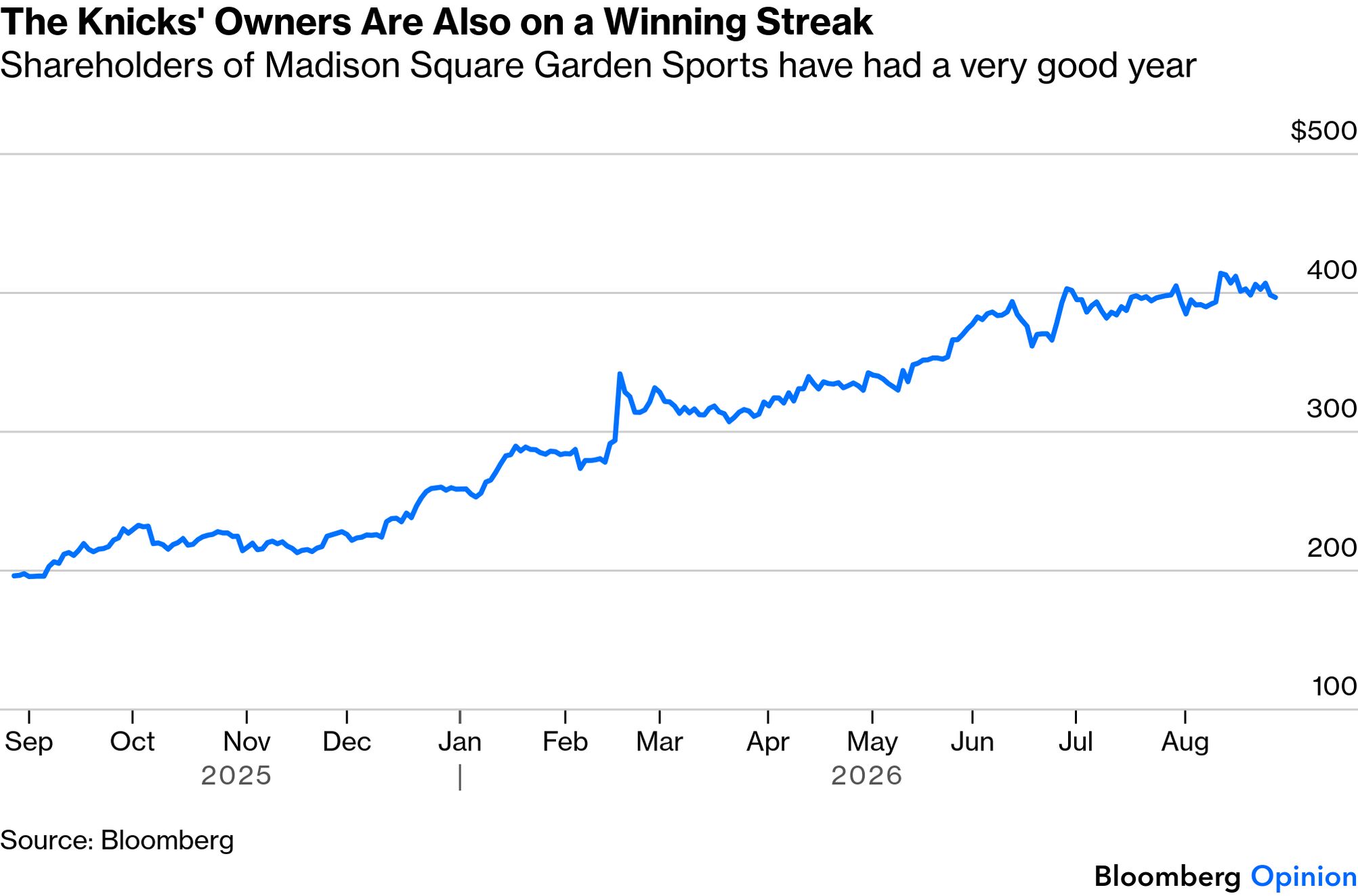
“The price of an oil company’s stock might be a function of the price of oil: If oil prices shoot up, oil-company stock prices will probably go up. For that matter, the price of a sports company’s stock might be a function of sports performance: If the Knicks win the NBA championship, for instance, the stock of Madison Square Garden Sports Corp. might go up,” writes Matt Levine. “In fact, the Knicks won the NBA championship in June, and MSGS is up more than 50% this year. I wouldn’t put a ton of weight on that one data point, and there are a lot of steps between ‘Knicks win games’ and ‘future cash flows available to MSGS shareholders are higher.’ But there is a connection, and in a very loose sense, MSGS’s stock is a bet on the Knicks to win a lot of future basketball games.” 
Source: Oed/ullstein bild via Getty Images
A basketball icon has been busy as well: “When LeBron James signed up to lead the Los Angeles Lakers to NBA glory with a $154 million contract in 2018, it wasn’t the biggest deal he did that year,” Bloomberg News reported last week. “Just months before he joined, a limited liability company he controls borrowed almost $300 million from a pair of Midwestern life insurers.” Who wins or loses here? “Somebody derives a coolness benefit from lending annuity money to LeBron James. Somebody — not a dispersed pool of retail annuity buyers, but a person — is sourcing and negotiating this loan on behalf of a life insurer,” Matt explains. “That person is handing James a big check and shaking his hand and saying ‘pleasure doing business with you,’ and is having more fun than the person handing over a similar-sized check for a pool of auto-loan receivables. Does this lower James’s borrowing cost, at the expense of the life insurance firm? Man I have no idea; just something to think about.” For LeBron:
Source: Oed/ullstein bild via Getty Images
For the starstruck guy handing over the check:
Source: Oed/ullstein bild via Getty Images
And for Finals MVP Jalen Brunson: 
Photographer: Andrii Shyp/iStockphoto via Getty Images
Note: Please send currywurst and feedback to Tobin Harshaw at tharshaw@bloomberg.net. Sign up here and find us on Bluesky, TikTok, Instagram, LinkedIn and Threads. We’re improving your newsletter experience and we’d love your feedback. If something looks off, help us fine-tune your experience by reporting it here. [1] We were also served a lot of potato, which the Germans seem to consider a green vegetable. On the plus side, we made it to the last day of the massive Brancusi show at the Neue Nationalgalerie, an absolute monster of more than 150 works that drew 320,00 visitors over the summer. I had one of those epiphanies of seeing the work of an artist I hadn't much cared for in larger context and coming to think, "Hey, this guy was pretty great." [2] The one downside of the Knicks' win is that the Dolan family owns almost a quarter of MSGS and the vast majority of its voting stock. Any former Cablevision subscribers will understand my sentiment. Follow Us
You received this message because you are subscribed to Bloomberg’s Opinion Today newsletter. If a friend forwarded you this message, sign up here to get it in your inbox.
|
Sunday, August 30, 2026
A big week for Nvidia, Burry and the little guy





Subscribe to:
Post Comments (Atom)
The $50 Trillion Robot Boom Starts at $10 an Hour
JPMorgan says humanoids are approaching a cost that undercuts warehouse labor. That is when a science project becomes an industrial market...
-
Revolutionary Stem Cell & PRP —Start Your Journey Today ...


No comments:
Post a Comment