“In politics, nothing happens by accident. If it happens, you can bet it was planned that way.” -Franklin D Roosevelt.
Over the past year, the Trump administration has executed a series of moves that – taken in isolation – look reckless, if not downright crazy.
Threatening to invade Greenland. Planning to annex Canada. Striking Venezuela. Seizing Russian oil tankers in international waters. Signing a relentless torrent of executive orders. Bombing Tehran.
The financial press has covered each event as if it exists in a vacuum.
They are wrong.
Every single one of these strange moves is closely connected.
And flows from a single, coordinated strategy – a 29-page National Security Strategy document published by the White House, laying out what we’re calling the “Donroe Doctrine”.
Trump's corollary to the original Monroe Doctrine of 1823.
The Monroe Doctrine was simple: keep European powers out of the Western Hemisphere. It defined America's sphere of influence for nearly two centuries.
The Donroe Doctrine updates that mission for the 21st century. Its target is not European colonialism – it is China.
And it changes everything about how you invest your money from here on out.
The Grand Plan
While America spent the last two decades bogged down nation-building in Iraq and Afghanistan, fighting the war on drugs, the war on terror, and mired in identity politics…
China was executing a quiet, methodical strategy of its own.
It poured more than $100 billion into Venezuela alone – building energy infrastructure, locking up oil exports, and establishing a critical nexus of influence stretching from Caracas to Tehran to Moscow.
It quietly cornered 70% of the world's rare earth mining and 90% of global processing – the critical materials without which no AI chip gets made, no GPU runs, no data center operates.
It built alternative financial systems specifically designed to weaken the U.S. dollar – settling oil transactions in yuan and gold, eroding the petrodollar's grip one transaction at a time.
While we were distracted, China was building an empire.
The Donroe Doctrine is America's response.
Not a diplomatic response or a policy response – a wartime response.
This Is What Mobilization Looks Like
I've spent 30 years studying how capital migrates from one side of the market to the other.
But this is unlike anything I’ve seen in my career.
In fact, the only time America has mobilized public and private money like this is during the throes of World War II – when freedom and democracy itself was at stake.
Think about what FDR did in 1941.
He drafted General Motors to build Sherman tanks. He conscripted Boeing to produce bombers. He mobilized General Electric, Caterpillar, Ford – the entire industrial complex of America – in service of a single national objective.
Private capital and public power moved in lockstep. Trillions of dollars (in today's terms) were channelled into a concentrated set of companies critical to the war effort.
And the investors who understood where that capital was flowing made fortunes that lasted generations.
Trump is running the same play.
Except this time, the battlefield isn't Europe. The weapons aren't tanks and bombers. And the critical resources aren't steel and rubber.
They are the physical foundations of artificial intelligence.
The energy to power it, the minerals to build it, the chips to run it and the infrastructure to scale it.
And the mobilization is already underway – at a scale that dwarfs anything FDR attempted.
Meta, Google, Amazon, and Microsoft committed more than $400 billion in 2025 toward data center construction, with that figure expected to hit $650 billion in 2026.
Apple is spending $500 billion – more than the entire GDP of Norway – to fast-track AI development on American soil.
The UAE has committed $1.4 trillion. Nvidia another $500 billion.
Threatened with 100% tariffs, Taiwan Semiconductor Manufacturing is relocating 40% of its chip supply chain to Arizona.
And for the first time in our history, the U.S. government is buying direct stakes in mission critical companies at the frontier of this war for control of the AI supply chain.
Trump has signed executive orders opening 625 million acres for offshore drilling, fast-tracking mining permits from years to days, and reopening retired coal and nuclear plants to meet the colossal energy demands of AI infrastructure.
I don’t necessarily like the way the President is going about his business. In my view, this level of command and control has the whiff of socialism about it.
But I learned long ago that the most dangerous (and costly) position to hold in the market is a moral one.
As investors, we have been given a map… a map telling us where trillions of dollars in urgent and mission-critical capital is headed.
All we have to do is follow it.
Where The Capital Is Flowing
History is unambiguous on what happens when a nation mobilizes like this.
During the First World War, U.S. Steel, General Motors, and Bethlehem Steel made fortunes for their shareholders.
During the Second World War, it was Lockheed, Ford, and Caterpillar.
During the Cold War, Northrop, Raytheon, General Dynamics, and Boeing.
In every case, the pattern was identical. Wartime capital flows fast. It concentrates into a narrow set of companies critical to the national objective.
And the investors who understood where it was going (before the rest of the market caught on) were the ones who built generational wealth.
That same pattern is playing out right now.
As money has flooded into the AI supply chain, the companies sitting at the chokepoints of America's colossal mobilization are already surging.
Stocks like Vertiv (+500% since 2024), GE Vernova (+700% since 2024), Arista Networks (+750% since 2021), and Taseko Mines (+370%since 2024) to name just a few.
And a critical event this December could accelerate everything. When world leaders gather in Miami for the G20 summit (at Trump's own resort) I believe the full scale of what he’s been building will become impossible to ignore.
Not just the AI mobilization.
Because the Donroe Doctrine isn't just a geopolitical strategy or an industrial initiative.
It is a historic monetary event.
Trump’s New Dollar
My new research tells me Trump's initiative will impact every aspect of your financial life – from your stock portfolio to your retirement account to your savings.
That extends, I can tell you now, to the dollar in your pocket.
Because buried within Trump's grand plan is something that will send shockwaves through American life:
A complete replacement of the U.S. dollar as we know it.
A new monetary order – already signed and sealed in the backrooms of the State Department – that will divide America into two groups:
Those who understand what’s happening to their money. And those who don't.
I've spent months making sure you end up on the right side.
By identifying one key investment you can make today to give you immediate exposure to what’s unfolding…
And uncovering five companies critical to Trump’s unstoppable drive to dominate the AI supply chain – and reset the dollar in the process.

Good investing,
Porter Stansberry
This Single Factor Is Holding Back Carvana’s Disruptive Edge
Written by Chris Markoch. Article Posted: 6/26/2026.

Key Points
- Carvana’s Q1 results showed record vehicle sales and improving margins, highlighting continued operational momentum.
- High auto loan rates may be the biggest obstacle for CVNA stock as financing-sensitive buyers face affordability challenges.
- Analysts remain optimistic on Carvana, but investors are waiting for Q2 earnings and clearer signals from the Federal Reserve.
- Special Report: Forget SpaceX. Buy the company Musk can't replace.
Carvana (NYSE: CVNA) delivered a genuinely impressive Q1 2026 earnings report that included a record number of units sold.
However, in the two months following that report, CVNA is down approximately 15% despite favorable analyst sentiment. That includes a 10% drop on June 17 in sympathy with cost commentary from CarMax (NYSE: KMX), even though Carvana's own unit economics are moving in the opposite direction.
An Elon Musk Fan's Warning About SPCX (Ad)
Jon Najarian called Tesla in 2014 when legacy automakers dismissed it. Now he's warning investors to skip SPCX - the largest IPO in stock market history.
He's not turning on Elon Musk. His concern is the math behind the deal.
Click here to hear Jon Najarian's full warning on SPCXAfter the company’s strong Q1 numbers, Carvana still appears to have operational fuel left in the tank. For example, the company’s AI-driven reconditioning tools haven't been rolled out at most facilities, meaning further margin expansion is still on the runway.
The company's new Stellantis (NYSE: STLA) hybrid hub model has also shown early traction. The Casa Grande franchise reportedly went from 30 to 50 units per month to more than 700 after Carvana took it over.
Why Is CVNA Under Pressure?
With all these positive factors supporting the stock's outlook, why is CVNA under pressure? Some may say the issue is valuation. At 41x forward earnings, Carvana is priced like a technology stock. But the company’s innovative, online-only model has been disruptive to a market that wasn’t known for innovation. And although the company doesn’t have a long history of profitability, the 41x figure is a discount to its historic average.
The company also cited the likelihood of lower gross profit per unit (GPU) in the coming quarter for a variety of reasons, including the year-over-year comparison to last year’s tariff anniversary. But that’s likely to be a one-time event and wouldn’t explain a sell-off that is now over 20% in 2026.
Carvana Is More Sensitive to Financing Conditions
The bigger factor weighing on CVNA is likely coming from something outside of its control: the near-term direction of U.S. monetary policy. The tone of Federal Reserve chair Kevin Warsh's statements on June 17 did not indicate that he intends to move toward an accommodative stance anytime soon.
The CME FedWatch tool agrees. The odds of a rate cut for the rest of 2026 are not even given a percentage. This may not satisfy investors looking for a neat mathematical reason to sell Carvana based on the company’s financials. But before dismissing it, here’s something to consider.
For an auto retailer, interest rates matter because auto loan rates are among the stickiest in consumer credit. The average used car APR is well above 11%. Trade-ins increasingly carry negative equity. A consumer who barely qualifies at current rates gets squeezed harder if rates hold or rise.
Something else to consider: Carvana's competitor CarMax recently delivered earnings and, despite beating estimates and growing penetration, saw net income drop nearly 12% to $185.6 million as it cut prices to defend volume. Its loan-loss reserve also climbed to 2.95% of loans, up from 2.78%, as the company leaned harder into Tier 2. This is a category of consumers with strong but not top-tier credit who usually qualify for rates that carry a cost premium.
The typical Carvana customer skews to a lower FICO score than CarMax and is more dependent on financing. When rates stay high, marginal buyers are the first to be disqualified, and those are disproportionately Carvana's customers. There's also a K-shaped wrinkle to consider. Upper-income consumers are still spending, but they're prioritizing travel and experiences over big-ticket vehicle purchases.
That does give fundamental investors something to consider. Restrictive policy compresses growth multiples hardest. At a 41x forward multiple, Carvana needs growth to deliver.
If higher-for-longer rates take $1 of earnings per share (EPS) away from CarMax, it could take 10x off CVNA's multiple. That puts Carvana’s 5-for-1 split last quarter into a different light.
Analysts Remain Bullish, But Technicals Stay Weak
Institutional buying was down sharply in the last quarter, but since the company’s earnings report, analysts have been mostly bullish on CVNA. The Carvana analyst forecasts on MarketBeat show a consensus price target of $93.14 as of June 24, representing a significant gain for investors. However, investors may have to wait until after Carvana reports earnings next month to get a better picture of analyst sentiment.
The CVNA chart shows a stock that continues to be in a downtrend, with recent rallies failing to break through the 200-day simple moving average. A bigger concern for investors may be volume, which is down sharply. The MACD also remains below its signal line, with the histogram near zero. There’s simply no real conviction one way or the other, which amplifies short interest of around 7%, which in and of itself isn’t bearish.
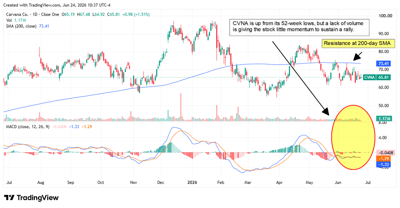
The next potential catalyst comes with Carvana's Q2 earnings report scheduled for July 29. Until then, CVNA is likely to remain tethered to macro signals rather than its own execution. The numbers say the company’s business model is working. The question is whether the Federal Reserve cooperates before the multiple compresses further.
Marathon Petroleum Is Back, But Cycles Still Matter
Written by Peter Frank. Article Posted: 6/24/2026.

Key Points
- Marathon Petroleum’s first-quarter rebound was driven by stronger refining margins, improved cash flow and positive renewable diesel earnings.
- Marathon Petroleum continues to return significant capital to shareholders through dividends and share repurchases.
- Marathon Petroleum remains exposed to commodity cycles, crack spreads, refinery downtime and regulatory risks despite its strong operating momentum.
- Special Report: Forget SpaceX. Buy the company Musk can't replace.
Marathon Petroleum (NYSE: MPC) is one of the most powerful energy companies in the United States, and as expected, it is having a very good year.
With an earnings rebound in this year’s first quarter, stronger refining margins, positive returns from its renewable diesel business, and surging cash from operations, the company is also, as usual, returning substantial capital to shareholders.
Sell these "safe" blue chips immediately (Ad)
Marc Chaikin, founder of Chaikin Analytics, says two forces - AI disruption and fracturing global trade - are triggering a historic wealth transfer already underway in 2026. Household names like Intuit (-57%), Boston Scientific (-49%), and Tractor Supply (-40%) are cratering, while lesser-known companies like Sandisk (+573%) and Rackspace (+444%) surge.
Chaikin has identified specific stocks he believes investors should sell before they fall further - and the names may surprise you. He's also pinpointing a company tapped as Nvidia's self-driving partner and a potential AI megadeal that could split into three high-growth stocks.
Stream his free presentation to get every buy and sell recommendation with no membership or credit card required.
Watch Marc Chaikin's free presentation and get his full buy-and-sell list todayThe question is not whether the business is performing well. It is whether the cycle driving these results will last long enough to justify buying the stock at current prices.
Multiple Sources of Earnings
Marathon operates the nation’s largest refining system, but it is not a single-play investment. With 13 refineries and a daily refining capacity of roughly three million barrels, the company also produces, stores, transports, and sells gasoline, diesel, and other refined products.
It also owns a large retail network of nearly 8,000 locations, mostly under the Marathon and ARCO brands. In addition, its fee-based midstream business and growing renewable diesel segment give it additional sources of cash that help offset cyclical weakness in refining.
Strong Refining Drove First-Quarter Rebound
The first quarter of 2026 showed what Marathon can look like when the refining cycle cooperates.
Total revenue for the quarter came in at $34.6 billion, up 8.5% from the first quarter of 2025 and ahead of analyst estimates. Net income attributable to the company reached $511 million, or $1.73 per diluted share, compared with a net loss of $74 million, or 24 cents per diluted share, in the same quarter a year earlier.
Adjusted net income was $487 million, or $1.65 per diluted share, more than twice what analysts expected. Cash from operations reached $1.1 billion, compared with a negative $64 million a year earlier. Adjusted earnings before interest, taxes, depreciation, and amortization (EBITDA) were $2.8 billion, compared with $2 billion in the first quarter of 2025.
Midstream and Renewable Diesel Added Stability
The standout segment in the three months was refining and marketing operations. Adjusted EBITDA came in at $1.4 billion, up from $489 million a year earlier. Segment margin improved to $17.74 per barrel from $13.38 per barrel, while adjusted EBITDA per barrel soared to $5.37 from $1.91.
The company’s midstream business, including pipelines, storage terminals, and processing facilities, continued to serve as a fee-based revenue generator that is largely disconnected from commodity price swings. Conducted through MPLX LP, the segment’s adjusted EBITDA was $1.6 billion in the quarter, down modestly from $1.7 billion a year earlier but still a dependable contributor.
Marathon’s growing renewable diesel operations also contributed. Adjusted EBITDA in that segment turned positive at $38 million, compared with a loss of $42 million in the year-ago period.
Wall Street and Shareholder Returns Support the Stock
Given these results, the company’s recent stock appreciation is no surprise. Currently trading near $250 per share, the stock has delivered a year-to-date return above 50%.
Of the 19 analysts following the company, the 12-month average consensus target is $272.94, with a recommendation of a Moderate Buy. After a recent analyst price target raise and several institutions buying into the stock, the highest current 12-month target is $344 per share, while the lowest is $210.
The company’s heavy capital returns also support the share price. Marathon returned more than $1 billion to shareholders in the first quarter alone, and its board approved an additional $5 billion share repurchase program, bringing total available buyback capacity to $8.6 billion.
The company also pays a quarterly dividend of $1 per share, which, at recent share prices, translates to a yield of about 1.6%.
Expansion Projects Aim to Improve Flexibility
The energy market, however, can change rapidly, and the past several months have offered proof of that. West Texas Intermediate crude oil started the year below $60 per barrel and soared to nearly $115 by early April. The current price is in the mid-to-low $70s. With crack spreads at historically high levels, prospects for continued strong earnings in the short term should be good.
Marathon, for its part, is looking to reduce some of that unpredictability. During the first quarter, the company brought its Garyville jet fuel flexibility project online, and an upgrade to its El Paso refinery’s fluid catalytic cracking unit is due in the second quarter. A jet fuel project at its Robinson refinery is targeted for the third quarter. By broadening its product mix, the company is aiming to increase its ability to shift output as market conditions change.
Commodity Cycles and Operational Risks Remain
The risks in the energy business, though, can be obscured by good times. Much of the first-quarter improvement came from favorable market conditions, and those can reverse quickly.
A year ago, the quarter was hit by lengthy planned maintenance, which reduced throughput and increased costs. Crack spreads were smaller, and the company reported a loss. Later in the year, fire-related downtime at one of its refineries helped contribute to lower-than-expected earnings.
In addition, the company’s own risk disclosures flag regulatory changes, geopolitical disruption, tariffs, inflation, interest rates, environmental liabilities, and unplanned outages as material uncertainties. Competition from others in the energy sector, including Valero Energy (NYSE: VLO) and Phillips 66 (NYSE: PSX), is also ongoing and intense.
Even strategies to protect against price fluctuations do not always work as intended. Much of the decline in earnings from its midstream segment came from a $77 million loss tied to derivative losses on its hedging activity.
A Strong Company in a Cyclical Industry
These days, given the state of the world, it is easy to see how energy companies can thrive. But cycles can quickly turn and punish even the best operations.
For investors who want energy exposure in a diversified portfolio, Marathon is a strong choice. It is a well-run company with a clear capital return strategy, improving operational quality, and a midstream business that provides income stability.
But it is not a guarantee. Investors should be willing to think in terms of commodity cycles rather than quarter-to-quarter stability. For many value investors, the energy sector is a marathon, not a sprint to the finish.
to bring you the latest market-moving news.
This email message is a sponsored message provided by Porter & Company, a third-party advertiser of TickerReport and MarketBeat.
Contact Us | Unsubscribe
© 2006-2026 MarketBeat Media, LLC dba TickerReport. All rights protected.
345 North Reid Place, Sixth Floor, Sioux Falls, S.D. 57103. USA..


No comments:
Post a Comment