The Factory Town That's Running Out of MoneyBy Joel Litman, chief investment officer, Altimetry
 In Ingolstadt, Germany, auto manufacturer Audi employs about 40,000 people and anchors the local economy... In Ingolstadt, Germany, auto manufacturer Audi employs about 40,000 people and anchors the local economy...
Things have gotten tough in the past few years, though. Consumer weakness, punishing auto tariffs, and slumping demand for SUVs and electric vehicles have taken a toll on Audi's business. Audi global sales dropped around 12% in 2024 and 3% in 2025. And U.S. sales fared even worse, falling 14% in 2024, 16% in 2025, and 17% in the first half of 2026. For decades, Audi's manufacturing model was strong. It supported high-paying jobs, local tax revenue, and public investment. That helped preserve Ingolstadt's infrastructure and the skilled workforce the company needed. But that loop is now running in reverse. As Audi and its parent company Volkswagen (VOW3.DE) have struggled, Ingolstadt's business-tax revenue has fallen by half. This has had real-world consequences for the town... Regional German authorities have rejected Ingolstadt's budget, halted new investments, and left major public projects frozen. One deteriorating school became so unsafe that students had to be removed. When an automaker's slowdown reaches city hall, investors start treating the damage as permanent. And now Volkswagen is being priced for extinction. This is despite Volkswagen remaining profitable and projecting €3 billion to €6 billion of net cash flow this year. As we'll discuss today, investors are far too pessimistic about Volkswagen's stock price. All the company has to do to beat expectations is avoid a collapse. And if conditions merely stabilize instead of deteriorating further, the upside could be substantial. Volkswagen was once a symbol of German manufacturing strength. Today, its stock tells a very different story...Shares have fallen roughly 65% over the past five years. At around €73 today, Volkswagen trades as though years of declining profits are still ahead.
However, we can see that investors have taken the pessimism too far through our Embedded Expectations Analysis ("EEA") framework. The EEA starts by looking at a company's current stock price. From there, we can calculate what the market expects from the company's future cash flows. We then compare that with our own cash-flow projections. In short, it tells us how well a company has to perform in the future to be worth what the market is paying for it today. Volkswagen's Uniform return on assets ("ROA") has been 6% or higher for each of the past five years. That said, investors currently expect its Uniform ROA to plummet to 1% by 2030. Take a look... 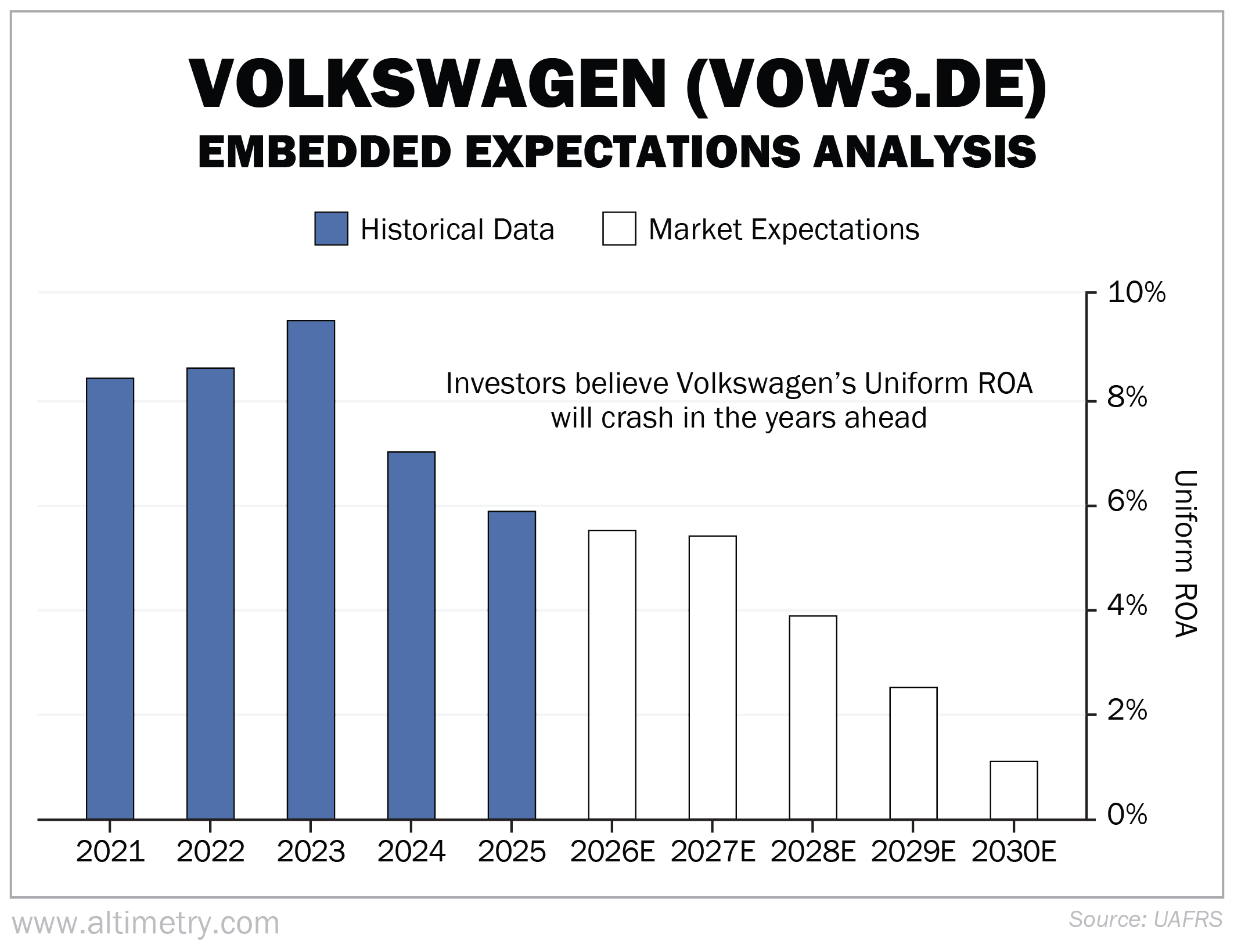
A 1% Unform ROA would be a dramatic break from the company's history. See, Volkswagen has survived major crises before... During the peak of the Great Recession in 2009, the company's Uniform ROA stayed above 2%. And it recovered to 7% by the next year. Similarly, when Volkswagen was dealing with a major emissions scandal in 2015, its return never dropped below 6%. Also, the company's portfolio remains broad, with both low-end brands (like Audi and Skoda) and high-end brands (like Bentley and Lamborghini). That diversification has helped Volkswagen weather recessions and industry downturns before, and there's little reason to think this time will be different. Simply put, even if the company isn't able to reclaim its past highs, the current valuation is just too negative. The bar for a recovery has collapsed...Volkswagen is clearly facing some problems today. Its sales are slowing, and exporting cars has gotten more expensive thanks to tariffs. Investors have responded by pricing Volkswagen as though those pressures will destroy nearly all of its economic profitability. However, that outlook seems far too extreme... Even if the struggles continue, Volkswagen can still outperform the expectations embedded in its shares. We believe that stable, mid-single-digit Uniform ROA through the rest of this decade is possible. That would already represent a far better result than the market's near-zero forecast. Volkswagen remains an automotive titan. All it has to do is survive to beat investor expectations. If the company simply proves it's more resilient than the market expects, the stock could rebound. Regards, Joel Litman
July 21, 2026
|




No comments:
Post a Comment