One Warning Erased Five Years of ConfidenceBy Joel Litman, chief investment officer, Altimetry
 International Business Machines (IBM) delivered a modest earnings warning last week... International Business Machines (IBM) delivered a modest earnings warning last week...
And the market snapped back with the company's worst trading day ever. Shares plunged 25%, wiping out roughly $69 billion in market value. IBM has estimated its second-quarter revenue at about $17.2 billion. That would be just 1% above the prior quarter and well below the 5% growth analysts expect. Future expectations made investors especially nervous... Management warned that IBM's customers aren't spending money like they used to. They've rushed through AI-infrastructure purchases due to rising equipment costs. In addition, IBM's routine software and consulting projects slipped down the priority list, particularly when Anthropic's Claude Mythos came on the scene. This AI model could exploit the toughest cyber defenses. And it forced companies like IBM to rethink their technology budgets. Today, we'll measure IBM's recent sell-off against its five-year turnaround... to understand investors' expectations and where the company is headed next. Back in 2020, IBM was still tied to mature hardware...It sold mainframes, power systems, and storage solutions for hybrid cloud environments. IBM's Uniform return on assets ("ROA") was roughly 16%. That was its lowest level since the early 2000s. Management spent the next five years pushing the company toward AI-strategy consulting. IBM wanted to be the go-to for large companies that needed to modernize complex tech systems. That helped IBM grow revenue... Its Uniform ROA recovered to the low 20% range by 2021, held that level through 2023, and then surged above 30% in 2024. Investors began treating IBM as a stronger, more efficient service platform. At one point, the stock more than tripled from its pandemic low.
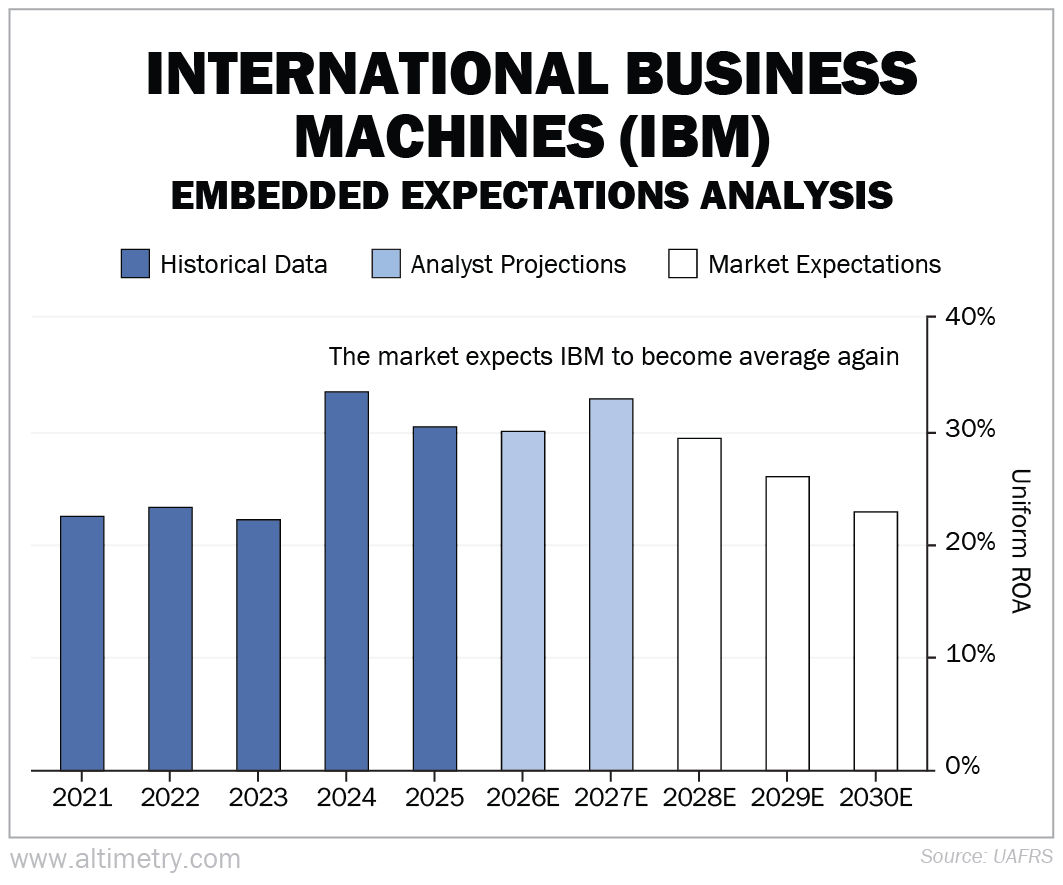
Its combination of software and consulting seemed to generate more recurring revenue... until the current quarter. Customers pivoted to expensive AI hardware and cybersecurity solutions. And the company failed to meet the demand. IBM's preliminary results showed that AI infrastructure revenue fell 7%... even as software revenue grew 5%. Investors worried that the good times were over for IBM...We can see this through our Embedded Expectations Analysis ("EEA") framework. The EEA starts by looking at a company's current stock price. From there, we can calculate what the market expects from the company's future cash flows. We then compare that with our own cash-flow projections. In short, it tells us how well a company has to perform in the future to be worth what the market is paying for it today. IBM's Uniform ROA climbed to roughly 33% in 2024 and remained near 30% in 2025. Analysts expect its Uniform returns to hold around that level during the next two years. The market is more conservative. It's expecting IBM's Uniform ROA to fall to about 23% by 2030. Take a look...
That forecast seems harsh given IBM's strongest years. But across the company's history, that would be fairly ordinary profitability. We see a healthy company whose Uniforms returns could settle back into their long-term range. IBM's recent sell-off marks the beginning of another chapter...The company enjoyed strong profits as businesses moved their workloads to the cloud and invested in AI systems. That said, Anthropic's Claude Mythos forced IBM to shuffle its priorities this year. Management also admitted that the company was slow to adapt to AI. And it allowed several large deals to slip by. All of this indicated that IBM might not be able to post record profits for much longer. The company's earnings report comes out later today. And the market is expecting IBM to return to business as usual... That might happen sooner than we expected. Regards, Joel Litman
July 22, 2026
|







No comments:
Post a Comment