Japan Is Facing a $2.3 Trillion Stress TestBy Rob Spivey, director of research, Altimetry
 For decades, Japan's financial system acted in a stable manner... For decades, Japan's financial system acted in a stable manner...
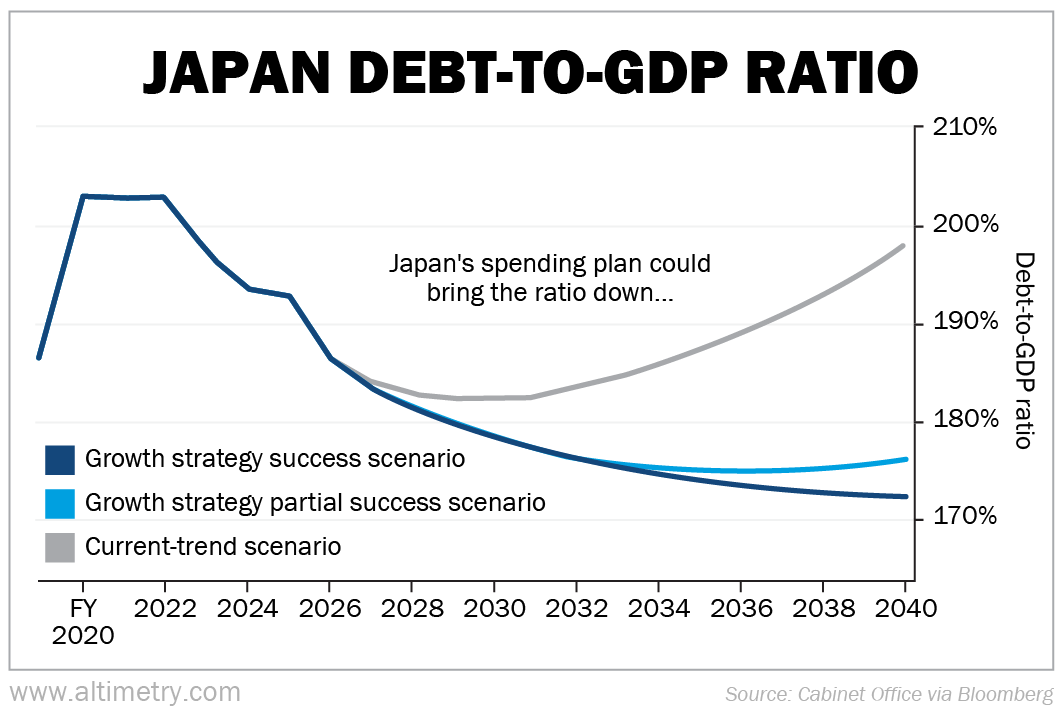
The Bank of Japan kept interest rates near zero... which made the country a popular market for international borrowers. Investors from all over could borrow for basically free... then invest in other markets where they could get higher returns. At the same time, low interest rates kept the Japanese yen weak... while keeping the bond market stable. Investors could treat currency frailty and bond-market strength as two parts of the same policy. But now, that typically inverse relationship is breaking down... The yen and Japanese government-bond prices are now falling together. And when bond prices fall, bond yields rise. The benchmark 10-year yield recently reached 2.87%, its highest level since 1996. And the 30-year yield climbed above 4%. This is being spurred by a massive sell-off in government bonds. Investors are saying the cause is Prime Minister Sanae Takaichi's plan to spend $2.3 trillion over the next 14 years. Today, we'll explain why this sell-off makes long-term Japanese bonds less attractive while strengthening the case for companies powering Japan's domestic economy. The bond market's warning deserves attention...You see, Japan has the highest debt-to-GDP ratio of any developed nation, at 187%. The International Monetary Fund estimates that Japan's government spent 1.5% of its GDP paying off interest in 2025 alone... and that's expected to more than double by 2031. This is because Japan will need to refinance older debt at higher rates... meaning even more of the government's budget will go toward interest payments. That leaves less room for other spending and can force the government to issue even more bonds. That's why bond investors are worried today... but the good news is Japan's economy is finally heating up.
| Recommended Links: |
|
 Here's What You Missed Yesterday It could be the discovery of the century – and it could make you a LOT of money, starting today. For the past several months, a former algorithm expert from Goldman Sachs has been testing a theory... that stocks and satellites move in the exact same pattern over time. And now, he's launching a new stock-picking breakthrough that proves that theory to be correct. It just delivered gains of 263%, 444%, 678%, and even 2,487% in back testing... along with 100% win rates on many stocks. Access the world premiere here (includes a free recommendation). |
|
|
You see, Takaichi's $2.3 trillion spending plan is expected to help the country catch up in several areas where the U.S. and China currently lead... including semiconductors, AI, and healthcare. Directing spending toward popular industries should, in turn, spur Japan's economy and bring down its debt-to-GDP ratio. Its goal is to bring the ratio down to roughly 170% by the end of the spending plan...
While bond investors are worried about Japan's debt levels today, the government is playing the long game. It's spending money now to boost corporate profits, which will help pay that debt down in the coming years. Companies are confirming the investment cycle is underway...The Bank of Japan raised its interest rate to 1% in June. Even at that level, companies are still trying to borrow more. Private bank lending has been growing at roughly 4.5% to 5.5% year over year, while corporate bond issuances have risen around 7%. That shows that companies are investing in the economy... and the government's plan to ramp up spending will only support that growth. The bond market seems to be pricing in the worst-case scenario...But this is likely what the Japanese government wanted to achieve. Low rates were great for the bond market, but they made it tougher for the economy to grow. Japanese companies stand to benefit as more money flows into automation, semiconductors, shipbuilding, energy, defense, and advanced manufacturing. The key is whether Japan's economy keeps growing fast enough to absorb higher interest costs. Rising investment, healthy corporate funding, and stronger profits all support that outcome. So far, those trends are all working in Japan's favor. As long as economic growth keeps pace with the rising debt burden, the bond sell-off should not derail the bullish case for Japanese stocks. Regards, Rob Spivey
July 16, 2026
|






No comments:
Post a Comment