| Read in browser | ||||||||||||||


Welcome back to Pursuits Weekly, our look at the world’s biggest culture stories, as well as ideas and recommendations around travel, dining and art. This week, I wrote for Bloomberg Weekend about the aesthetics of debt. I’d love to hear your thoughts. And sign up here to get this newsletter every Saturday in your inbox! Dining is destiny
Illustration by Pat Thomas for Bloomberg Businessweek
One of the most memorable dinners of my life took place in the improbable setting of Tarrytown, New York. Just before you get to the state thruway, you’ll pass a grand estate that used to be owned by John D. Rockefeller and that now serves as the residence of the Nigerian ambassador to the United Nations. If you’re lucky enough to be invited to dinner there, you’ll eat in a beautifully appointed room and enjoy not only a series of spectacularly prepared West African specialities, but also a lengthy and lively conversation. Food has been a social adhesive for millennia, far predating the institutionalization of the restaurant. Outside foodie culture, it’s normally a means to an end: When you have people over for dinner, or even when you meet them at a restaurant, you don’t want the food to overshadow the broader conviviality. One of the reasons so many people have a problem with tasting menus is precisely that it’s hard to keep the communal flow going when you’re constantly being interrupted by new courses and descriptions thereof, or even just being encouraged to focus more on culinary artistry than on your fellow humans. I have a new column about the range of different ways that eating with friends varies around the world — txokos in Basque country, braai in South Africa, asado in Argentina. One central theme is that, in many parts of the world, including parts of West Africa, it’s a terrible idea to judge a city’s food by its restaurants. Another is that you can often get a good sense of where and how people eat in a certain city just by looking at the ratio of its grocery prices to its restaurant prices, as seen here on this scatter plot. 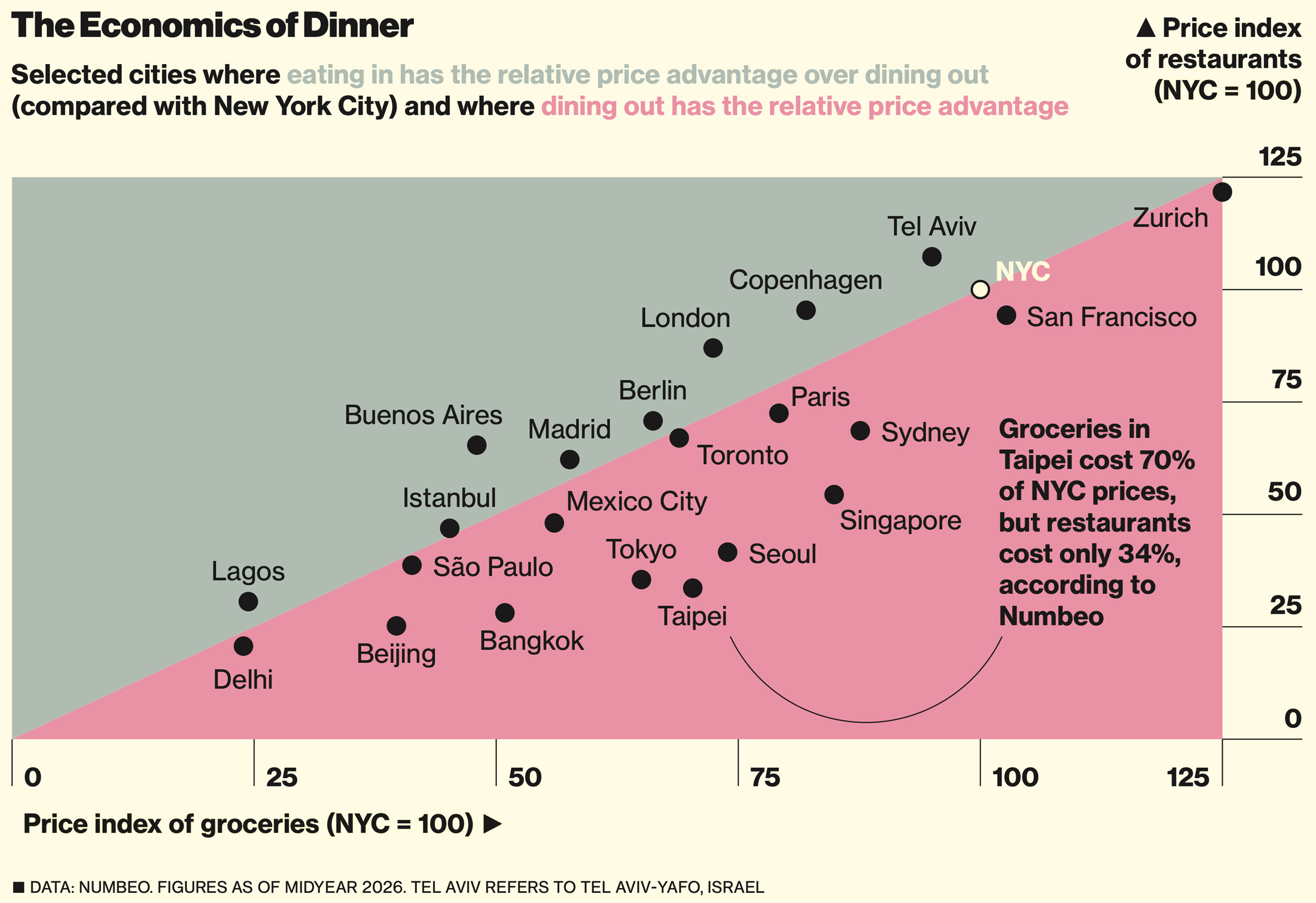
In London and Copenhagen, diners have an incentive to buy groceries rather than eat out; in many East Asian cities, such as Tokyo, Seoul and Taipei, restaurants are so affordable that cooking at home often saves little. (In New York, a bit like in Zurich, you end up paying through the nose either way.) Those prices both reflect and reinforce national differences in how people socialize over food. Singapore built hawker centers on the ground floor of its residential towers, making dining much more communal and public. London, by contrast, is a sprawling city where large in-home dining rooms facilitate private dinner parties. But perhaps the distinctions are being erased: Kat Odell reports on home cooks who are going far beyond the basics, with centrifuges, dehydrators and meat-aging chambers, turning at-home meals into restaurant-quality experiences. One of them, Travis Iwanaga, even goes so far as to charge his guests about $150 per person to cover the cost of his pricey ingredients. It doesn’t seem to put anyone off: He now has “an expanding waitlist of friends, as well as friends of friends.” Which is one way to build an active social life out of a 1,200-square-foot New York apartment. By the numbers
That’s one hell of a crowd.
Photographer: Steven Branscombe/Getty Images
92,003 The number of spectators at a 2023 women’s volleyball game in Nebraska. That’s 11,340 more people than attended the World Cup final, and 26,513 more than the average World Cup fixture. Lauren Mechling reports on the rise of a team sport that’s suddenly everywhere. 5,300 The number of US medical professionals certified by the Menopause Society as experts in midlife women’s health. As Kristen V Brown reports, “that’s not nearly enough to serve the 1.3 million American women who reach menopause every year.” Filling the vacuum: a massive industry designed “to monetize all that midlife dread.” 1,420% The year-on-year increase in Bookshop.org weekly sales of Homer’s Odyssey in the week the movie adaptation came out, according to founder and CEO Andy Hunter. (This stat courtesy of the essential On Books newsletter.) $1 The price (for the time being) of the Taco Bell Enchirito, a cross between an enchilada and a burrito. While it features a tortilla filled with beef, beans and onions, and is topped with cheddar, it crucially doesn’t include any lettuce. Taco Bell is hoping its 77%-off sale will help it win back customers put off by cyclosporiasis headlines. The 2-in-1 vacation
A split vacation could mean time in both Singapore and Borneo’s Danum Valley rainforest.
Source: Getty Images (2)
When you visit a busy city, do you find yourself after a few days feeling as though you need a vacation to recover from your vacation? Why not do just that? It’s called the split vacation, and it’s increasingly popular, according to travel advisers. The general idea, Hannah Howard reports, is “emotional contrast” — plus getting your money’s worth. With plane tickets reaching record levels, it kinda makes sense to amortize that cost over two different holidays rather than just one. Cynika Drake, founder of Lavish Lifestyles Concierge, says her clients “want to feel that the trip was worth the time and the investment.” Shhhhh
Tinnitus affects three quarters of a billion people.
Illustration by Petra Pétterfy
Fourteen percent of all adults worldwide have experienced Tinnitus; 2 million Americans are so severely affected they’re incapacitated. Hannah Elliott reports on the chronic condition where research remains limited and underfunded, and where scientists are only beginning to understand the links between tinnitus, hearing loss and cognitive decline. The lack of effective solutions has opened the door for iffy remedies, including tinctures, vegetable capsules and hormone therapy. Some may help patients feel a modicum of relief, generally as a placebo. None are scientifically proven to help. In the US, only Lenire, a handheld at-home device that combines sound and electrical stimulation to reprogram the brain, has been approved by the FDA. The era of chatfishing
Is it cheating to use AI to compose your Tinder messages?
Illustration: Zhenya Oliinyk for Bloomberg
Singles are turning to ChatGPT and Claude to write, edit and analyze conversations with potential matches on dating platforms, because of course they are. Samantha Kelly reports on the emerging phenomenon of “chatfishing,” where the connection that develops over text reflects AI rather than the person behind the screen. One Very Specific Recommendation: Zojirushi coffee carafe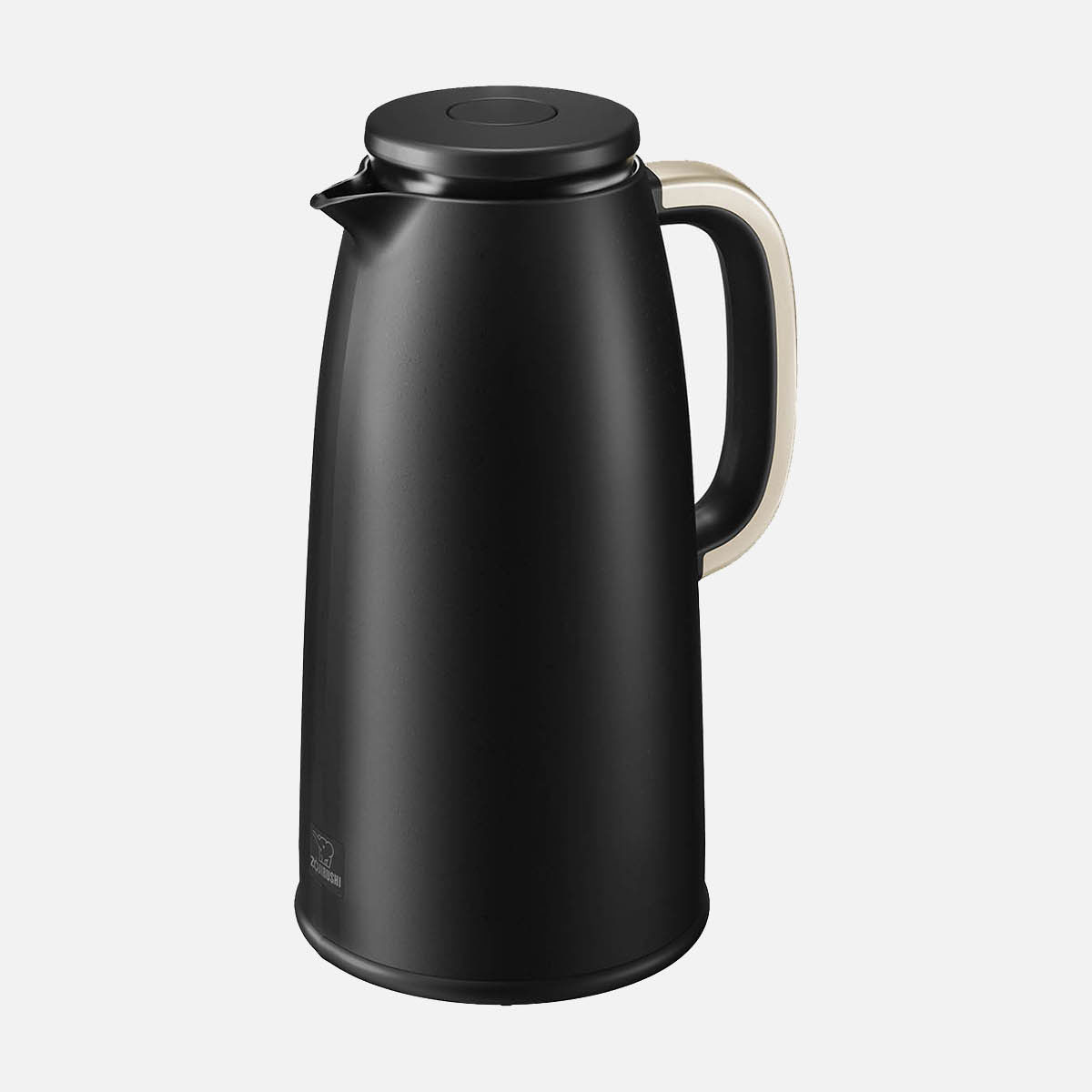
Zojirushi 34oz glass vacuum carafe
Source: Zojirushi
While the quality of the coffee made by a machine is undoubtedly important, another great feature of at-home drip is that it delivers on the quantity side too. It’s great to be able to drink more than one cup without having to do a pour-over twice. One thing all drip machines have in common, however, is a temperature problem. Either they put some kind of a heating element under the carafe, which stews the coffee and makes it unpalatable, or else they don’t, in which case the coffee goes cold (and unpalatable). The solution can be found in a relatively obscure corner of the Zojirushi product range — the Japanese company famous for its rice cookers, thermal mugs and adorable elephant logo. Pour one cup into your mug and the rest of the batch into its handsome coffee carafe, priced at around $60. It keeps hot liquids hot for hours by using a medical-grade borosilicate glass vacuum liner, and design-wise, makes an elegant addition to any breakfast table too. New for subscribers: Free article gifting. Bloomberg.com subscribers can now gift up to five free articles a month to anyone you want. Just look for the “Gift this article” button on stories. (Not a subscriber? Unlock unlimited access and sign up here.) More from Bloomberg Ideas & Culture
We’re improving your newsletter experience and we’d love your feedback. If something looks off, help us fine-tune your experience by reporting it here. Follow Us
You received this message because you are subscribed to Bloomberg’s Bloomberg Pursuits newsletter. If a friend forwarded you this message, sign up here to get it in your inbox.
|
Saturday, July 25, 2026
Finding a city’s real flavor





Subscribe to:
Post Comments (Atom)
The Playbook That Built Silicon Valley Could Build the Next AI Fortune
In today's Masters Series, Luke Lango shows that AI's biggest players are increasingly deciding that it's faster to buy breakt...

-
PLUS: Dogecoin scores first official ETP ...
-
Swaps, memes, homes, tokens. View in browser Unicorn bucket We have talked a fe...


No comments:
Post a Comment