An AI Trade That Pays You to WaitVIEW IN BROWSER By KEITH KAPLAN, CEO, TradeSmith There’s not enough electricity to run the AI boom – and this major grid operator just said so out loud. PJM Interconnection keeps the lights on for 67 million people, from Virginia to Illinois. It’s also become the epicenter of America’s data-center boom – the giant warehouses of computers that run AI models like ChatGPT, Gemini, and Claude. PJM tried to line up more supply through an auction. But it came up short. So it told regulators that, when demand runs ahead of supply, it will require the largest data centers to power down first – to keep the electricity flowing to everyone else. That’s a choice no grid operator wants to make. And it points to something bigger than one region’s problem. As we all know by now, the AI boom doesn’t just run on chips and clever software. It runs on electricity – more of it than anyone expected, arriving faster than the country can build the supply. PJM has done the math years ahead of time, and the numbers don’t add up. When I see a shortage like that, I don’t just see a problem. I see where the money has to flow to fix it. If there isn’t enough electricity, someone has to generate more of it – and the fuel most new American power plants burn is natural gas. But gas in the ground is worthless. To reach a power plant, it has to travel through a pipeline. Every new plant built to feed a data center becomes a new customer for the companies that own those pipelines. And those pipeline operators get paid no matter which AI firms win or lose. So today, I’ll also show you why one of the dullest corners of the market – the toll roads that move the fuel AI depends on – is a great way to profit without the gut-churning volatility of high-flying chipmakers and tech stocks. First, it’s important you understand why America’s power shortage is getting worse and unlikely to ease for years. We’ll start where the strain is most severe.
Recommended Link |
|
Have you heard of Blue Zones? The fraction of the globe where people live to 100? Well, the stock market has Blue Zones too… tiny pockets of the market where 1,000% winners show up over and over. And a brand-new algorithm is finding 81% of them in backtesting. Already it has identified 16 triple digit winners since 2023. See the first ever demo of this “Blue Zone” breakthrough here. |
 |
|
The Math Doesn’t WorkIn a stretch of Northern Virginia now known as Data Center Alley – the densest concentration of data centers anywhere on Earth – the warehouses of computers have multiplied faster than anyone planned for. And they keep coming, spreading west into Ohio and Maryland. Across PJM’s territory, 1,214 data centers are already up and running, with a combined capacity of roughly 57,431 megawatts (MW). That’s enough to power about 50 million homes. And according to Cleanview, which tracks U.S. power infrastructure and data center developments, another 1,700 or so are waiting in line to connect. If every one of them gets built, they’d add another 370,111 MW – roughly six times today’s capacity. That pipeline of projects is a wish list, not a certainty. Plenty of them will never break ground. But even a fraction of that demand actually connecting would far outstrip the power available today. That’s why PJM did the math and reached the conclusion it did. And this isn’t a one-year problem. By 2035, data centers across the country are expected to use four times as much electricity as they do now. It’s a chronic shortage – the kind that takes years to fix. Here’s the question that shortage raises: If there isn’t enough electricity, who profits from making more of it? Someone Has to Build the Power – and Move the FuelThe obvious answer is the power companies. But there’s a less obvious one I find more interesting. Because not only does it produce a steadier return, but it’s a great way to add passive income to your portfolio. To generate more electricity, you build more power plants. And as I mentioned, the fuel most new American power plants burn is natural gas. It’s abundant, it’s cheap, and the plants that run on it can be built relatively quickly to meet surging demand. But to turn that natural gas into electricity, it has to travel – sometimes hundreds of miles – from where it’s drilled to where it’s burned. And it travels through pipelines. Every new gas power plant built to feed a data center is a new customer for the companies that own those pipelines. They don’t have to guess which AI company wins. They don’t have to bet on any single chipmaker, or model, or breakthrough. They simply move the fuel – and collect a fee on every unit that flows through their pipes. It’s a toll road. It doesn’t matter who’s driving or where they’re headed. The traffic pays the toll. So how do you own the toll road? A One-Click SolutionThe simplest way is the Alerian MLP ETF (AMLP). Instead of trying to guess which single pipeline company wins, it holds a basket of the biggest ones in one investment. One click in your brokerage account, and you own the toll collectors. MLP stands for master limited partnership – the tax structure most big pipeline companies use. Owning these partnerships directly can mean filling out a form called a K-1 at tax time, something your accountant won’t thank you for. AMLP is built to spare you that. It’s designed for ordinary investors and sends a normal 1099 instead of a K-1 – the same form your bank sends for interest. On top of that, AMLP pays an annual income known as a “distribution” in the MLP world. Right now, that distribution stands at 7.7%. And here’s what I really like about AMLP. On TradeSmith Finance, it carries a Volatility Quotient (VQ) of 11.8%. That’s a measure of how much an investment normally bounces around. That’s a world away from the high-flying chipmakers. They can deliver bigger gains on the way up. But as we’ve seen these past few weeks, when they fall, they fall hard. This is the opposite kind of investment – a calm, cash-generating business that happens to have an AI tailwind behind it. But like with so much else related to the AI boom, AMLP has had a strong year. It’s up 16% year to date, which is a lot for this fund. 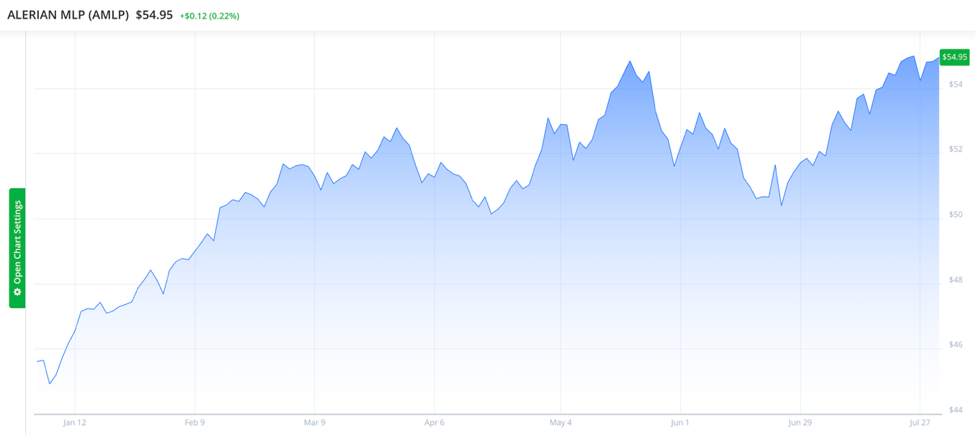
So, I wouldn’t pile in at today’s price. I’d ease in instead – buying a fixed dollar amount on a regular schedule, an approach called dollar-cost averaging, so you’re never betting everything on a single day’s price. One reason that patience makes sense is this 15-year Seasonality chart of AMLP. It shows that its share price has tended to be weaker in the back half of the year. 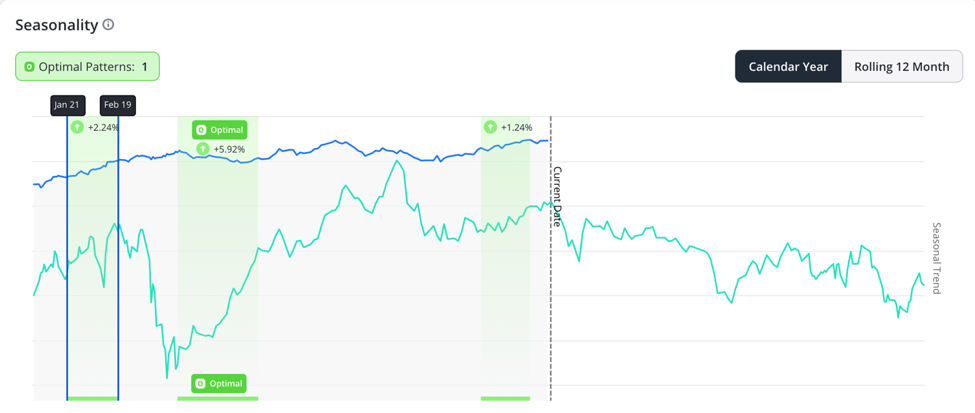
That’s no guarantee – seasonal patterns are odds, not promises – but it suggests today’s prices may be the highest you’ll see this year. That steady approach is how you profit from a shortage without getting swept up in the mania that created it. All the best, 
Keith Kaplan
CEO, TradeSmith P.S. Speaking of the AI trade – it’s been a rough few weeks. We’ve seen chipmakers slide into a bear market and the air come out of Micron and other high-flying AI memory stocks. Even giant AI plays like Google and Tesla took it on the chin. I know many of you wanted to throw in the towel. But I’ve been calling this a Mega Melt-Up since 2024 – my term for a boom where a real, world-changing technology, easy access to the markets, and cheap, abundant credit all collide at once. When that happens, stocks don’t just rise. They get priced for perfection, because everyone already believes the story. And when the market is priced for perfection, it doesn’t take much to knock it off balance – a single doubt is enough to send it reeling. This week, four doubts hit at once. I broke them down on X here. |




No comments:
Post a Comment