History's Biggest IPO Is HereBy Rob Spivey, director of research, Altimetry
 Strap in, folks. The biggest IPO of all time is almost here... Strap in, folks. The biggest IPO of all time is almost here...
Elon Musk's SpaceX is set to begin trading just a few days from now, on June 12. The company has already published its investment prospectus. And it aims to go public at an unprecedented $1.8 trillion valuation. Musk is a controversial figure, to say the least. And there tends to be a lot of hype surrounding anything he's involved with. The SpaceX initial public offering ("IPO") is no exception. We've received our fair share of subscriber questions about SpaceX in recent weeks. We've also received a number of astute questions about Uniform Accounting as a whole – particularly how it works and how we use it to evaluate businesses. This week, we're tackling both... with a three-part series covering SpaceX and its looming IPO through the lens of Uniform Accounting. We'll start off with a detailed look at SpaceX's three segments... what each business does... and how profitable they are (or aren't) today. Let's start with the company's namesake...SpaceX's "space" segment does exactly what you might expect – it launches objects into space. Musk personally created this legacy business back in 2002. So it has been running for more than two decades. Today, it boasts revenue of about $4 billion. You might have seen some of SpaceX's satellite test launches on the news. It also plays an important role in helping other organizations launch into space. Last year, SpaceX facilitated 11 of the 12 medium and heavy launches on behalf of the National Security Space Launch (part of the U.S. Space Force). And it provided the launch site and services for all five of NASA's trips to the International Space Station. The space business is essentially a toll operator for getting things and people into orbit. It's the dominant player in this market. SpaceX was responsible for more than 80% of all U.S. launches in 2025. And as the market leader, SpaceX has turned its space segment into a decent business...
Regular readers know that we often talk about companies in terms of Uniform return on assets ("ROA"). Think of this as a company's profitability. For most businesses, a 5% Uniform ROA is their breakeven level. And the corporate average across the entire market is 12%. For today's purposes, we're breaking down Uniform ROA even more... looking at each of SpaceX's individual business units. The space segment generated abysmal 1% returns in 2023. So it wasn't profitable. But that number rose to 12% in 2025. And as it handles more launches every year, our models project profitability reaching 17% this year. Take a look... 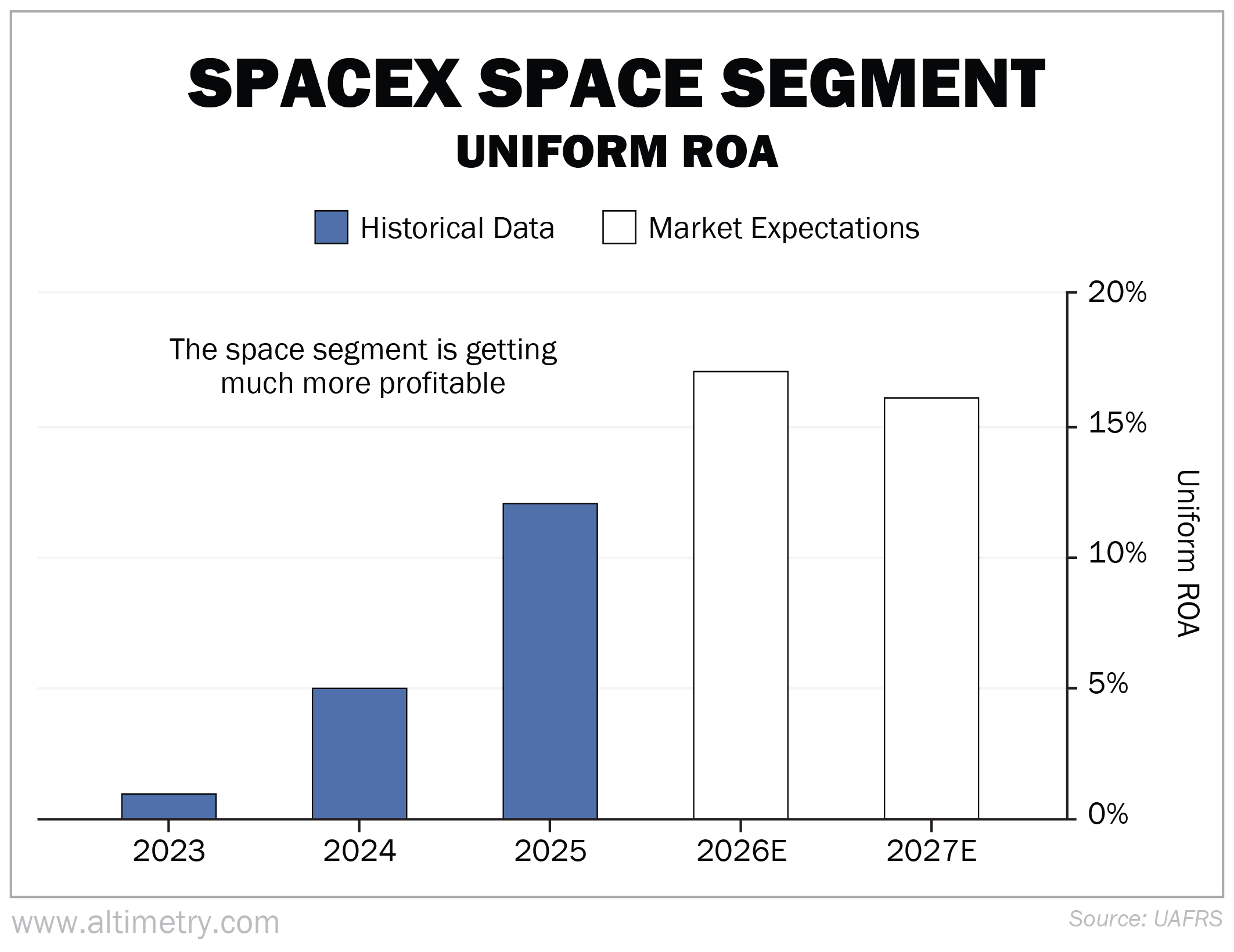
As we noted earlier, this is a mature business. So it should earn a decent profit. And as SpaceX launches more things into space, it makes sense that the space segment would become a bit more profitable. Space is a pretty steady segment. But the rest of the company isn't quite as straightforward... Earlier this year, SpaceX acquired another one of Musk's businesses – xAI...Musk launched xAI in 2023 to compete with AI model developers like OpenAI and Google parent Alphabet (GOOGL). It owns Musk's competing AI model, Grok. It also owns the social media network X (formerly Twitter), which Musk bought in 2022. But mostly, the AI business consists of two massive AI data centers called Colossus and Colossus II. We'll be blunt... This business is a money pit. And the social media landscape has been challenging. Several advertisers pulled out after Musk bought the platform. And Grok hasn't caught on the way Musk hoped. As of the end of 2025, it had just a 3% market share for all AI models. This segment only generated $3.2 billion in revenue last year. And new data centers don't come cheap. No wonder its Uniform ROA has been deeply negative for three years running. Its "best" year was 2024, at negative 9%. Last year, returns fell to negative 18%. To claw its way out of the red, the AI segment is renting out space at its data centers. It signed a deal leasing space to competitor Anthropic for $1.25 billion per month (that's $15 billion per year). That cash is expected to help improve returns to a "mere" 5% loss by 2027... 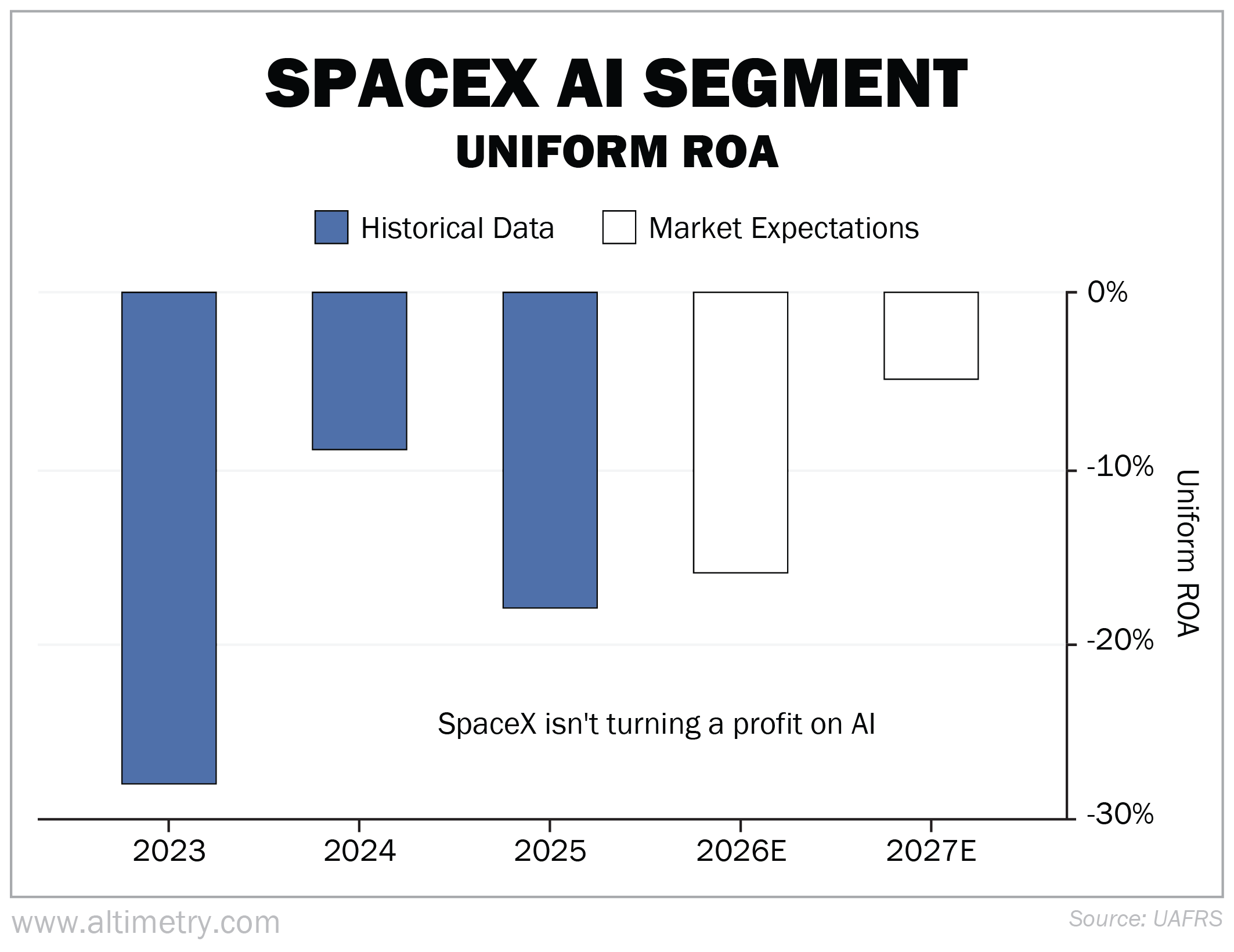
AI is SpaceX's biggest question mark. It's trying to compete with the biggest players on several fronts. But we can expect it to stay unprofitable for at least a few years. Finally, let's look at the company's cash cow...You probably know the "connectivity" business by its other name... Starlink. Starlink has roughly 10,000 active satellites. Through that network, it offers satellite-based broadband and cellular subscriptions for folks in 164 countries. It has amassed more than 10 million customers already. It also brings in more revenue than the other two segments combined, at $11.4 billion. Connectivity has high "operating leverage." Once it launches satellites into space, it doesn't have to spend much more to add each new customer. In other words, the more customers the business has, the more profitable this segment will become...Starlink brought in less than $4 billion in revenue in 2023. Returns were already a respectable 15%. And they doubled to 30% last year. On its current trajectory, profitability could reach 61% by 2027... 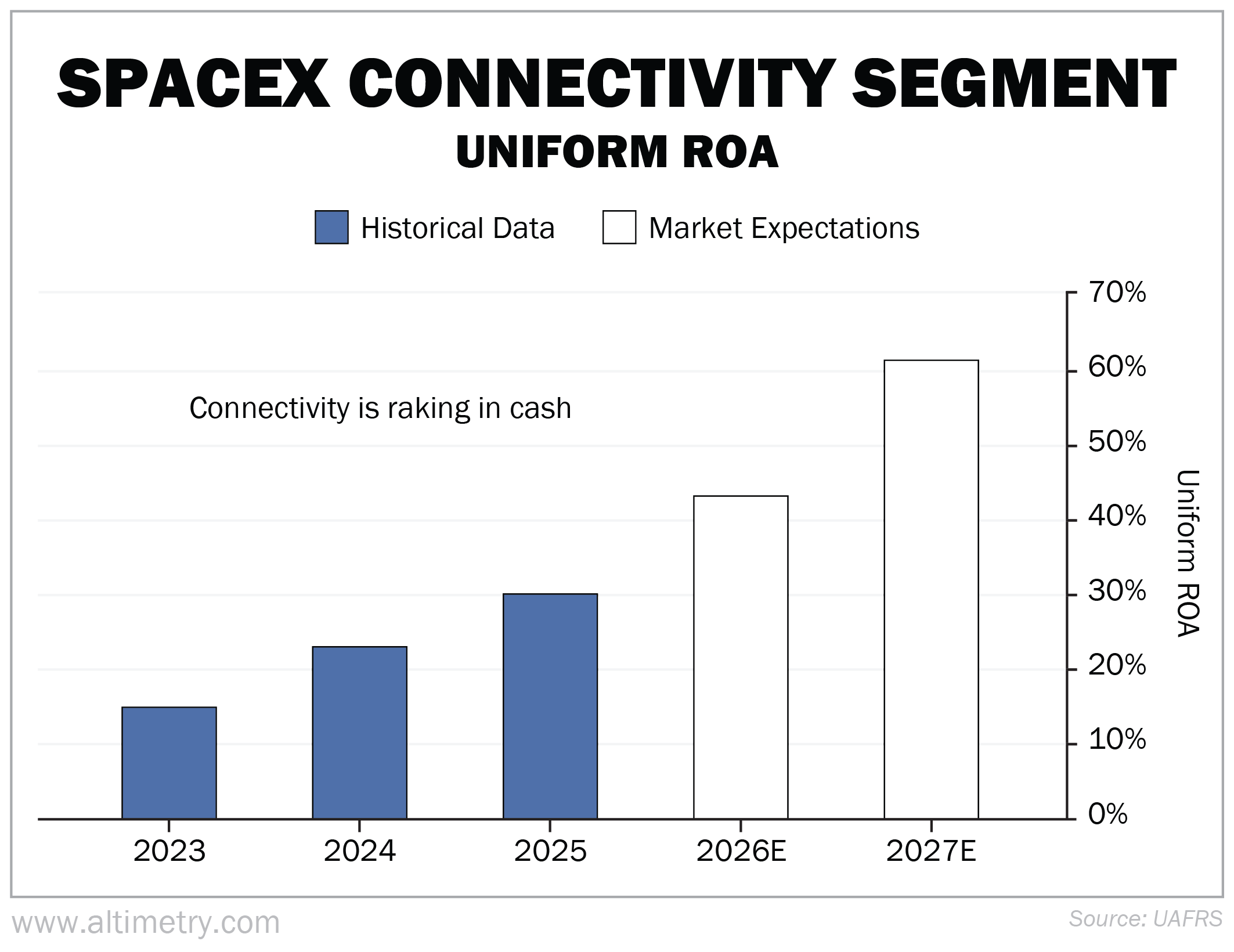
This is SpaceX's most profitable segment by far. And right now, it's the one keeping the lights on for the rest of the company. Musk has high ambitions for SpaceX...As we mentioned earlier, he expects the company to go public at a $1.8 trillion valuation. That would be the highest-valued public offering of all time. We can't judge that number without understanding each segment. But that alone isn't enough, either... So far, we've covered one great business... one that's fine... and one that's still finding its footing. Check back in tomorrow. We'll take a look at what each segment is worth based on how it's doing today... and how it should do in the next few years. Regards, Rob Spivey
June 8, 2026 P.S. The SpaceX IPO is just days away... And the man behind the most profitable research at our sister company, Stansberry Research, says most investors are about to make a serious mistake. He has never made an announcement quite like this before. But he says this story couldn't wait any longer. He shared all the details (plus what he calls his most important "buy" call) in an urgent briefing. Check it out right here.
|







No comments:
Post a Comment