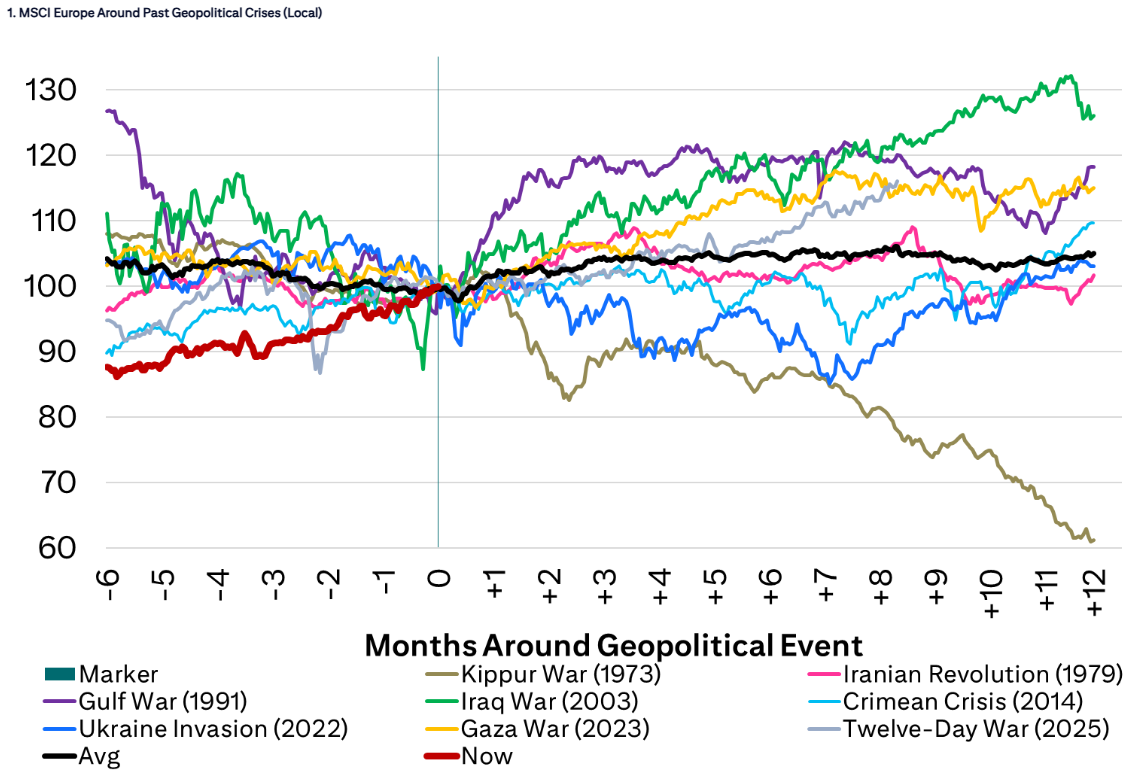
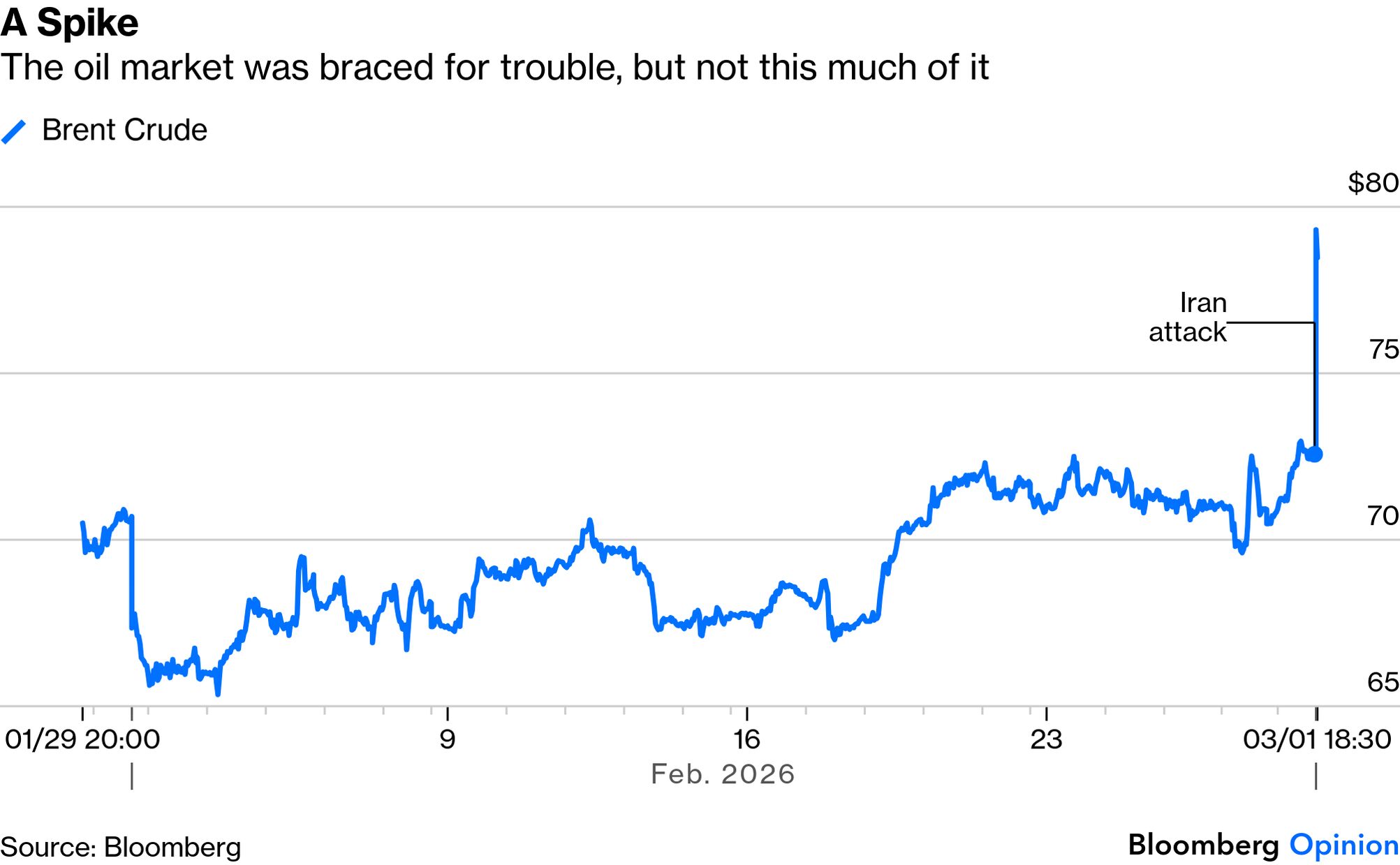
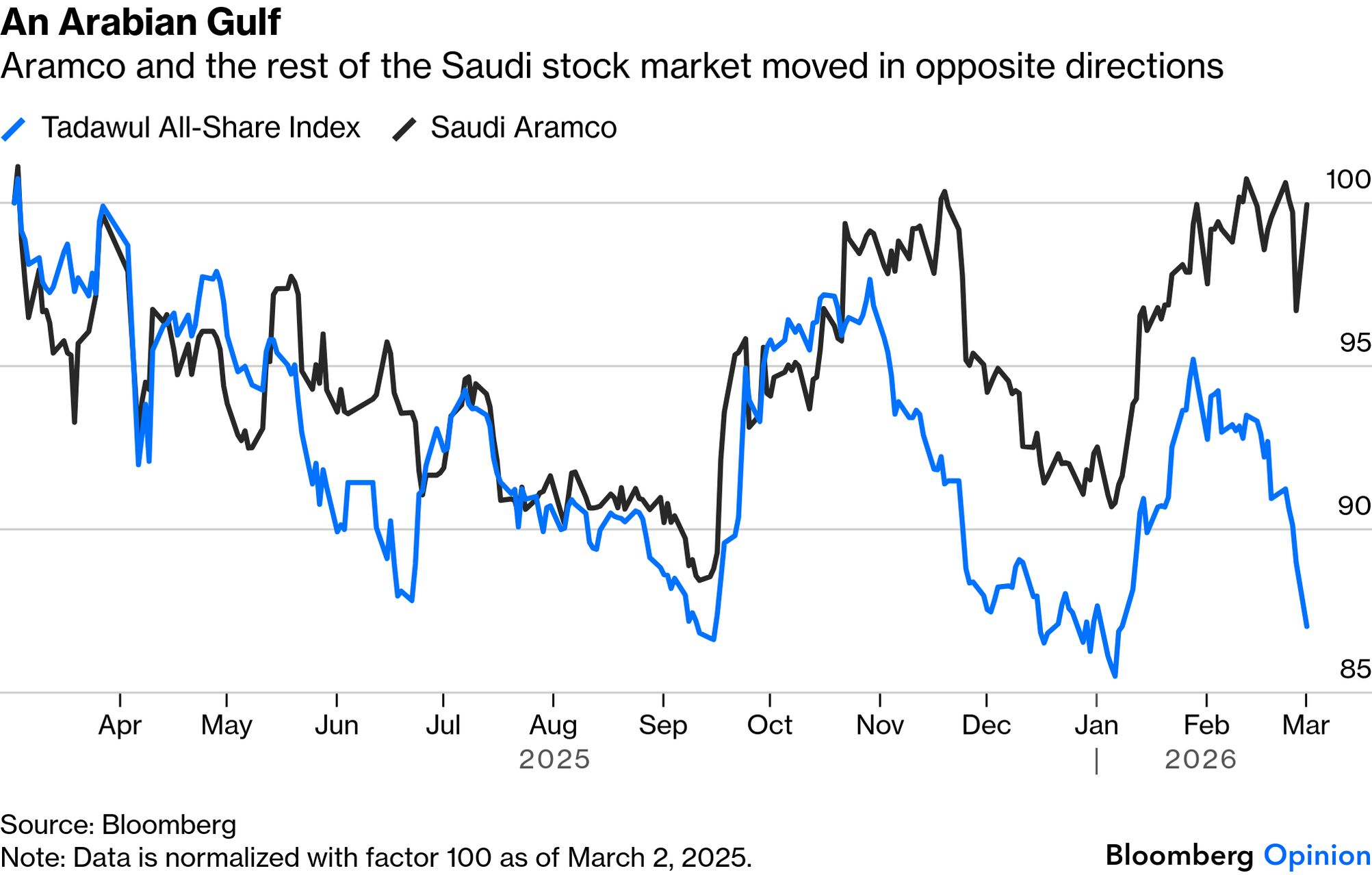
| Regime change may be afoot in Iran. Decapitation in the successful killing of Ayatollah Ali Khamenei and a number of other senior leaders has already happened with breathtaking swiftness. The range of potential longer-term consequences for the American role in the developing new world order, and for the balance of power in the Middle East, is equally breathtaking. But there's no template. The breadth of responses to similar shocks in the past has been varied, as Citi demonstrates in this chart. The huge outlier was the 1973 Yom Kippur War, which triggered a massive bear market. It was different from the others because it led to a protracted reduction in the supply of oil to the rest of the world. Shocks that passed quickly, or in which the threat to the oil supply was decisively countered, often proved to be buying opportunities. So as the oil markets reopen after an extraordinary weekend with a massive spike (Brent crude leapt 12.5% before stabilizing), it's best to focus on what always matters most to markets in the short term after a geopolitical incident. Will it affect the supply of oil? Javier Blas argues in Bloomberg Opinion that the Iran strikes will be nasty for oil prices but won't constitute a full-blown shock. What's different about this incident compared to other recent conflagrations is that there has been retaliation, which has hampered other countries in the region and cost American lives. The longer an outright shooting war continues, and the further it spreads, the greater risk that this becomes a major shock that brings down a range of markets. The immediate response in Saudi Arabia, which traded on Sunday, shows that such risks should be taken seriously. Usually the fortunes of the oil producer Saudi Aramco, which accounts for 16% of the main Saudi equity benchmark, are inextricably linked to the overall market. Not this time. Aramco surged on the outlook for higher oil prices, but that didn't stop the overall index from plummeting: The key issue is the Strait of Hormuz, through which about 20% of global oil exports are transported. If Iran wants to close them, it can — at great financial cost to itself and to other Gulf countries. There are already reports of attacks on ships. Hubert Marleau of Palos puts the prospects for the oil price as follows: A true Hormuz disruption would constitute a tail scenario, which could easily increase the price of Brent to $125 a barrel, whereas a quick regime change would oppositely restore normalcy and bring oil prices back to $60 a barrel. There is a third scenario, where the oil flows under threat not in an apocalyptic manner as OPEC+ increases oil production at an accelerating pace; but nonetheless in an escalating one, constraining supply and running the price to an $80 peak.
The third is arguably the likeliest. For now, the problem is that an interruption of some duration to oil supply, and therefore a hike in the price, is a given until there is greater clarity. Even though Iran has formally announced that it does not intend to close the strait, the impact on the flow of oil from the region is still significant, as the emerging markets investment group Gramercy explains: Commercial shipping has largely paused regardless, as insurance underwriters withdrew war-risk coverage within hours of the initial strikes. Our assessment is that the binding constraint on oil flows is currently the insurance market, not a military blockade
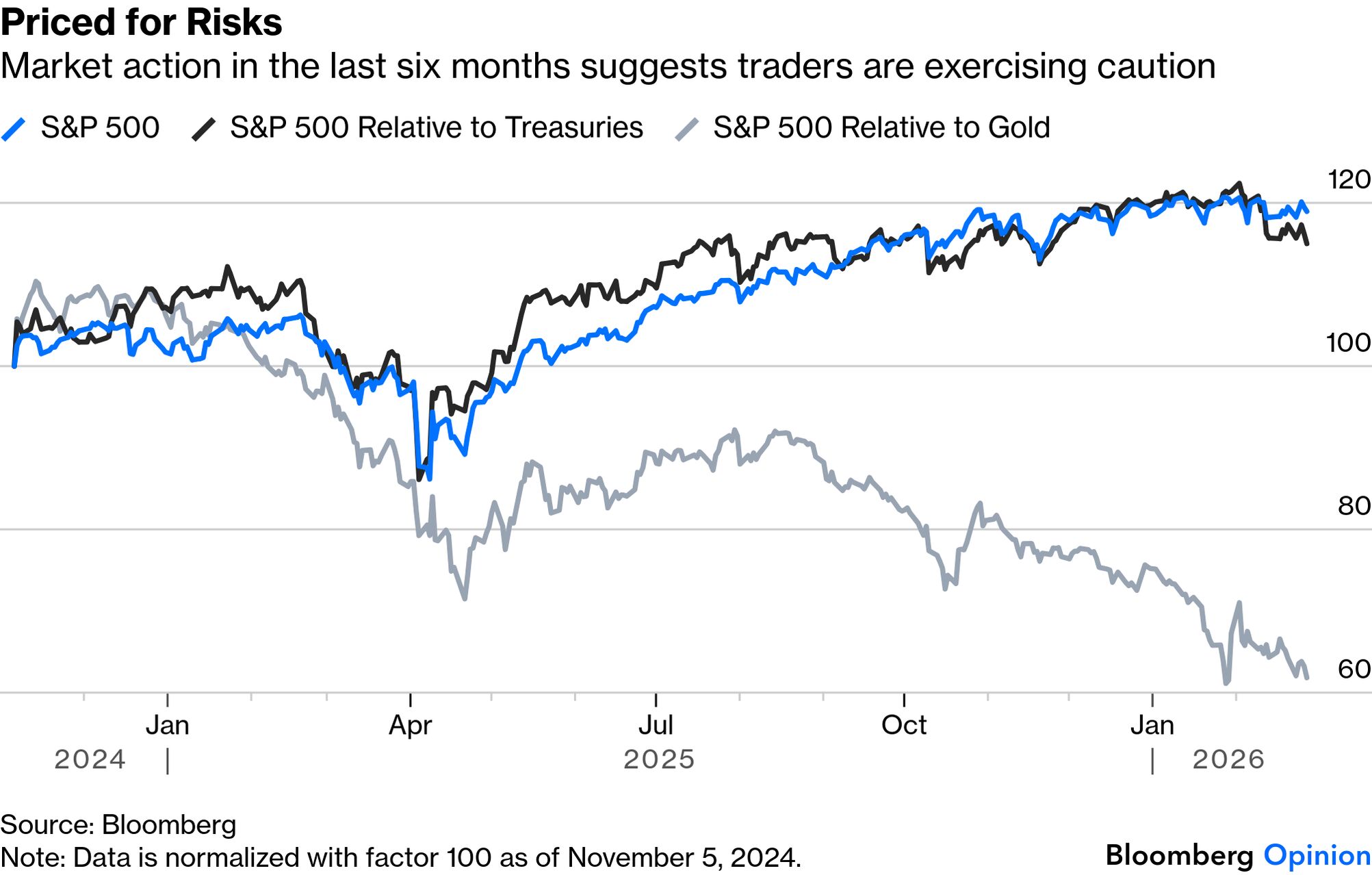
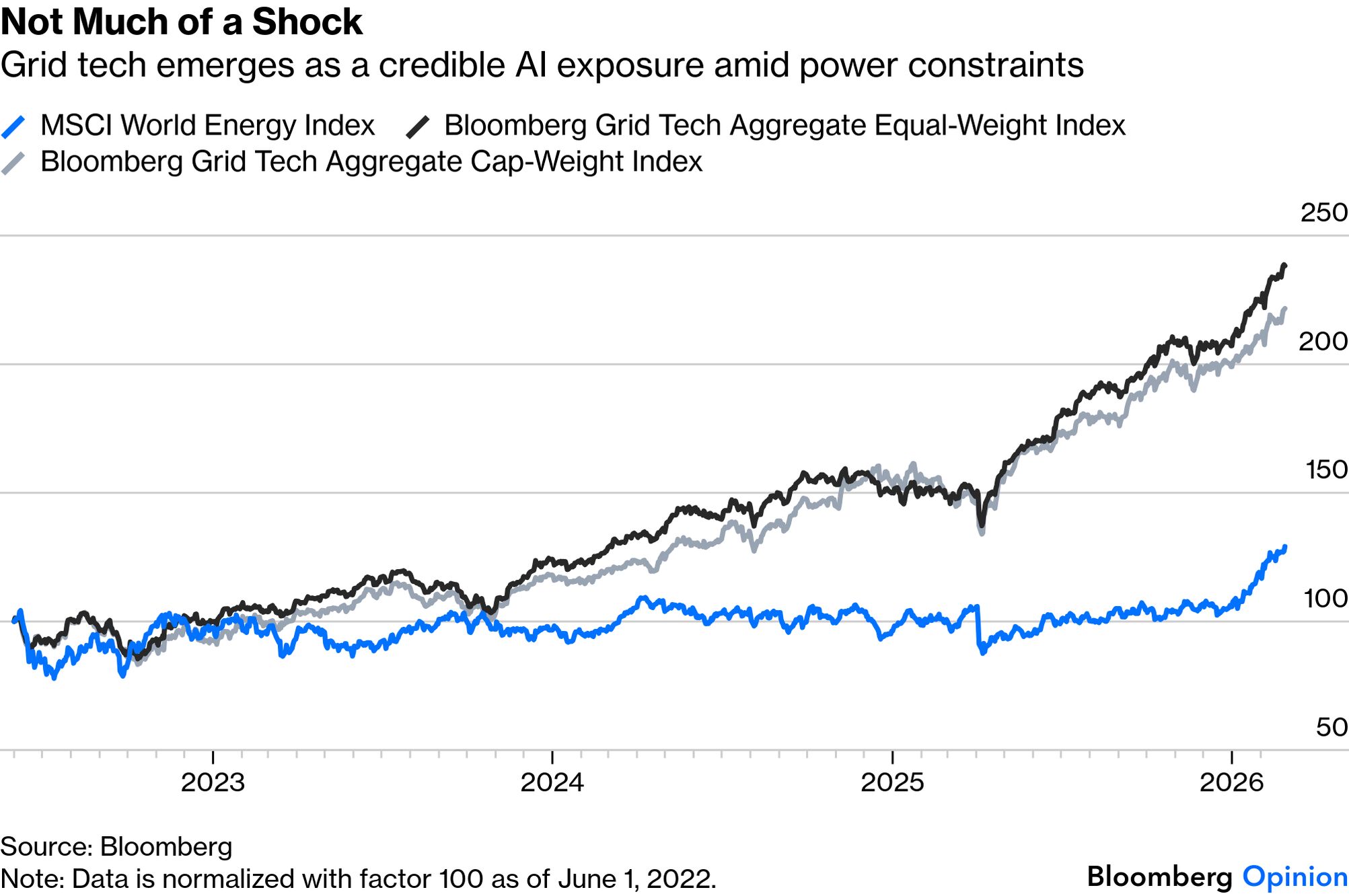
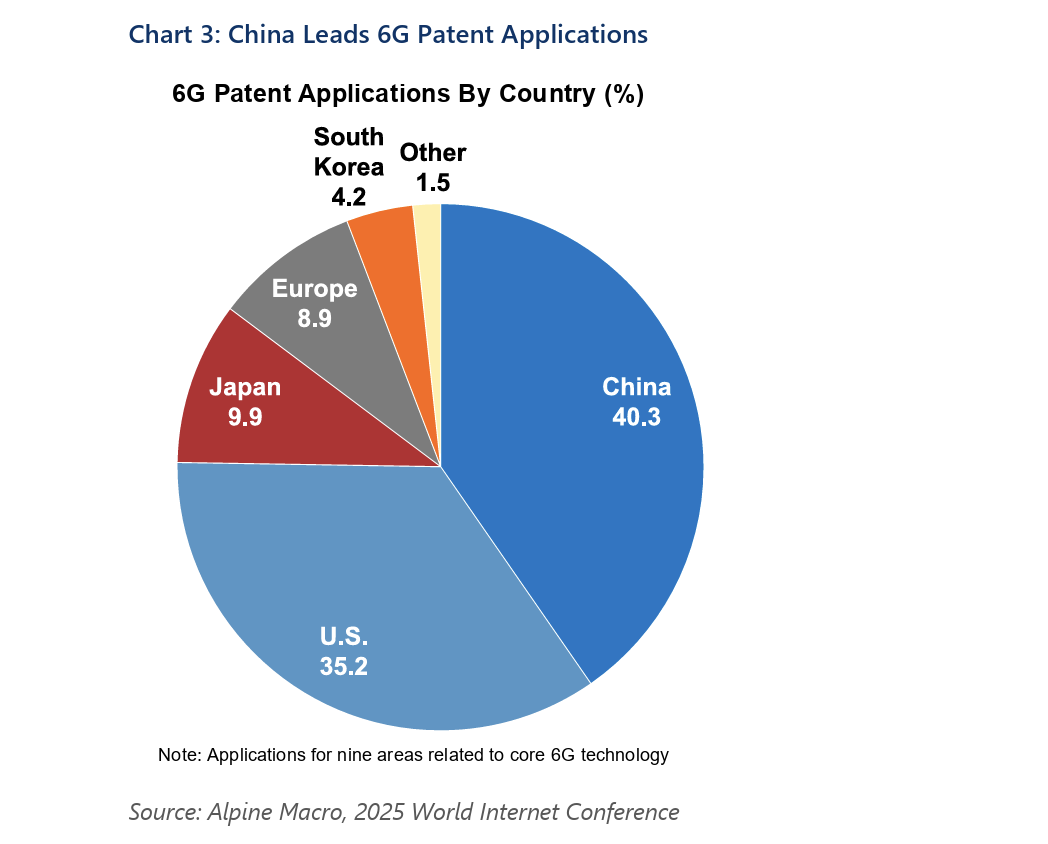
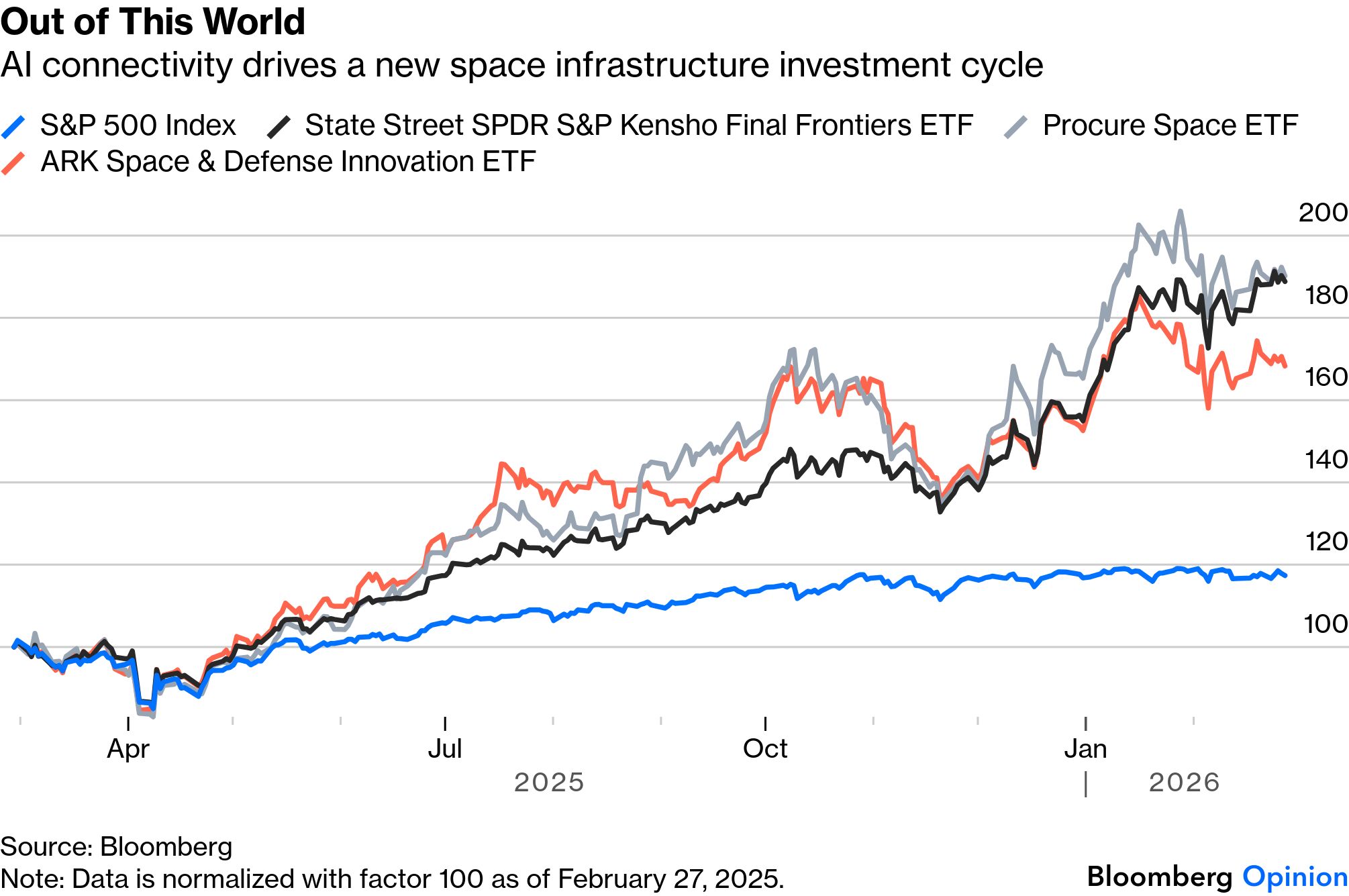
On this basis, the immediate surge above $80 for Brent seems to make sense, and there is also no need for the price to move much further without material new developments. For the immediate future, markets will try to adjust the risk premium on equities — it should be higher, but it's not at all clear how much. They will also look for winners and losers from the conflict, much the exercise that they've been carrying out for AI of late. There could be some strange collateral beneficiaries, including the UK. Citi equity strategist Beata Manthey pointed out: "The UK market is tilted heavily towards commodities and defensive sectors along with a sizable share of aerospace & defense, and thus serves as an effective 'geopolitical hedge' within equity portfolios."  | | | The other critical variable in any given crisis is the evasive action markets have taken in advance. On this front, it is oddly good news that the US has gone nowhere for months, while the price of gold suggests great concern. There are reasons to believe US assets are overpriced, but there's no sign of excessive risk appetite in recent action: It's also clear, however, that confidence cannot be too bad. Despite talk of bubbles and a sequence of geopolitical shocks, US equities are staying on a high plateau. The latest Absolute Strategy Research quarterly survey of 284 global asset allocators, jointly responsible for some $13.2 trillion, finds them their most optimistic in five years, despite everything: 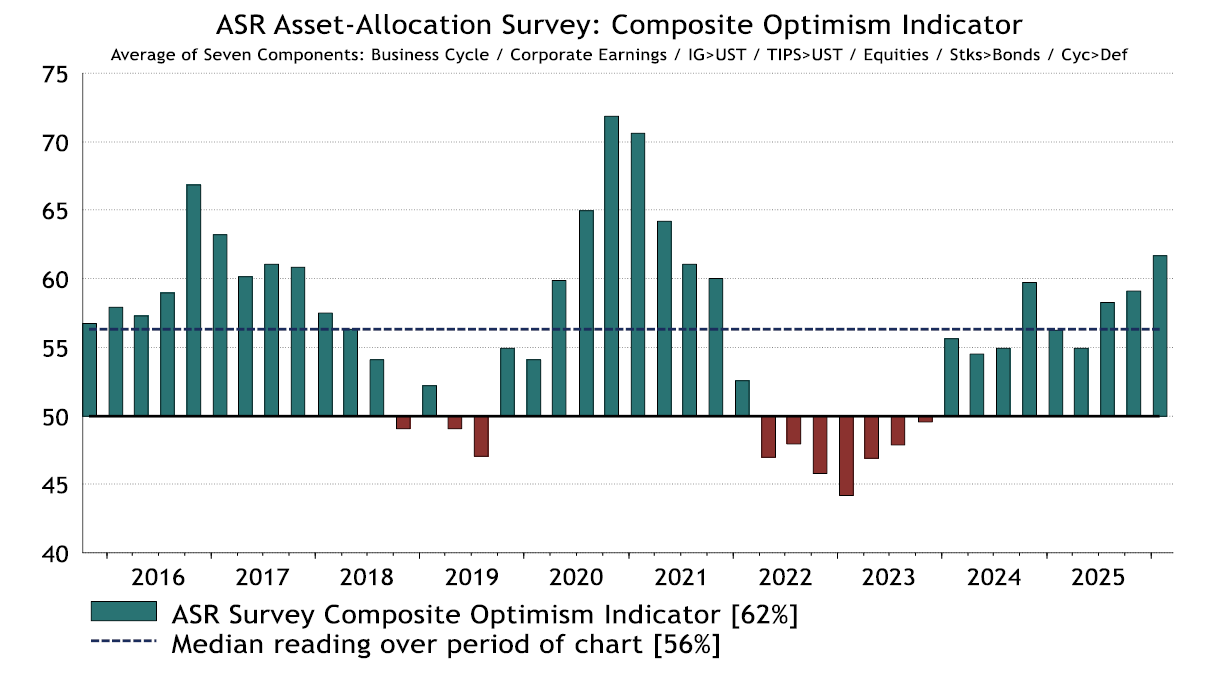 Source: Absolute Strategy Research Central to this is earnings momentum. Profits are reviving, particularly in the emerging world, and there is solid confidence that this will continue. In such circumstances, the downside for markets is limited: 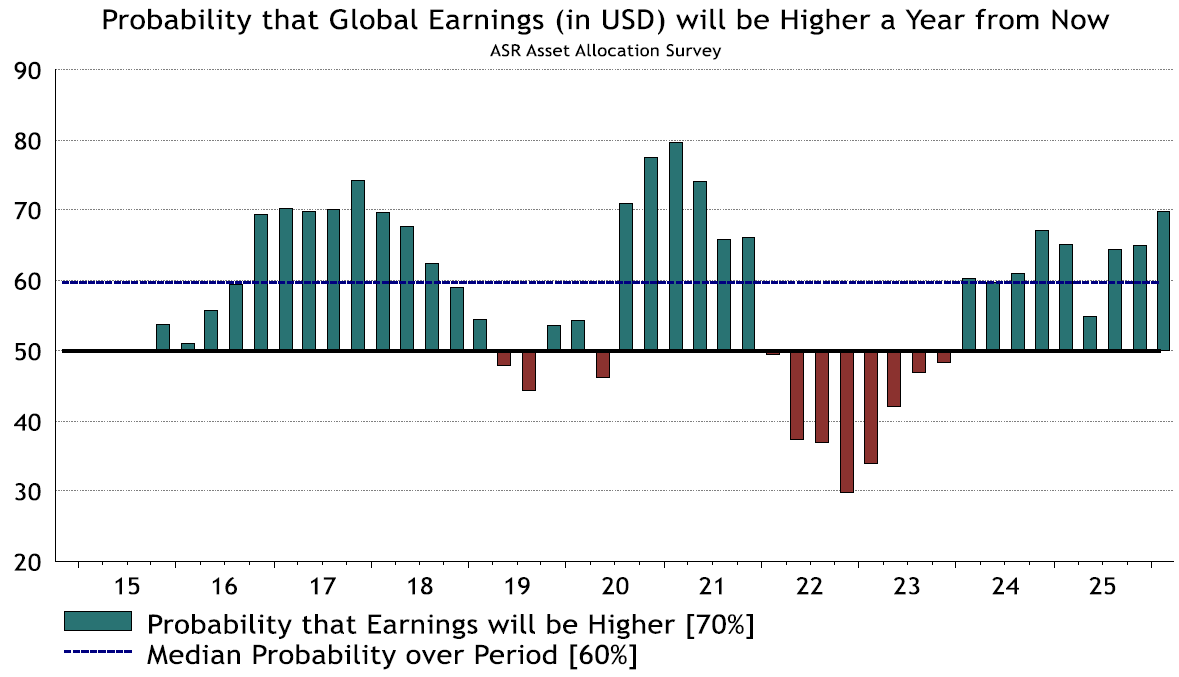 Source: Absolute Strategy Research Another key factor in their optimism is confidence that inflation has been beaten — never mind ongoing turbulence caused by tariffs. If they're right about this, the chances of lower rates and easier financial conditions are that much stronger: 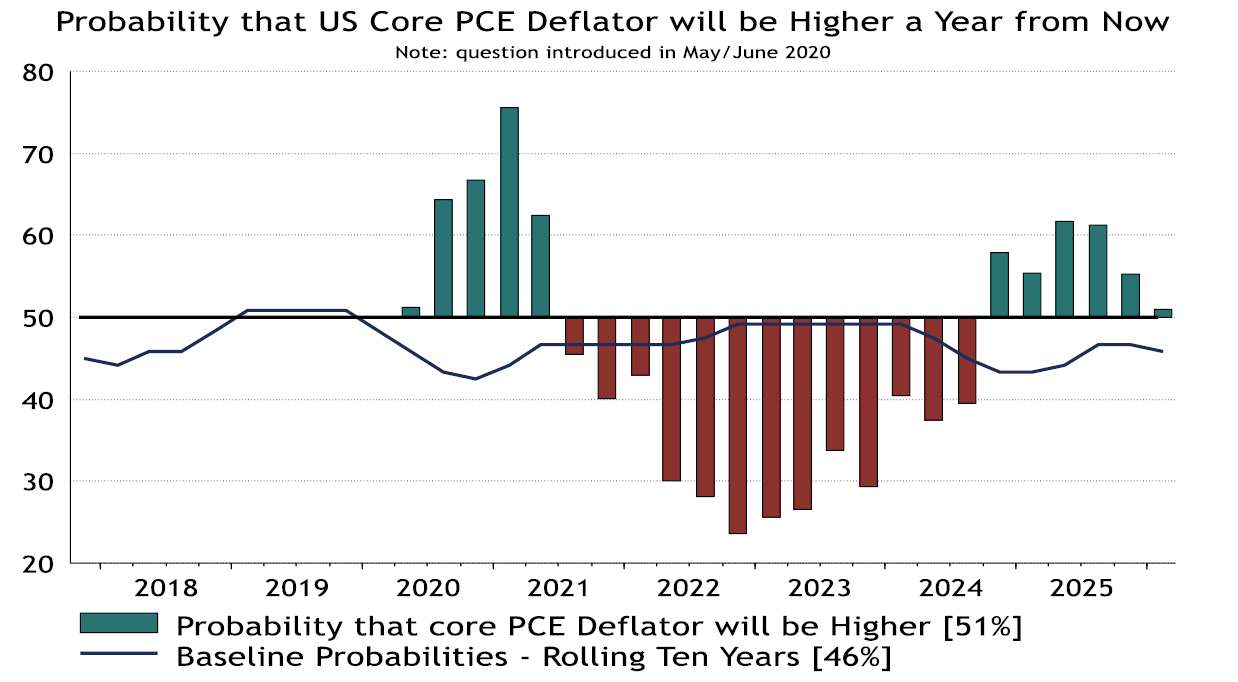 Source: ASR Ltd If inflation hasn't really been bottled up, that could create problems. An oil spike would damage this hypothesis, as would an overheating from the fiscal and monetary ease that has generated such optimism. The fact that a new Federal Reserve chair will take office in two months, and is likely to be tested by the market, should add to the risk. Absolute Strategy's David Bowers points out that a weak dollar is almost universally assumed at present. That is another risk. When the dollar is cheaper, so is dollar-backed financing. The correlation with emerging markets is strong — periods of EM strength overlap almost perfectly with downswings for the dollar. The initial response to the Iranian carnage has seen traders bid up the dollar. That may well not last. If it does, a lot of people could be wrongfooted. 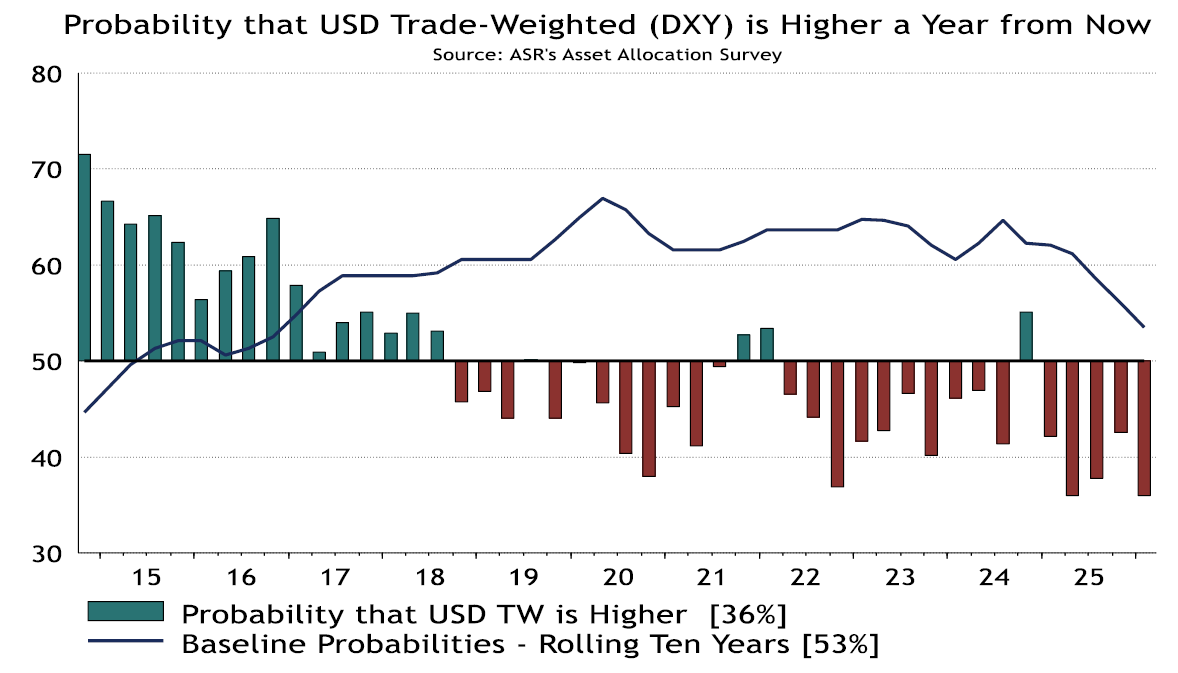 Source: ASR Ltd The other great potential could come if AI adoption hits a major snag. One of the fascinating insights from the survey is that asset allocators, based around the globe, don't seem particularly perturbed by AI. In Wall Street, it has appeared of late as though nothing else matters. And on that subject…. The buildout of artificial-intelligence infrastructure has been anything but linear. Hyperscalers have poured billions into expansion and pledged to spend even more, often frustrating impatient investors seeking proof that earlier investments are paying off. Answers to basic questions, such as how many of these data centers will ultimately be powered, remain unconvincing. Building the power plants to supply the vast energy these facilities consume is laborious and time-consuming. Some of the most promising proxies for the AI trade may lie in power generation and grid technologies. Their network effects look unparalleled, with little risk of competitors emerging overnight: Beyond power, a less talked-about constraint is whether today's internet infrastructure can deliver next-generation AI to consumers. To quote Noah Ramos of Alpine Macro: "Scaling advanced AI without improving wireless networking is akin to putting the cart before the horse." 5G connectivity is critical to today's AI applications. But the network wasn't purpose-built to support AI, and its structural limitations threaten to become a bottleneck. Improvement is plausible, with Ramos pointing out that 6G wireless represents a paradigm shift to a purpose-built platform with intelligence woven into every layer. It's hard to say how close we are to 6G connectivity, although remarkable strides have been made. Nvidia Corp.'s partnership with Nokia is starting to bear fruit, for example. All else equal, 6G is expected around 2030. What does this mean for AI and the broader Internet of Things? China's obsession with the nascent technology hints at what is possible. This Alpine Macro chart illustrates just how much Beijing is positioning itself to make the most of 5G's successor: While a full rollout remains far off, Ramos notes that China's advances in robotics, autonomous vehicles, and distributed AI to form an increasingly integrated innovation ecosystem explain Beijing's eagerness to bring the technology online quickly. China's rare-earth metals, crucial to 6G devices, give a further edge. Meanwhile, SpaceX's rapid growth, led by Elon Musk, underscores the role of space-based communications technologies in AI adoption. The company's Starlink — a network of thousands of satellites serving millions of customers — is planning an IPO that could be valued at around $1.7 trillion. That such a massive valuation is even being discussed testifies to the excitement around the demand for space assets in communications. With the global space economy exceeding $626 billion in 2025, the sector appears to be entering a structural, technology-driven expansion phase: 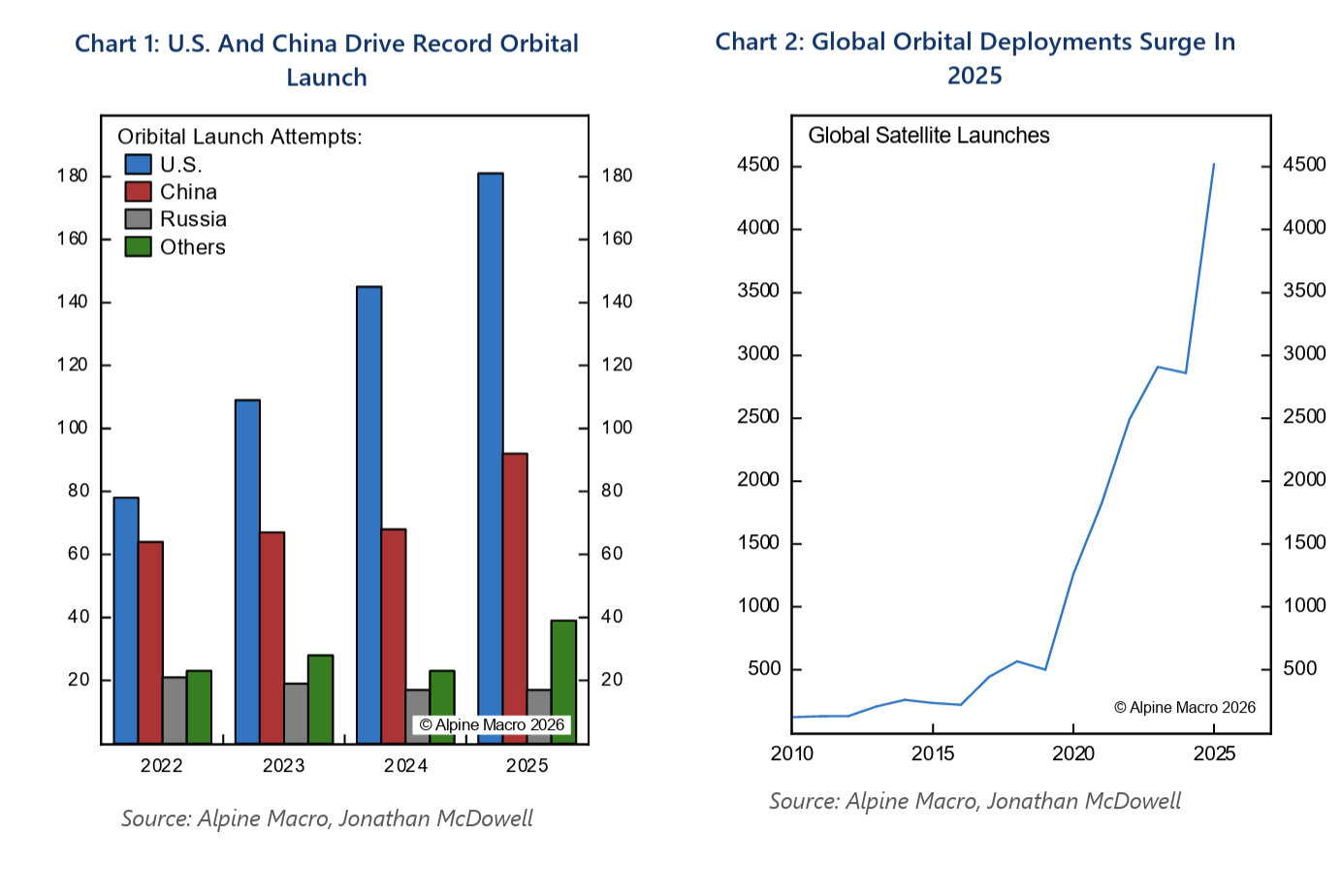 Source: Alpine Macro In the last six months, global inflows into aerospace and defense exchange-traded funds more than doubled from the prior six months, according to Bloomberg Intelligence data. Their performance explains those rising inflows: Are we on the cusp of a proliferation of space-based assets providing the infrastructure needed to accelerate AI adoption? The simple answer is no. Yet the potential that Starlink has demonstrated is enormous, particularly as autonomous systems and advanced computing expose terrestrial networks' limitations. What long existed only in science fiction may now be coming to reality, bit by bit. —Richard Abbey | 






No comments:
Post a Comment