Monday, December 1, 2025

Collect Social Security at 62 or wait until 70?

Insolvency is coming either way.
View in browser
Bloomberg

This is Bloomberg Opinion Today, a favorite punching bag of Bloomberg Opinion's opinions. Sign up here.

Today's Agenda

America's Insolvency Era

If you turn 62 next year, should you take your Social Security or wait it out? It's a question more and more people seem to be asking. While some TikTok finfluencers will urge you to retire at the earliest age possible, most experts still agree that delaying until 70 is the least risky option for savers.

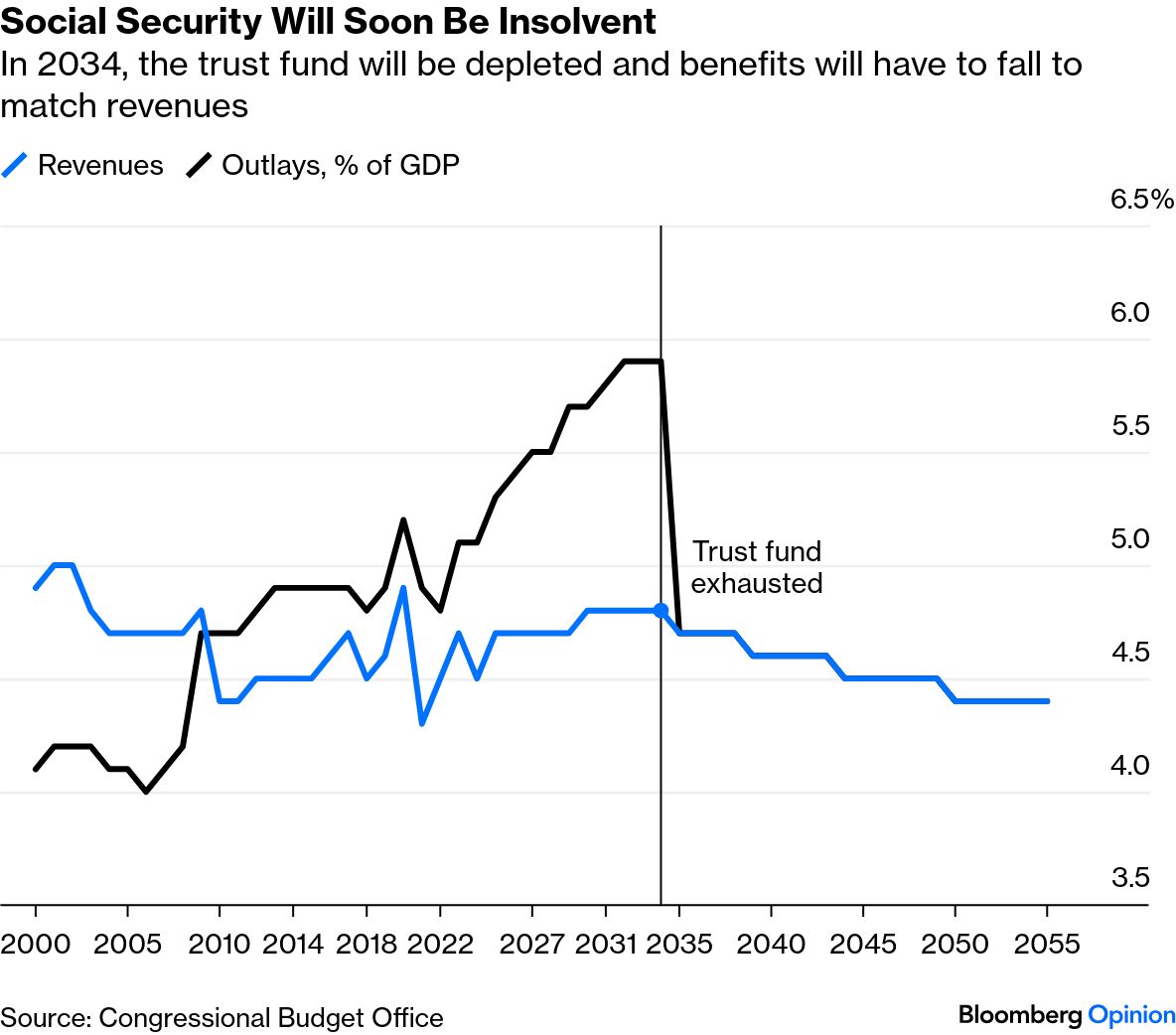
That's all well and good until you realize that you won't be collecting benefits until 2034, which just so happens to be the year the safety net is predicted to implode:

"If there's one thing Democrats and Republicans have agreed on in recent years, it's to ignore the rapidly deteriorating finances of Social Security and keep its unsustainable benefits intact," the Bloomberg editorial board writes. "The system's two trust funds — one for the elderly, one for the disabled — are both on course to be depleted by 2034, at which point automatic benefit cuts of about 20% are supposed to kick in."

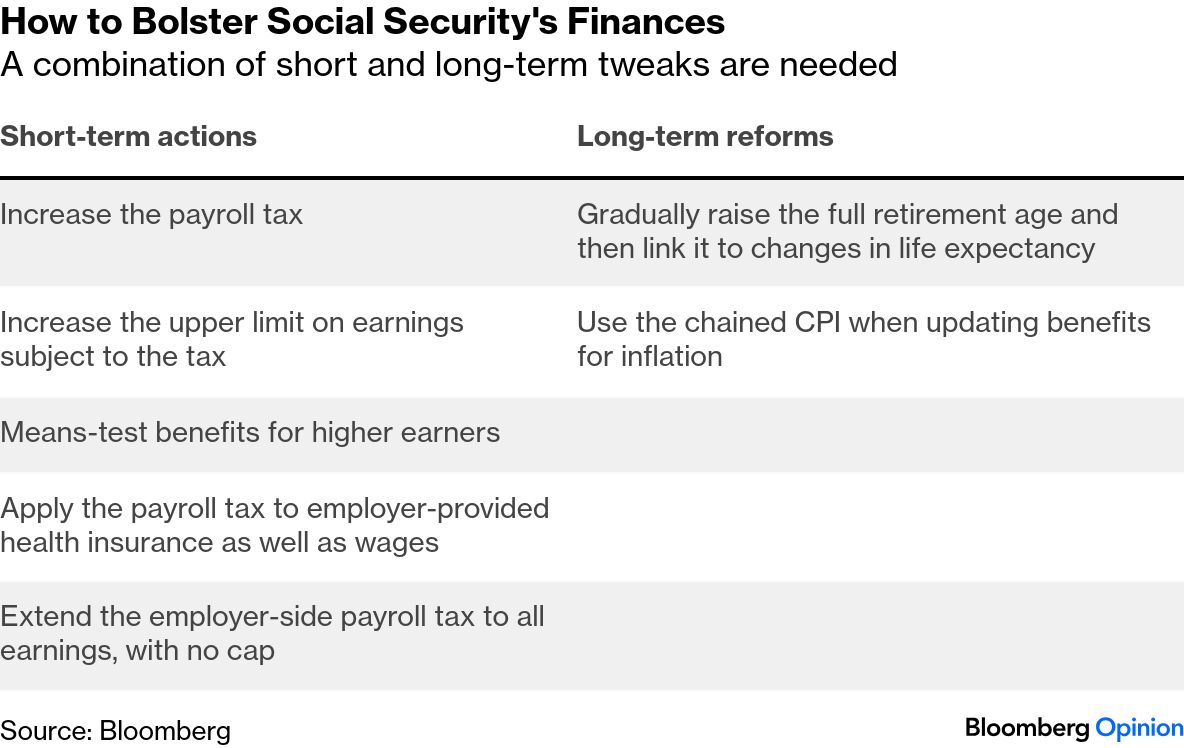
Much like a person with a cavity delaying their dentist appointment, the longer that Washington dithers, the worse the problem gets. "What's needed is a combination of short-term action to stave off insolvency and technical fixes to bolster the system's finances over the long haul." Instead of rattling off all the reforms the editors propose, I've combined them into one big menu. If done properly, these tweaks could actually strengthen the program for decades to come:

"One way or another," the editors write, "the promise to leave Social Security untouched will have to be broken. The fix is daunting precisely because it's been delayed so long." Read the whole thing.

Private Credit Hysteria

Here's a quote from Apollo CEO Marc Rowan:

"People have really just lost their minds, and the headlines get more and more hysterical and have almost nothing to do with the substance."

Hmmm. What do you think he was talking about here? The crypto rout? The true meaning of Christmas? The "most extreme cold on Earth"? All good guesses, but no, no and no. Instead, Rowan was zeroing in on Wall Street's favorite punching bag as of late: private credit, which pads a questionably large quantity of retirement and insurance portfolios. Is it the villain some are making it out to be? Maybe not. But our columnists say there's plenty of truth within those "hysterical" headlines.

"Private credit now accounts for about 35% of the investment portfolios of North American insurance companies," writes Allison Schrager. On paper, she says "the strategy promises high returns, which allows insurers to set aside less money to pay out on things like life insurance and annuities. It's tempting to believe you can get something for nothing, and no one falls for that more than those who should know better, meaning institutional investors such as pension fund managers and insurers."

Private markets may boast high returns, but that's at the sacrifice of liquidity and transparency. "No one really knows what the investments are truly worth," she writes. "So as pensions need their money to fund payouts, many are finding these investments weren't so great." It's a good thing, then, that defined benefit pension plans tied to private markets are becoming less common.

Looking at junk-rated loans made by private credit funds to midsized companies, Paul J. Davies sees similar fears. Although losses from borrowers defaulting remain low, "the outlook for repayment problems and bankruptcies isn't great,"  he writes. "Private credit has grown massively in recent years and lots of people are worried about whether some fund managers have expanded too fast and taken too many underwriting risks."

Changing Times

"Babe, I would trade the Cartier for someone to trust ... just kidding," is a lyric from Taylor Swift's new-ish song about Elizabeth Taylor. But in some ways, it's autobiographical. When Travis Kelce got down on one knee and proposed to her, Andrea Felsted says watch enthusiasts glommed onto the rare gold and diamond Cartier timepiece on her wrist.

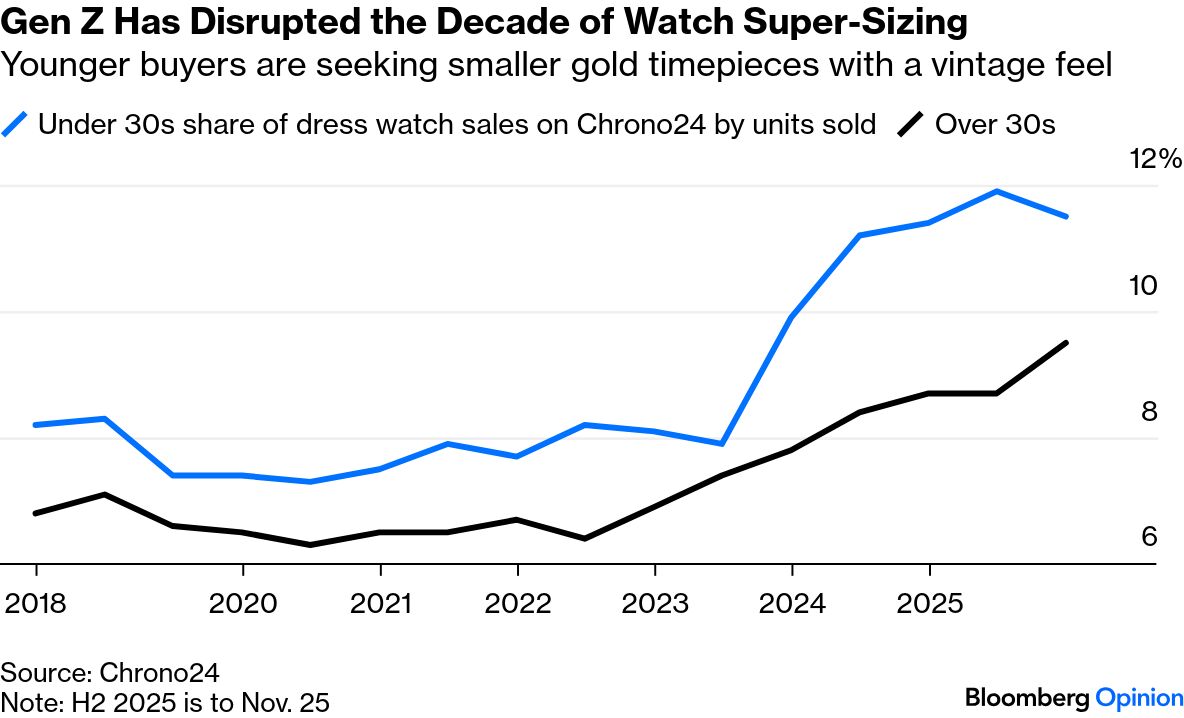
Just as the pop artist boosted the economies of entire cities during The Eras Tour, Andrea says Swift has cemented Cartier as Gen Z's most wanted watch brand, upending the market in the process. "Young buyers are shifting from bulky, mostly steel sports watches, led by Rolex, to smaller, predominantly gold models. The styles are being worn not only by women — some of whom are stacking them like bracelets — but also men, such as Cartier ambassador Timothee Chalamet," Andrea writes.

For those unable to splurge on a dainty new watch, some are finding luck in the vintage market. Prices for secondhand Cartier timepieces rose 10% between March and October. "Can Cartier's Gen Z popularity last?" Andrea asks. It's cliché to say, but time will tell.

Telltale Flip-Flop Charts

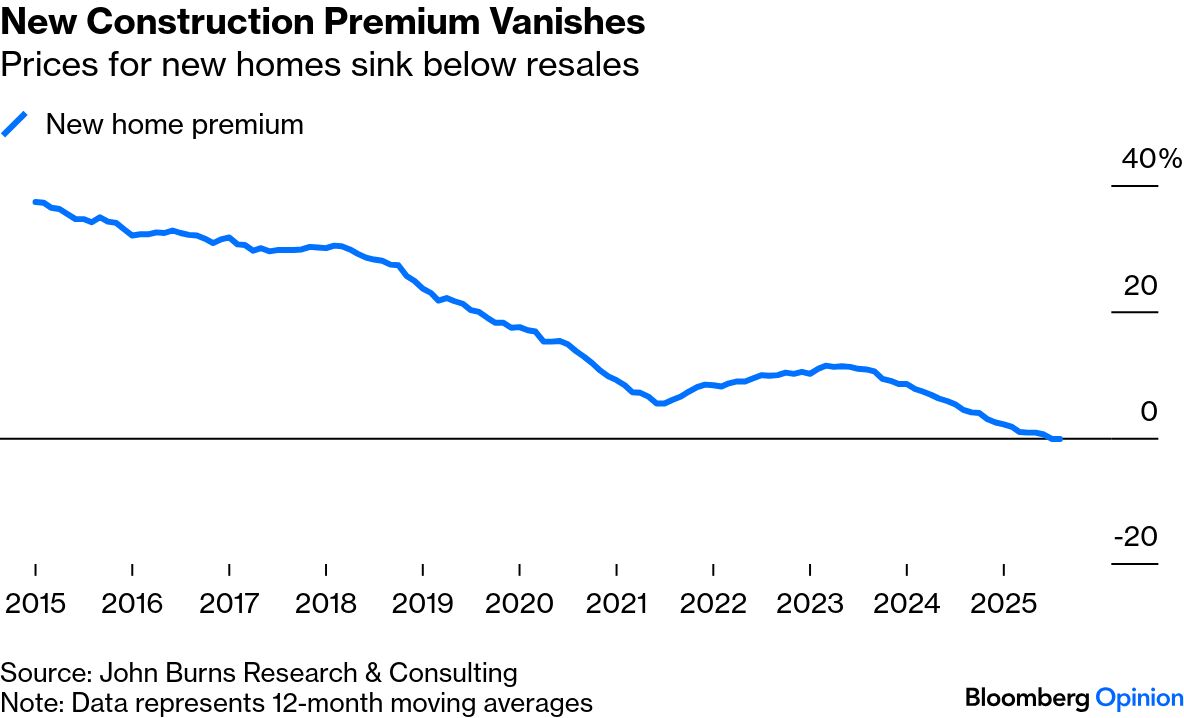
The average new single-family home costs more than the average old single-family home, right? Wrong! For the first time in more than five decades, Conor Sen says new construction is selling at a discount to re-sale houses. "The struggling new home market is the best gauge of how challenging it has been to sell a house this year," he writes. "Perhaps most concerning for sellers thinking about waiting until next spring is the fact that they are far from alone in hoping things will improve — delistings are surging heading into the end of the year."
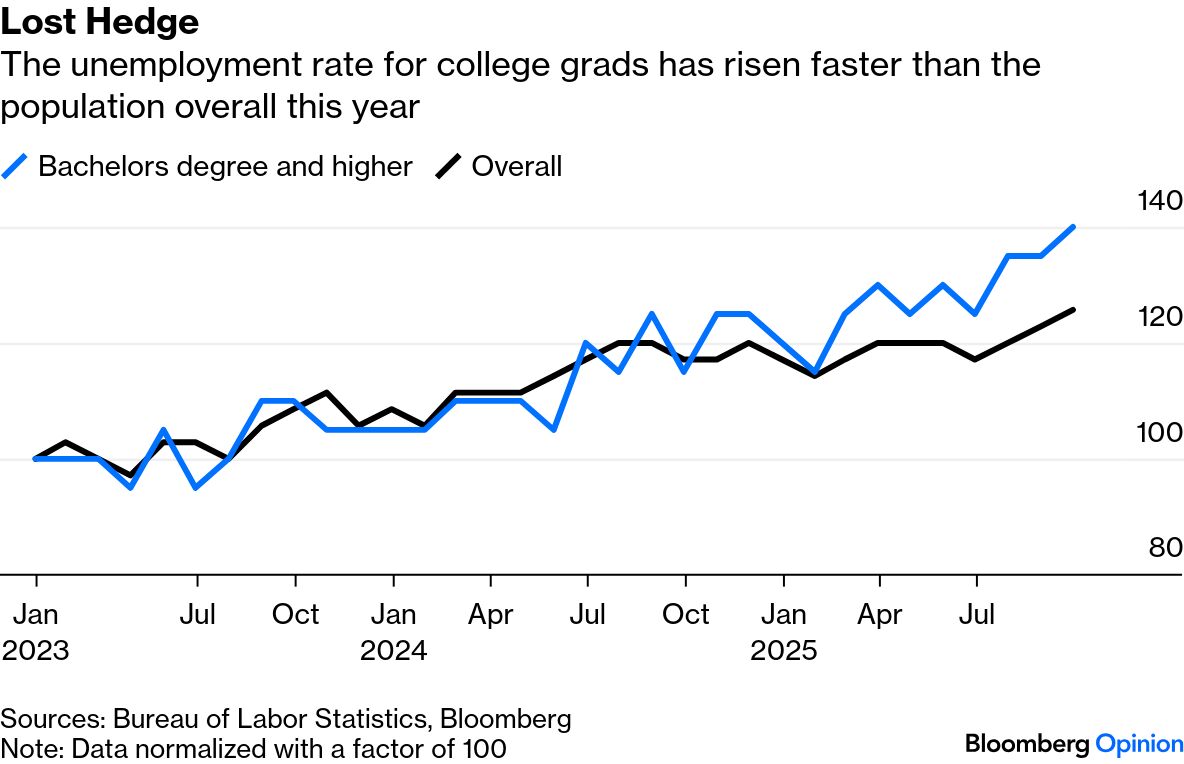
Meanwhile in the universe of higher academia, Allison Schrager says another age-old assumption is being turned on its head: "Historically, college grads had much lower rates of unemployment and if they lost their job, they were not unemployed for long. Now unemployment rates and the job-finding rate are converging between college grads and everyone else. Even more worrying, some are leaving the labor force entirely, perhaps because they are discouraged."

Further Reading

One in six US households is behind on utility bills — why not Uberize the grid? — Liam Denning

It's unfair to punish 190,000 Afghans for the alleged actions of one. — Patricia Lopez

ByteDance's Doubao app is using AI to win over Chinese consumers. — Catherine Thorbecke

Trump's tariff checks are a good idea in theory but are badly planned. — Claudia Sahm

With its new media rights deal, the NBA finally has a strategy for the post-Lebron era. — Adam Minter

Sam Altman's ChatGPT still has a winning edge over Google's Gemini. — Parmy Olson

Is China's Xi Jinping preparing a Ukraine-style invasion of Taiwan? — Karishma Vaswani

Rheinmetall is about to make a lot of money. Maybe too much. — Chris Bryant

ICYMI

Trump locks in his Fed pick.

Pope Leo provides peace in Lebanon.

You'll never guess MIT's hottest major.

Kickers

Chernobyl fungus is thriving.

Potatoes are shoes.

Reindeer on the run.

Wedding yurt disaster payday.

Rebel nuns win reprieve. (h/t Andrea Felsted for the last three kickers)

Notes: Please send potato shoes and feedback to Jessica Karl at jkarl9@bloomberg.net.

Sign up here and find us on Bluesky, TikTok, Instagram, LinkedIn and Threads.

Follow Us

Before it's here, it's on the Bloomberg Terminal. Find out more about how the Terminal delivers information and analysis that financial professionals can't find anywhere else. Learn more.

Want to sponsor this newsletter? Get in touch here.

You received this message because you are subscribed to Bloomberg's Opinion Today newsletter. If a friend forwarded you this message, sign up here to get it in your inbox.
Unsubscribe
Bloomberg.com
Contact Us
Bloomberg L.P.
731 Lexington Avenue,
New York, NY 10022
Ads Powered By Liveintent Ad Choices

No comments:

Post a Comment

The "elevator method" to wealth rejects buying stocks

No stocks or options and none of the volatility you get with normal AI stocks...   ...