
Ticker Reports for September 4th

3 Explosive Growth Stocks Hiding in Plain Sight
Most investors draw a line in the sand between value and growth investing without realizing that, at their core, they are essentially the same thing. Value relies on future growth potential to justify buying a beaten-down stock, and growth depends on intrinsic value to deliver returns. Recognizing this connection is key to building a forward-looking portfolio.
Burlington Stores Inc. (NYSE: BURL), Snowflake Inc. (NYSE: SNOW), and Cameco Corp. (NYSE: CCJ) are three stocks that illustrate how combining value and growth principles can reveal overlooked opportunities, particularly in sectors undergoing transformation or facing future tailwinds.
Burlington Stores: A Retail Stock That Defies Trade War Fears
When tariffs were announced for most of the United States and its trading partners in April 2025, stocks in the retail sector sold off sharply. As one of the most trade-sensitive industries, retailers like Burlington took a hit amid peak bearish sentiment. Yet, despite the tariffs remaining in place and negotiations ongoing, the market seems to have moved on.
Burlington trades at 94% of its 52-week high, and the bullish outlook appears justified. The MarketBeat consensus forecast for earnings per share (EPS) is $3.84, a significant jump of 141% from today’s EPS of $1.59. That kind of earnings acceleration supports the current price action and fuels a strong bull case.
Wall Street analysts rate Burlington stock as a Buy, with a consensus price target of about $345 per share, indicating a potential 19% upside from today’s prices. Some analysts think it could go even higher, like UBS Group analyst Jay Sole, who gave BURL stock a $430 price target, implying 48% upside potential.
Snowflake: Paying a Premium Today to Avoid Regret Tomorrow
As artificial intelligence (AI) becomes more commercialized, some software companies are becoming increasingly redundant. However, that is not the case for Snowflake. The company’s cloud computing and data management services are not just immune to AI disruption; they are essential to it. AI systems require vast amounts of data storage, transfer, and management, which makes Snowflake a vital part of the ecosystem. This explains why the markets have treated SNOW so favorably in recent months.
Trading at 95% of its 52-week high, this stock is showing bullish momentum. The MarketBeat consensus price target is $255.53, reflecting an approximately 9% potential upside. Zack’s Investment Research sees Snowflake reporting $1.52 in EPS for the next 12 months, a big jump from its current EPS of $1.07. Connecting the cloud moat and this leading EPS growth can begin to justify why the market has valued Snowflake stock at a high 26.5x price-to-book (P/B) ratio—far above the computer sector average of 9.4x.
Critics may label it “overpriced,” but Snowflake’s valuation reflects expectations of superior growth in a sector with immense staying power. The overlap of AI reliance and cloud scalability makes Snowflake a textbook case of growth justifying a seemingly high valuation, a trait it shares with the best value stocks of the past.
Cameco: Fueling the Future With Uranium
While solar and wind dominate the renewable energy conversation, the reality is that current infrastructure can’t support a full transition. With the United States planning multiple AI-focused data centers across the country, electricity demand is about to surge, and nuclear energy is poised to fill the gap.
Enter Cameco, a key player in uranium mining. Institutional investors are already taking notice as Cameco saw $1.5 billion in stock purchases this past quarter. And with a recent earnings beat ($0.51 EPS vs. $0.29 expected), momentum is clearly building.
Currently, Cameco trades at a 89.1x price-to-earnings (P/E) ratio, well above the mining industry’s average of 17.0x. While that may seem steep, it reflects the long-term growth story being priced in: nuclear energy becoming a critical part of global energy infrastructure.

An $8 trillion-dollar discovery 17,000 ft underwater
An $8 trillion-dollar discovery 17,000 ft underwater

With Rate Cuts Ahead, Buffett-Backed Builders Look Like a Buy
Between elevated rates and historically high home prices, the housing market has deterred buyers, many of whom are uncomfortable assuming a 30-year fixed-rate mortgage above 6%, according to the National Association of Realtors (NAR).
Another deterrent is housing supply—or lack thereof. In July, Zillow reported that the U.S. housing shortage hit a record deficit of 4.7 million homes. Fortunately, help for real estate buyers (and investors eyeing homebuilder stocks) is on the way.
The odds of an interest rate cut happening at the Federal Reserve’s September meeting stand at nearly 90%. However, 6% fixed rates aren’t likely before early 2026, per the NAR. So homebuyers may have to continue waiting. However, if rate cuts materialize later this month, homebuilders may be able to start addressing the housing deficit sooner than later.
That might have contributed to Warren Buffett's recent nearly $1 billion bet on two of them.
Lower Rates Don’t Necessarily Mean Lower Mortgages
Many assume that a lower effective federal funds rate (EFFR)—the Fed’s benchmark—translates into lower rates for a spectrum of debt, including car loans, credit cards, and mortgages. But during the central bank’s last rate-cutting cycle from September 2024 to December 2024, that didn’t happen.
Instead, mortgage rates increased. FRED data from that cycle shows 30-year fixed rate mortgages went from a monthly low of 6.08% in September to a monthly high of 6.85% that December.
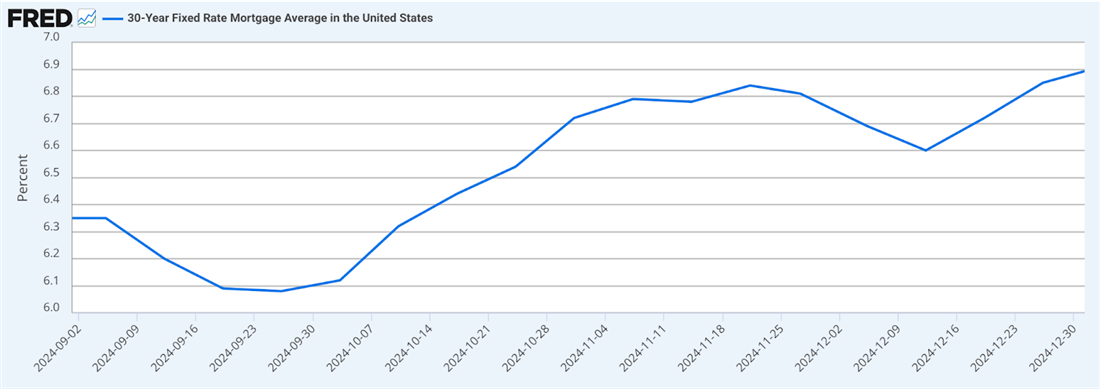
Historically, though, when the Fed cuts the EFFR, mortgage rates follow. But that isn’t the only factor. Mortgage rates are impacted—to a greater extent—by the 10-year Treasury. That 10-year note doesn’t precisely reflect what borrowers repay, but when its yield increases/decreases, mortgage rates mirror that, albeit within a predetermined spread of each other.
Lower Rates Do Mean Lower Borrowing Costs for Homebuilders
On the other hand, homebuilders are poised to profit from cuts. Lower rates beget lower borrowing costs for new construction projects and present opportunities to refinance existing debt at more attractive rates. Once those projects come to fruition, lower mortgage rates in early 2026 will incentivize buyers, thereby accelerating sales.
That’s important. One factor that’s contributed to negative sentiment around homebuilder stocks over the past year has been mounting carrying costs—the expenses incurred by financing and holding property (e.g., the cost of land and construction) as well as ongoing expenses (e.g., property taxes, insurance, and utilities). Carrying costs are recouped through sales. Faster sales mean improved cash flow and the opportunity for capital reinvestment (e.g., new construction projects). That’s what increases profitability for homebuilders and shareholders alike.
So while rate cuts are unlikely to immediately affect homebuyers’ borrowing costs, the leverage they’ll provide homebuilders could help begin to address the housing shortage while seeing inflows into their stocks. That’s perhaps why two of the largest companies in this space recently got a big vote of confidence from Buffett.
Lennar: Climbing Back From a 1-Year Low
In its most recent Form 13F filing, Berkshire Hathaway showed an $800 million position in Lennar (NYSE: LEN). Buffett’s not alone. Institutional ownership stands at 81.10%, with buyers (613) outnumbering sellers (381) over the past 12 months.
Much of that may have to do with the stock’s recent performance. Since its YTD low in April, Lennar is up 29.56%. However, the stock remains down 25.26% from its all-time high in September 2024. So there’s plenty of room until it retests that high.
Fundamentally, LEN’s recovering from the post-pandemic housing boom. Net income decreased 11.21% from $4.430 billion in 2021 to $3.933 billion in 2024. But consistent dividend payments of $130–$160 million quarterly indicate a shareholder-friendly approach and stable cash flow management. That dividend currently yields 1.50%, or $2 per share annually.
Lennar’s earnings are expected to grow 24.60% next year, from $12.48 per share to $15.55 per share.
More in Store for D.R. Horton
At $191.50 million, Berkshire’s stake in D.R. Horton (NYSE: DHI) is significantly lower but notable nonetheless. Institutional ownership is higher than Lennar's at 90.63%, with buyers (82) outnumbering sellers (607) over the past 12 months.
After also hitting its all-time high in September 2024, DHI fell 39% before bottoming on April 8, 2025. Since then, the stock’s up 47.25% through the last trading day of August. It’s still down 13% from that all-time high, suggesting there’s momentum en route to retesting resistance.
Despite the housing slowdown, DHI has managed to increase net income from $4.176 billion in 2022 to $4.756 billion in 2024—good for a 13.88% increase. More recently, D.R. Horton beat on earnings in Q2 but missed on revenue, which fell 7.4% year-over-year.
But earnings are rear-facing; the macro environment should be conducive to DHI expanding profit margins and rewarding shareholders going forward. The company’s expected to grow earnings 10.74% next year from $13.04 per share to $14.44 per share.
Meanwhile, its dividend currently yields 0.94%, or $1.60 per share annually.

Trump's 2025 Economic Revolution Is Here Are Your Retirement Savings Ready?
Trump's 2025 Economic Revolution Is Here Are Your Retirement Savings Ready?

Palantir Insider Selling: Risk Signal or Normal Activity?
Palantir Technologies Inc. (NASDAQ: PLTR) stock is down about 2.5% in the last 30 days. Some long-time critics of the company and the stock’s current valuation believe this could be the beginning of what they believe is a long-overdue correction.
Their concerns aren’t without merit. Based on traditional metrics, Palantir is very overvalued.
However, a recent concern is the amount of sales being made by company insiders. This can be a dangerous news item for investors to digest without context.
Why Palantir Insider Selling Matters for Investors
The primary concern about insider selling is that it could be a form of insider trading. That is, executives or board members of a company sell shares because they know some material information that will cause a stock drop in value.
However, almost all of the recent trades in PLTR stock were part of a Rule 10b5-1(c) plan. These plans are expressly set up to prevent insider trading. Rule 10b5-1 goes back to the adoption of the Securities Exchange Act of 1934.
The rule “provides an affirmative defense to insider trading for individuals and issuers that trade stocks under plans entered into in good faith at a time when the individual or issuer does not possess material nonpublic information.”
The Palantir Insider Selling page on MarketBeat shows you the trades that have occurred and allows you to see the SEC Form 4 showing whether the trade was part of a Rule 10b5-1(c) plan.
Palantir’s Heavy Stock-Based Compensation and Dilution Risk
Since going public in 2020, many investors have expressed concern over the amount of stock-based compensation (SBC) issued by Palantir. Stock-based compensation allows companies to retain talent without ample cash outlays, helping to preserve capital for business operations and growth.
Granting employees partial ownership in the company also helps align their interests with those of shareholders.
On the downside, SBC increases the number of outstanding shares, reducing the value of existing shares and making a company’s stock seem more expensive on a per-share basis.
While SBC is standard among software companies and companies in the tech sector in general, Palantir’s use of it is higher than that of many companies. As of June 2025, Palantir’s trailing 12-month SBC expenses totaled $1.57 billion, a 30% year-over-year (YOY) increase.
Investor Concerns: Valuation, Dilution, and Adjusted Earnings
There are three valid reasons for investors to be concerned about Palantir’s use of SBC.
- The company’s high share count makes its price-to-earnings ratio extremely high, fueling concerns about long-term value, especially if growth fails to outpace dilution.
- Investor returns are threatened if SBC continues at such a high rate, as investors' proportional ownership in the business drops even if the company grows.
- Some claim Palantir’s exclusion of SBC in “adjusted earnings” presentations can obscure the true compensation cost, making financials seem artificially stronger.
That’s why insider selling combined with high stock-based compensation is frequently referred to as a negative signal. The belief is that company insiders are benefiting while eroding shareholder value.
Understanding Insider Selling: Why Palantir Executives Take Profits
The keyword in stock-based compensation is “compensation.” A company’s stock growth is a financial benefit to an employee's compensation package. It’s logical that with a stock that’s enjoyed the run-up of Palantir, insiders would look to take some profits.
In fact, the most common reason insiders sell shares is to diversify their personal wealth (outside of the company’s stock), or to fund personal expenses (life events, taxes, etc.).
This is where the 10b5-1 plan designation is essential. These sales are routine, predictable, and most importantly, pre-planned. That means they reflect personal financial planning rather than believing that the company’s stock will go down.
Do Palantir’s New AI Partnerships Change Insider Selling Risks?
One more thing to consider. In the last week, Palantir struck two major deals that hardly qualify as sell-the-news events.
The company announced a new partnership with Lumen Technologies (NYSE: LUMN). Lumen is transforming its traditional telecom business into a next-generation technology company to help customers meet their evolving AI-ready needs.
Lumen is using Palantir’s Foundry and AIP programs to unlock new value and is already reporting an enormous impact from the partnership.
The company also expanded its partnership with the global automotive leader, Lear. The company is using Palantir’s Foundry, AIP, and Warp Speed platforms, which Lear credits for generating $30 million in cost savings in the first half of 2025 alone.

Buy the stock when it touches this ONE line on the chart
Buy the stock when it touches this ONE line on the chart

MarketBeat Media, LLC dba TickerReport
345 N Reid Place, Suite 620, Sioux Falls, SD 57103.




No comments:
Post a Comment