
Ticker Reports for August 1st

Rocket Lab Reports Next Week: Here's What Investors Should Know
Rocket Lab USA, Inc. (NASDAQ: RKLB), a leading aerospace name, is set to report earnings for the second quarter of fiscal 2025 on August 7, and institutional and retail investors are watching closely. The stock has gained significant online attention and a following for good reason. The company has continued to execute at a high level.
The result? The stock has rocketed higher over the previous year. Shares are up 760% over the last twelve months and 82% on the year.
After surging to new all-time highs earlier in the month, the stock has since pulled back 13% from its highs but remains in a firm uptrend. Investors will be eagerly anticipating the upcoming earnings as they might impact the stock's short-term trajectory, given the significant upward momentum. Here’s what investors should know ahead of its forthcoming report.
Technical Setup: Despite Recent Pullback, Uptrend Remains Intact
Ahead of earnings, the stock has maintained its bullish positioning across multiple timeframes. Despite its recent pullback from its 52-week highs, shares remain firmly above significant SMAs. In the short term, the stock just found support at its 20-day SMA near $43. That level will act as major short-term key support going forward.
On a higher timeframe, its 50-day near $35 will act as a significant potential inflection point post-earnings. Should the stock fall below that area, it would signal a major shift in momentum and one sparked by a substantial miss on earnings, margins, or potential Neutron commentary.
So, on that note, let’s take a closer look at its previous earnings and what to watch for in its upcoming earnings.
Q1 Recap: Solid Growth, Improving Margins
In Q1 2025, Rocket Lab reported revenue of $122.6 million, slightly below the analyst estimate of $123 million but reflecting a 32.1% year-over-year increase from Q1 2024. Launch services contributed $35.6 million, driven by Electron missions, while space systems generated $87 million, led by contributions from satellite manufacturing and components businesses.
The company achieved a non-GAAP gross margin of 33.4%, improved sequentially due to a favorable mix in satellite manufacturing, though slightly offset by a lower average selling price in launch services.
The adjusted EBITDA loss was $30 million, better than the guidance range of $33 million to $35 million, indicating operational improvements despite ongoing investments in the Neutron program.
Rocket Lab's backlog at the end of Q1 2025 was $1.067 billion, with $422.2 million in launch backlog and $644.8 million in space systems backlog, reflecting strong future demand. Approximately 50% of this backlog is expected to convert to revenue within 12 months.
Key Metrics to Watch in Q2
Heading into earnings, there are three main areas investors will potentially focus on:
1. Launch Cadence and Pipeline Clarity
Rocket Lab completed multiple successful Electron launches in Q2 and has a full slate of missions lined up. Investors will want clarity on the Neutron rocket timeline, as this vehicle is central to RKLB’s long-term revenue expansion and access to larger contracts.
2. Backlog Growth and Contract Wins
In Q1, the backlog remained strong, bolstered by defense and civil space contracts. Any update showing increased backlog or new awards from agencies like NASA could strengthen the bull case.
3. Margins and Cash Burn
Progress on margins will be critical. Investors are looking for continued gross margin expansion and signs that Rocket Lab is on a path toward positive EBITDA. The company has managed costs well so far, but scaling the launch and space systems businesses efficiently will remain a priority.
Analyst Sentiment and Valuation
RKLB maintains a consensus Moderate Buy rating and an average price target of $35.64. Several analysts have recently taken positive action ahead of earnings.
Notably, Citigroup upgraded its target from $33 to $50, and Bank of America analysts boosted their target from $30 to $50.
However, there’s no denying that the stock trades at a premium valuation on a price-to-sales basis.
But with revenue growing rapidly and high visibility from backlog, some believe it’s justified.
Still, expectations are elevated. RKLB needs to show continued execution to maintain investor confidence and potentially attract further institutional buyers as the business matures and Nuetron becomes a reality.
Nearing a Critical Inflection Point
Rocket Lab is nearing a technical inflection point just as a potential fundamental catalyst approaches. With Q2 earnings due August 7, investors will be watching closely for updates on launch cadence and Neutron, backlog strength, and margin progress.
If RKLB delivers a strong print and maintains its upward trend, it could trigger further momentum after an already impressive YTD performance. Either way, the upcoming earnings will likely determine and set the tone for the next phase of Rocket Lab’s trajectory.

5 Trillion Reasons to Prepare for the Coming Market Turmoil
5 Trillion Reasons to Prepare for the Coming Market Turmoil

Apple Stock: Big Earnings, Small Move—Time to Buy?
Apple Inc. (NASDAQ: AAPL) delivered a blowout earnings report after the market closed on July 31. That’s not showing up in the company’s stock price. The stock is up over 3% after the results dropped. However, the stock was trading just a little over 1% before the earnings call.
By every metric that matters to Apple investors, this was a strong report:
- Revenue of $94 billion beat expectations of $89.53 billion and was up 10% year-over-year (YOY). This was the best growth since the December 2021 quarter.
- Earnings per share (EPS) of $1.57 beat expectations of $1.43 and were up 12% YOY.
- Revenue for the iPhone came in at $44.58 billion, up 13.5% YOY.
- Revenue for Services came in at $27.42 billion, up 13.3% YOY.
- China revenue was up 4.4% YOY.
Apple also guided to mid- to high-single-digit revenue growth in the current quarter, which gave the tech company the feeling of the good old days. It shows that Apple’s user base of over 2.4 billion consumers is still willing to pay a premium for its products (the company hasn’t cut the price of its iPhone). However, investors seem to treat the quarter as if the results were already baked in.
A Low Bar to Clear, But Also a Low Ceiling?
The questions are why consumers bought like they did and whether these results are repeatable. The post-earnings reaction hints at a lot of skepticism. The results were refreshing for shareholders, for sure. However, immediately after the report came out, analysts chattered about the possibility of a “pull forward” in the company’s results.
That means consumers in the United States and China bought iPhones and other Apple products in the prior quarter in anticipation of higher prices due to tariffs. Chief executive officer (CEO) Tim Cook acknowledged that about 1% of the 10% growth the company saw in YOY revenue was due to that “pull forward” effect.
Specifically with China, government rebates and JD.com’s sales event (similar to Amazon Prime days) certainly had an impact.
What About AI?
While investors got a better-than-expected and certainly better-than-feared report, the company didn’t provide specifics about its AI intentions other than to say that it is focusing on the "new Siri" that is due out next year. Cook did say that the company would be increasing spending in AI, but the company didn’t put a number on that commitment.
In a big week for some of the largest technology stocks, bulls could say that Apple saved the best for last. However, when compared to the results from Microsoft Corp. (NASDAQ: MSFT) and Meta Platforms Inc. (NASDAQ: META), investors could be concerned that Apple isn’t playing the same game.
Is It Time to Bite into APPL Stock?
Apple had a low bar to clear heading into earnings. AAPL stock was down more than 18% in 2025 heading into the report. However, it’s also fair to say it has the lowest ceiling.
Before earnings, the Apple analyst forecasts on MarketBeat had a Moderate Buy rating on AAPL stock with a consensus price target of $234.94, a 13% upside for investors. That included a bullish $270 price target from Wedbush’s Dan Ives.
Bulls will point out that if Apple can repeat these results, AAPL stock could be the comeback trade in the year's second half. The bears will point out that it’s unlikely that Apple will be able to repeat this performance.
In the current quarter, Apple reported $800 million in tariff-related costs. That number will increase to $1.3 billion in the current quarter. On the earnings call, Cook acknowledged the tariff uncertainty by pointing out that the company would not issue guidance beyond the upcoming quarter.
The one-year chart for AAPL stock shows the stock has made a complete round trip and is trading almost exactly where it was at this time in 2024. Few investors would’ve expected that, and it makes it difficult to have conviction.
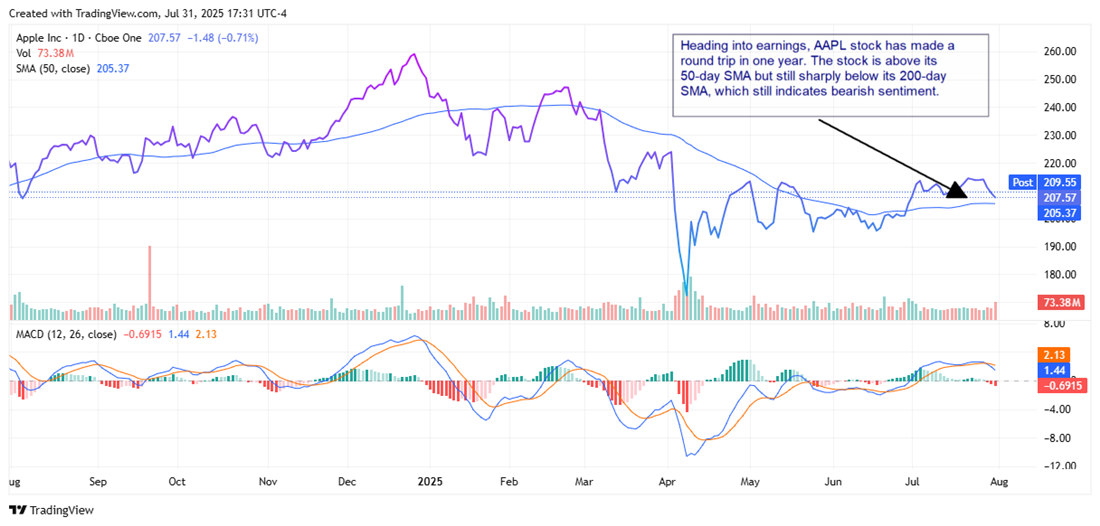
One trading idea could be a bull put spread. In this example, a trader would believe AAPL stock would stay above $200 per share in the next two to four weeks.
- Sell AAPL $200 Put
- Buy AAPL $195 Put (to limit downside risk)
- Net Credit: You collect the premium upfront
- Max Gain: If AAPL stays above $200 through expiration
- Max Loss: If AAPL closes below $195
This neutral-to-bullish setup allows traders to profit from a sideways or slightly rising stock without needing a breakout rally.

Everyone's watching Nvidia right now. Here's why I'm excited.
Everyone's watching Nvidia right now. Here's why I'm excited.
Amazon's Earnings: What Comes Next and How to Play It
Shares of tech giant Amazon.com Inc. (NASDAQ: AMZN) finished Thursday's session up nearly 2%, only to tumble more than 6% in after-hours trading following the company's Q2 earnings release. This sharp reversal underlines just how high expectations had gotten after the 40% rally from April's low.
The stock's multi-month move meant anything less than a near-perfect report risked triggering a wave of profit-taking, and that appears to be exactly what's happening already. As we'll see below, however, this is also creating a couple of interesting plays for investors to consider depending on their belief in Amazon's potential over the long run, and their near-term appetite for risk.
Let's jump in and take a look.
The Report Looked Good, But It Had to Be Great
At first glance, Amazon seemed to deliver. The company's earnings per share came in more than 25% above expectations, while revenue was up 13.3% year-over-year. Both metrics landed hot and were well above analyst expectations, adding to Amazon's impressive track record of delivering strong headline numbers quarter on quarter.
But investors weren't satisfied based on the after-hours price action. As anticipated earlier in the week, any sign of weakness in last night's report could send the bulls running and the bears raging. And Amazon's weaker-than-expected guidance for operating income and some free cash flow concerns seem to have done just that.
The range shared by management on the former was notably conservative, while the latter figure is now at its lowest in two years. In that context, it's perhaps not all that hard to see what investor sentiment would swing from risk-on to risk-off so quickly.
It remains to be seen how long this switch will last, but in our view, there's little to be worried about regarding Amazon's long-term potential.
What the Market Might Be Missing
While the overnight sell-off might feel sharp, it's also arguably overdone. This was still an impressive report for Amazon, with revenue growth accelerating across the board and profitability improving at the same time. Overall growth remains strong despite ongoing infrastructure investments and competitive pricing pressures.
The bears will point to growing concerns around the company's ability to stay in the lead group of the artificial intelligence (AI) arms race, but CEO Andy Jassy was not overly concerned. He spoke about this on the post-earnings conference call, saying, "I don't believe that we will have fully resolved the capacity we need for the amount of demand that we have in a couple of quarters. I think it will take several quarters, but I do expect that it's going to get better each quarter".
Taken in total, there's a strong case to be made that Amazon is still in the early innings of its next growth phase, and Thursday's after-hours drop is more about positioning than fundamentals.
2 Ways to Play It
For those of us on the sidelines, what kind of plays should we be looking for? Option one might be to sit back and let the correction play out. A move down to around the $220 level would take the stock back to a key area of support, and, given how one-directional the recent rally has been, would actually be quite healthy.
If that $220 level were to hold, and or if we were to see a fresh bullish crossover in the MACD, it would likely mark the start of the next leg higher. Waiting for confirmation here gives you better risk/reward and protects against a deeper pullback.
The other option is to start accumulating right away. This argument rests on the idea that Amazon's core thesis remains intact and the bears' concerns are already, or at least close to being, priced in after last night's drop. For big-time believers and long-term investors, this dip could be a gift - especially considering the company's strength across multiple verticals and its growing strength in high-margin, AI-driven businesses.
Remember, multiple firms have been reiterating their Buy and Overweight ratings all through 2025, and even as recently as this week. The most recent price target from the team over at UBS Group sees the stock trading north of $270, a move that points to additional upside of around 15% from current levels. Don't expect their bullishness, and that of their peers, to change anytime soon.

Man Who Called Nvidia at $1.10 Says Buy This Now...
Man Who Called Nvidia at $1.10 Says Buy This Now...

MarketBeat Media, LLC dba TickerReport
345 N Reid Place, Suite 620, Sioux Falls, SD 57103.




No comments:
Post a Comment