Monday, September 2, 2024

An Amazon chief's warning for the world

The rainforest's radical transformation

Today's newsletter sits down with Chief Raoni Metuktire, who has spent most of his life fighting for the Amazon. The rainforest has been losing trees at an alarming rate over the years, and just this past week massive wildfires across the region have blown toxic smoke into Brazil's financial center São Paulo.

You can read and share a full version of today's main story on Bloomberg.com. For unlimited access, subscribe.

The rainforest's radical transformation

By Olivia Rudgard

When Chief Raoni Metuktire was a young man, the Amazon rainforest was a different place. "Nature was all around us," says the Indigenous Brazilian leader and environmentalist. "We could make long trips, travel across the land. There wasn't anything stopping us. The forest was big."

Over half a century later, a fifth of that forest has been lost. Areas that were once remote and unspoiled are now cut through with roads and farms, and the land Raoni's people occupy is much smaller. Since satellites started tracking the Amazon in 1972, there has been a "radical transformation across the southern and eastern frontiers," says Douglas C. Morton, an Earth system scientist with NASA. "People are no longer clearing 10 hectares at a time. People are clearing 10,000 hectares in a weekend."

The Amazon's plight set the tone for Raoni's remarkable life, which has taken him out of Brazil's Mato Grosso state and all over the world to meet presidents, celebrities and business leaders. Raoni worked with Juscelino Kubitschek, Brazilian president in the late 1950s, and was the subject of a 1978 documentary narrated by Marlon Brando. In 1989, he mounted a campaign against deforestation with pop star Sting, which prompted the Brazilian government to recognize the Menkragnoti Indigenous Territory — millions of hectares of rainforest that includes Raoni's home. 
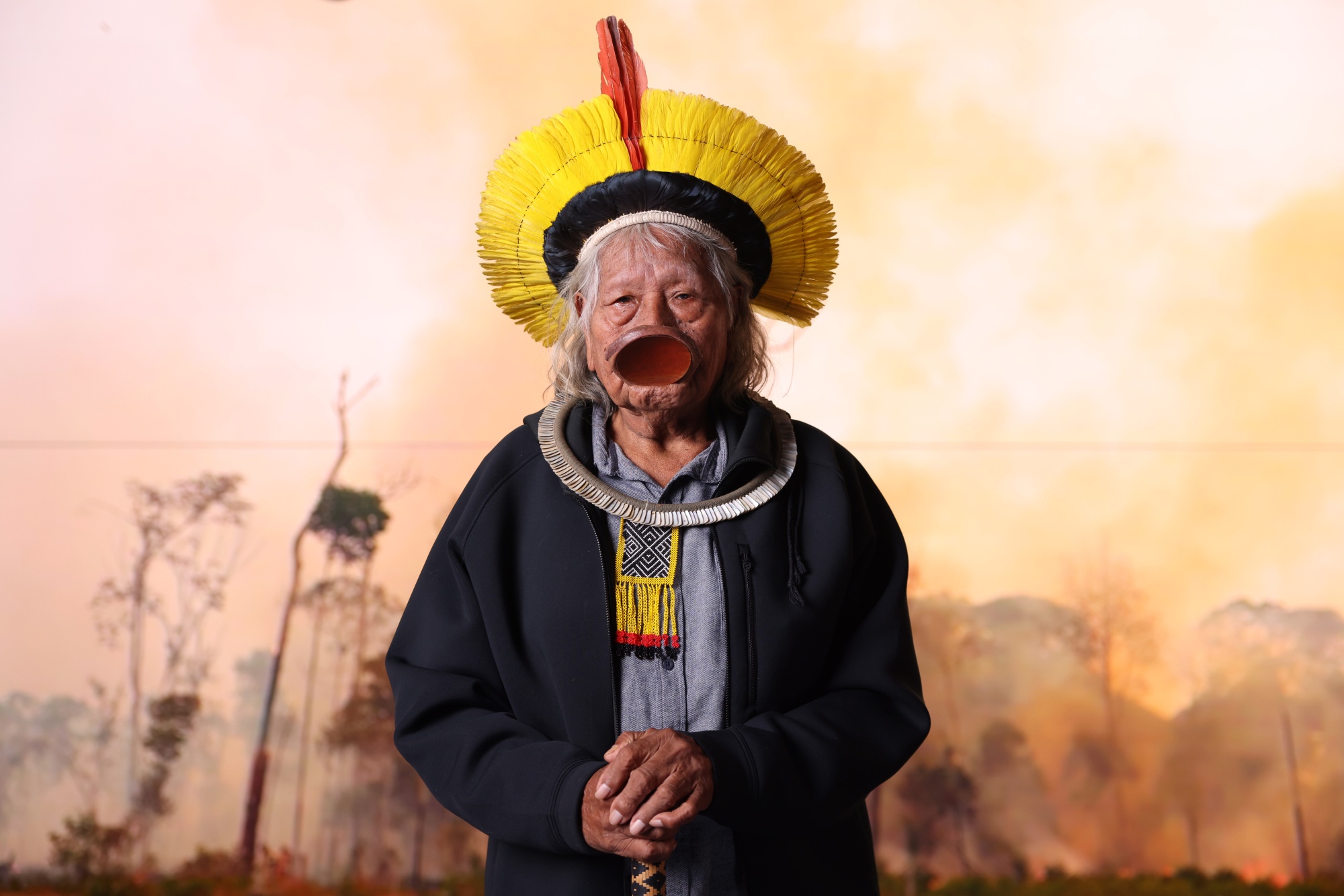
Chief Raoni Metuktire during an interview in London on June 25. Photographer: Hollie Adams/Bloomberg

Now in his 90s, Raoni is still traveling the world, including a sojourn to the Bloomberg office in London, where he spoke to Bloomberg Green. Flanked by family and associates who translated the discussion to and from his native language, Raoni wears a headdress and an ornamental disk in his lip — cutting a striking figure amid the suits of London's Square Mile. 

Long ignored or persecuted, Indigenous people are increasingly involved in global discussions about the Amazon, where roughly 1.5 million of them live. The world's forests have also risen to the top of the climate agenda. In 2022, 195 nations agreed to protect and restore at least 30% of the Earth's land and water by 2030. Deforestation is expected to be a major topic at next year's United Nations climate summit.

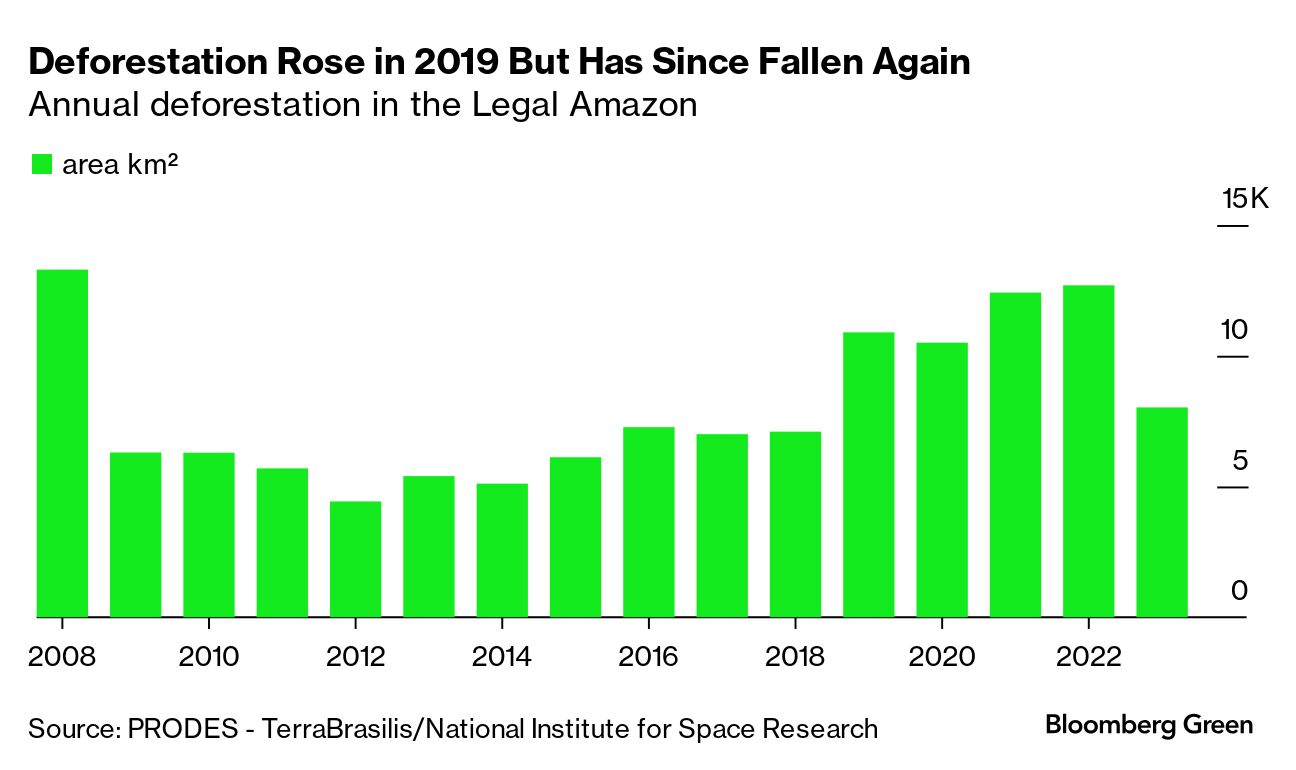
With that attention — and public awareness — has come some progress. Around 2005, the pace of deforestation in the Amazon slowed from 20,000 square kilometers (7,700 square miles) per year to 5,000 square kilometers. It rose again during Jair Bolsonaro's presidency between 2019 and 2022, but dropped to less than 10,000 square kilometers in 2023 as Bolsonaro's successor, Luiz Inacio Lula da Silva, bolstered enforcement.

"I'd like to think that we're heading in the right direction," says Michael T. Coe, a senior scientist at the Woodwell Climate Research Center. 

But the threat to the rainforest is also being exacerbated by a warming world. Roughly 5% of the Amazon is no longer suitable for rainforest at all, and is turning into other landscapes such as savannah or drier forests. "The ideal climate for rainforest is shrinking," Coe says. 

Those impacts are felt disproportionately by Indigenous people, who depend on the ecosystems damaged by deforestation and don't benefit from its economic activity. "The wealth is not shared locally. The Amazon region is among the poorest and most underserved areas in Brazil," says WRI Brasil Executive Director Cristiane Fontes. 

There is evidence that Indigenous people are successfully protecting some of the most carbon-rich parts of the Amazon, but Raoni has noticed droughts, heat and changes to rainfall. "The banks in your country here must stop sending money to Brazil, investing in deforestation," he says.
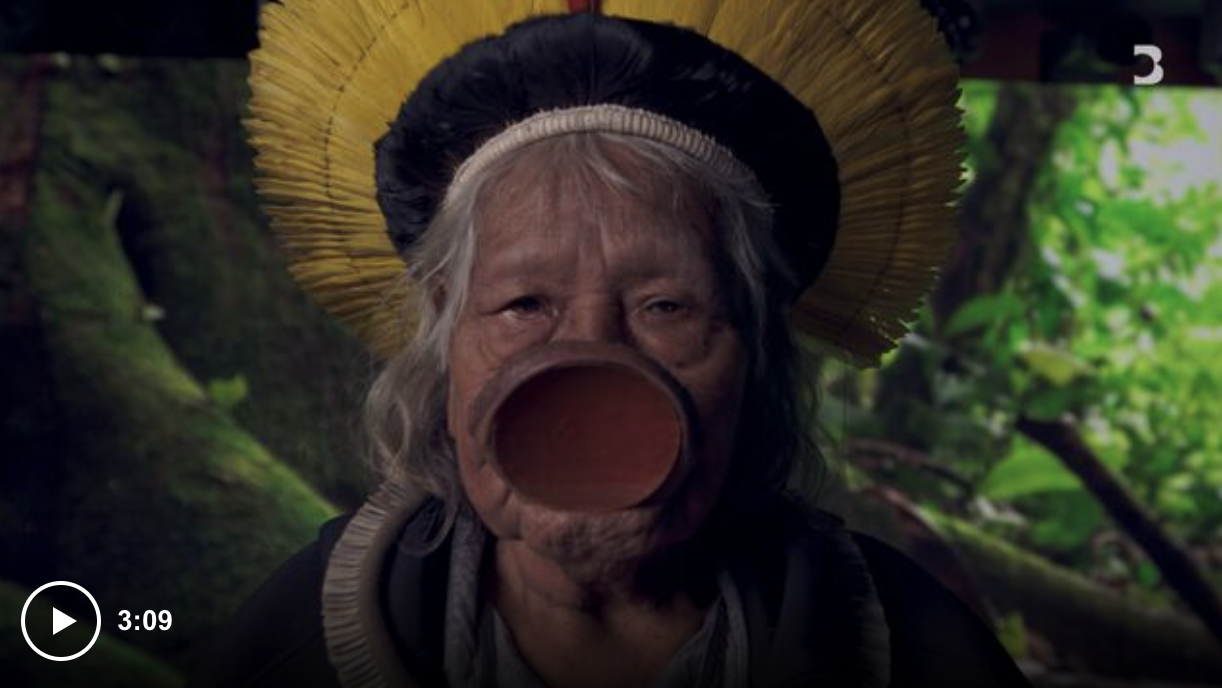
WATCH: This Amazon Chief Has a Warning for the World

Even as he approaches 100, Raoni doesn't blink at traveling thousands of miles to fight for his homeland. He traces his skill with advocacy back to the 1950s, when Raoni was in his early 20s and first met someone outside of his community. The Villas Boas brothers, Brazilian activists and advocates for the Indigenous, came to his village. They quickly bonded.

Claudio Villas Boas was "the man that really taught me about white people and the way they think," Raoni says. "So now I can defend the forest." 

Read and share a full version of this story on Bloomberg.com

For unlimited access to climate and energy news and original data and graphics reporting, please subscribe.

The wrong direction 

590,000 
If current trends continue, that's how many square kilometers of the Amazon will be lost by 2050, according to the World Resources Institute. It's an area larger than France.

Fighting deforestation

"We really are starting just to see the scale of this challenge around the globe. Everyone is trying to scramble and respond to the EUDR reality."
Elizabeth Teague
Senior director of climate resilience at Root Capital, an impact investor supporting small-scale farmers as they prepare for the European Union Deforestation Regulation

Brazil is burning

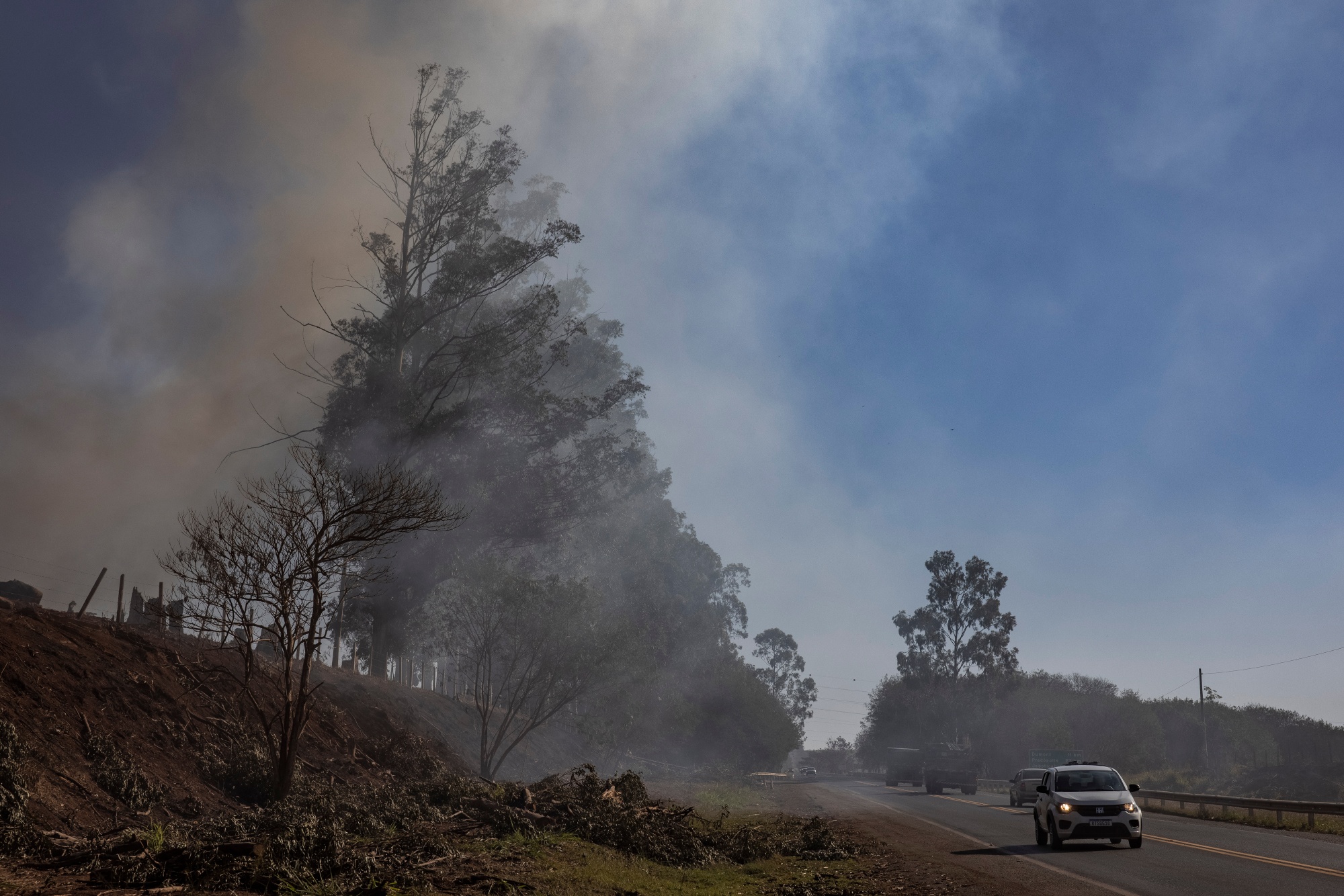
A curtain of smoke from wildfires in the Amazon rainforest has been spreading across Brazil. There were 28,697 fires reported in the Amazon region in August, 38% higher than the 10-year average, WWF-Brasil said, citing data from the National Institute for Space Research known as Inpe. The number exceeds 50,000 in the year to Aug. 27, the most since 2010, it said.

Burnt land along a road following wildfires in Riberaio Preto, Sao Paulo state, Brazil, on Aug. 27. Photographer: Victor Moriyama/Bloomberg

Toxic particles smothered the capital Brasilia last week and spread to Sao Paulo, the country's financial center and Latin America's biggest city.

This is the second straight year of extreme drought in Brazil and dry, hot weather has created ideal conditions for wildfires to spread across large areas. 

Read the full story here.

More from Green

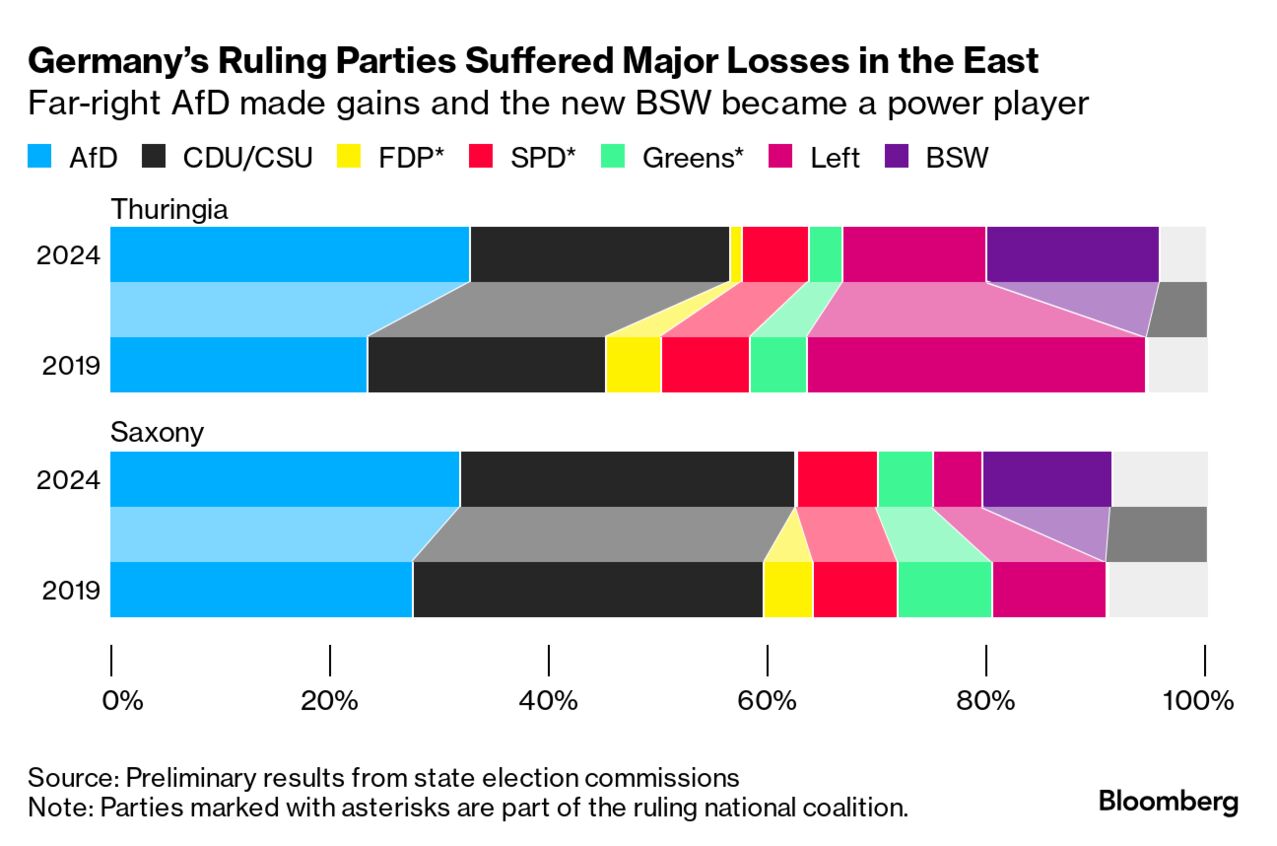
A populist upsurge in elections in two eastern German states on Sunday sent the signal that opposition is growing to policies aimed at cleaning up Europe's biggest economy.

The Greens, the main driver of Germany's environmental push in Chancellor Olaf Scholz's ruling coalition, suffered losses in Saxony and an even bigger blow in Thuringia. In the state that was won by the climate-skeptic Alternative for Germany, the Green Party was dumped from the legislature and 86% of voters in a poll by Infratest dimap for public broadcaster ARD said they were dissatisfied with it.

More bad news could come in three weeks, when Brandenburg — the state surrounding Berlin — votes for a new regional government. The latest poll shows support for the Greens at 5%, the threshold generally needed to secure seats in the legislature.

China's solar manufacturing glut may soon resolve itself. Goldman Sachs Group sees an imminent wave of factory closures that would help rebalance the market, while Morgan Stanley reckons equipment prices have already bottomed out.

The world's strongest crane is coming for wind turbines. The crane, built by heavy lifting firm Mammoet for tens of millions of dollars, will help meet soaring demand for massive new energy infrastructure — including giant wind turbines.

Kyle Bass says blackballing oil has been a bad bet for ESG. The hedge fund veteran and founder of Hayman Capital Management says the backlash that's been building against ESG in recent years is largely due to climate activists' demands that fossil fuels be abandoned here and now.

Worth a listen

Before he founded the geothermal startup Fervo in 2017, Tim Latimer was a drilling engineer for the oil and gas industry — a job he loved. "Honestly, if it wasn't for climate change, I probably wouldn't have ever changed my career," he says on the latest episode of Zero. Now Latimer is applying his drilling know-how to Fervo's wells, supercharging their energy production in the process. Latimer and Akshat Rathi chat about opportunities in geothermal, the infernal permitting process, and why Fervo has its sights on expanding into Kenya, Indonesia, Turkey and the Philippines. Listen now, and subscribe on Apple or Spotify to get new episodes of Zero every Thursday.

More from Bloomberg

  • Hyperdrive for expert insight into the future of cars
  • Energy Daily for a daily guide to the energy and commodities markets that power the global economy
  • CityLab Daily for top urban stories and ideas, curated for your inbox by CityLab editors
  • Tech Daily for what to know in tech

Explore all Bloomberg newsletters at Bloomberg.com.

Stay updated by saving our new email address

Our email address is changing, which means you'll be receiving this newsletter from noreply@news.bloomberg.com. Here's how to update your contacts to ensure you continue receiving it:

  • Gmail: Open an email from Bloomberg, click the three dots in the top right corner, select "Mark as important."
  • Outlook: Right-click on Bloomberg's email address and select "Add to Outlook Contacts."
  • Apple Mail: Open the email, click on Bloomberg's email address, and select "Add to Contacts" or "Add to VIPs."
  • Yahoo Mail: Open an email from Bloomberg, hover over the email address, click "Add to Contacts."

No comments:

Post a Comment

The "elevator method" to wealth rejects buying stocks

No stocks or options and none of the volatility you get with normal AI stocks...   ...