| Good morning. Traders brace for September volatility, emerging markets confront investor caution and the BRICS group faces the prospect of expansion. Here's what's moving markets. — Kristine Aquino US markets are set to return from a holiday to kick off September, which has traditionally been a terrible month for traders, with the S&P 500 Index suffering its biggest percentage loss since 1950 in this month. And investors may need to prepare for stormier weather this time ahead of a report on the American job market due on Friday. That's expected to show hiring and wage growth accelerated in August, which could cast doubt over the quarter-point Federal Reserve interest-rate cut that traders are pricing for September. With US markets shut, emerging markets bore the brunt of investor caution. An MSCI gauge of developing-nation equities slid on Monday, led by Chinese blue-chips such as Alibaba and Tencent. The slide followed data showing Chinese factory activity contracting for a fourth straight month in August. A similar gauge for emerging-market currencies also fell, and the Brazilian real was among those on the backfoot despite the central bank's auction of currency swaps in an effort to curb losses. Turkey has formally asked to join the BRICS group of emerging-market nations as it seeks to bolster its global influence and forge new ties beyond its traditional Western allies, according to people familiar with the matter. Turkey submitted an application to join BRICS some months ago amid frustration over a lack of progress in its decades-old bid to join the European Union, the people said. The bid is also partly a result of rifts with fellow NATO members after Turkey maintained close links with Russia following its invasion of Ukraine in 2022, they said. Beyond key US data, investors will also contend with geopolitical catalysts amid a row between China and the Philippines in the South China Sea. Skirmishes between ships from the two countries have opened a new flashpoint shortly after a deal was struck to ease tensions at another hot spot. At the center of the latest clashes is Sabina Shoal, a coral atoll in the contested Spratly islands, where the Philippines deployed one of its biggest coast guard vessels in mid-April, a move China has described as illegal. Cathay Pacific shareholders will be bracing for fallout after the airline said it's being forced to cancel some flights because of a "precautionary" inspection of its entire Airbus A350 fleet, following the discovery of some engine issues on the long-haul plane. The Hong Kong-based airline, among the biggest operators of the European planemaker's marquee jet, said it identified an engine component failure on an A350 aircraft that was forced to return from its flight to Zurich on Monday. A subsequent check of the fleet uncovered "a number of the same engine components that need to be replaced," Cathay said in a statement. Here's what caught our eye over the past 24 hours: On average in recent years, September has been the worst month of the year for credit. That holds true for investment-grade, high-yield and emerging-market bonds. Excluding 2024 evens things up a bit, but September still sticks out, along with March, as one of the worst months for credit. Investment-grade credit has handed investors losses in September in nine of the last 10 years. That's the sort of track record that will give a month a bad name. 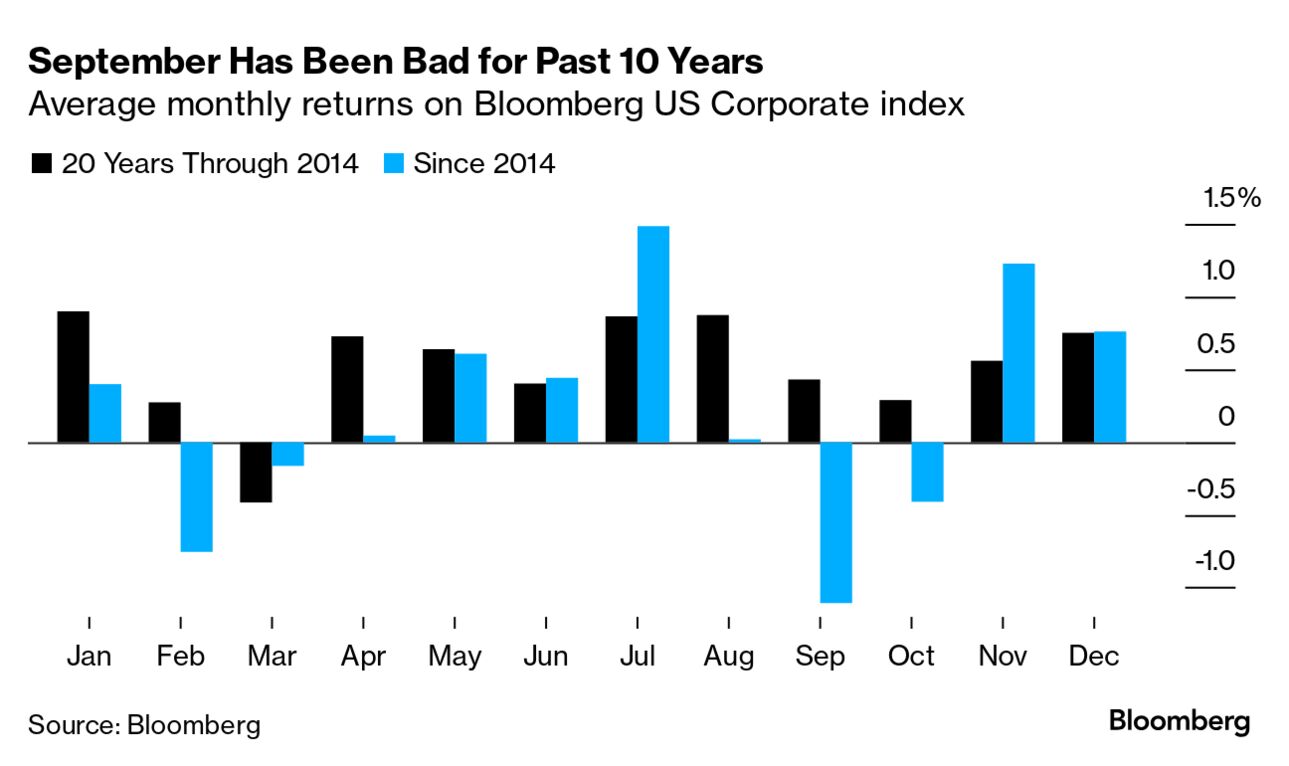 But this is a tiny sample size. March is a terrible month for credit because there was a massive panic when the Covid-19 pandemic started to reach the US in March 2020. High-yield lost more than 11% that month. Similarly, September has a particularly bad average because there were negative returns in September 2022. Yields were rising anyway because inflation concerns were leading traders to price in higher-for-longer Federal Reserve rates. That's already a toxic environment. But at the same time, that was the month of the Kwasi Kwarteng mini-budget in the UK. So I looked at 30 years of history for the Bloomberg US Corporate, Bloomberg US Corporate High Yield and Bloomberg EM USD Agg indexes and searched for the worst monthly performance of a rolling 12-month period, to identify the number of occasions on which a month had been the worst in the previous 12 months. It turns out the biggest loser is indeed September, followed by March. But there's nothing particularly special about those months. In the 20 years through 2014, September was a month much like any other for investment grade. And this is a sample that includes September 2001 -- a terrible month for markets in every way. Sebastian Boyd is a Santiago-based strategist who writes for Bloomberg's Markets Live blog. Sign up for Hong Kong Edition newsletter to get an insider's guide to the money and people shaking up the Asian finance hub. | 










No comments:
Post a Comment