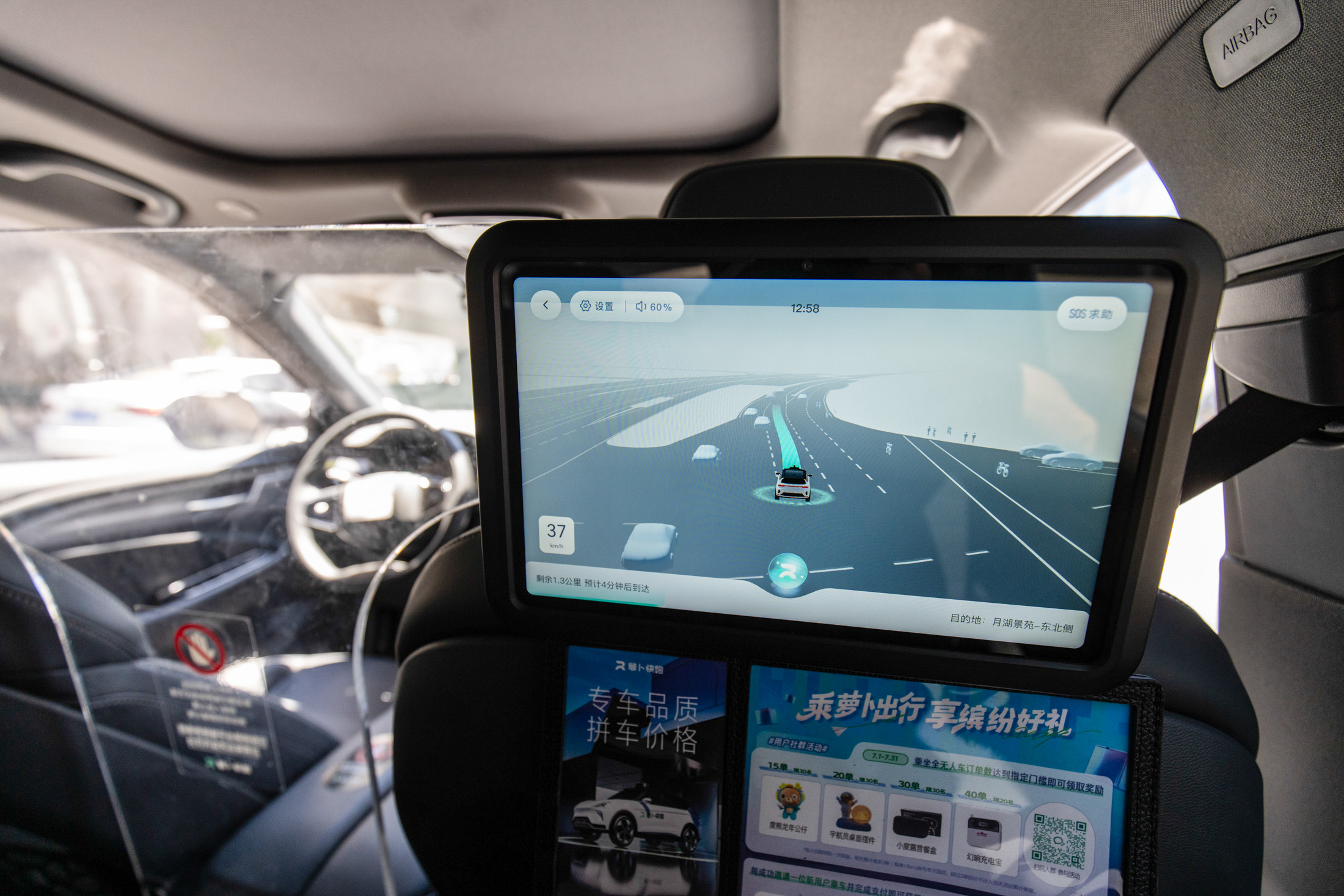
| Hello, this is Colum Murphy, reporting from Wuhan, the central Chinese city where people are increasingly using their smartphones to book rides in driverless taxis. These Baidu robotaxis are so popular that people are coming from out of town to zoom around in one of the 500 cars now on the streets, a contrast to the slower rollout in the US. I did exactly that recently, just to see what it was like letting AI-guided wheels take me across town. Entering the vehicle, I found a transparent divider separating the passengers' back seat from the empty driver's seat, apparently to keep people from messing with the steering wheel. Once we got going, the car mostly went about 20 kilometers an hour around Wuhan, though we hit 50 once, inspiring a bit of apprehension, I'll admit. Also, the sight of a steering wheel moving on its own was a tad unsettling. 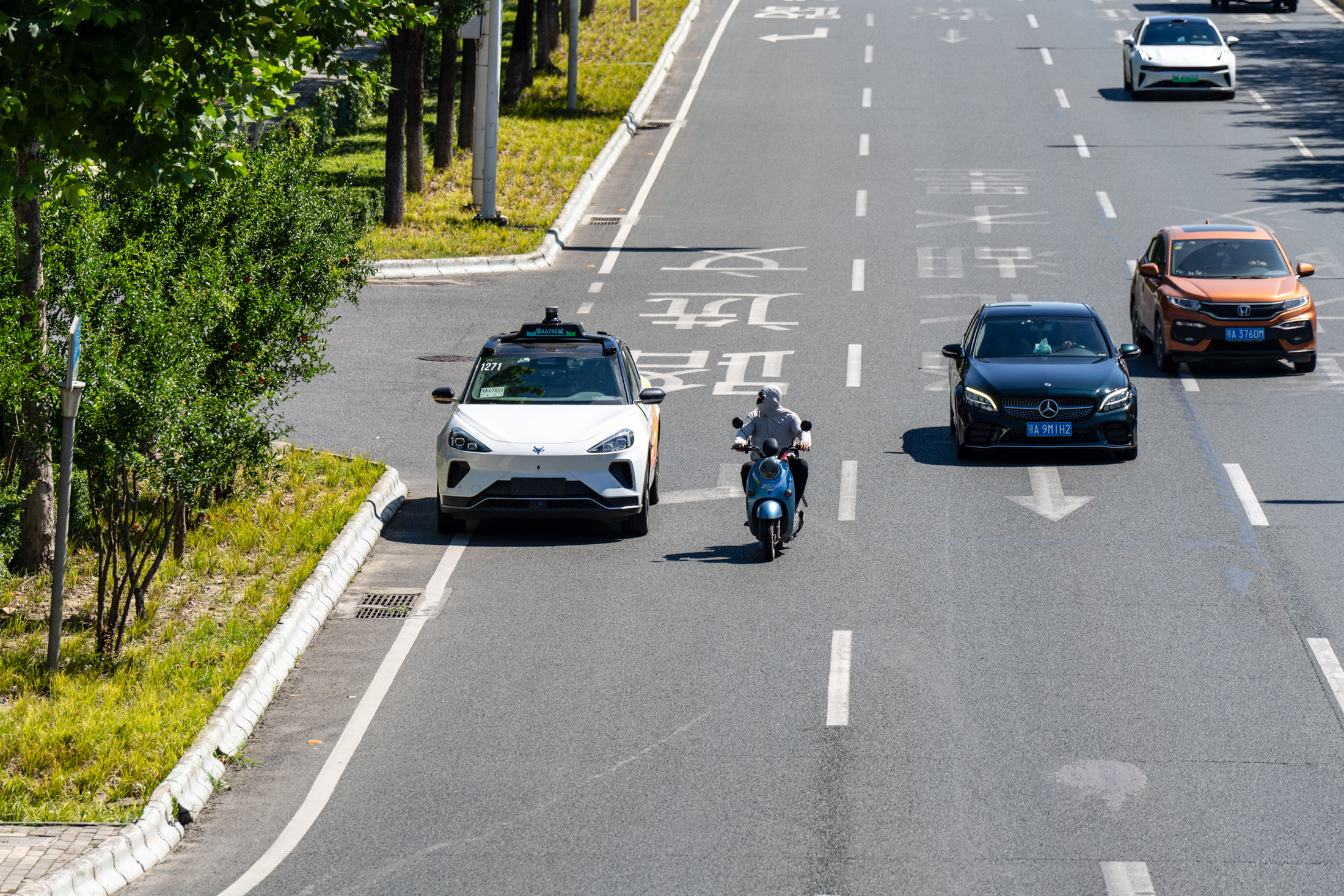 A Baidu robotaxi tries to negotiate traffic in Wuhan. Photographer: Qilai Shen/Bloomberg The in-car entertainment system was a welcome distraction, though. It was a bit like the options on any new airplane, with a slightly more eclectic music selection. Maybe the high point of our ride was cruising along to the thumping electronic song Fast Cars & Superstars. "Grab another bottle,
Party with some models/
Fast cars, superstars,
Leave the club tomorrow" Wait, I digress. One key draw of the robotaxi: it was super cheap. A 30-minute daytime jaunt across town cost the equivalent of a couple dollars, a price heavily discounted by the company to encourage ridership. Wuhan could certainly use an image boost as it tries to shake off associations with Covid-19, and positioning itself at the vanguard of smart-car technology may help. But it's also discovering that running ahead of the curve has its drawbacks. Some locals are already complaining that robotaxis are causing traffic jams, partly because they're driving pretty cautiously. Wuhan's 24,000 taxi drivers have also voiced concerns they'll lose jobs to the new technology. Still, the broad enthusiasm for driverless taxis signals that many people in China will take to them pretty quickly as long as the tech works out, much as they did now-ubiquitous cashless payments. "We all know it's going to move forward eventually," said Huang Shan, a 35-year-old resident of Wuhan who works in public relations. "Sometimes you just cannot stop things from evolving." What We're Reading, Listening to and Watching: Italian Prime Minister Giorgia Meloni had her work cut out for her when she arrived in Beijing this week for a meeting with Xi Jinping. For one thing, she controversially pulled Italy out of Xi's flagship Belt and Road Initiative last year, irking some in China's officialdom. Yet Italian diplomats and Chinese state media hailed Meloni's visit a success after she talked to Xi and scored several cooperation deals. To pull that off, she avoided criticizing her host for backing Russia during its attack on Ukraine or its massive production in key tech industries like electric vehicles, though she did warn trade that ties between Italy and China must be rebalanced. 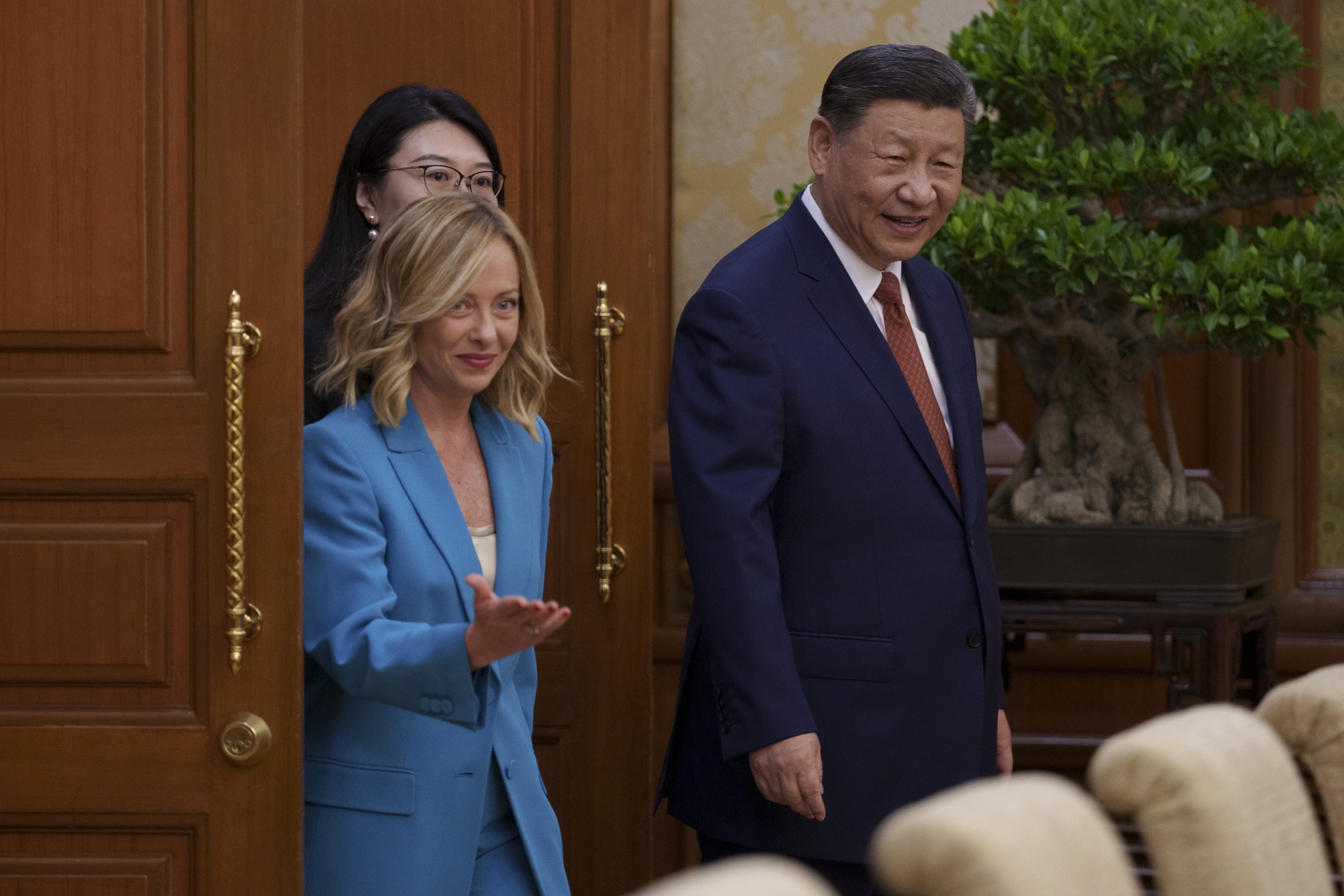 Giorgia Meloni and Xi Jinping arrive at a meeting in Beijing on Monday. Photographer: Vincent Thian/Getty Images Meloni's warm reception suggests Beijing wants to make the most of the differences between European Union members, with the promise of lucrative bilateral ties for some, even as the 27-nation bloc as a whole moves closer to the tougher US approach to trade with the world's No. 2 economy. That's especially important to Xi as he prepares for a possible second Donald Trump presidency given the huge trade war and souring of ties the first time around. By catering to Meloni and Hungary's Viktor Orban, who visited Beijing in July, Xi is also exploiting the main faultline running through European politics. Meloni and Orban are the most prominent far-right leaders in the EU; Olaf Scholz of Germany and France's Emmanuel Macron have seen their authority undermined by challenges from the right. While Macron was treated to a tea in a residence once used by Xi's father when he visited China last year, he left with few concrete gains. Scholz echoed US complaints about an unfair glut of Chinese exports when he visited in April. Meloni's willingness to bring Xi into discussions over Russia's war in Ukraine also suits the Chinese leader. In recent years, Xi has tried to cast himself as a neutral arbiter on the world stage capable of brokering agreements such as last year's accord between Iran and Saudi Arabia. Meloni has little power to influence the most pressing bilateral issue between Beijing and the EU: the European Commission's probe into subsidies for Chinese electric vehicles. But if Xi can encourage countries like Italy to consider a more conciliatory approach to China then he'll make it harder for the bloc to take decisive action on other issues, say human rights or the Taiwan question. | 







No comments:
Post a Comment