| Data-dependency can be painful. Wednesday finished on a high for the US stock market as investors reacted to strong hints from the Federal Reserve that it would be cutting rates in September. Thursday, however, saw a selloff as some downbeat economic data immediately prompted fears that the Fed had made a mistake and should already have cut.
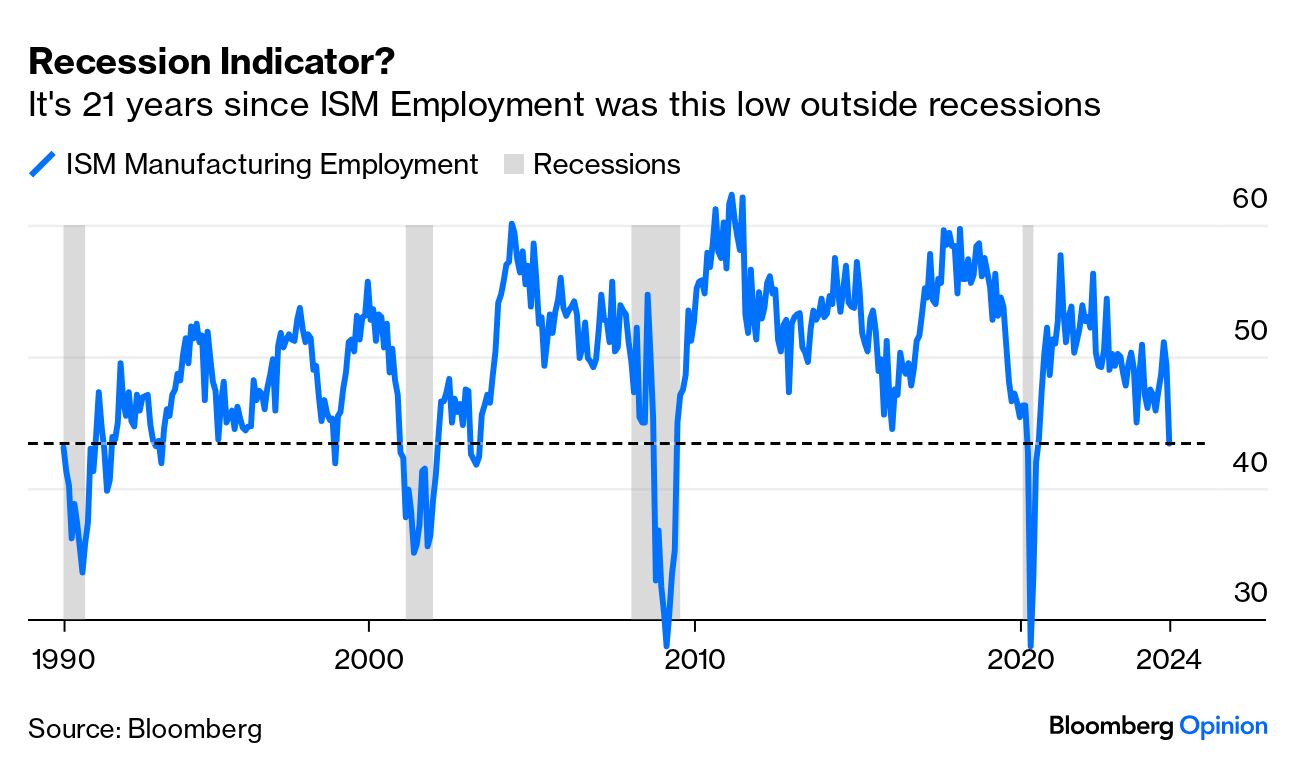
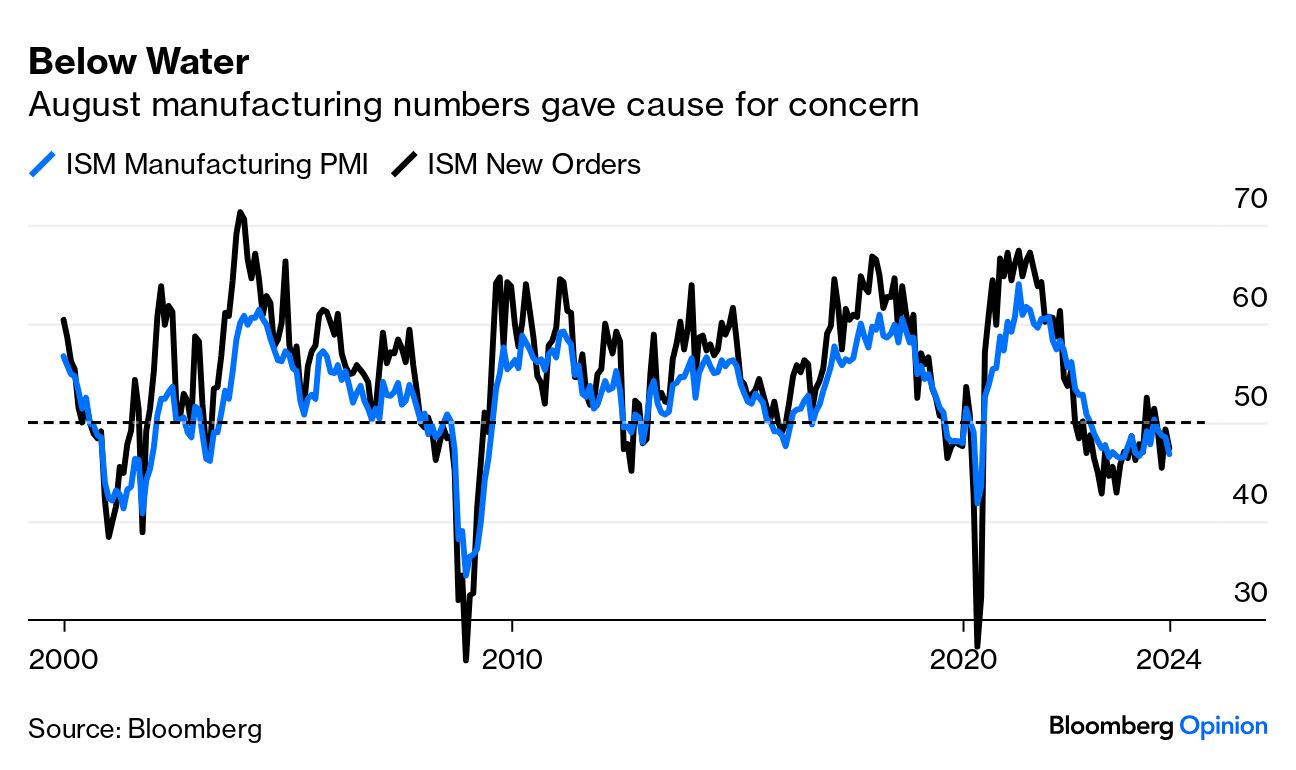
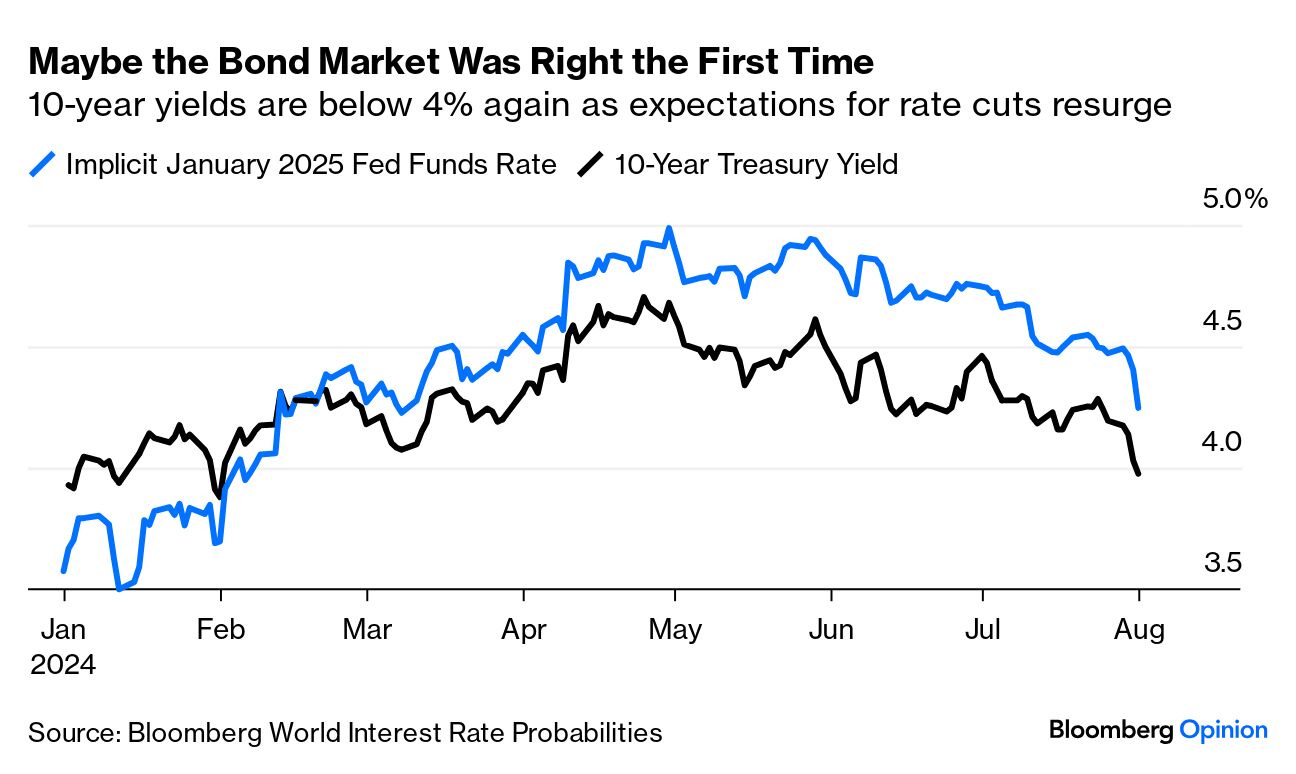
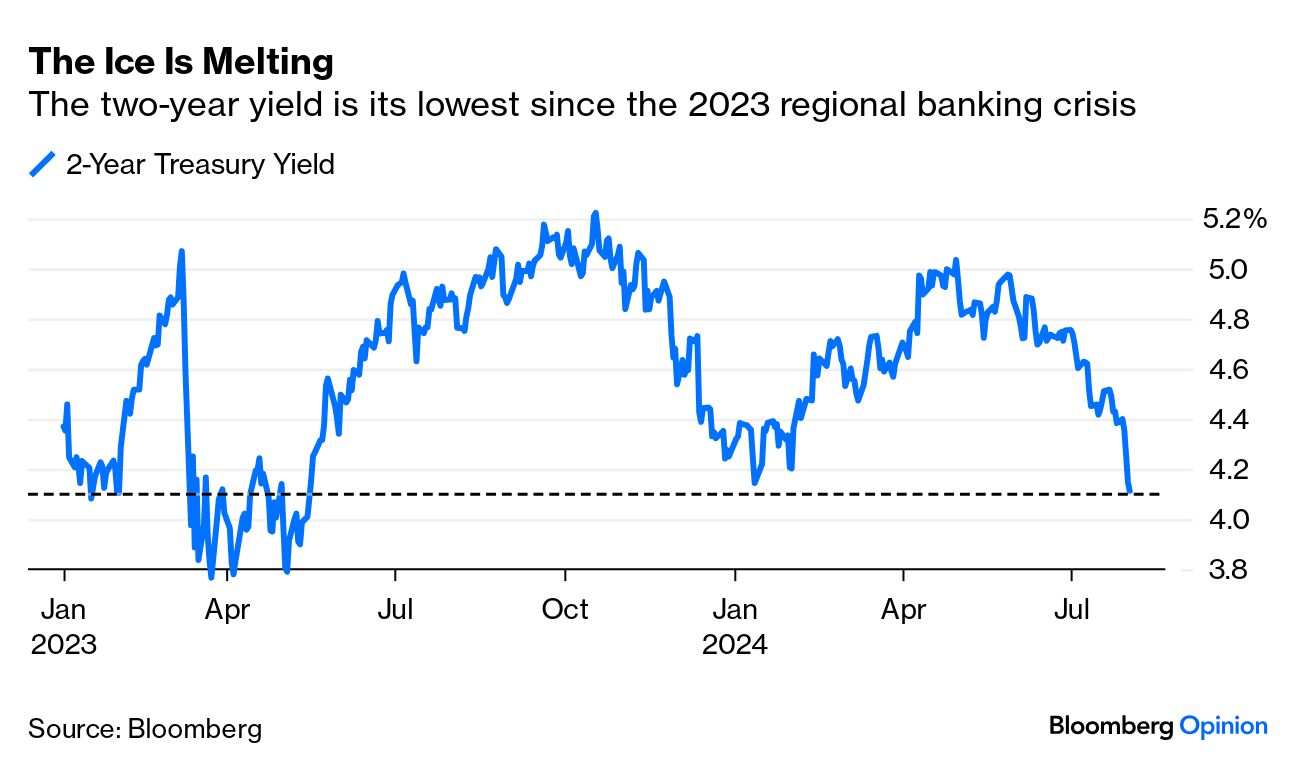
If the Fed is wrong, note that the market's behavior this week suggests that plenty of others would have made the same mistake. One big data point against the FOMC: the latest jobless claims numbers. Taken in conjunction with the figures on continuing claims, which come out every two weeks, they're now on a clear rising trend, and their highest since late 2021: 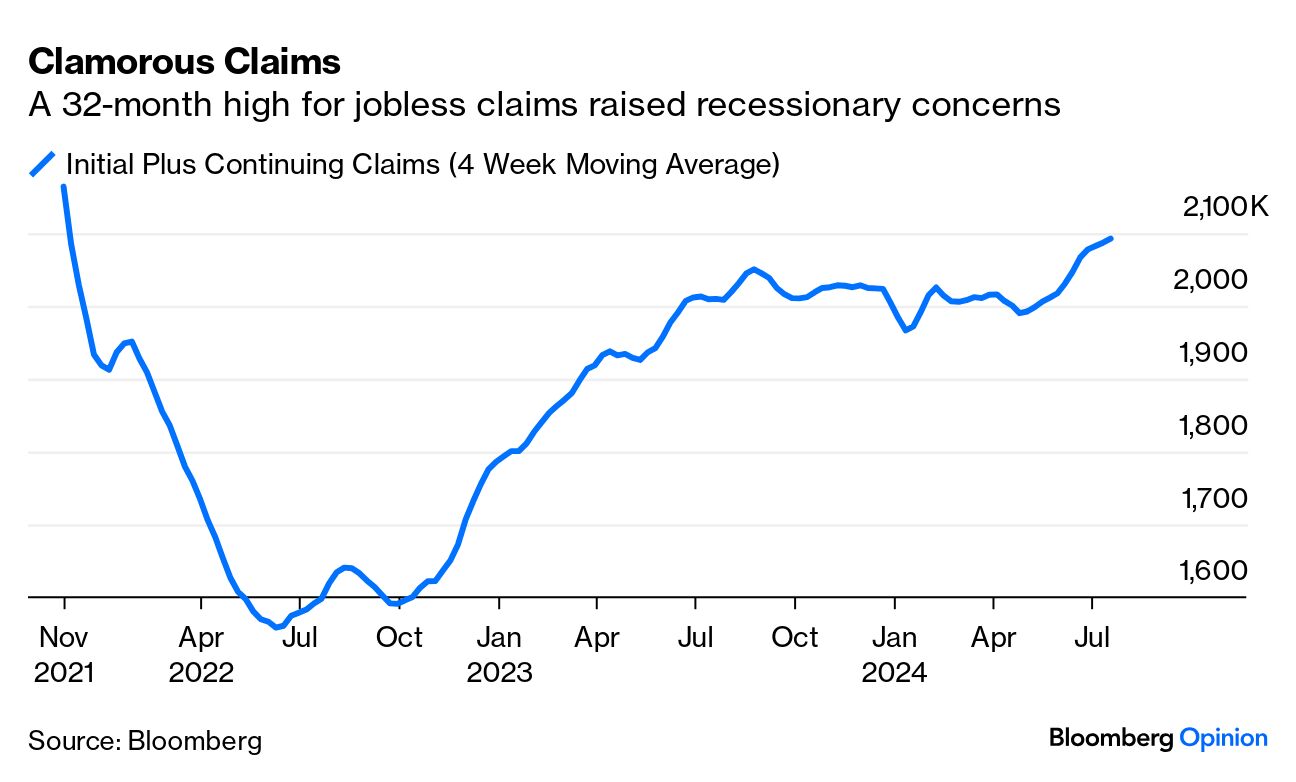 Meanwhile, the monthly ISM survey of supply managers in the manufacturing sector was horrible. Notably, the diffusion index on manufacturers' plans for employments is its lowest since the beginning of the pandemic. It's 21 years since it last dropped to such a level outside of a recession (although there were a few more incidents during the 1990s): The headline manufacturing PMI, and the new orders reading that is taken as a good leading indicator, both slipped ominously into negative territory. (In theory, any number below 50 means recession rather than contraction): To compound the sense that the Fed may have waited too long, the Bank of England announced its first rate cut since the pandemic. It was only by a 5-4 majority of its Monetary Policy Committee, and a cut at its meeting in September looks unlikely, but the news still spurred a sharp fall in gilt yields. In the US, the benchmark 10-year yield dropped below 4% for the first time in six months as traders moved to price in a rate cut at each of the next four meetings of the Federal Open Market Committee: Meanwhile, the two-year yield is now its lowest in 15 months and plummeting in a way that suggests traders think the economy is slowing down for real this time: All of this could of course change once the non-farm payrolls data for July is available, not long after this newsletter is published. For now, the stock market has fallen out of bed, primarily because of fear of a policy mistake. Quincy Krosby of LPL Financial said the selloff wasn't about earnings, "It's about whether the Fed sees what the data is saying." The drop in the 10-year Treasury yield to below 4% reflects a looming economic growth scare and further questions whether the Fed is correct in waiting until September to begin its easing cycle. The market remains hyper-mindful that the Fed waited too long to begin raising interest rates as it now wonders if the Fed is too late in transitioning monetary policy.
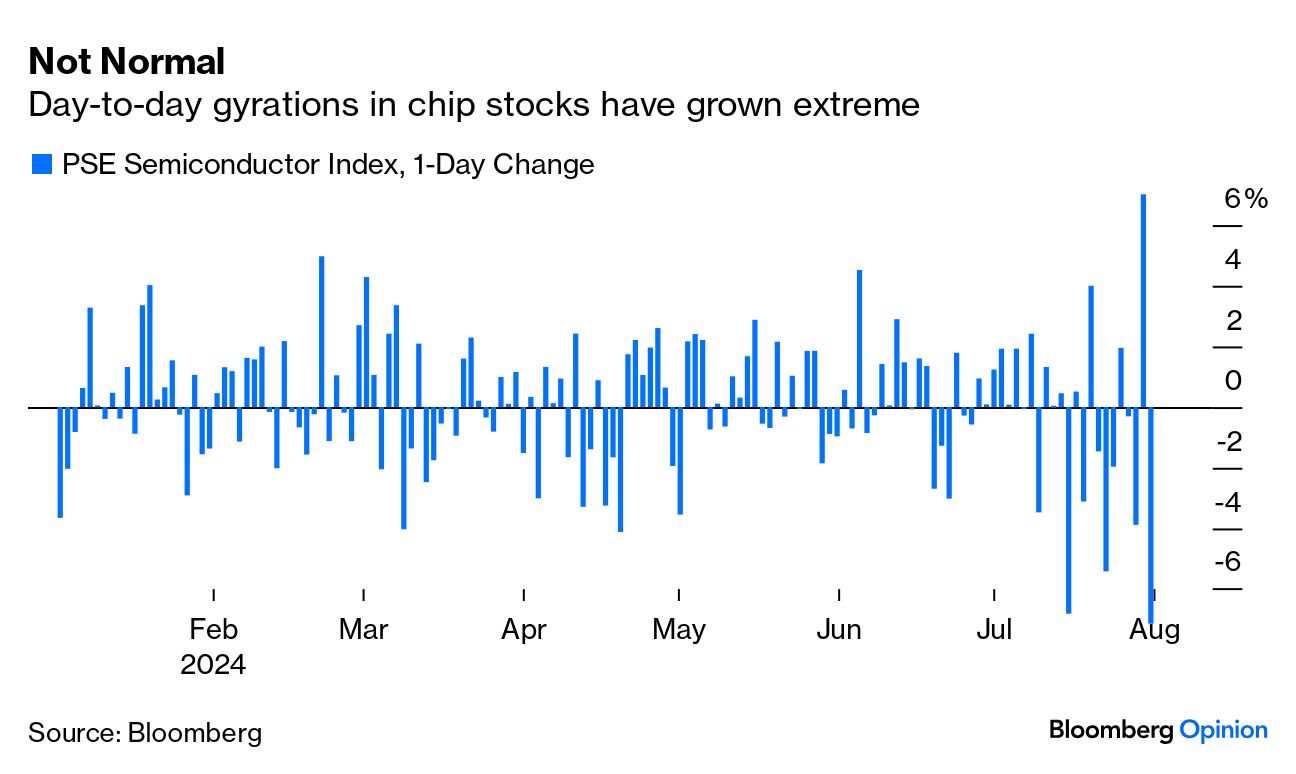
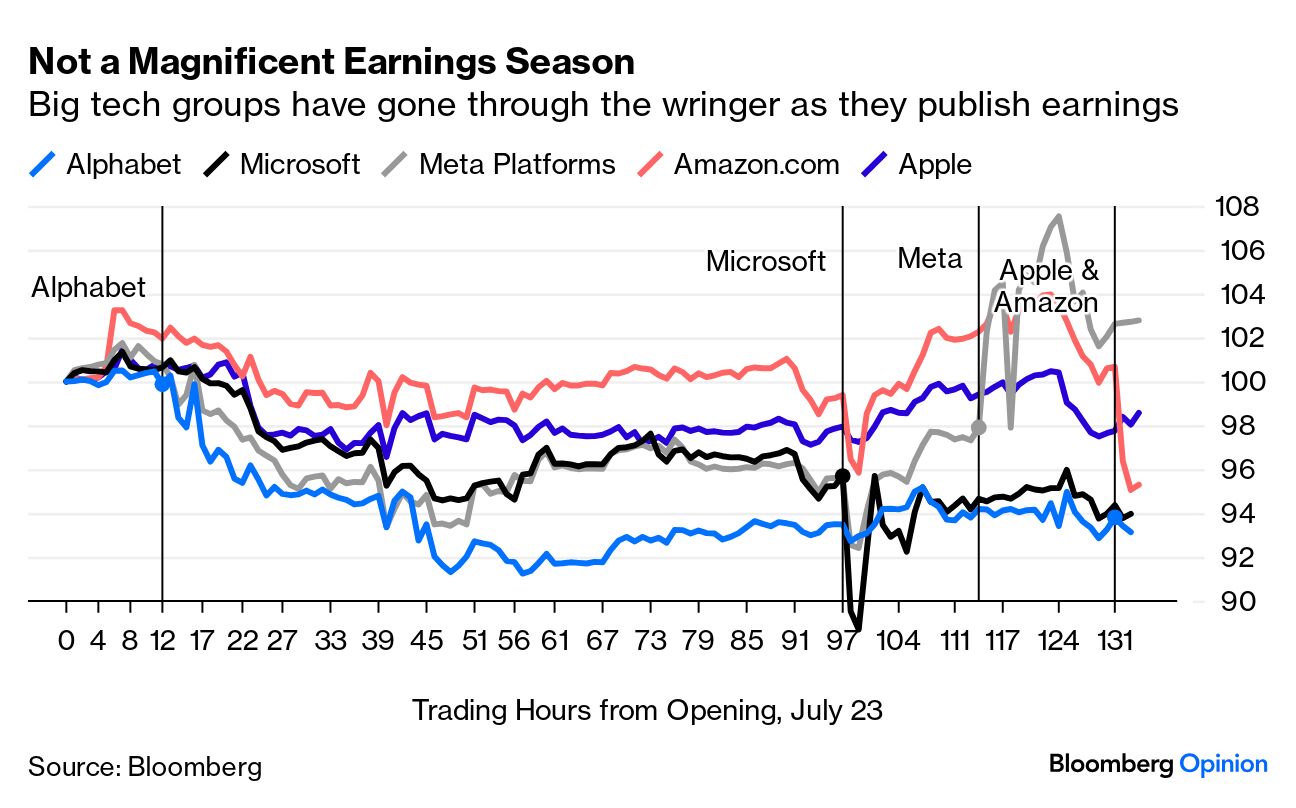
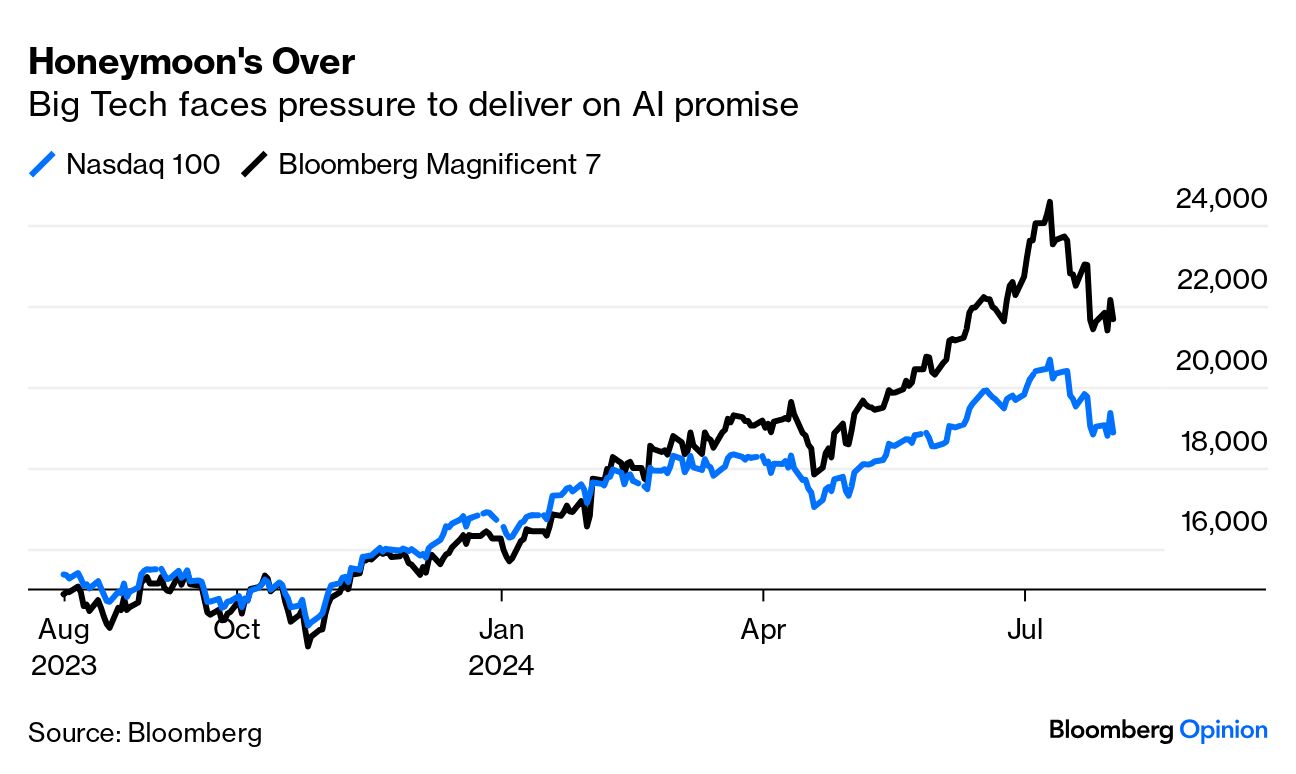
Bear that in mind as we try to explain the extraordinary goings-on in the tech sector. Amid one of the most profound stock rotations in years, investors' patience has worn thin as they parse earnings. They need to know if artificial intelligence is delivering for Big Tech. As momentum wanes, companies find that merely talking about big AI-powered ambitions no longer moves the needle on their share price. With a weakening economy and monetary policy easing underway, Lombard Odier's Florian Ielpo suggests that investors begin to seek answers on what they can expect from the two engines of the investment cycle — the macro and the micro. With macro weak, the micro of the earnings that companies can produce grows more important. That explains the hair-trigger reactions to every shred of news. In the chip sector, possibly more sensitive to AI news than any other, the daily oscillation of stock prices is stretching the charts: The reaction to earnings misses, as seen from Alphabet Inc., Tesla Inc., and Microsoft Corp., shows that the AI honeymoon is over. Meta Platforms Inc. is the only Magnificent Seven stock to have gained since Alphabet started Big Tech's earnings season last week, adding over $123 billion in market cap on solid ad revenue growth on the back of AI investments. A day earlier, Microsoft's shares fell as revenue from its cloud business missed estimates. Apple Inc.'s results had a guarded reception Thursday evening, while Amazon.com Inc. disappointed: The mixed Big Tech earnings are weighing on the Nasdaq, which continues its selloff. Nvidia Corp. is the only mega cap with earnings outstanding, and on the face of the recent performance of the Bloomberg Magnificent Seven, it needs to do more to keep the AI premium going: Those who have questioned the sustainability of the AI-powered S&P 500 run see the mixed results as providing a partial answer. All good things do come to an end. As Glenmede Investment Management's Jordan Irving puts it, the stasis in an asset allocation looks to have ended: Economic reality appears to be impacting the mega-cap companies as their growth ramp apparently isn't to infinity and the astronomical capex budgets aren't yielding immediate results. None of this is to say that the Mag 7 aren't good businesses, but rather that the investor fever with which they were adored has begun to break, which means that things like valuation might start to matter again. In that case, the small-cap side of the ledger has a much lower bar to clear and now has a potential tailwind from a declining rate environment.
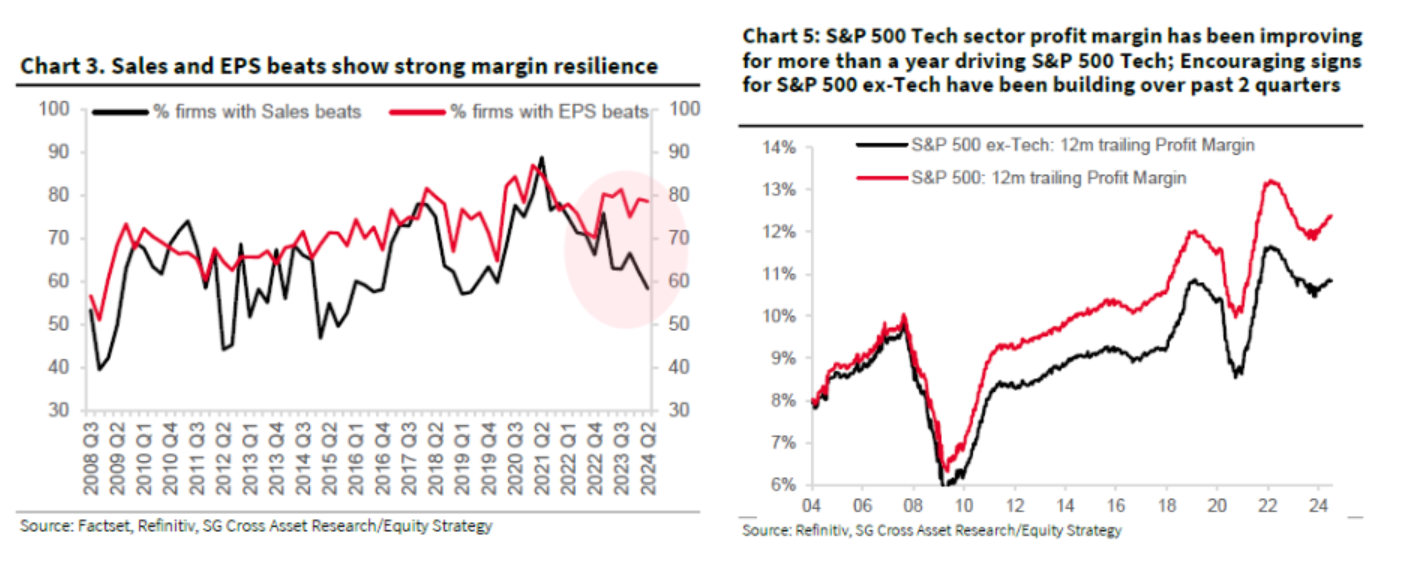
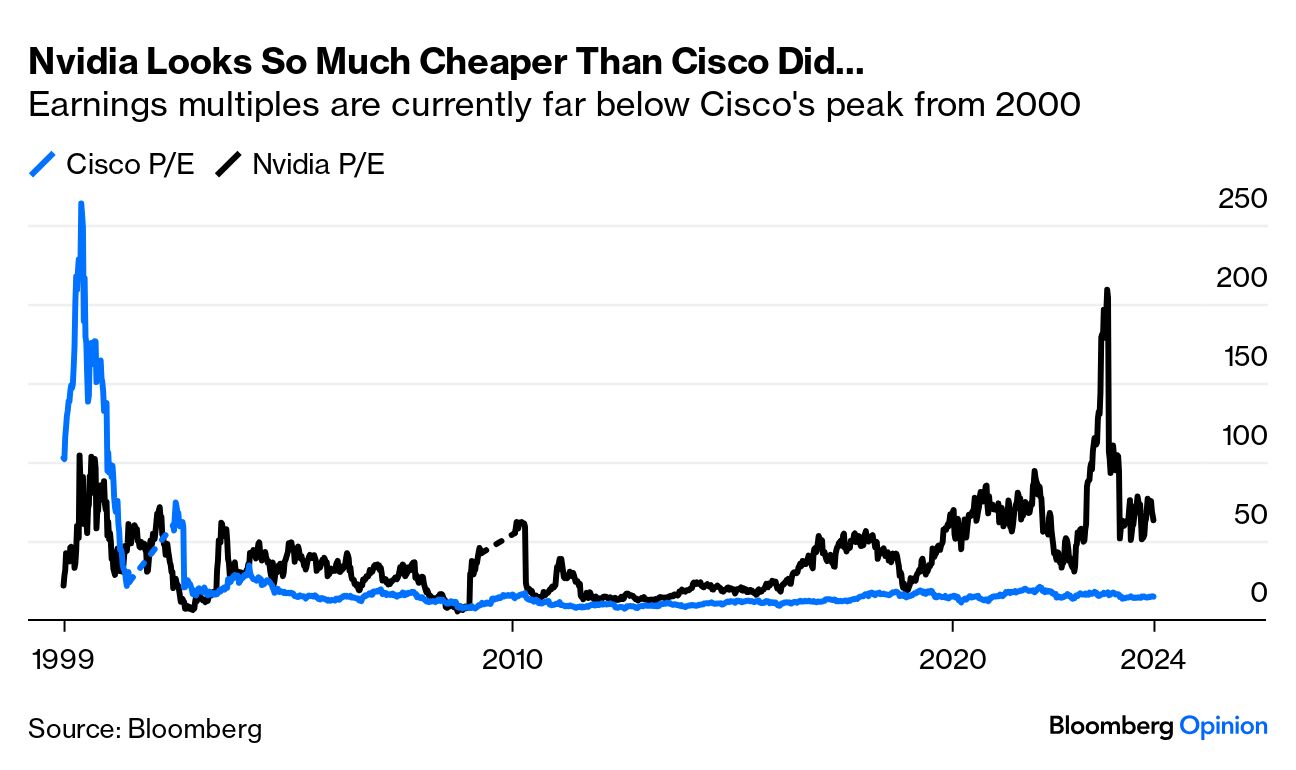
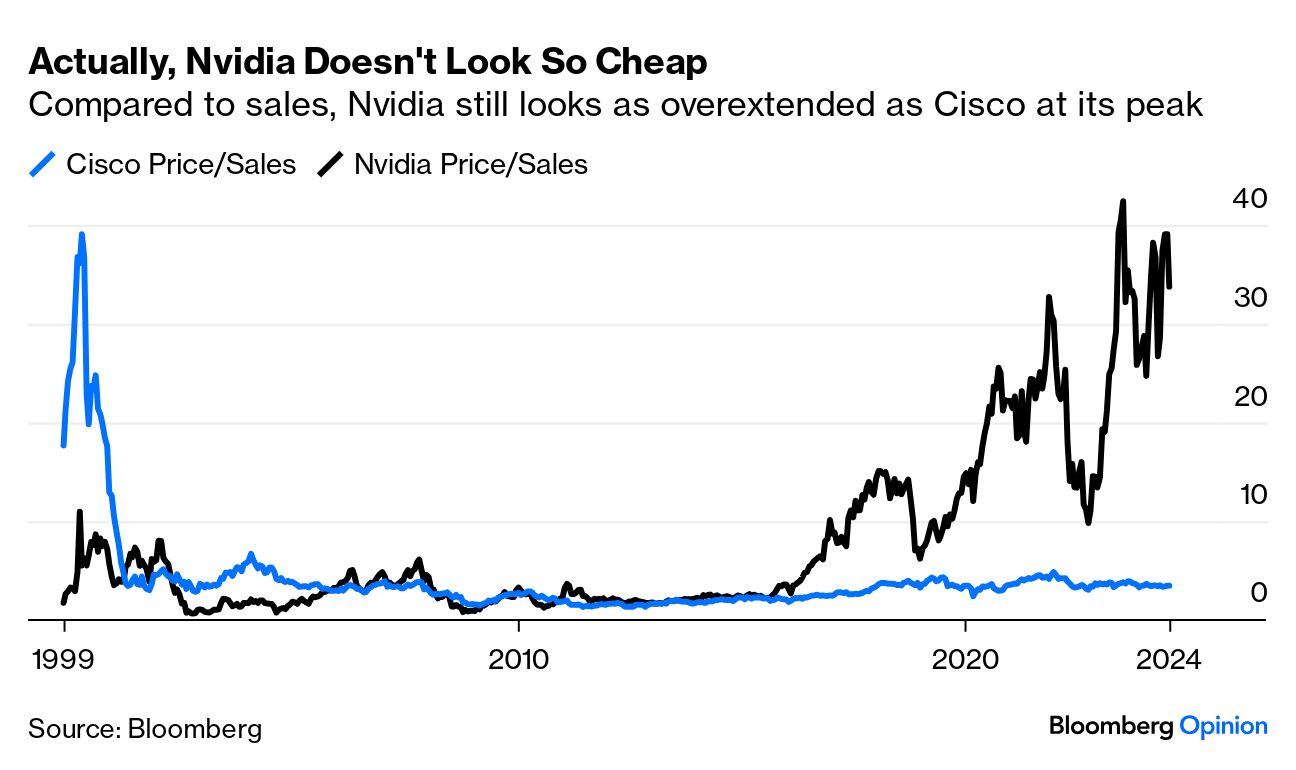
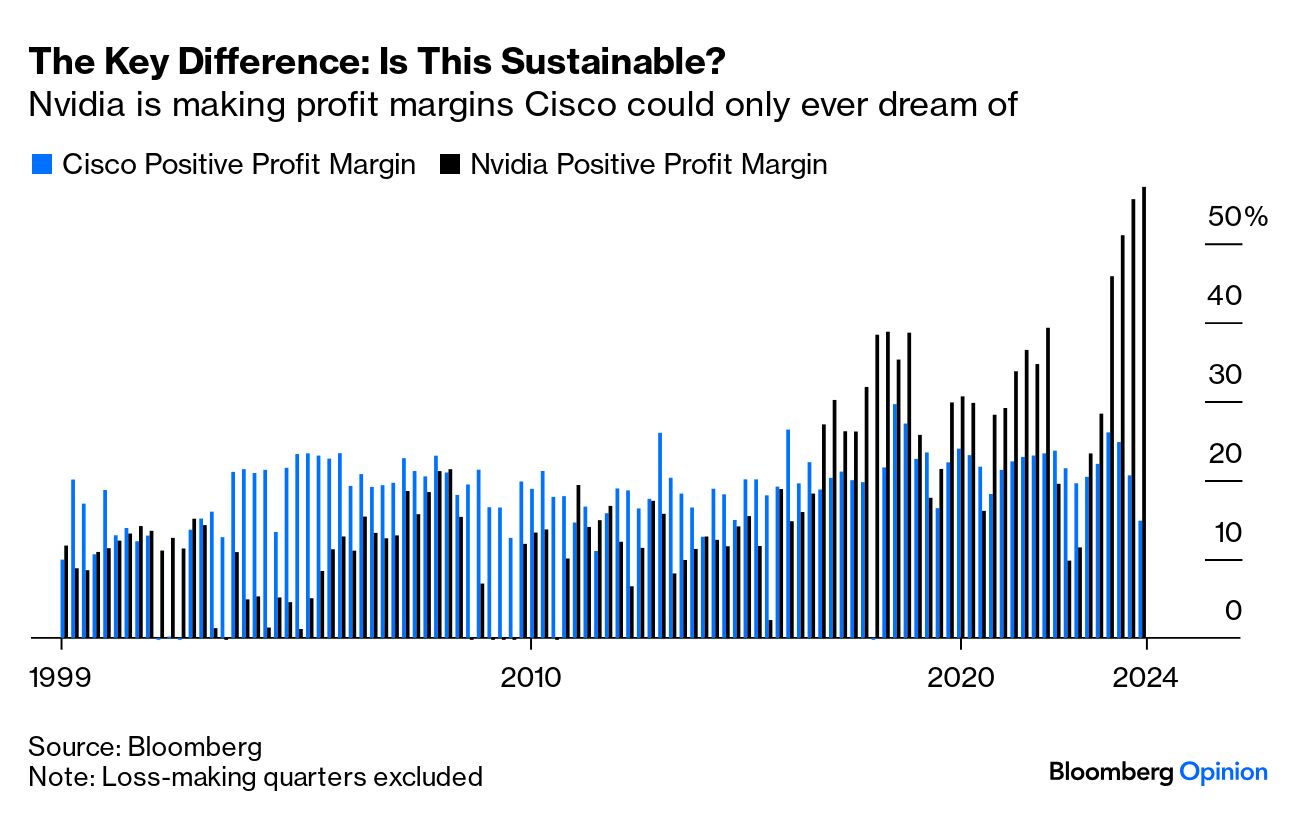
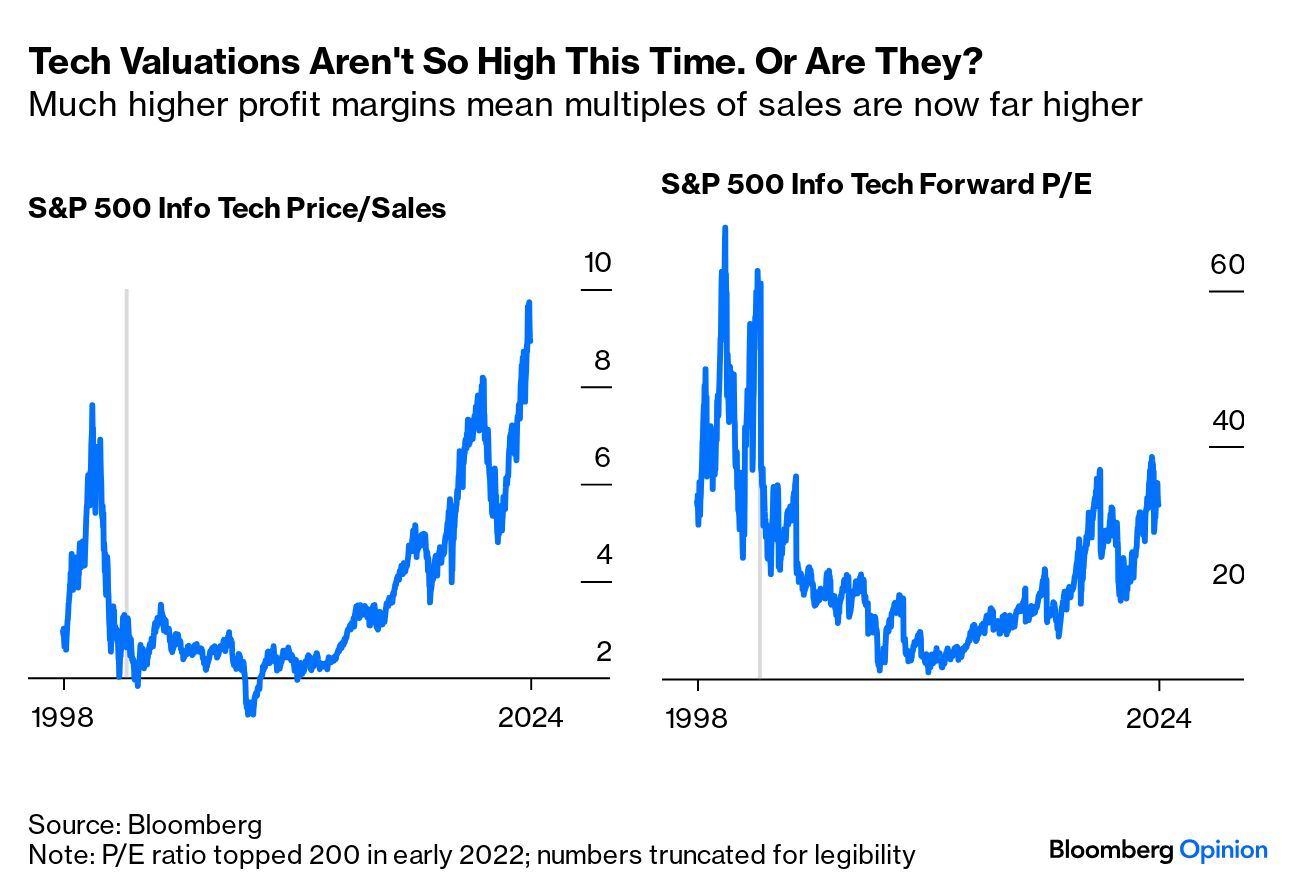
Wherever Big Tech goes from here, the sky is not falling. This isn't a rerun of the dot-com bubble. Meanwhile, small caps may yet make the most of the Mag 7 blues. Irving explains that last year, perceived career risk was tied to not owning enough of the Seven. If managers no longer fear that they'll be fired for that, it could give a lift to small caps. The tech mega caps cloud a generally fine earnings season. Halfway through the reporting period, Societe Generale reports an EPS beat of 78% above average levels, but crucially only 58% of firms beating sales expectations, the lowest in five years. SocGen's Manish Kabra identifies sales as the relative "shock" while the relative surprise is in profit margins. Overall, S&P 500 profit margins are rising. Tech margins have been improving for more than a year and are already at new highs, while profits in other sectors have been slowly increasing over the past two quarters: AI is undeniably a game changer. Ultimately, many companies will profit from its efficiencies. But how long will it take, and will they continue to pay quite so much money to chipmakers while waiting? As Mark Zuckerberg argued in Meta's most recent earnings call, investing billions may not seem rational at the moment, but in the next 10 to 15 years, it will all make sense. Let's hope he's right. And on that subject… —Richard Abbey Back in March, Points of Return wrestled with the comparisons between Nvidia in 2024 and Cisco Systems in 2000. The former is the chief beneficiary of the AI excitement because it creates the hardware to make it work, just as Cisco gained more than anyone else from the internet as the dominant force in routers. The parallels are very relevant. It's time for a rematch, thanks to this chart of their share prices by Deutsche Bank AG's Jim Reid, which we republished yesterday. It shows that Nvidia's price action is spookily similar to Cisco's, and suggests that Nvidia is about to tank spectacularly: 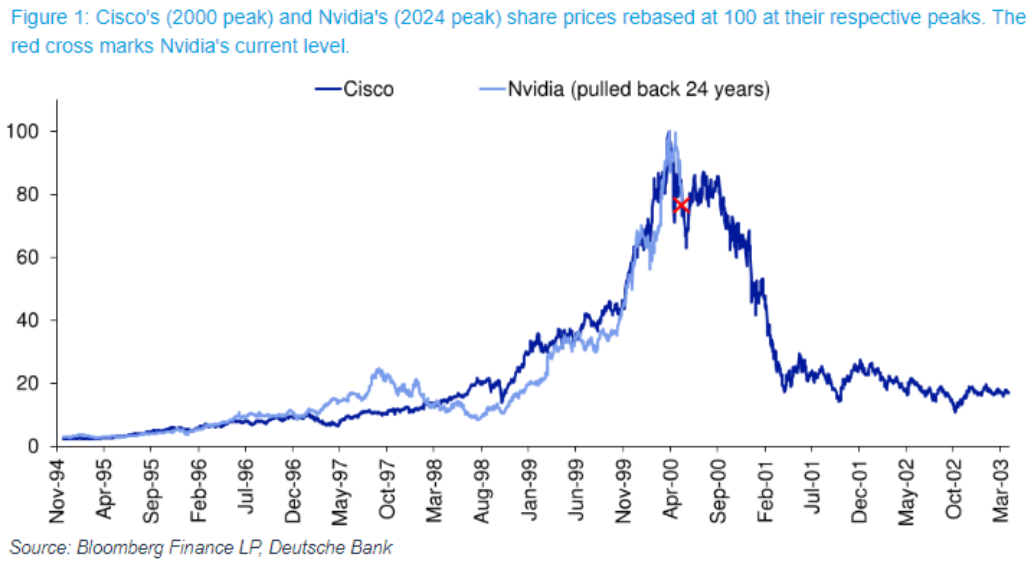 Overlay charts like this are fun, but are always vulnerable to the criticism that they prove nothing. When prices have entered the stratosphere, markets become a pure exercise in human emotion and group dynamics, so price patterns can be as valid as anything to hold on to — but the exercise is still questionable. The main reason we shouldn't take this comparison seriously, it's alleged, is that valuations are radically different this time. Nvidia isn't as disconnected from the fundamentals as Cisco was in early 2000. Let's explore that. Price/earnings multiples are of course the most popular valuation metric, and with good reason. And indeed, Cisco's peaked at a considerably more extreme level than Nvidia's, which is now all the way back to the relative sanity of about 50. On this yardstick, Nvidia did have a Cisco-type bubble, and it burst last year: It doesn't feel like Nvidia's bubble has burst, however. When we instead look at the multiple of its share price to sales, the picture changes. Nvidia was even more expensive than Cisco at its peak, and it's still trading close to that: The reason that revenues multiples look so much more extended than p/e ratios lies in the extraordinary margins Nvidia is making on each sale. Nvidia currently makes more than double any margin than Cisco ever did. It's a phenomenal performance, but the company surely can't keep profiting at this rate unless nobody wants to try to compete: To be clear, this isn't just about these two exceptional companies. Here are the price/sales and price/earnings multiples for the S&P 500 information technology index over the last 25 years. The sector as a whole looks far more expensive than in 2000 on the basis of sales, and far cheaper on the basis of earnings. That's because they're doing a much better job of extracting profits from their sales: If those margins can be sustained, then so can the sector's share prices. If not, not. As we live in an era of fury over "greedflation" and price-gouging, while sentiment on both left and right moves toward aggressive antitrust action, it's going to be difficult. Evan Gershkovich has been freed from more than a year of unjust imprisonment in Putin's Russia. As always in such cases, some murky compromises were involved in negotiating his release, but this is fantastic news. For a great long read, try the Wall Street Journal's fascinating and moving account of how he was released, and this letter from his boss (and my own very long-term colleague), Emma Tucker. Heartfelt congratulations to all, and particularly to Gershkovich's indefatigable mother, Ella, and to the Journal's tireless pointman on the issue, another old friend, Paul Beckett. Have a great weekend everyone. Like Bloomberg's Points of Return? Subscribe for unlimited access to trusted, data-based journalism in 120 countries around the world and gain expert analysis from exclusive daily newsletters, The Bloomberg Open and The Bloomberg Close. More From Bloomberg Opinion: Want more Bloomberg Opinion? OPIN <GO>. Or you can subscribe to our daily newsletter.
Please note: Our email domain is changing, which means you'll be receiving this newsletter from noreply@news.bloomberg.com. Update your contacts to ensure you continue receiving it.
| 










No comments:
Post a Comment