| The US Securities and Exchange Commission moved one step closer last week to fully approving spot-Ether exchange-traded funds, but there are other, more controversial options vetted by regulators that allow investors to profit off of crypto without actually owning a digital currency. Prediction market platform Kalshi introduced crypto-themed wagers in March, allowing customers to bet on scenarios like whether Bitcoin will hit $100,000 before January, the timing of a new all-time high for Ether and whether Coinbase Global Inc.'s trading volume will surge past $250 billion this quarter. Kalshi users make their predictions by buying shares of their chosen outcome that are priced off of current market probability. For example, if the market thinks there's a 75% chance that Ethereum will outperform Bitcoin this year, shares of that outcome cost 75 cents and pay out $1 if the prediction comes true. 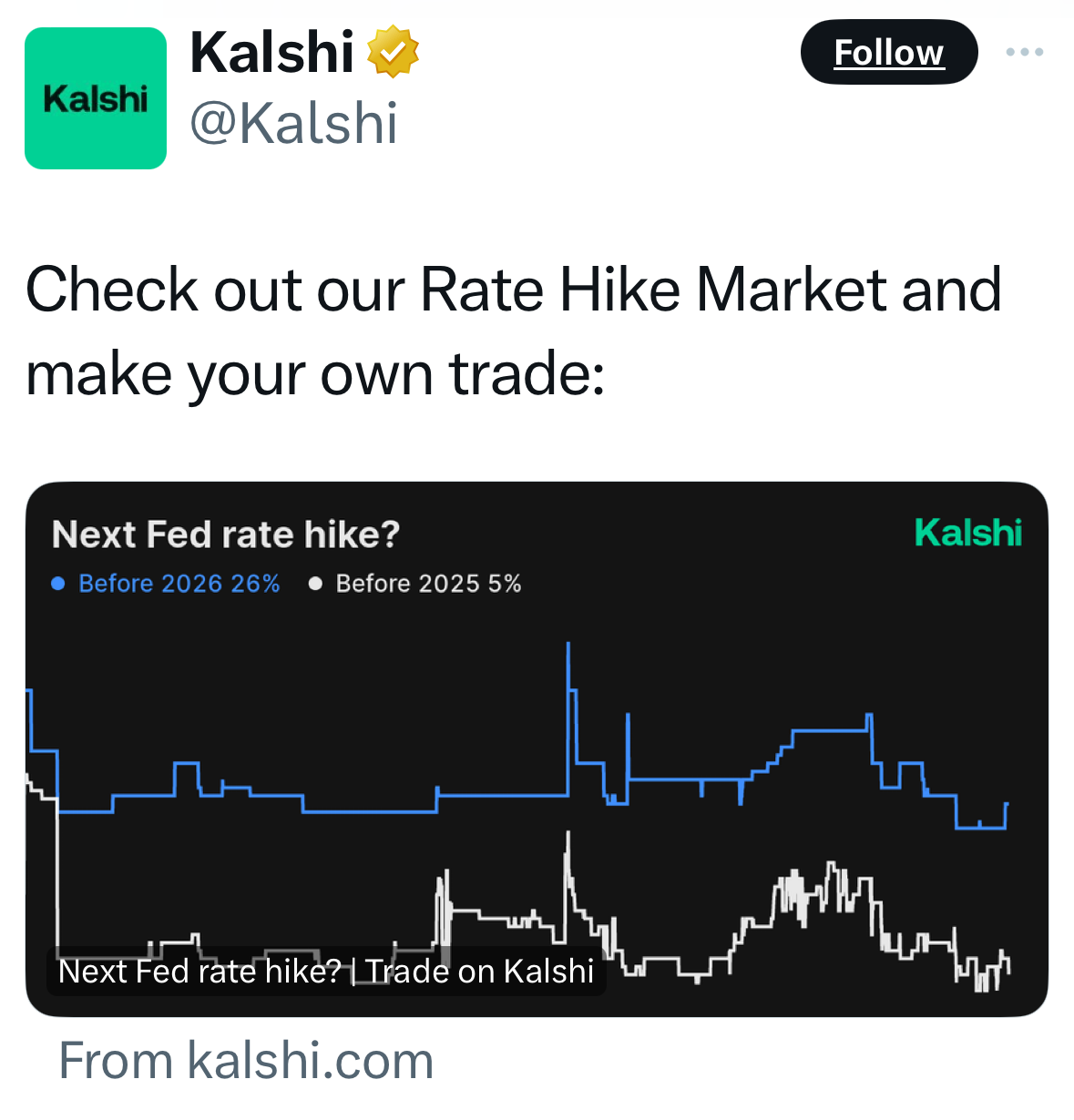 Source: @Kalshi Unlike crypto exchanges, Kalshi's business isn't as affected by crypto winters or bull runs, according to founder and Chief Executive Officer Tarek Mansour. "Our markets are less sensitive to whether things are going great or not, and much more about how much disagreement is in the marketplace," he said in an interview. The intersection of crypto and prediction markets isn't new—fraudulent digital-asset exchange FTX ran a predictions market business before its collapse. Mansour said his company spent more than three years getting regulated by the Commodity Futures Trading Commission as a designated contract market and ensures its business operates in "a safe way." But that's not enough for some industry watchers. Dennis Kelleher, CEO of the advocacy group Better Markets, and Lisa Gilbert, executive vice president of Public Citizen, published an op-ed on Tuesday criticizing Kalshi's quest to get approval for a prediction market based on congressional election results. The CFTC rejected Kalshi's proposal in November and the company sued the regulator over the decision. Kelleher and Gilbert argued that Kalshi's plan to allow people to "gamble" up to $100 million on an election would incentivize bad actors to manipulate election results, including through the use of misinformation and artificial-intelligence deepfakes. These same concerns could be applied to crypto, which has suffered high-profile run-ins with scams and misinformation. While a prediction market is a simpler — and often cheaper — way for investors to gain crypto exposure, there's still potential for manipulation and unfair profit-making in an industry that already experiences volatility from moves made by whale traders. None of this has stopped Kalshi. The company is even eying some of the industry's more controversial tokens for prediction markets, including memecoins, which are joke-themed cryptocurrencies that have sparked worry over their susceptibility to market tampering. "We're going to do more [in crypto], so I think there's Dogecoin coming," Mansour said. | 





No comments:
Post a Comment