| Have thoughts or feedback? Anything I missed this week? Email me at bsutherland7@bloomberg.net. To get Industrial Strength delivered directly to your inbox, sign up here. ESG fund managers in both the US and Europe have grown more willing to hold stocks of military contractors, an attitude shift that stands in notable contrast with the divestment demands of student protestors across college campuses this spring. Among US domiciled funds that invest based on environmental, social and governance principles, about 130 — or 36% — held positions in the aerospace and defense sector as of the end of the first quarter, according to data from Morningstar Direct. That's up from 99 funds — or 35% of the total at the time — as of the end of January 2022, roughly a month before Russia's invasion of Ukraine sparked a debate about how manufacturers of weapons used both to kill people and to defend democracy might fit into an ESG paradigm. The transition in Europe and the UK has been even starker: About 30% of ESG funds domiciled in those regions had some exposure to the aerospace and defense sector as of the end of March, up from only about a quarter at the start of 2022, the Morningstar data shows. 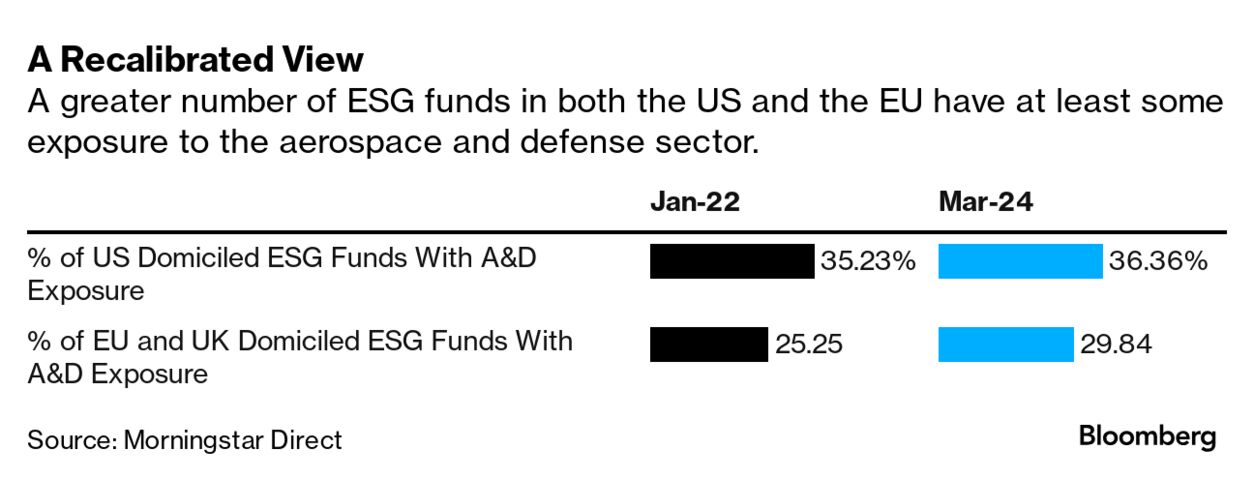 BlackRock Inc.'s iShares ESG Aware MSCI USA — one of the biggest ESG-focused exchange-traded funds — currently includes shares of missile-maker RTX Corp. and Honeywell International Inc., which provides cockpit systems and navigation technology for fighter jets. Both companies were singled out by various student protestors seeking to pressure university endowments to cut financial ties with companies that support Israel's military response to the Oct. 7 attack by Hamas. Read more: Harvard Protests End With Whimper as Divestment Demands Fail ESG investors and student protestors have different aims and vetting processes. Still, the contrast is constructive in understanding the limits of the protestors' divestment campaign and the complicated pendulum of public opinion on military endeavors. Russia's invasion of Ukraine sparked a major increase in military spending among members of the North Atlantic Treaty Organization as countries backfill weapons reserves depleted by shipments to Ukraine and ramp up their own defense investments. It also added gravity to defense companies' complaints about being financially sidelined amid what was at the time a massive redirection of investing dollars to sustainably minded funds. Now there's another war and another lens through which to assess defense manufacturers' business model. President Joe Biden has threatened to cut off the supply of bombs and artillery shells to Israel should the country proceed with a full-scale invasion of heavily populated areas in Gaza. It's likely too early to assess the full impact — if any — of criticisms of Israel's military push on the ESG calculus for defense stocks with scrutiny growing in the current quarter. 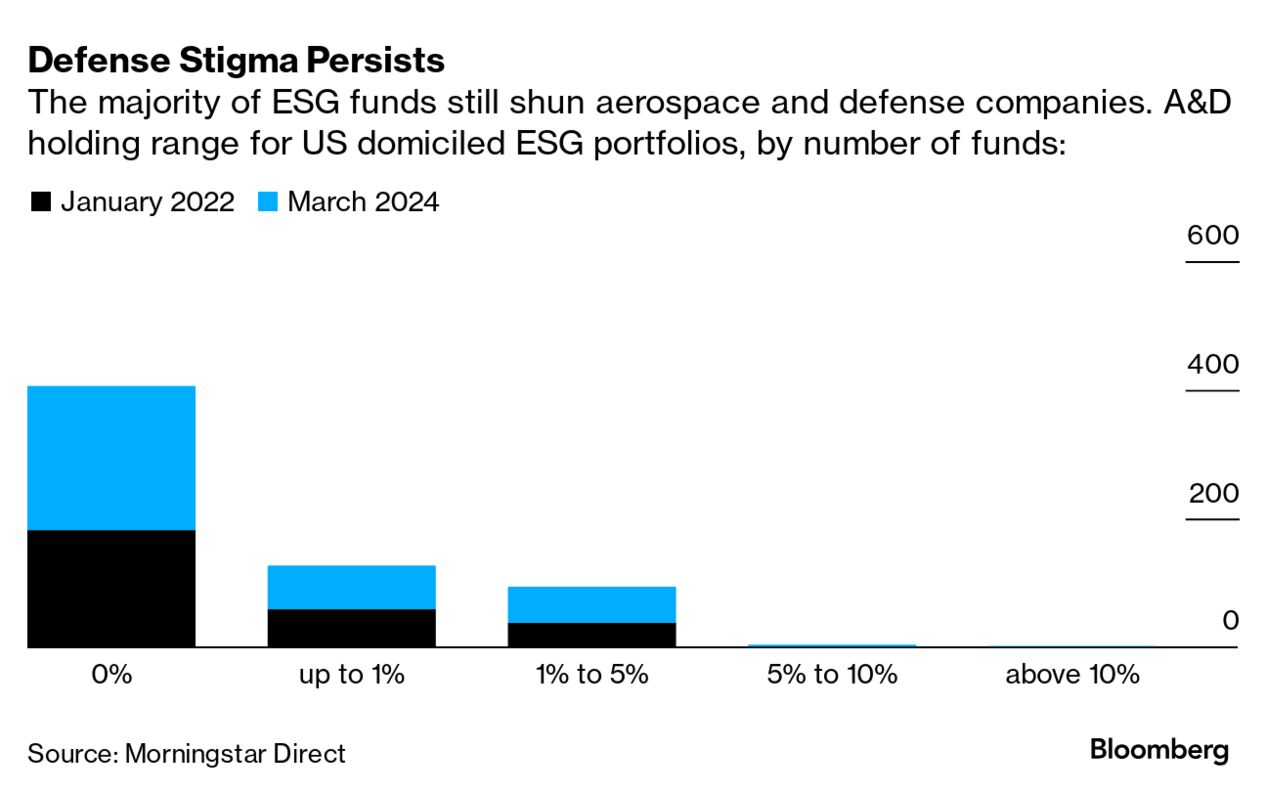 At its core, ESG investing is meant to be a quantitative strategy: The underlying premise is that companies with certain attributes — more diverse boards, more satisfied employees and well-explained plans to adapt their businesses for climate change — have less volatile or better-performing stocks. By this definition, the defense industry isn't an automatic no-go — and neither are oil and gas, tobacco or mining companies, for that matter. Most, if not all, aerospace manufacturers make parts and equipment for defense purposes, in addition to supporting commercial jetliners, but the size of their military businesses can vary significantly and that will factor into how an ESG fund thinks about them. Some ESG funds will allow investments in defense contractors but exclude companies linked to the manufacturing of controversial weapons, such as cluster bombs, anti-personnel mines and nuclear warheads. The student protestors are less discriminating: At Occidental College in Los Angeles, leaders of a pro-Palestinian encampment successfully negotiated for a vote by the school's board on divestments from companies including Caterpillar Inc., which gets the vast majority of its revenue from construction and mining equipment but also provides specially outfitted bulldozers to the Israeli military. University administrators and lawmakers have for decades rejected the Boycott, Divestment, Sanctions movement against Israel, viewing it as antisemitic because it calls into question the legitimacy of the Jewish state and singles out one country's policies. Most university endowments rely heavily on external managers who then invest their money into diversified funds with positions in hundreds of different stocks. And even funds that are designed to align with social and governance ideals hold positions in defense contractors, as evidenced by the Morningstar data. Read more: Defense Stocks Search for Their Place in ESG Investors' perspective on the public value of defense companies depends in part on the degree of blame they assign to companies for what end users do with their products. Military exports are heavily regulated in the US and Europe. Defense contractors do sell products directly to third-party countries but only with the approval of their home government. In other situations, weapons are purchased by US or European governments and then redistributed — meaning the companies themselves don't necessarily know if the missiles and artillery shells they've delivered are heading to Israel, Ukraine or elsewhere around the world. One interesting thought exercise is to consider how defense companies might have been viewed from an ESG perspective if this investing style had been popular during World War II. "If ESG analysts, trustees and fund managers think that their definitions of what is right for society trump those of democratically elected governments, then ESG has gone too far," Rupert Soames, Winston Churchill's grandson and the then-chief executive officer of Serco Group Plc, wrote in a late 2021 column published by the Times. Pressure from investors reportedly forced the facilities management company to abandon plans to compete for a contract to oversee the UK's nuclear weapons arsenal. 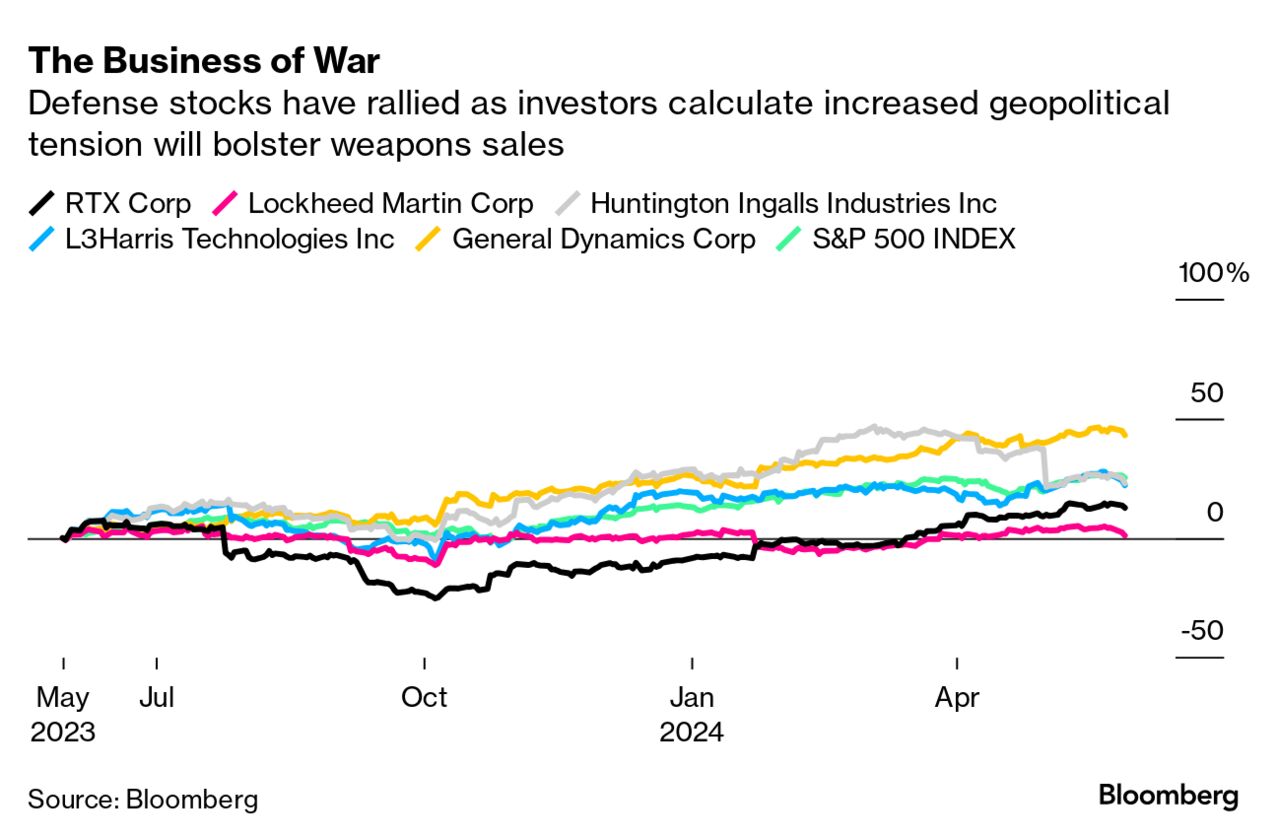 The growing prevalence of defense-related stocks in ESG portfolios suggests Soames' argument may have resonated with at least some investors. But ESG investing and related corporate initiatives have also fallen out of favor amid political pushback and questions about the strategy's financial effectiveness. Led by US clients, investors pulled $2.5 billion from ESG funds in the fourth quarter of 2023, the first ever global outflow, according to a Morningstar analysis. "The ESG bandwagon seems to have lopped off a bit," Vertical Research Partners analyst Rob Stallard said in an interview. For most investors, the student protests are little more than "peripheral noise," he said. The defense companies themselves are already well-versed in dealing with criticism of their business. "They will carry on with the very sound argument they've had before about why defense is a public good," he said. A custom basket of US defense primes this month traded at the highest price in data going back to 2015. RTX and General Dynamics Corp. both have large aerospace businesses but they also make missiles and nuclear submarines, respectively. They're both trading near record highs. "Having two engine types, if you have large fleets, is not a big deal." — United Airlines Holdings Inc. CEO Scott Kirby Kirby made the comments this week at a conference hosted by Bernstein. Asked what the biggest constraints are right now on aircraft supply, Kirby said the grounding of a huge chunk of in-service Airbus SE A320 planes because of a recall of RTX jet engines is "probably worse" than the production problems at Boeing Co. RTX is hauling thousands of geared turbofan (GTF) engines in for accelerated and enhanced inspections after discovering microscopic contaminants in powder metal materials that can shorten the lifespan of certain parts. The company expects that an average of 350 planes from the GTF-powered A320 fleet will be grounded annually from 2024 through 2026, with a peak of as many as 650 aircraft out of commission in the first half of this year. For context, Airbus delivered a total of 571 jets across its A320 family last year. So far, RTX has stuck by its initial forecast for the cost and timeline of the engine recall, but analysts have expressed concern that shop turnaround times may drag with the company's maintenance and repair network already strained by labor challenges and other fixes to durability issues in hot and dusty climates. "Look how many airplanes are grounded from GTF engines and I'm not sure if, when it gets fixed," Kirby said. There are two engine options for Airbus' A321neo plane: the GTF and the Leap, which is built by the CFM International joint venture between General Electric Co. and Safran SA. United is intentionally picking planes with Leap engines for new jet leases because of the GTF's issues, Kirby said. It's a telling comment that doesn't bode well for the already widening market share gap between the GTF and the Leap. 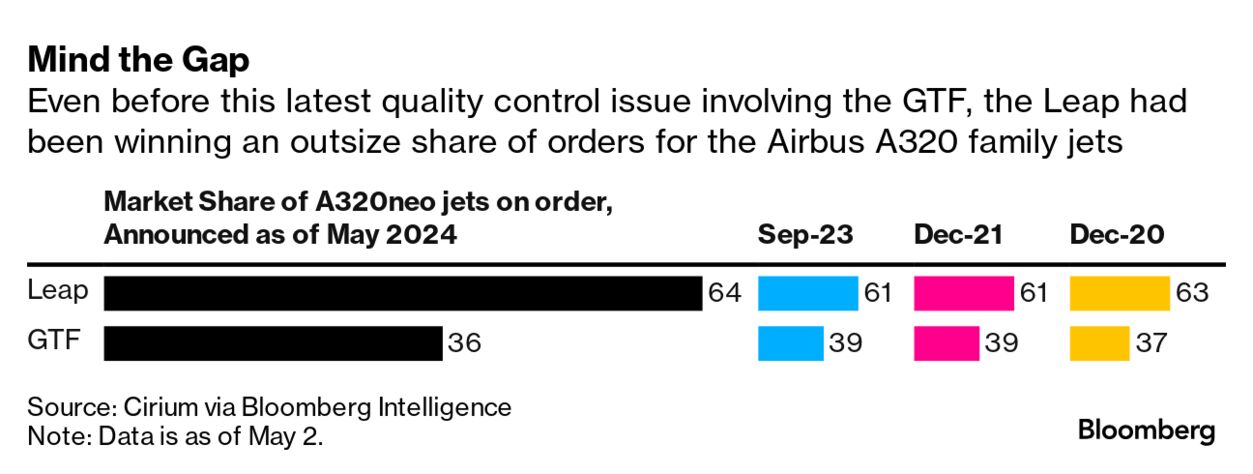 At the Paris Air Show last June — about a month before RTX first publicly disclosed the powder metal issue — the company announced that United had selected the GTF engine for an order of 70 Airbus A321neo jets and 50 of the extra-long-range version of the plane. United has yet to announce the engine provider for a separate, later order of an additional 60 A321neo aircraft. While many airlines prefer to organize their fleets around one narrow-body aircraft provider and one engine maker, United is somewhat unusual in that it has ordered a substantial number of single-aisle planes from both Boeing and Airbus. That can be tricky to manage because pilots require different training for each plane, Kirby said. But "a pilot can fly an A320 with a Leap engine or a geared turbofan engine without any issues," he said. "Aircraft complexity is hard. Engine complexity is not." Read more: United Jet Order Puts Focus on Engine Makers The 737 Max has only one engine option, a version of the Leap. But the Federal Aviation Administration has capped output of Boeing's 737 Max jet until it's satisfied that the company has remedied what the regulator has deemed "systemic quality control issues." The FAA hasn't even begun preliminary discussions with Boeing about lifting the production constraints, FAA Administrator Michael Whitaker said this week. "This is about systemic change and there's a lot of work to be done," he said. 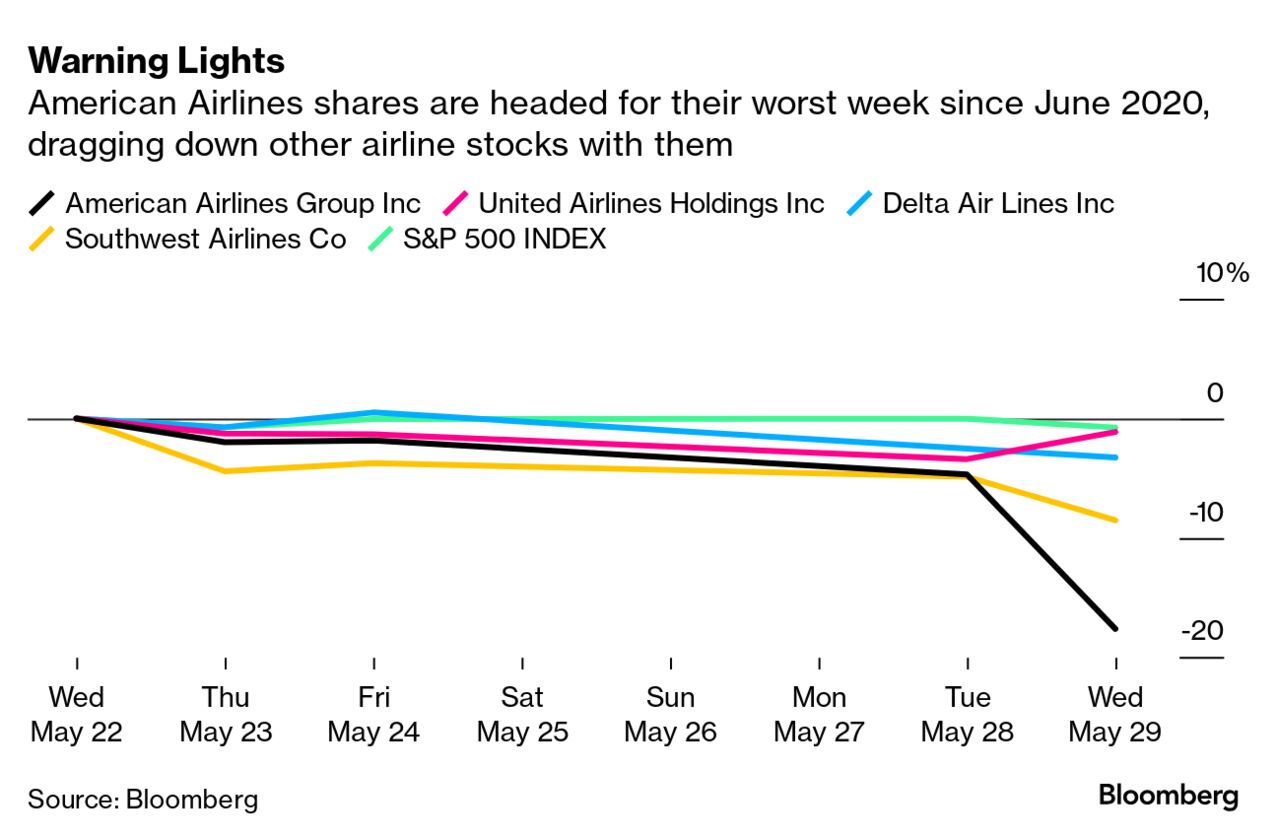 Shares of American Airlines Group Inc. fell more than 13% on Wednesday after the carrier sharply lowered its earnings forecast for the current quarter. CEO Robert Isom blamed the reduced outlook on a lingering surplus of available seats that's led to more fare sales than American initially anticipated. Revenue for each seat flown a mile, a measure of pricing power, will drop as much as 6% in the second quarter, compared to an earlier forecast for a slide of at most 3%. But he also said American hadn't helped itself with a new ticket sale strategy that sought to steer customers away from booking agencies and onto its own website and app. Vasu Raja, American's chief commercial officer and a champion of this direct sales push, is leaving in June. Isom fired him after an assessment from Bain & Co. that showed the marketing strategy was turning off corporate clients, Bloomberg News' Mary Schlangenstein reported, citing a person familiar with the matter. "We moved faster than we should have and we didn't execute well," Isom said at the Bernstein conference. "We need to make it easier to participate in our programs and easier to do business with American Airlines." Other airline stocks also slid on American's commentary about weaker-than-expected pricing and demand, but United rallied after reiterating its own second-quarter earnings guidance. "I think for them, that was just a forecast issue. Not weakness," United CEO Kirby said at the Bernstein conference. Deals, Activists and Corporate Governance
Johnson Controls International Plc has attracted the attention of not one but two activist investors. Elliott Investment Management and Soroban Capital Partners have both built large stakes in the air-conditioning and fire safety company, Bloomberg News reported. Neither investor has publicly specified what sort of changes they might seek at Johnson Controls. The stock's performance has recently lagged behind those of other air-conditioning and heating manufacturers, such as Trane Technologies Plc, Carrier Global Corp. and Lennox International Inc. But that's not without good reason: The companies' businesses don't actually overlap all that much. 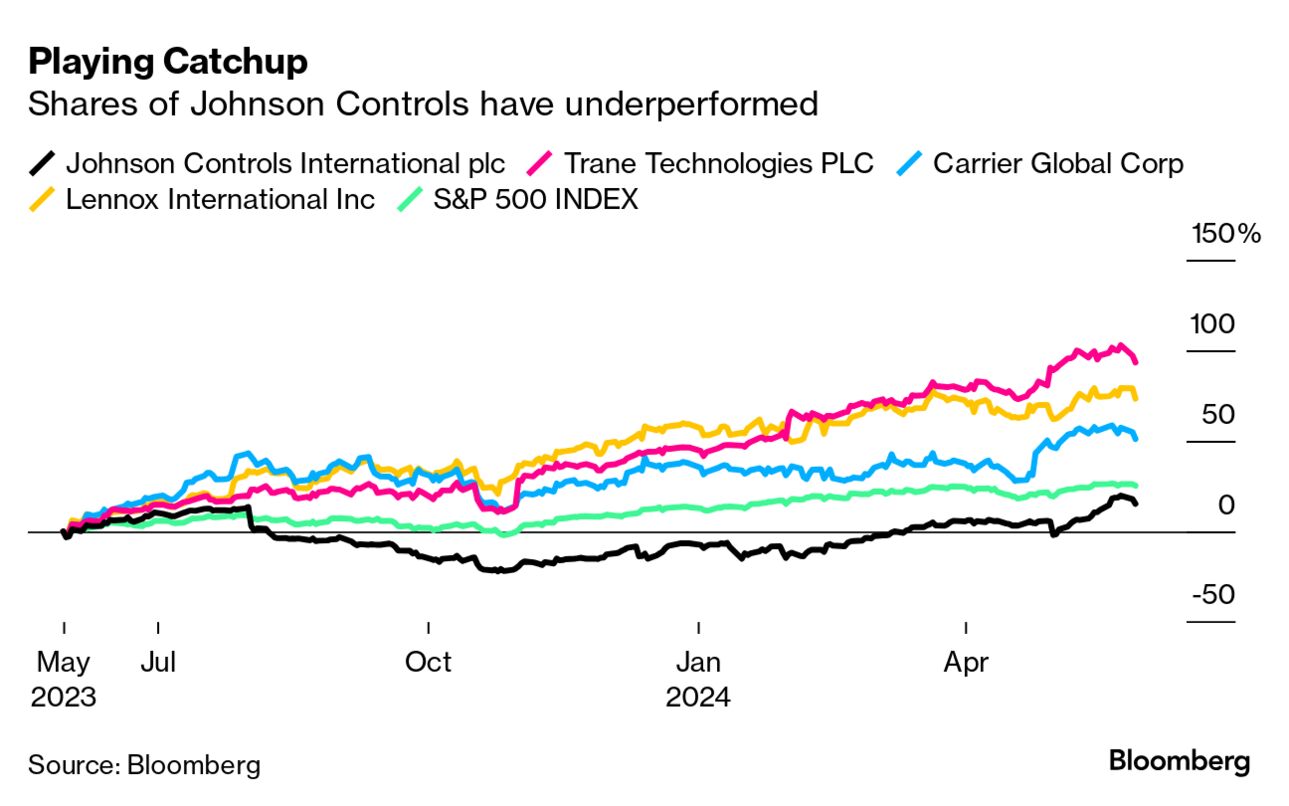 Only about 35% of Johnson Controls' sales are tied to products that compete with Trane, with the former company focusing more on building management systems and markets outside of North America, according to Barclays Plc analyst Julian Mitchell. Johnson Controls announced earlier this year that it's exploring the potential sale of its non-commercial businesses, including its residential heating and air-conditioning arm. Should it proceed with the divestitures, Johnson Controls won't compete at all with Lennox. This peer set "confusion clouds much of the investment community discussion," Mitchell wrote in a report. Still, the company's structure is highly complex and centralized, perhaps to the detriment of its profitability and operations, and investors have been frustrated by a string of operational hiccups. Johnson Controls' M&A track record has also been a bit spotty: It took a writedown on the 2021 acquisition of hyperscale data-center cooling expert Silent-Aire and the stock has starkly underperformed the S&P 500 in the years since the company's blockbuster merger with Tyco International in 2016.
DuPont de Nemours Inc. could turn industrial breakups into a professional sport at this point. The maker of Tyvek coveralls, water purification technologies and chemicals used in electronics manufacturing announced last week that it would split itself into three parts. DuPont merged with Dow Chemical in 2017 in a complicated transaction that spawned its own three-way breakup, with the Dow Inc. commodity-chemical business and the Corteva Inc. agricultural-products company both spun off in 2019. DuPont has since embarked on a series of blockbuster divestitures, including a 2021 Reverse Morris Trust transaction that valued its nutrition and biosciences division at about $26 billion and an $11 billion deal for its automotive materials business in 2022. The result of all this financial engineering has been a ho-hum stock price, a string of earnings disappointments and a mix of businesses that is still incredibly complex and disjointed. It's not clear that yet another breakup will be a fix. The water technologies and electronics materials businesses have strong long-term growth prospects and could be more attractive to investors as standalone entities, but they could also struggle to command comparable valuations to peers, given their more commoditized offerings and smaller size, Bank of America Corp. analyst Steve Byrne wrote in a note.
Bonus Reading | 











No comments:
Post a Comment