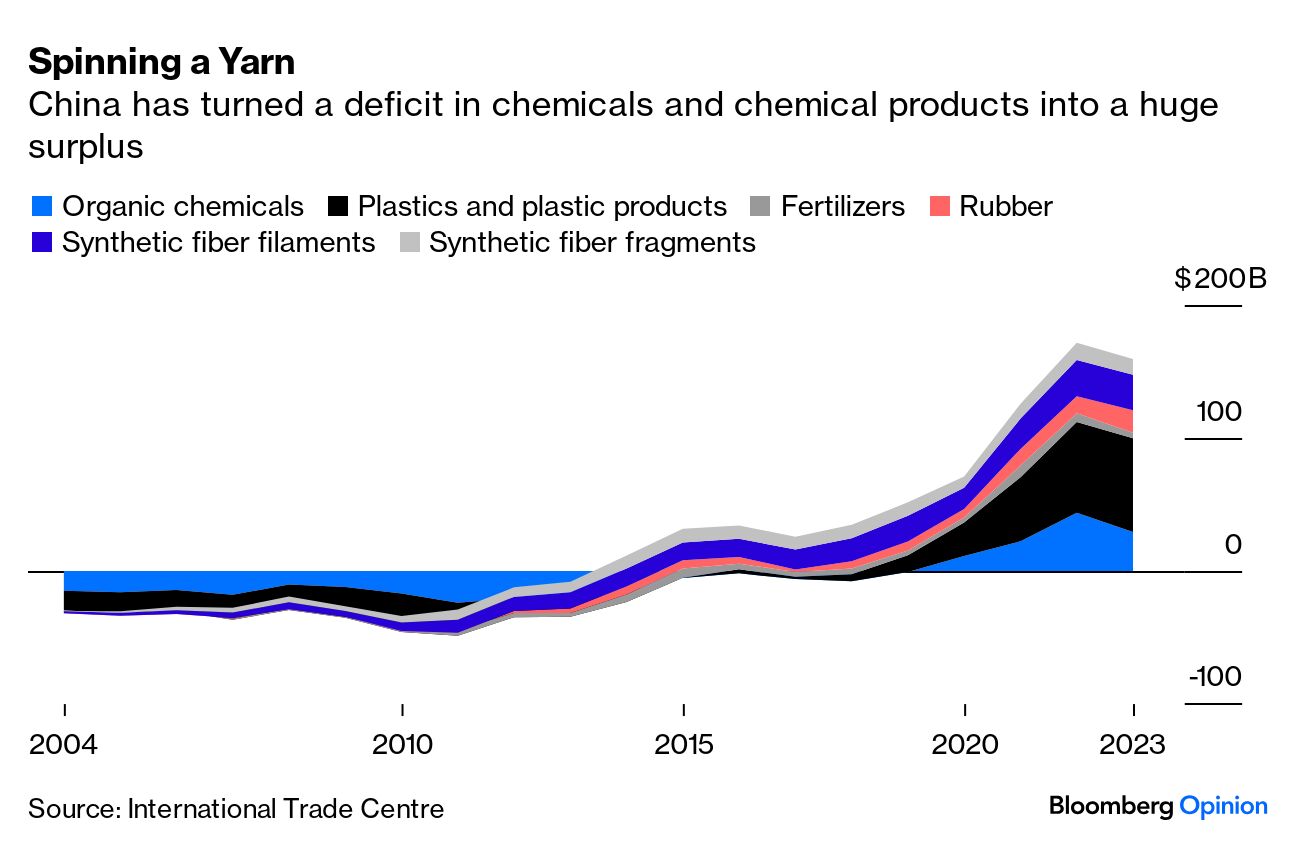
| This is Bloomberg Opinion Today, the presidential meme stock version of Bloomberg Opinion's opinions. Sign up here. Donald J. Trump is a man of many firsts. He's the only former US president to face criminal charges, the first in over a century to run for office again after losing as the incumbent and — to the best of my knowledge — the sole candidate in history to have launched his own meme stock. But did you know that he's also running as the first candidate to knowingly set his own votes on fire? Now that's different! As Mary Ellen Klas writes (free read), vote-by-mail used to be a reliable source of support for both parties. For the GOP, it provided a large and reliable pool of older, White Republican voters. For years, Republicans saw the advantages of vote-by-mail and their state legislators passed no-excuse absentee voting across the country. But Trump continues to baselessly malign the practice, deriding the many GOP voters who like the convenience of it. Citing a new study in the Election Law Journal by researchers at the Universities of Florida and Alabama, Mary Ellen writes that Trump did worse in primaries where more people voted by mail. "From this vantage point, Trump's strategy looks illogical," Mary Ellen writes. "He's now banking primarily on a single day to get votes out, preemptively declaring a large swath of the election system fraudulent and falsely claiming it is rigged." That's not the only bewildering — and, frankly, dark — development in Trumpworld recently, though. As Tim O'Brien writes (free read), Trump posted a short video to Truth Social on Good Friday with an image of a hogtied President Joe Biden in the back of a pickup truck. Trump has desensitized many of us to such antics, but Tim says we should see the video for what it really is: a threat of violence. "That's the bile that animates him," Tim writes. "Avoiding such bad juju is only natural for anyone exposed to his theatrics and menace. Looking the other way offers a measure of solace and continuity in a harrowing, jarring era. Trump's counting on that, of course." Tim says we must fight the urge to normalize that sort of behavior. Meanwhile, for those keeping score, Trump Media & Technology Group Corp. — the money-losing meme stock that recently made Trump as paper-rich as ever — swooned 21.5% on Monday. A regular day at the office, in other words. Bad for Trump if you think the meme stock was somehow going to get the former president out of his current financial bind. Bad for the unfortunate retail investors who were unwittingly lured in by the promise of fast profits. But in general, it's probably a decent development for rationality in financial markets. Elsewhere in markets, the US looks, at least for now, like the paragon of excellence. As Mohamed A. El-Erian writes, the US stock market defied a number of notable headwinds to surge 10.2% in the first three months of the year, its biggest first-quarter gain since 2019. Not only did that growth come amid heightened geopolitical uncertainty and economic weakness in Germany, Japan and the United Kingdom, but it also happened with yields on two-year US Treasury notes rising and Brent oil moving higher. Mohamed chalked the strength up to growing awareness and enthusiasm about generative artificial intelligence, US economic exceptionalism and what he characterized as "the Federal Reserve's relatively dovish stance on monetary policy." The rally in the US was so great that it became infectious, even spreading to such diverse assets as Bitcoin, Japanese equities and emerging-market stocks. "The first quarter of 2024 reminded us that US stocks can thrive amidst considerable uncertainty, especially when backed by a transformative sector narrative and a supportive central bank," Mohamed writes. "Investors should cheer this environment while being mindful of the need to extend the rally's drivers beyond these two influences." Also on the topic of American exceptionalism, Daniel Moss writes that reports of the death of dollar supremacy have been greatly exaggerated. Daniel has been at Bloomberg long enough to remember the many, many times that doomsayers have predicted the end of dollar dominance, and recent episodes, including Japan's decision to end its streak of negative interest rates and the Fed's projected rate cuts, have been no different. "There's just no getting past the supremacy of the dollar, much as skeptics of American influence wish for it or lonely yen bulls cry for relief," Dan writes. "The greenback has been frequently tipped to retreat, only for it to blow away everything in front of it." One final note on the economy from late last week, when readers in the US were starting their holiday weekends. New data on Friday showed that personal spending jumped 0.4% on an inflation-adjusted basis in February, comfortably exceeding the median estimate of economists surveyed by Bloomberg and adding to the signs of US economic strength that my colleagues have also pointed out. As I write, the report shows it's getting much, much harder to deny the underlying strength of the US economy. 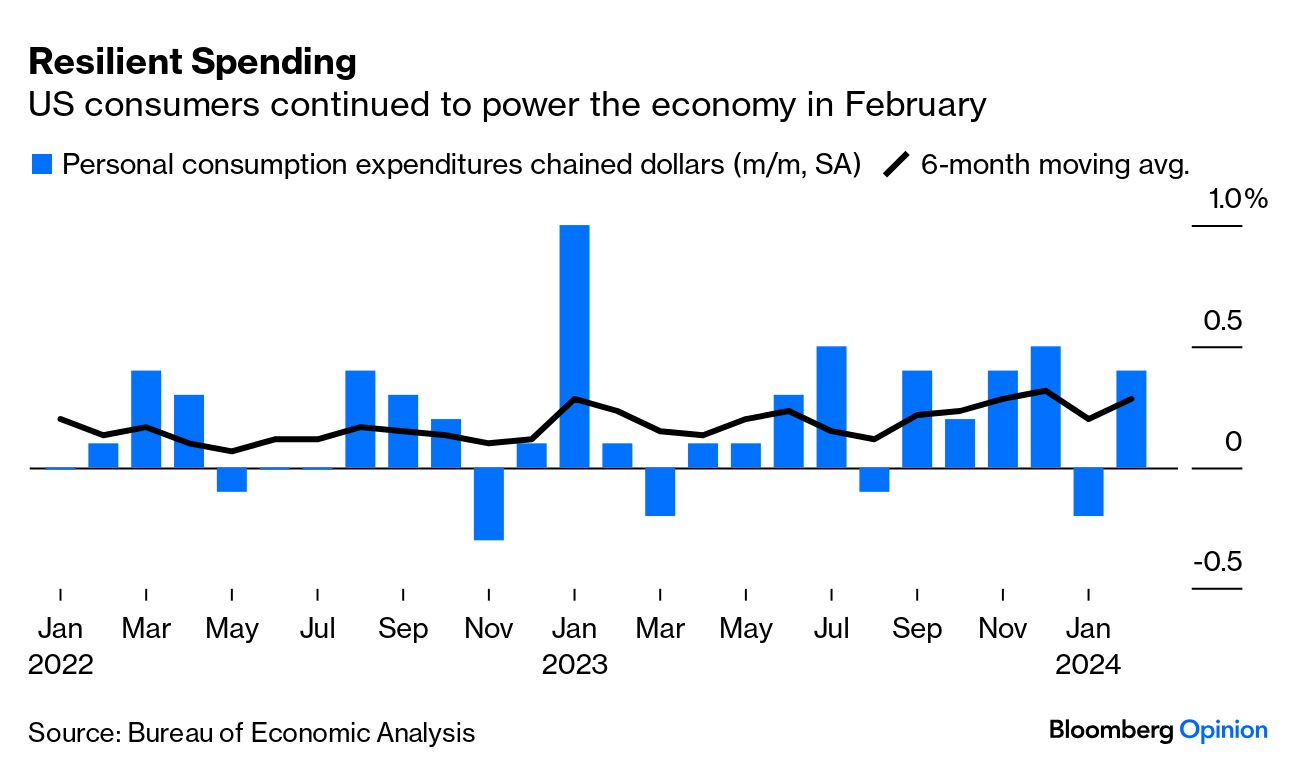 Turning to oil markets, David Fickling has a column out correcting a common misconception about the sources of demand from China. Buoyant Chinese oil demand, he says, isn't so much about cars as it is petrochemicals, with China "aggressively" bringing the sector onshore for end-uses such as synthetic fibers to make apparel. As David writes, "if you're seeking an explanation for the remarkable persistence of `Chinese oil demand,' you're better off looking at the world's consumption of plastic products and cheap clothing from the likes of Shein Group Ltd. and PDD Holdings Inc.-owned Temu, rather than travel behavior." America must do more for Afghans who worked with US military. — Editorial Board The Capital One-Discovery deal faces a tough road with regulators (free read). — Marc Rubinstein Financing is critical for the global plastic recycling industry. — Steve Hardman US drone makers must increase production capacity. — Thomas Black The Amazon labor movement was no match for corporate power. — Dave Lee Casino mogul Steve Wynn is said to be part of a deal for a $110 million Aspen mansion. McKinsey is offering staff nine months of pay to go away. A person got bird flu in Texas after being near cows. Cicadas are the strongest urinators in the animal kingdom, and this fact made the news. You won't need to sign up to use ChatGPT anymore. There was lots of April Fools' Day trickery on the Internet. Notes: Please send Krispy Kreme glazed pizzas and feedback to Jonathan Levin at jlevin20@bloomberg.net. Sign up here and follow us on Threads, TikTok, Twitter, Instagram and Facebook. | 







No comments:
Post a Comment