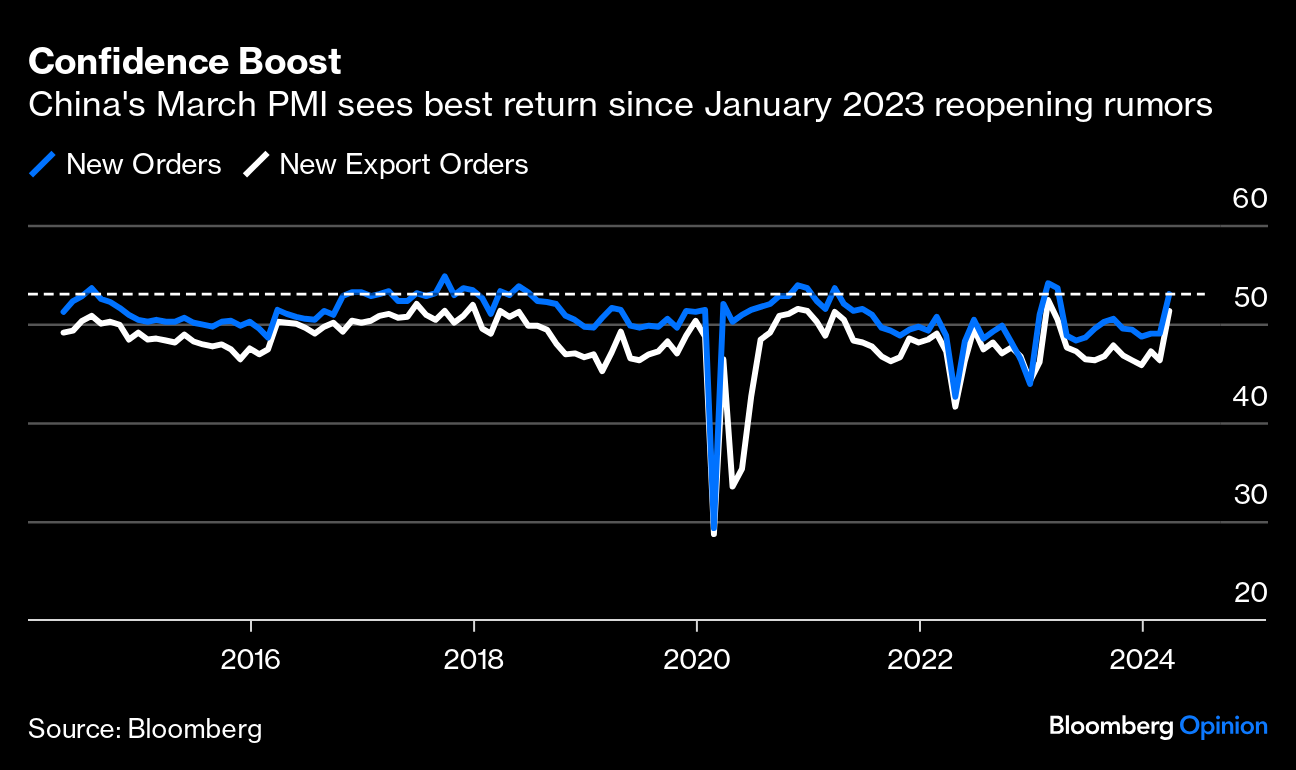
| Maybe we need to channel Janet Jackson and accept that we should wait a while, before we go too far. That at least is the message the Federal Reserve has been trying to get across of late, and for once the data has backed the Fedspeak to the hilt. As a result, chances of imminent rate cuts have been marked down drastically, which should make for interesting trading in Europe once the continent reconvenes from the Easter break. On Good Friday, Fed Chair Jerome Powell spoke at a forum organized by the San Francisco Fed. He made clear that the strengthening economy left him in no rush to cut rates, while the decline of inflation was still ambiguous. He was speaking just after the Fed's favored inflation measure, the personal consumption expenditure index, had come in more or less exactly in line with expectations for February. Taking the statistical purists' preferred "trimmed mean" — excluding outliers and averaging the rest — the Dallas Fed shows that inflation did indeed diminish ever so slightly on a year-on-year basis, while the monthly glitch in January begins to look like a fluke. That said, progress toward the target of 2% looks to be too slow: 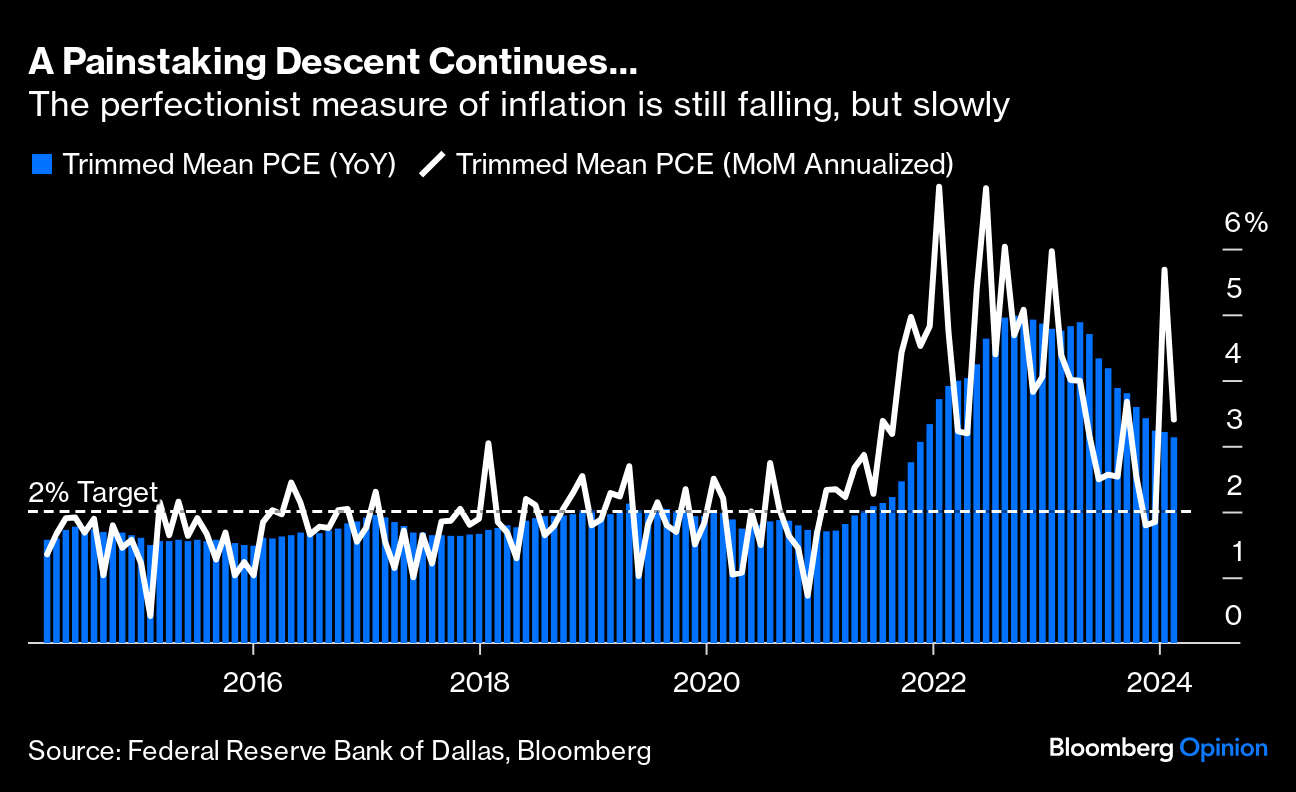 With the first of the month came the customary download of supply manager surveys of manufacturing, set so that 50 represents the gap between expansion and contraction. On that basis, US industry is back into expansionary territory for the first time since 2022 — but the prices they report paying are rising at the fastest clip in more than a year: 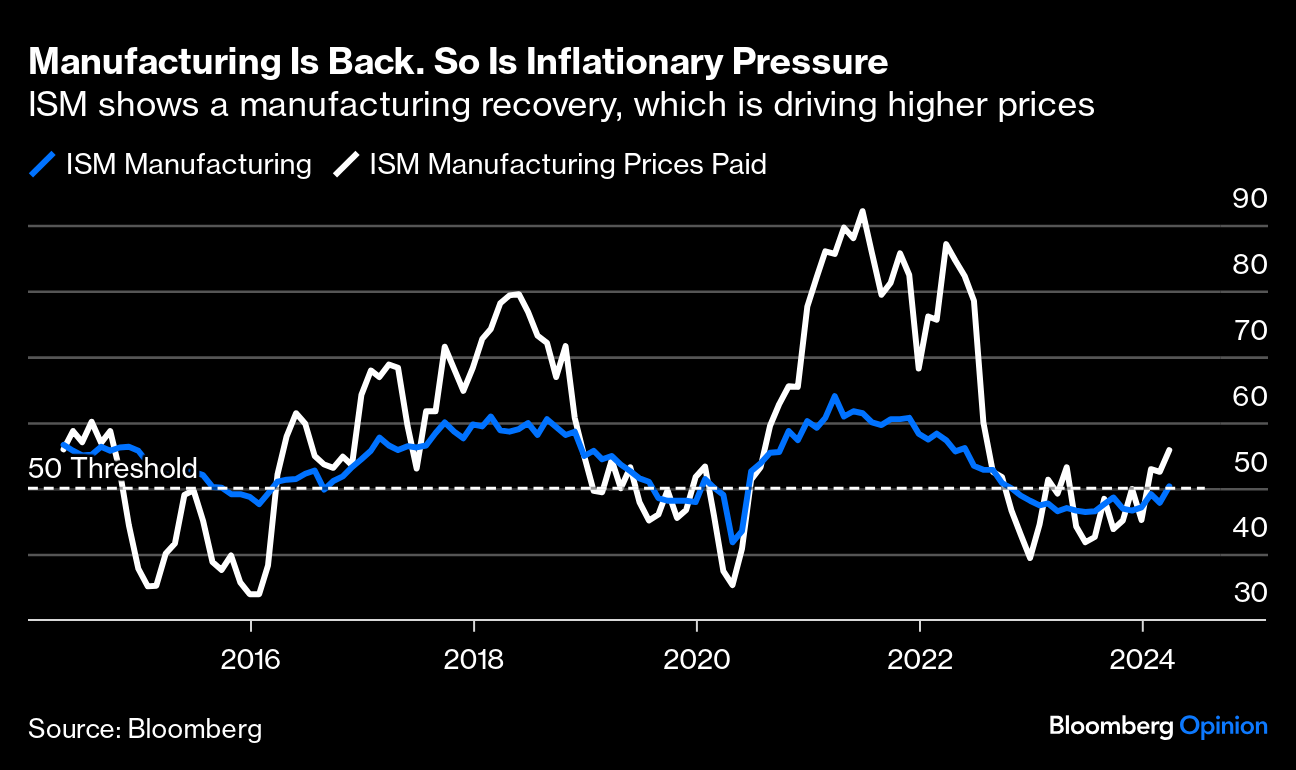 Naturally, this implies less need for rate cuts and indeed suggests that they could be risky. You can't hurry rate cuts, or at least you shouldn't, in these circumstances. And the market gets that. If we look at the implicit pricing of the future fed funds rate derived by the Bloomberg World Interest Rate Probabilities function, we find that the odds of one 25-basis-point cut by the June meeting of the Federal Open Market Committee are now down to about 50/50. Two months ago, three cuts were being priced as a virtual certainty. Further, for the first time since October, a little doubt is creeping in to the chances that the Fed will even have made a cut by its July meeting:  After a lengthy debate over whether we would really see "higher for longer," it's happened. The fed funds rate reached 5% in March last year, and the market now prices it to stay that high until November. Not long ago, that would have been regarded as a nightmare scenario. It probably shouldn't be, however. Rates are usually only that high because the economy is strong. Fed funds had an extended stay above 5% in the late 1990s, and the economy roared — although admittedly growth deteriorated sharply during the 15 months they stayed at 5.25% on the eve of the Global Financial Crisis: 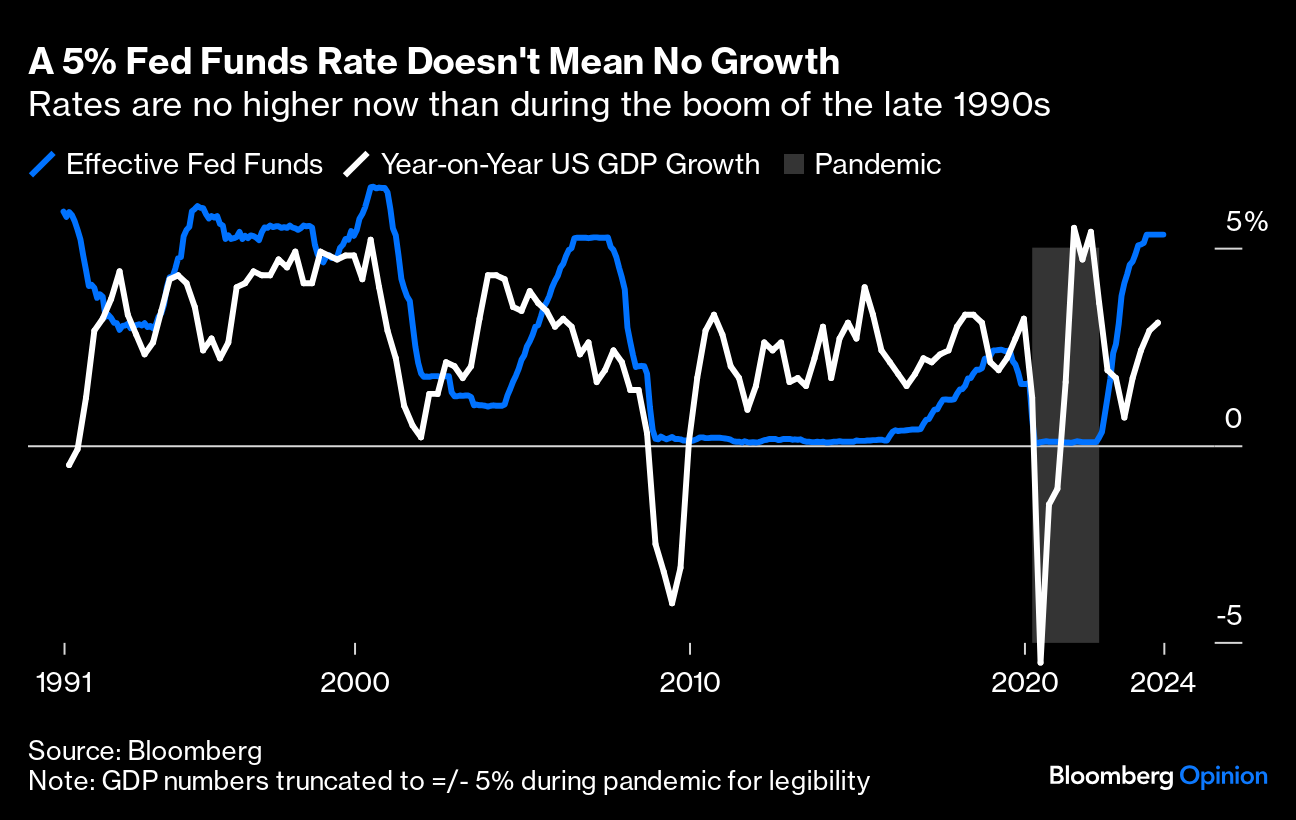 In principle, then, there's no reason to get out of stocks just because the fed funds rate is high. That is a headwind to valuation, and makes it harder for companies to grow, but usually rates are only that high because corporate conditions are good. Meanwhile, higher rates are by definition bad for bonds. It therefore makes sense for stocks to outperform bonds when rates are rising. What's startling is that stocks have been outperforming bonds even when the yields on Treasuries are moving sideways. The benchmark 10-year Treasury yield hit 4.25% for the first time since the GFC in October 2022. In Monday's trading, it oscillated between 4.2% and 4.3%, but essentially yields have been trading in a range for 18 months. So bond prices have been stable — yet stocks have beaten them by almost 33% over that period, if we use a simple yardstick comparing the most popular exchange-traded funds for the S&P 500 and Bloomberg's index of 20-year or longer Treasuries. The ratio hit a new high after the ISM data: 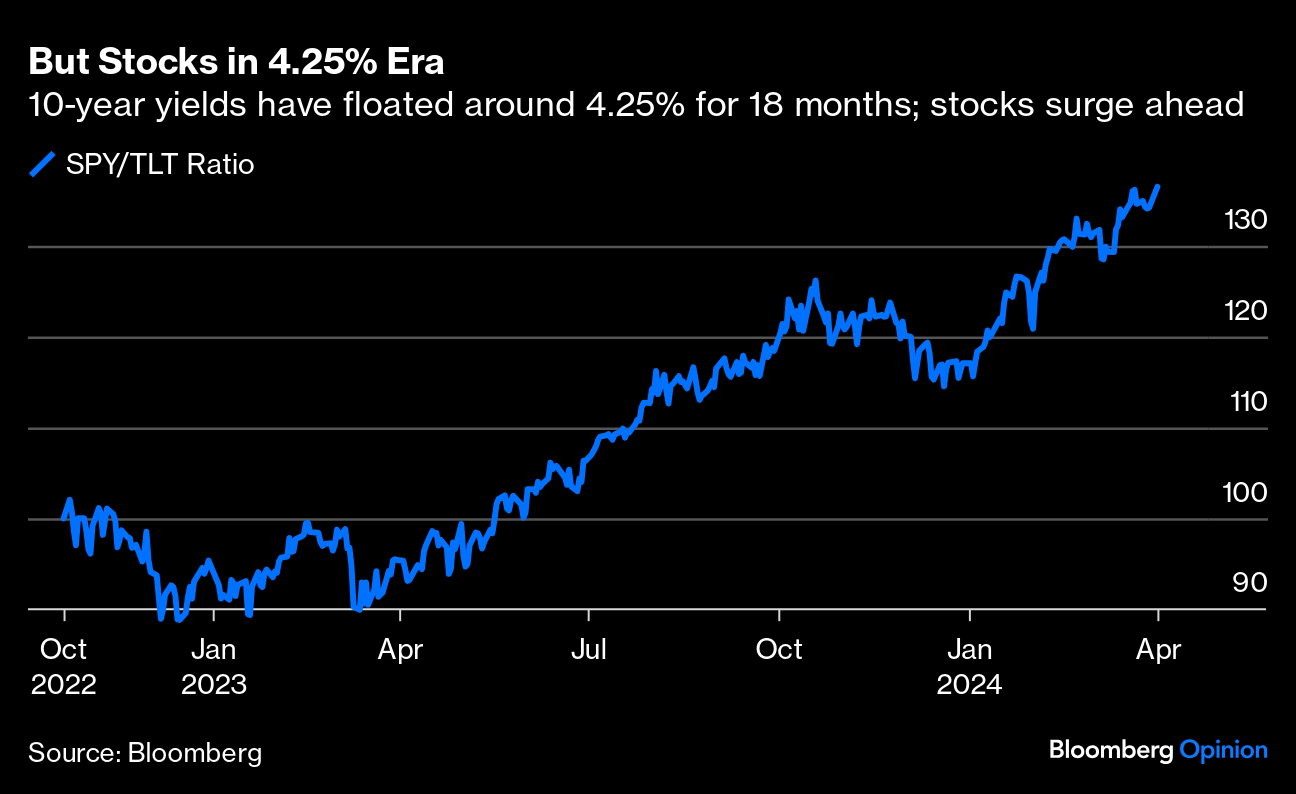 For asset allocators, it seems impossible to move beyond holding stocks rather than bonds. The risk is that protracted high rates eventually create a financial accident. This doesn't have to be a full-blown repeat of 2008; another US banking crisis like the one that hit last spring could be very damaging. And the longer rates stay higher, the greater the risk that companies have to refinance — on much worse terms — the very generous loans they were able to fix in 2020 and 2021. The so-called "maturity cliff" could be approaching. Except, the spread of investment-grade corporate bond yields over Treasuries has dipped below 1.5%. Any pressure the Fed and the Treasury market are putting on corporate balance sheets is being counteracted by the corporate credit market: 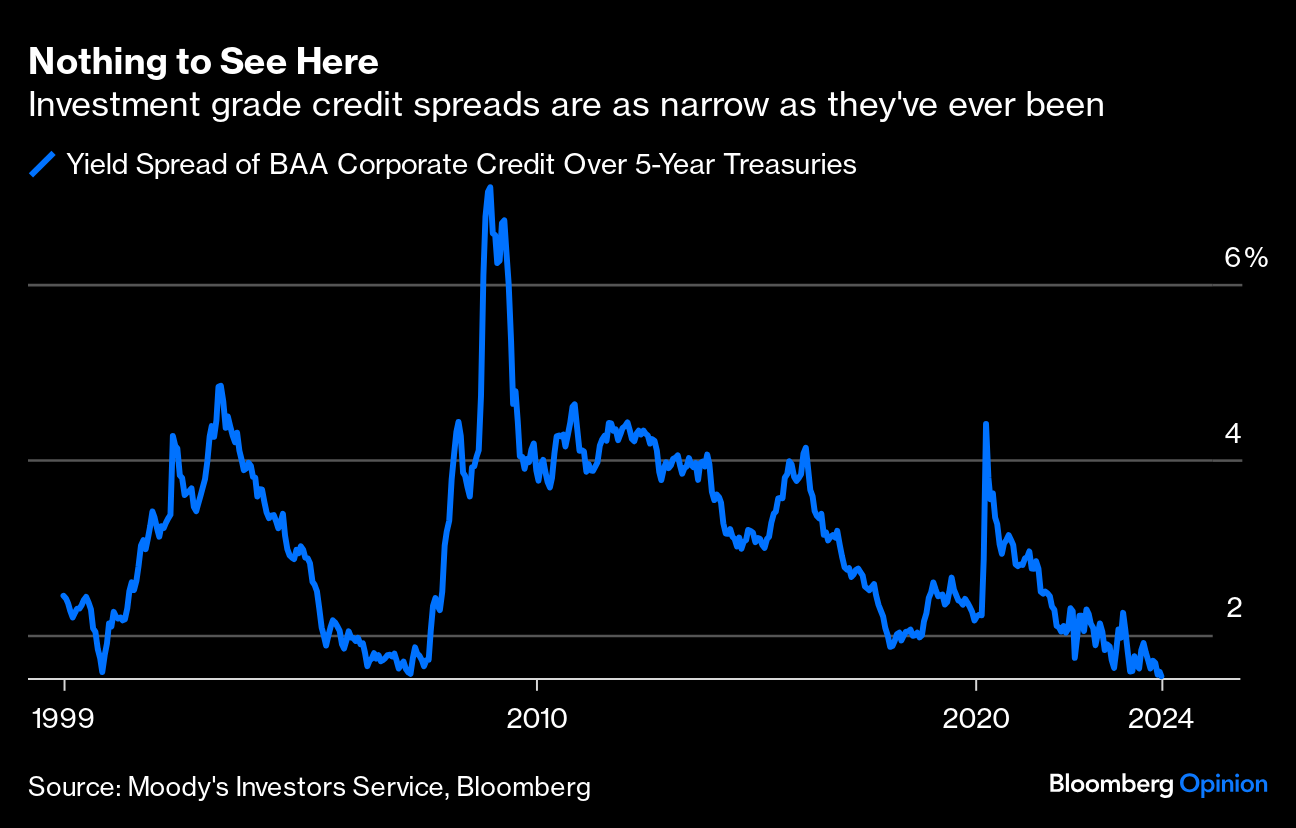 As for the relative appeal of the US, the news that its economy is stronger than everyone thought and that rates will probably stay higher for longer than expected is buoying the dollar. The dollar index, against a trade-weighted basket of developed market currencies, is its highest since November. Emerging market currencies, as measured by JPMorgan, are their lowest this year and close to the all-time low they set last fall. It's difficult to avoid the phrase America First these days; at this point, it appears to be less an aspiration, and more a statement of fact. April 1 marked a third consecutive day of rally for the Chinese stock market. After a miserable start to the year, combining disappointing economic growth with geopolitical gloom, news of the April Fool's Day resurgence could easily pass off as an expensive joke — except that this rally is beginning to get real. The CSI 300 index, the main benchmark for mainland-quoted stocks, rose 1.65% Monday, its best day in over a month. This was different from the rally that brought it away from its trough in February, which was primarily fueled by optimism that the National People's Congress, a forum the leadership traditionally uses to announce new policies, would push reforms to jolt the stock market. This rally is backed less by hopes for policy, and more by actual better-than-expected economic numbers. March's manufacturing PMI climbed to 50.8, up from 49.1 in February, with the measures for new orders and export orders, generally regarded as good leading indicators, back to where they were at the beginning of 2023, when expectations peaked for a big reopening after Covid-Zero restrictions eased. The fits and stops since then cast doubt about the sustainability of this latest PMI measure, but this news was surprisingly good: Bloomberg Intelligence's David Qu sees sustainability as a legitimate concern: Domestic challenges remain, including property retrenchment, weak household consumption and deflationary pressures. On the external front, contractionary PMIs in Europe and Japan raise concerns about exports. Bottom line: The economy needs a stronger lift from policy support.
As convincing as the PMI survey results may be, they're not the entire story. If anything, Capital Economics' Zichun Huang and Julian Evans-Pritchard argue that the survey portrays wider evidence of a stimulus-induced pickup in activity — although they suspect that it "won't prove durable" and that "the economy will be weakening again by year-end." While the NPC may not have fully delivered on structural reforms to shore up productivity and spur growth through a nudge in domestic demand, there's no shortage of initiatives. The upbeat PMI numbers came after a rare, highly publicized meeting between President Xi Jinping and a US business delegation. Xi can now point to the survey as evidence of the economy emerging from the throes of the pandemic in an attempt to court overseas money after foreign direct investment in 2023 fell to the lowest in three decades. If not exactly calling for a truce, China's message seems to be that it's still open for business, and that there's still money to be made. Whether Beijing successfully woos these foreign businesses or not, this shouldn't be surprising. As Points of Return noted, China is likely to push back on its isolation from the west. It will not simply cower. Will we see more of such meetings and policies that favor foreign businesses? That will be hard to tell, even though the intent of restoring their confidence is clear as daylight. "Talk is cheap," Evans-Pritchard and Huang argue — whatever path Beijing chooses must be backed by real action to achieve any results. There has been some progress on that front, such as relaxing cross-border data transfer rules last week. More is in the pipeline, including shortening the "negative list" that restricts FDI in designated sectors. Chinese stocks' exceptional cheapness after the last few brutal years might also tempt some western investors to brave political wrath at home and buy; MSCI's China index trades on a forward earnings multiple of just less than 10, while its US index trades at 22. But there are limits to what the leadership will be willing to offer, while the US Senate imbroglio over how to deal with Tik Tok shows that the relationship is in a very bad place. Chinese authorities no doubt know what it takes to put the economy back on track. It's obvious they still want to get things sorted largely on their own terms — a near-impossible feat. Whether Beijing is ultimately willing to pay pay the price is another question. —Richard Abbey As the world went into its long weekend, we learned that Daniel Kahneman had left us, aged 90. A psychologist famous for winning the Nobel Prize for economics even though he was never an economist, he was one of the great intellectual figures of the last half-century. The bombshell that changed economics, which you should read even though it does have a lot of math in it, is this one on Prospect Theory, authored with his academic partner Amos Tversky, who sadly died in 1996. I was lucky enough to meet Kahneman twice, so I can't claim to have known him at all well, but he came over as probably the most courteous and humorous genius I ever met. May he rest in peace. Tributes have poured in, from the likes of Cass Sunstein, who co-authored the book Noise with him, and the Wall Street Journal's Jason Zweig, who helped him write his masterpiece Thinking Fast and Slow. You can also read some great pieces in the Washington Post, Financial Times, and Time. At book length, Michael Lewis beautifully captured the story of Kahneman, and Tversky, in The Undoing Project; these two very different Israeli academics had a remarkable friendship that played out during some of the darkest moments in their country's history. More importantly for Points of Return's purposes, Kahneman's ideas had a profound impact on the way we invest. The issue is just how to use his insights. I'll try to add a little more to the discussion later this week. For now, I hope this gives you some good reading. Taking in Kahneman really can help you survive, in investing as in real life.
Like Bloomberg's Points of Return? Subscribe for unlimited access to trusted, data-based journalism in 120 countries around the world and gain expert analysis from exclusive daily newsletters, The Bloomberg Open and The Bloomberg Close. More From Bloomberg Opinion: - Bill Dudley: The Bank Run of 2023 Could Easily Happen Again
- Mohamed El-Erian: Financial Markets Just Delivered a Powerful Reminder
- Daniel Moss: The Dollar Is More Armored Division Than Currency
Want more Bloomberg Opinion? OPIN <GO>. Or you can subscribe to our daily newsletter. | 











No comments:
Post a Comment