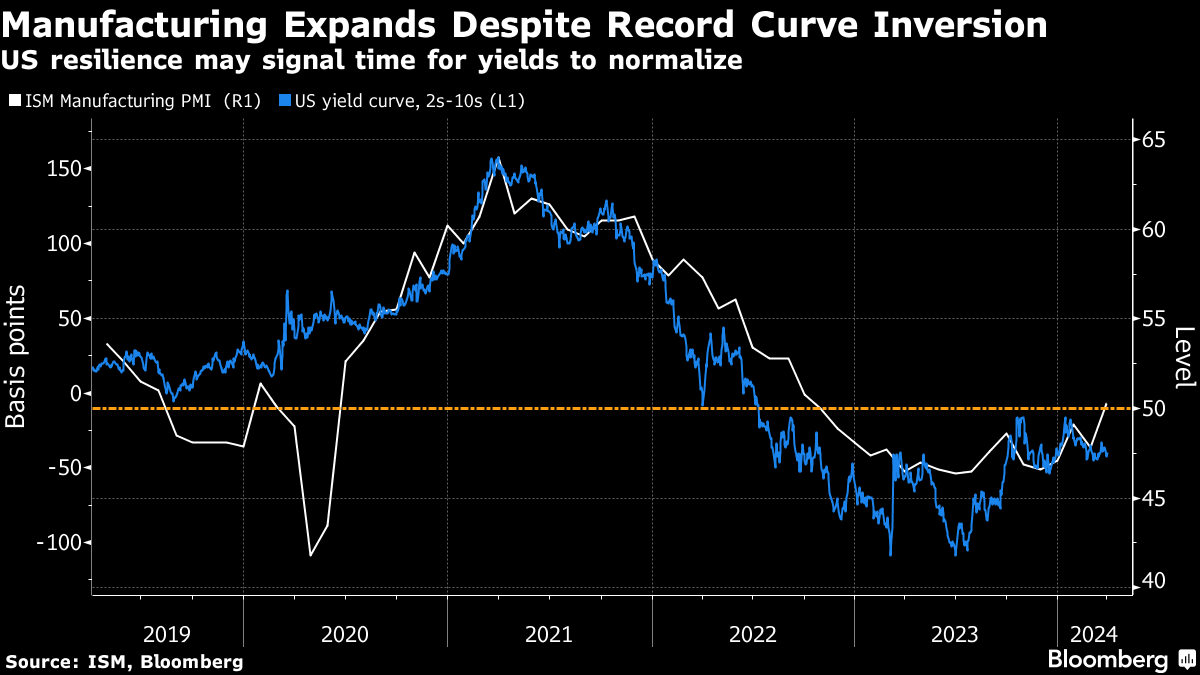
| Good morning. US Treasuries fell across the curve. Fed rate-cut odds for June dipped below 50%. The yen weakened toward 152 per dollar. Here's what's moving markets. — Isabelle Lee Bond traders priced in less monetary policy easing by the Federal Reserve this year — and briefly set the odds of a first move in June to less than 50% — after a gauge of US manufacturing activity showed expansion for the first time since 2022. The amount of Fed easing priced into swap contracts for this year dropped to fewer than 65 basis points — less than Fed policy makers themselves have forecast — after ISM manufacturing for March exceeded all estimates in Bloomberg's survey of economists. Treasuries fell across the US curve — with 10-year yields climbing more than 10 basis points. The selloff was already under way before the ISM data release as traders reassessed the outlook for monetary policy based on economic figures and comments by Fed Chair Jerome Powell on Friday, when US markets were closed. Equities edged lower after the S&P 500 notched its fifth-straight month of gains — spurring speculation of a consolidation or pullback. Emerging-market assets extended losses following fresh US data and amid still-thin global liquidity, as several markets across Europe, Australia and Hong Kong remained shut for Easter Monday. Broad MSCI gauges for EM stocks and currencies fell. The Brazilian real and the Hungarian forint led losses versus the dollar. But this decline doesn't mean investors are shying away from the space. In fact, as they scour the globe for undervalued stocks, actively managed exchange-traded funds that focus on EMs are back in vogue. Among $350 billion of emerging-market ETFs, the holdings of only about 5% of funds are actively managed, but those funds have lured in more than a third of new cash that's flowed into the asset class over the past year, data compiled by Bloomberg show. Key to the inflow is the 43% discount EM stocks are trading at compared to their peers in the US, just shy of the biggest valuation gap on record. Meanwhile, the yen weakened toward 152 per dollar, a key level that traders see elevating the risk that Japanese officials will intervene in the market, as strong US factory data boosted the dollar. The yen slipped 0.2%, putting it at about 151.70 per dollar. Last week it touched the weakest level in 34 years. Traders are on high alert after Japanese Finance Minister Shunichi Suzuki said authorities are monitoring the yen with a high sense of urgency and are ready to take appropriate measures against any excessive moves. Officials have been warning that they're willing to take action in the currency market, if needed, to stem the slide in the yen. The currency has lost about 7% against the greenback so far in 2024 and is the worst performer among Group-of-10 peers over the past year. Even after the Bank of Japan ended the world's last negative interest-rate policy, investors remain focused on the rate gap between Japan and the US. Tiger Global Management gathered about $2.2 billion for its latest venture-capital fund, well short of a $6 billion target and its smallest fundraising haul in roughly a decade, according to people familiar with the matter. Last week's final close of Private Investment Partners 16 fund marks the first time a Tiger venture pool attracted less cash than the vintage that preceded it. That's a stark reversal after years of robust investor demand. Tiger's last fund of $12.7 billion was its largest ever. Now, Tiger faces the most difficult fundraising climate in years, with investors growing more cautious about VC and private equity bets. With firms slow to return cash, clients have limited ability to make new investments. Many private equity and venture firms have recently missed or cut their fundraising targets, including Apollo Global Management, Carlyle Group and Insight Partners. It's going to be quite a packed Tuesday for traders in the US, what with factory orders, light-vehicle sales and JOLTS job openings data. These will be accompanied by comments from several central bank speakers including the Fed's John Williams, Loretta Mester, Mary Daly and Michelle Bowman. It's worth noting that St. Louis Fed President Alberto Musalem takes office as well, replacing James Bullard. Elsewhere, traders can expect the euro area S&P Global Manufacturing PMI and the Reserve Bank of Australia's minutes from the March policy meeting. Here's what caught our eye over the past 24 hours: The US economy is looking far too robust for those, including many bond investors, who were expecting it to roll over toward a recession this year. ISM's manufacturing PMI became the latest piece of data to blow the lights out, jumping above the 50 line to signal expansion for the first time since 2022. The increase was five times larger than economists expected, with the prices and new orders sub-indexes also surging. Little wonder traders immediately started betting the Federal Reserve may only reduce interest rates twice this year, instead of the three penciled in by the central bank's dot plot projections. It's also looking like bets that rate cuts start in June may join prior favorites on the scrap heap. We started the year with investors certain that it would be March, then that got pushed back to May and then June. The Treasuries yield curve is the more stubborn part of the bond-market positioning picture. While the premium offered by two-year notes over 10-year peers did narrow, it is still at a hefty 40 basis points. That inverted setting — longer-dated Treasuries normally offer the higher yields to compensate for the greater risks involved — is proving very persistent. Still, if manufacturing continues to thrive to further undermine recession bets, there's a decent chance that the longest-ever curve inversion is living on borrowed time. Garfield Reynolds leads Bloomberg's Markets Live blog in Asia and is based in Sydney. | 









No comments:
Post a Comment