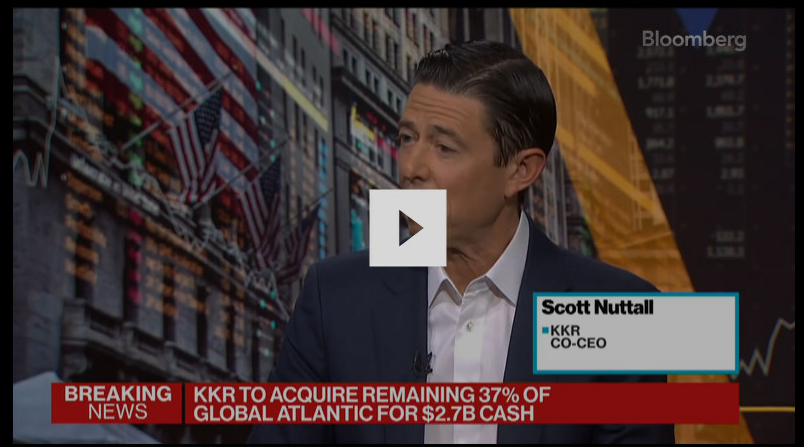
| This is a story in the buyout industry that's been more than a decade in the making. In 2004, Goldman Sachs Group Inc. started an insurance company called Global Atlantic, but the bank mostly separated from it in 2013 in the wake of the 2008 financial crisis. The insurer's assets then stood at about $15 billion. In 2020, KKR & Co. agreed to buy a majority stake in Global Atlantic, which by then had ballooned to roughly $70 billion in invested assets. This week, KKR agreed to buy the remaining stake, bringing the insurer fully into the buyout firm's empire. Global Atlantic had more than doubled to nearly $160 billion in assets since KKR's initial stake purchase. Aside from that tremendous growth, this is a story about just how much traditional—and often boring—financial activities are moving into the hands of the private investment giants. The way KKR sees it, fully owning Global Atlantic can give it a fresh advantage in capital markets. KKR now has a bigger balance sheet to put toward deals. Scott Nuttall, KKR's co-chief executive officer who earlier in his career worked on insurance deals as an investment banker, described it to me like this: KKR itself has doubled in assets over the past five years through various strategies, and it plans to double assets once again. In a call with investors this week, he said he envisioned a firm with a $200 billion market value—close to quadrupling what it is today. The more KKR and its rivals dig into insurance, the less they look like the traditional buyout firms they once were. KKR this week also said it would be moving its core private equity unit—its biggest strategic investment outside of Global Atlantic—into a new segment that spits off dividends to the firm. I asked Nuttall if these changes put the future of private equity, now about a $30 billion business at KKR, at risk across the industry. "Private equity is still a growth business for us, and we expect to continue to grow that part of KKR for a long time in respect to the flagship strategies," he told me in a Bloomberg Television interview. "This isn't about an 'or,' this is about an 'and.' We see an ability to grow PE, and all the other parts of KKR." Amid these changes, they're looking to make sure investors get a bigger chunk of the fee-related earnings that come from businesses like Global Atlantic. The "carry," which comes from whether rainmakers can ink profits from buyouts and other types of investments, will go to KKR's own people. (This is typically a move that shareholders like, partly because it keeps the buyout titans more responsible for better returns. No profits, no payouts, after all.) When I was covering the Global Atlantic story just as Goldman sold the bulk of its stake, the buyout industry was really snapping up these types of assets. The idea was something like the play that created Berkshire Hathaway: Buying such assets creates "float," or money that can come more easily than borrowing from a bank or tapping fresh fund investors, and investing it in other places like mortgages, stocks, bonds and even private equity. Apollo Global Management Inc. was the kingmaker of this trade, building Athene into one of the largest annuity firms in the US, quickly expanding around the world. Now insurance companies contribute the majority of the "perpetual capital," that makes up more than 55% of Apollo's $631 billion of assets under management. (Prior to the most recent Global Atlantic deal, KKR said that such perpetual capital was almost 40% of its $528 billion in assets.) Apollo's CEO, in a report published Friday by Wells Fargo, reiterated to the bank's analysts that "every dollar that moves out of the banking system reduces systemic risk." But one thing you have to remember, we call these vehicles "insurance companies" as a shorthand. Really, they're providers of annuities, which are retirement products that have become more popular in an aging population that's increasingly lacking employer-sponsored pensions. The buyout titans have fundamentally made a bet on retirement, not by going to pensions and taking their money in bulk, but by collecting the investment capacity of millions of Americans. This comes with potential regulatory risks in the future, because it's really mom and pop we're talking about. There's also concern about bad behavior as dozens of buyout firms rush into this model. Semafor reported this week that 777 Partners, a buyout firm that's seeking to buy English football club Everton FC, is facing scrutiny from the US Department of Justice. The firm has been bankrolled by its US insurance operations. Semafor said the probe is in its early stages and may not lead to a further outcome, and that an attorney representing 777 Partners "considers these scurrilous and damaging accusations to be deliberately timed to undermine its ongoing commercial activities, including the ongoing period of regulatory approvals for the proposed acquisition" of the football club. Then, of course, there's the story of how AIG nearly collapsed in the heat of the financial crisis, with its investment portfolio souring. Those holdings, credit default swaps, were dubbed "weapons of mass destruction" by Berkshire Hathaway's Warren Buffett. Fixed annuities now account for more than $3 trillion worth of retirement savings in the US, and Bloomberg's editorial board has said that "they could also become a nexus of the next financial crisis" if the risks go unchecked. The big story here is the direction things are going. Turns out the next hot ticket into a finance job might be learning how to parse NAIC regulatory filings, where insurers are required to disclose their holdings, as well as an understanding of capital rules and the finer details of loan origination. These were the skills I learned a decade ago that I thought I'd need again. Turns out, they've lasted me a career. —Sonali Basak, Bloomberg Television's global finance correspondent | 








No comments:
Post a Comment