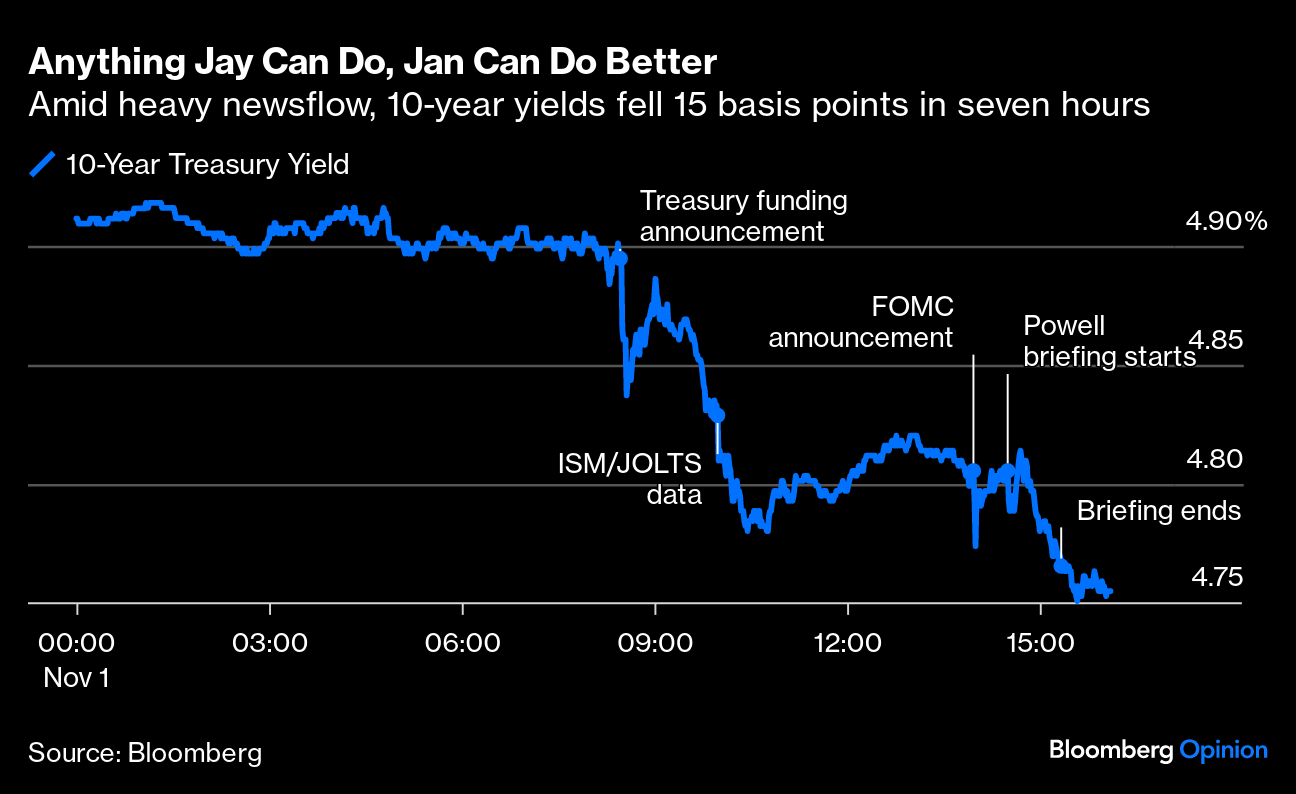
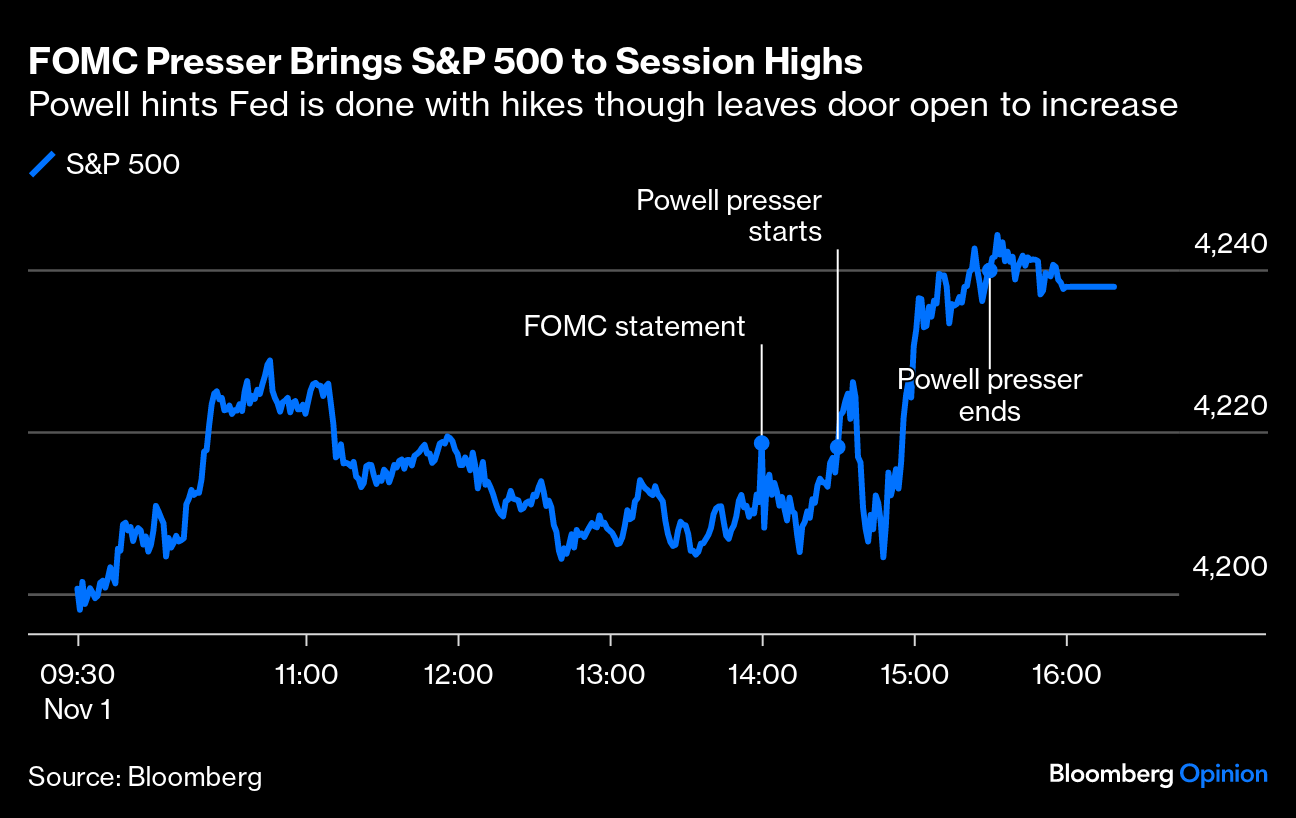
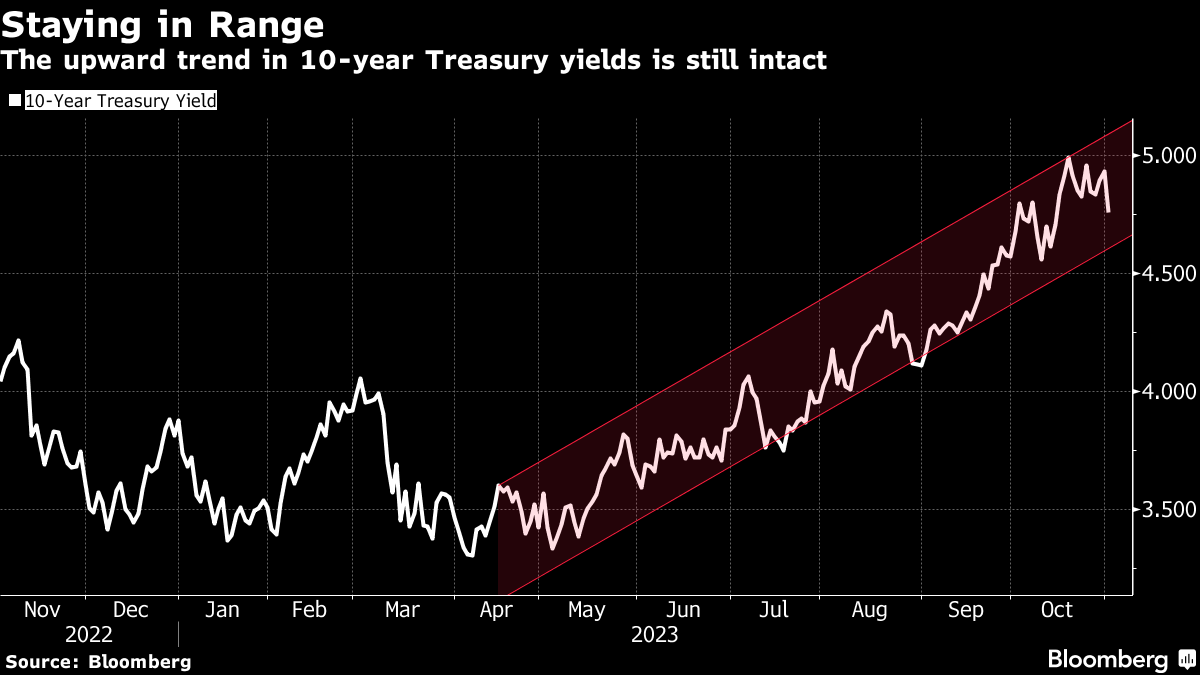
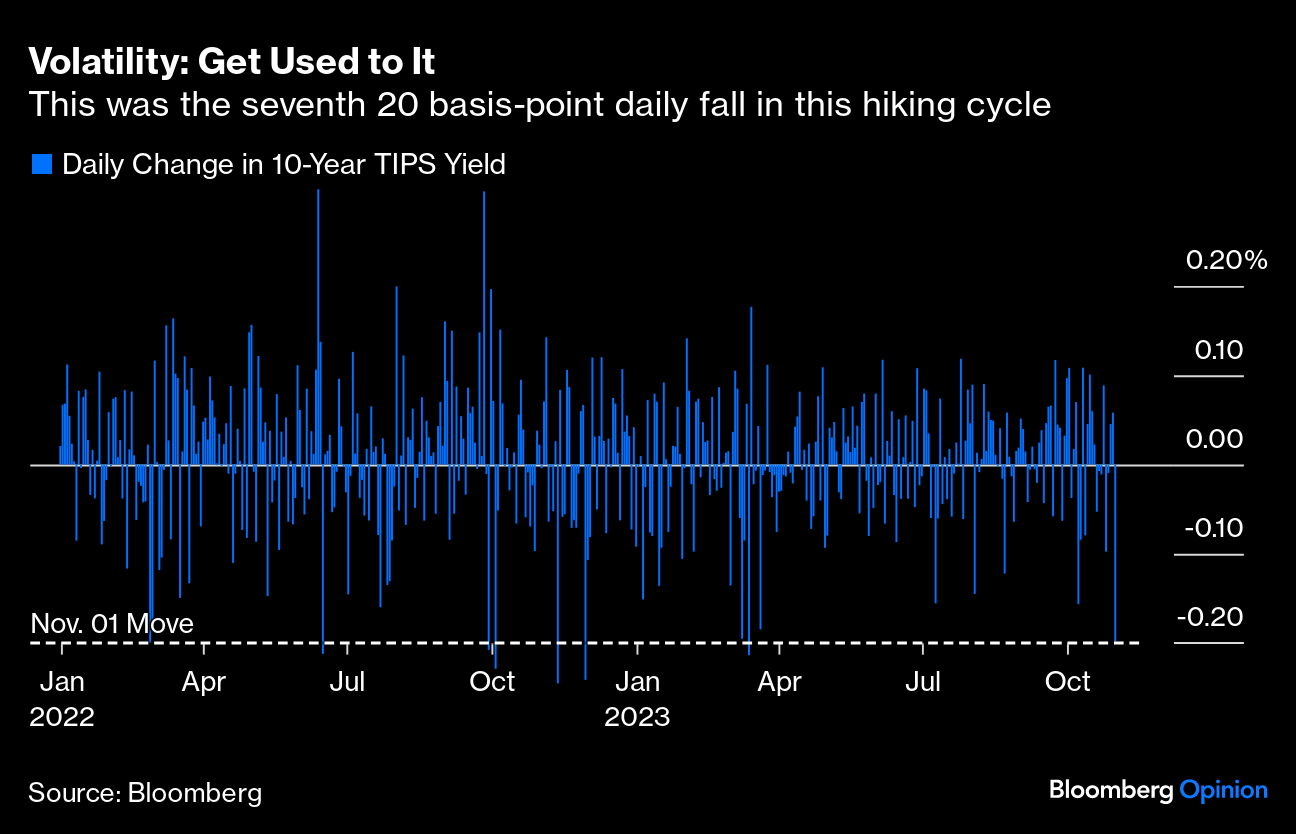
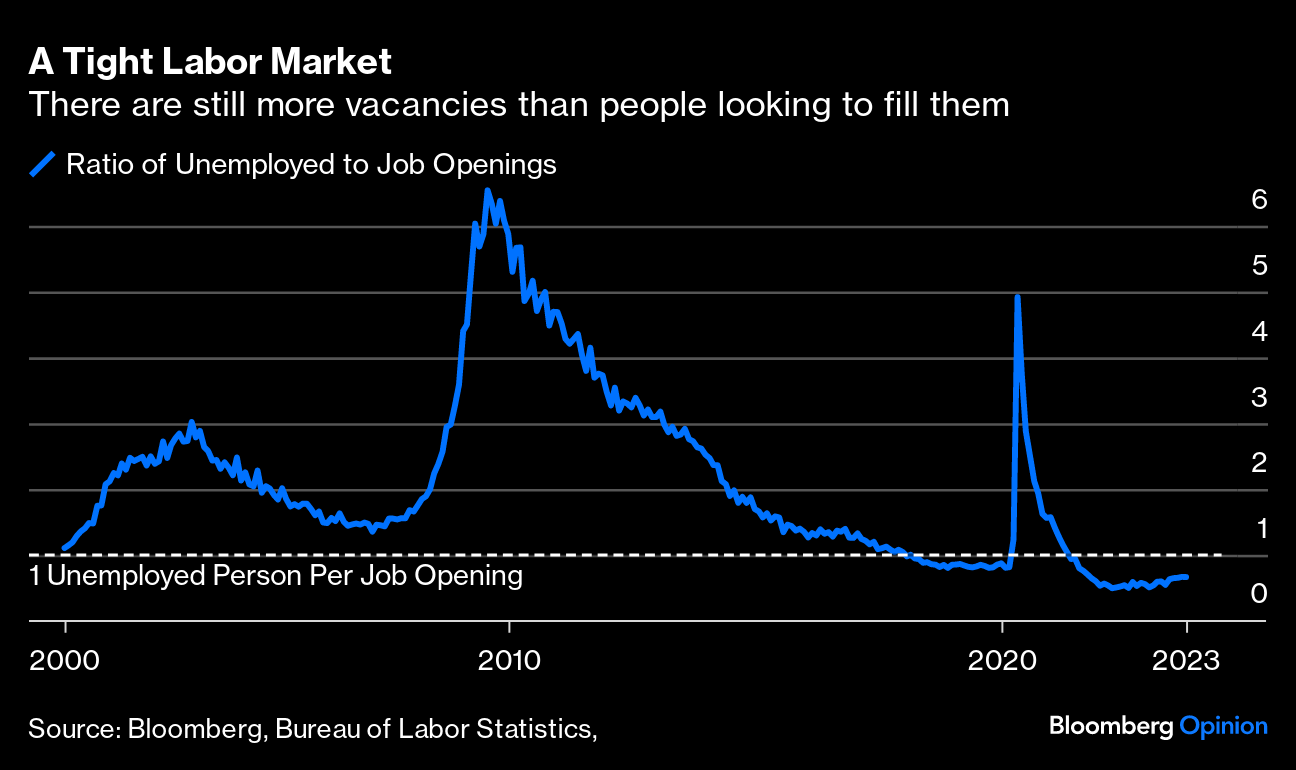
| US Treasury bonds form the largest, most liquid and important securities market on the planet. Many things move it, but nothing can change it unaided. Bear this in mind on a day when two of the three institutions with the greatest power to shift it — the Federal Reserve and the Treasury Department — acted only hours after a big announcement from the third, the Bank of Japan, whose massive interventions in its own bond market have pressed on yields across the world. There was also the customary heavy download of data that comes at the beginning of every month. The net result for US bonds was a huge rally, with the benchmark 10-year Treasury yield falling 17 basis points by the close of trade in New York (and further in Asian trading). This is how the day unfolded, with interventions from Janet Yellen of the Treasury and Jay Powell of the Fed marked: Meanwhile, the stock market took heart from lower rates, having endured gyrations in the aftermath of the Federal Open Market Committee meeting: But it's important not to get too carried away. Bond yields are in an historic surge that many believe is overdone. This reverse only leaves them well within a clearly upward trend: And volatility in these conditions is virtually a given. The 10-year yield on Treasury Inflation-Protected Securities (TIPS) had dropped 20 basis points by close of trade. That is a lot. But it's happened six times before during this tightening cycle and none of those reverses thwarted the rise: Bearing all of this in mind, let's take a look at what all those potentially market-moving institutions did. The Treasury tends to be ultra-conservative, working hard to avoid surprises that could raise Uncle Sam's borrowing costs. Creditors must find it trustworthy. So there's real significance to the fact that it's deviated from this. Liz Capo McCormick offers all the details here. In summary, the Treasury made three moves that can be construed as "dovish." First, it's going to sell "only" $112 billion in longer-term securities next week, which is less than expected. Second, its planned issuance of two-year to seven-year bonds will go up by the same amount trailed at the last refunding announcement in August, but sales of 10-year and 30-year bonds will rise by less than planned — arguably a sign that the Treasury doesn't want to let the surge in longer-date yields carry on. And third, it countered expectations that it would increase the amount of debt to be auctioned at both the next two refundings, in February and May, by saying that it expected to finish the job in February. The Institute of Supply Managers' survey of manufacturers was surprisingly downbeat. It's regarded as one of the best leading indicators for growth, so this matters, and would tend to let bond yields go down. Of the other data, the ADP survey of private sector payrolls suggested that employment had grown more slowly than expected (also good for those who want lower bond yields), but that was counterbalanced by the JOLTS survey, which showed that job openings actually increased in September. That means that vacancies continue to outnumber the unemployed people available to fill them, the very definition of a tight labor market: Markets could have chosen to treat this as a hawkish signal. They didn't, and yields instead fell on the supply manager data. It will be harder to ignore whatever transpires from the Friday payroll report. Investors headed into the FOMC meeting ready for a non-event. Market consensus was pricing in a Fed that left the target range for the benchmark federal funds rate unchanged at 5.25% to 5.5% for the second straight gathering. They were right about this. Indeed, the FOMC statement was barely changed. The decision was unanimous, 12-0. All the changes came in the first two paragraphs, annotated here by Oxford Economics: Eagle-eyed market watchers swiftly registered that the communique referred to "tighter financial conditions" that would weigh on the economy. This was a subtle tweak with immense weight, taken as an admission that higher bond yields were doing the Fed's work, and hence that short-term interest rates might not need to rise again. Then came Powell's press conference. The conclusion, for the market, was clear: The Fed is done hiking rates, even if Powell is too embarrassed to say so in as many words. Swaps for January show a peak rate of 5.41% — equating to only eight basis points of additional hikes. To Anna Wong of Bloomberg Economics, the implication of the tweak was dovish: Considering the various ways officials could have crafted a more hawkish statement — given upside surprises in inflation and activity data — this suggests the FOMC is inclined toward an extended rate pause.
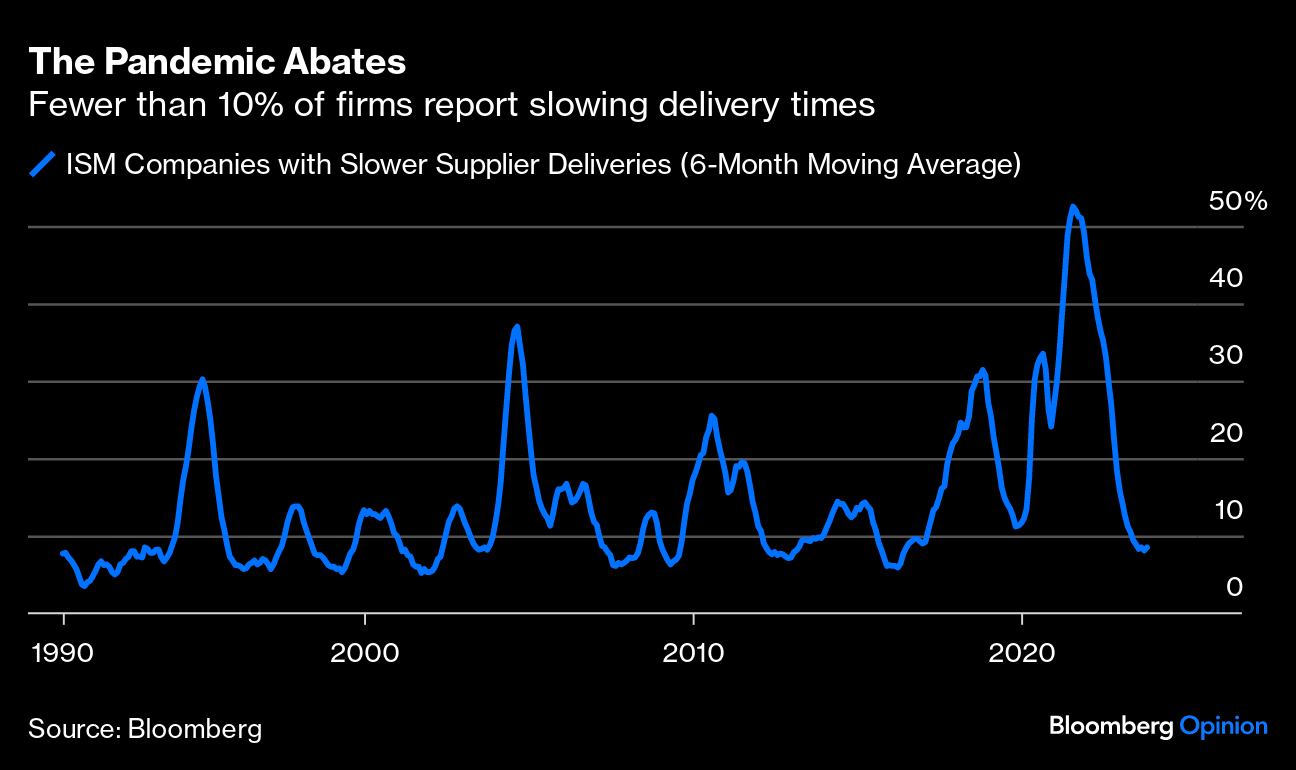
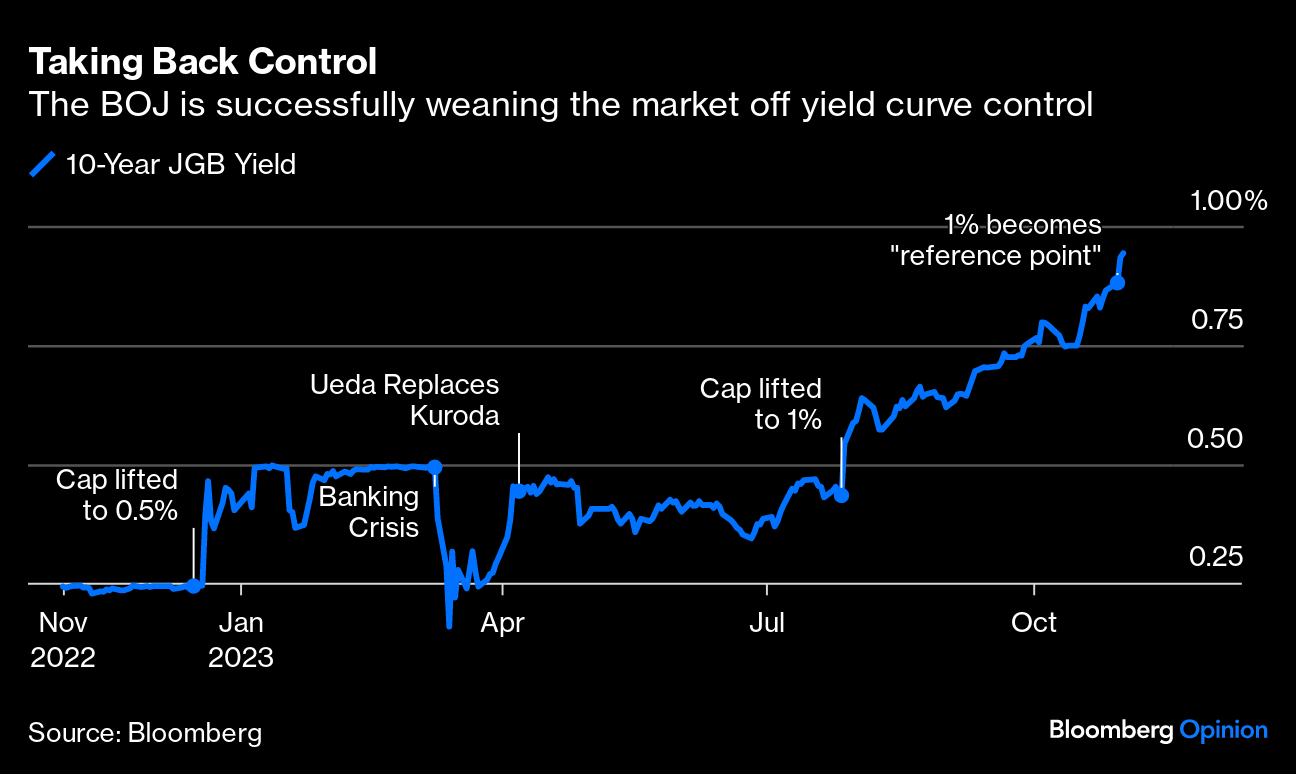
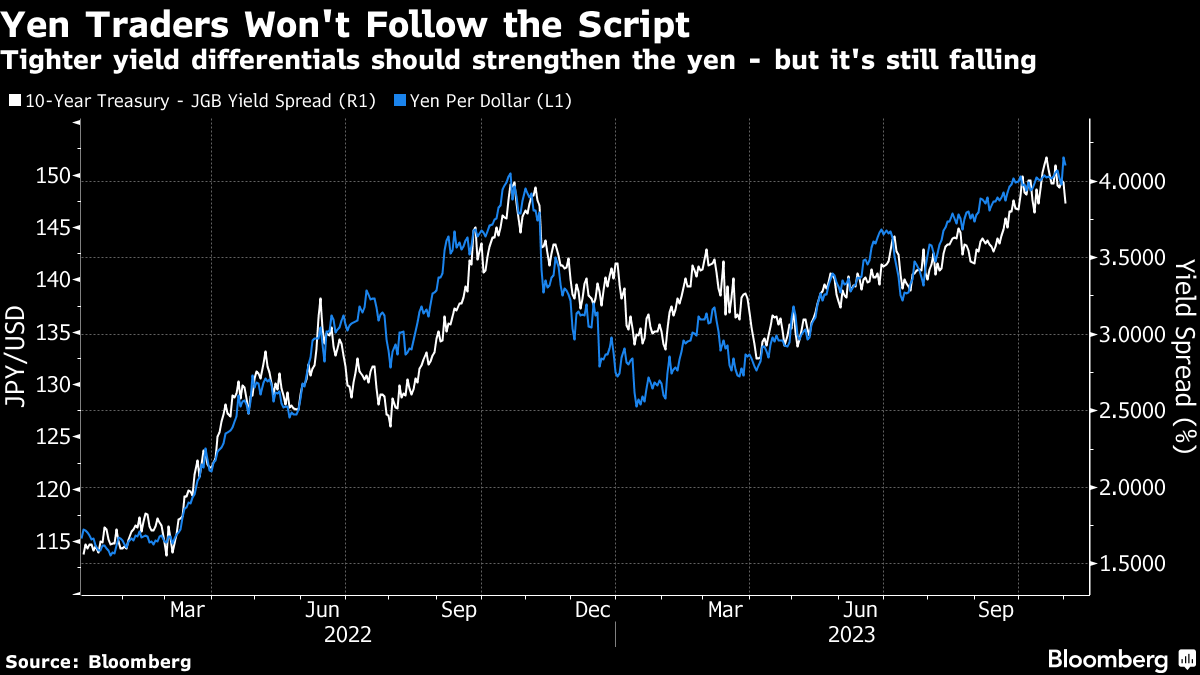
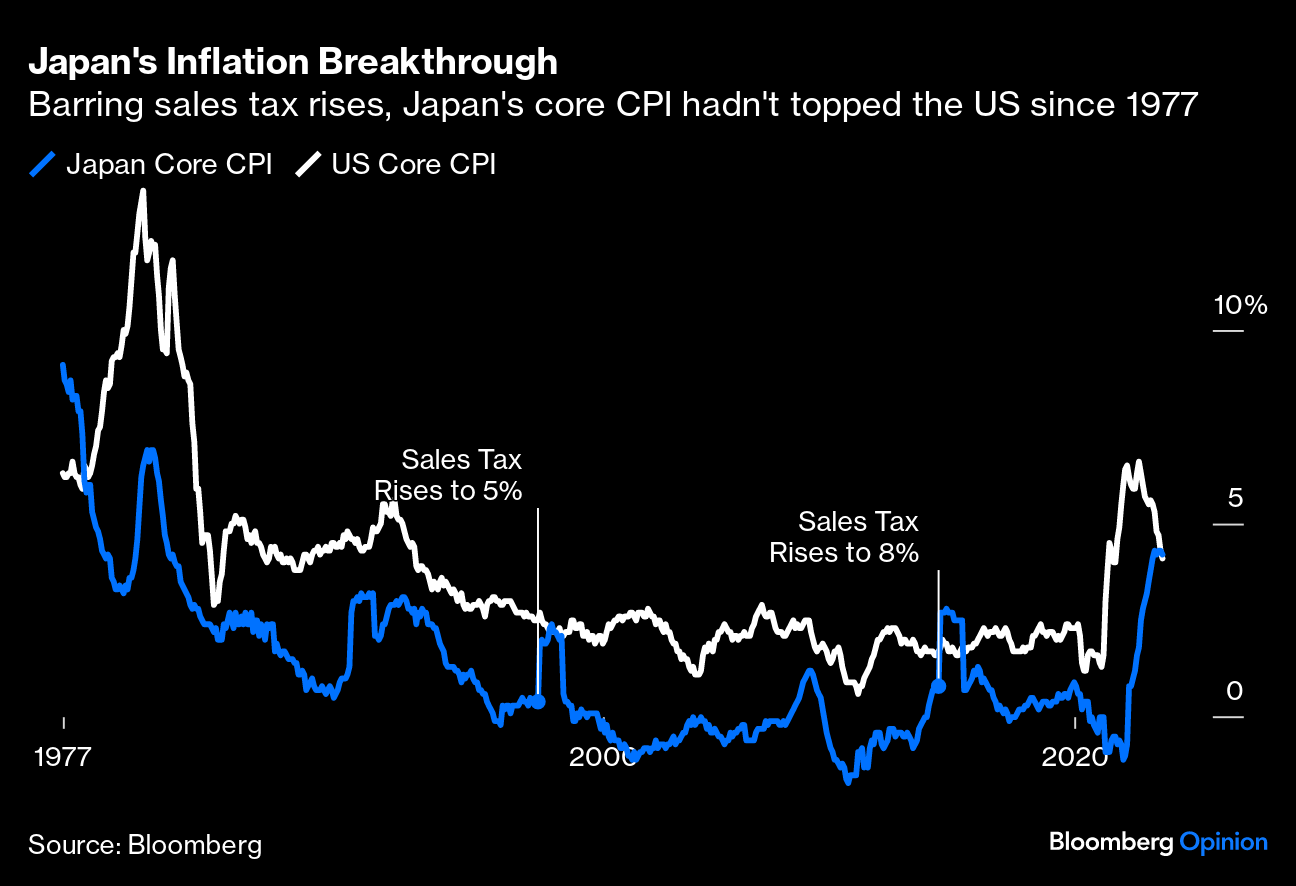
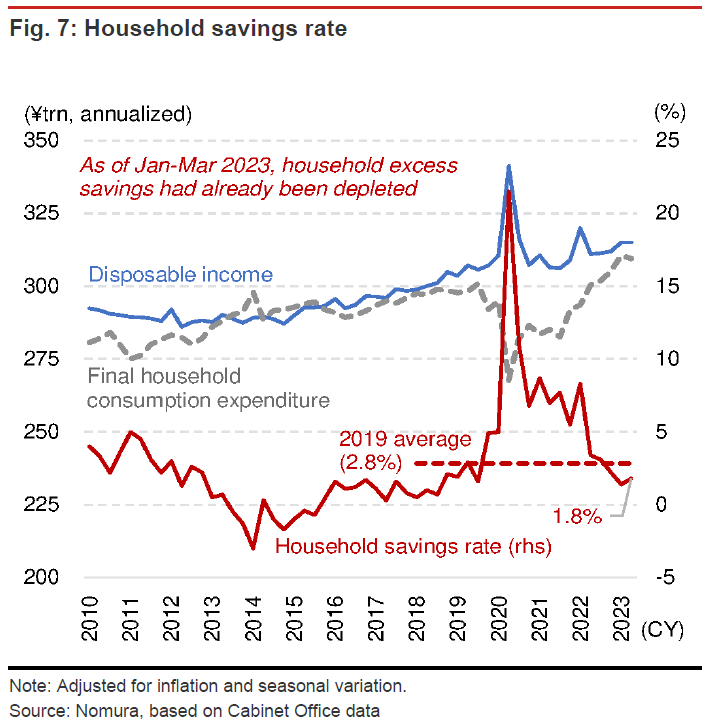
Acknowledgment of tightening financial conditions was crucial, said Ayako Yoshioka, senior portfolio manager at Wealth Enhancement Group. "It implies the Fed is aware that pushing interest rates higher at this point could be too much, and that they still need time for the impact of higher interest rates to work into the overall economy," she said. Priya Misra, portfolio manager at JPMorgan Asset Management, said thatwhile the market had reacted to Powell's caution, "that's only as good as the next data point and Fedspeak." There is, of course, a very big data point coming up with payroll data. How dovish was Powell really? He admitted in questioning that "obviously" committee members were watching Treasury yields. And the market seemed to ignore his assertion that tighter conditions needed to last a while. "We just don't know how persistent it's going to be and it's tough to try to translate that" into how many more hikes are needed. Thus, though conditions have "clearly" tightened, the FOMC is "not confident" that they're sufficiently restrictive — and the fall in yields might end up forcing another hike. This is when logic begins to bite. A problem with adding "financial" conditions to the statement is that they can go down as well as up, former deputy Fed governor Richard Clarida of Pacific Investment Management Co. told Bloomberg TV. He cautioned that Powell & Co. might regret including the word. And indeed, markets immediately loosened financial conditions by buying stocks and bonds. "Powell is very aware that his words can work against their goals, which is why he always needs to talk tough and keep the door open for further tightening," said Dan Suzuki, deputy chief investment officer at Richard Bernstein Advisors. Powell emphasized that this cycle was different from others because of the impact of receding pandemic conditions. And indeed, the ISM manufacturing survey included emphasis that acute logjams in supply deliveries were over: In the closest approach to a "gaffe," Powell talked down the last "dot plot" of predictions for rates and the economy, published in September, which shocked markets by showing most FOMC members expected the fed funds rate to remain above 5% at the end of next year. This struck many as strikingly hawkish, but Powell said that dots "decay" with time and the arrival of new information. That seemed like attempting to establish a justification for dovishness. "When Powell speaks, traders hear what they want to hear and disregard the rest (apologies to Paul Simon).Today's magic word was 'done.' He was hawkish, giving us no reason to expect cuts anytime soon," said Steve Sosnick, chief strategist at Interactive Brokers. "The thing to keep in mind is that traders react while investors consider. We'll see if sober-minded investors continue to feel as enthusiastic overnight and into tomorrow as traders feel today." The Bank of Japan baffled most of us with its announcement earlier this week that it was kind of lifting its policy of yield-curve control. More precisely, the 1% top level for the 10-year Japanese government bond yield is now a "reference point" rather than a strict limit, which to many seems like a distinction without a difference. Kazuo Ueda has only held the governorship for six months, and communication miscues are virtually inevitable when new leadership takes over — but he's still attracted criticism for poor messaging, as Daniel Moss and Gearoid Reidy write today. A defense of him is possible. This shows what's happened to the 10-year JGB yield over the last 12 months: There were several sharp switchbacks during the last few months of Haruhiko Kuroda's leadership, when the BOJ struck markets by surprise. Since Ueda took over, the moves are less dramatic. Presumably, he wants to engineer a gradual return to yields of 1% and above, without causing financial accidents. He's succeeding so far. However, the BOJ must contend with more than domestic bond yields. A weak currency could raise the cost of imports. Higher Japanese yields, combined with the recent fall in US yields, should help strengthen the yen by deterring capital flight. Yield differentials have long been tightly linked to the yen/dollar exchange rate — but the yen surged beyond the Y150 level, and even Y151, since the BOJ successfully pushed yields up: The market is exploiting the difference between the central bank and the Finance Ministry. Capping bond yields is the bank's responsibility, but direct intervention in currency markets is a treasury duty. The ministry now says that it didn't intervene in early October when the yen briefly broke Y150. So the game is to see how far the market can push the yen before sparking intervention. This is all incongruous as Japanese core inflation (excluding food and fuel) is now higher than in the US. Except on two occasions when the ministry raised sales taxes (which dampened what had been promising growth), Japanese year-on-year inflation hadn't exceeded the US since 1977: That makes a pretty compelling case for rising Japanese yields, which would counteract the falls in the US. But it's not inevitable. The economics team at Nomura points out that households have burned through their excess pandemic savings already, implying lower inflationary pressure than in the US: Jesper Koll, a long-time Japan investor who now publishes the Japan Optimist newsletter, believes Ueda and his colleagues can hold out against tightening more easily than the Fed or the European Central Bank. There has been no real "smoking gun" suggesting real risks of demand-pull inflation: More importantly, Japan has a political reality that actually allows for fiscal policy to act fast and decisively: Prime Minister Kishida has a 100% record of turning bills into law. Specifically, he has passed at least four extra budgets and spending allocations for public subsidies to those hurt by supply shock/imported inflation... Japan actually acts rationally and policy gets made efficiently, in a competently and refreshingly 'no nonsense' kind of way. No government lockdown or Brussels inertia in Tokyo…
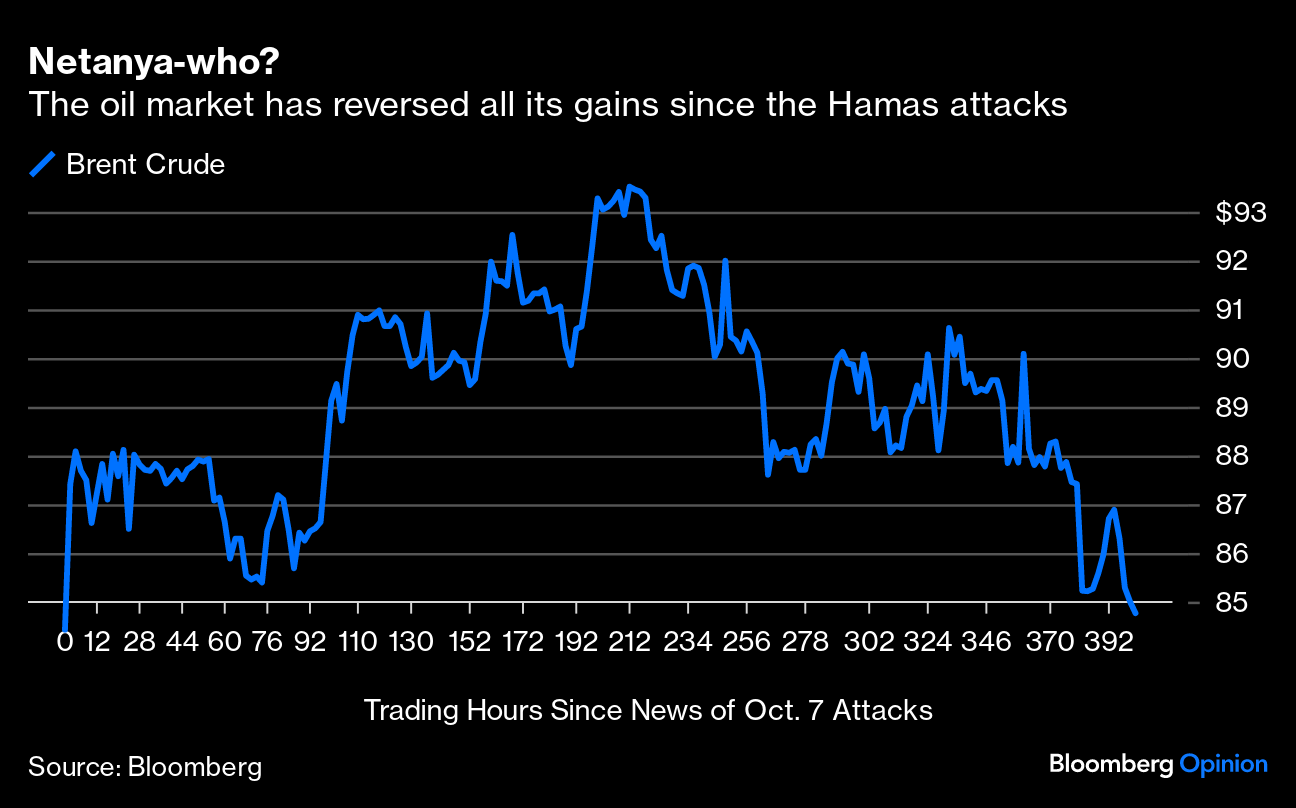
That's good to know. The balance of probabilities remains that Japan will continue to put upward pressure on Treasury yields. Powell tried his best to maintain a "hawkish hold," but did nothing truly surprising. Similarly, the day's macro data offered excuses either to buy or sell bonds. In both cases, investors chose to take bond yields downward. The most plausible explanation is that the Treasury, which controls the supply of bonds, had started the day with a big bona fide surprise. With so many important announcements still to come, it's understandable that yields didn't respond all at once. Instead, traders waited to make sure there were no nasty surprises from the data or the Fed. Once those risks had been avoided, it was safe to pile in and buy even more bonds. That's ultimately why bond yields fell so much; it was down to Janet Yellen. It's way too soon to say that this was a decisive turning point. And indeed, if yields come down too much, that would just layer on the pressure for the Fed to be aggressive. One more factor has been moving bond yields. The perception — which may very well be wrong — is that the chances have greatly reduced that the Israel-Hamas conflict metastasizes into a broader war that significantly affects oil prices. The Oct. 7 terror attacks were almost a month ago. This is what has since happened to the crude oil price: This is a huge topic to which we'll doubtless have to return. For now, note that the oil market implies confidence that the conflict won't rise to have global macroeconomic effects. All else equal, that suggests that there is less pressure to buy Treasuries as a safe haven and that the effect on the bond market is now effectively neutral. November is National Novel Writing Month in the US. But why not take it global? The idea is to try to write a short novel of 80,000 words by the end of the month. (Each Points of Return is about 2,250 words, much to our boss's dismay, so writing that amount every day will get you there.) Rather than editing as you go along, the idea is to let it all flow, see what happens, and then maybe revise it into a real novel later. Could be fun. Also, as Isabelle will within hours be taking the long flight from New York to Manila, any recommendations for long novels that have already been written would be gratefully accepted.
Like Bloomberg's Points of Return? Subscribe for unlimited access to trusted, data-based journalism in 120 countries around the world and gain expert analysis from exclusive daily newsletters, The Bloomberg Open and The Bloomberg Close. More From Bloomberg Opinion: Want more Bloomberg Opinion? OPIN <GO>. Or you can subscribe to our daily newsletter. | 









No comments:
Post a Comment