The fiscal theory of everything
We pay more attention to monetary policy than fiscal policy because monetary policy is more obvious.
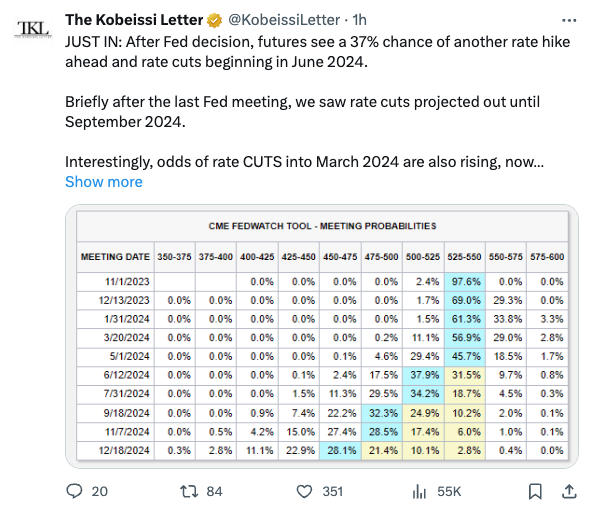
The FOMC makes headlines with its semi-monthly announcements of what interest rates will be and FOMC voters make headlines in between meetings by hinting at what the next announcement will be.
Fiscal policy, on the other hand, is less obvious.
We know the government is always spending too much money, but no press conferences are held to announce to what degree they plan to overspend — instead, they tell us everything will be paid for in ten years (assuming lots of things happen that they know for sure won't happen).
Monetary policy is summed up in the fed funds rate, which is easy enough to google — much easier than googling how much money Congress is spending or how much debt the Treasury is issuing.
The market, however, is increasingly doing the math and deciding that the real risk of inflation comes not from a money-printing Fed, but from a spendthrift government.
In economics terms, this means that the monetary theory of money is on its way out and the fiscal theory of money is on its way in.
I was told there would be no math
The quantity theory of money is intuitive: More money chasing the same amount of goods will make the price of those goods rise.
In your Econ 101 textbook, this was expressed as MV = PY.
In response to the pandemic, the Fed printed a lot of money (M), so prices (P) of course went up — although they did so on a delay, once people stopped saving and started spending (V) and economic growth (Y) accelerated.
Now, however, the Fed has stopped printing money and started un-printing it.
The supply of money is falling at an unprecedented pace, and yet prices are still inflating (albeit less quickly) and people seem more, not less, concerned about the long-term outlook for the dollar.
The cause of that concern, however, has shifted. We no longer think that the Fed will print us into hyperinflation but that the government will spend us into it.
How that could happen is a little less intuitive.
Deficit spending does not appear in the monetarists' equation (there's no G for government in MV = PY) because monetarists believe inflation is "always and everywhere" a function of money supply and government spending does not directly affect the supply of money.
When the Treasury borrows to pay for Congress's deficit spending, existing money moves from one group of bank accounts and into another set of bank accounts — all else equal, it's not obvious why that would cause prices to go up.
What deficit spending does create, however, is new liabilities and these liabilities, according to the fiscal theory of the price level, are the real cause of inflation.
The fiscal theory of the price level posits that the value of government debt is equal to the present value of future surpluses.
When the government borrows money without a credible plan to pay it back, it lowers the expectation of future surpluses and therefore reduces the present value of its debt.
To restore the real value of government debt, prices have to rise (inflating away the debt by making it easier to pay off).
Not all government debt takes the form of Treasuries, though.
Fed-printed dollars (a liability of the US government) are a type of debt, too — as are promised entitlements.
Treasuries, dollars, and entitlements are all forms of IOUs issued by the US government — and while the Fed is shrinking the government's dollar IOUs, Congress is growing its Treasury and entitlement IOUs.
This, then, may be why the Fed's restrictive monetary policy hasn't stopped bitcoin from rallying and gold getting back near its highs: Hard money is a hedge against all kinds of government liabilities, not just Fed-printed money.
In short, the new bull case for hard money is that the government is printing IOUs faster than the Fed can un-print dollars.
That's as good as money, sir
Monetary policy is still relevant, of course, but it may be that its longer-term effect on inflation is only indirect: The best thing the Fed can do to prevent runaway inflation is to use monetary policy to frighten lawmakers into getting the deficit under control.
They won't do so explicitly.
"We don't comment on fiscal policy," Chair Powell told a questioner last week.
He did, however, take the opportunity for a subtle jab: "We know that we're on an unsustainable path fiscally."
The Fed will attempt to alter that path by threatening Congress with the rising debt service costs and recurring recessions that would come with an extended period of artificially high rates.
Secretary Yellen acknowledged this recently: "We have to put forward fiscal plans that will keep the deficit manageable," she said, noting as well that "the higher the interest-rate path, the more that we need to do."
This is how monetary policy has a long-term effect on inflation — by forcing a change in fiscal policy.
But lawmakers have to play along.
If they don't, US dollars may end up being worth not much more than Lloyd Christmas napkin IOUs.











No comments:
Post a Comment